
Reviewed · WALKING TOURS
Trier Private Walking Tour With A Professional Guide
Trier packs 2,000 years into a walkable center. This private tour gives you a useful shortcut through Roman ruins, medieval streets, grand churches, and an elegant palace, all with a guide focused on your group. I like the small private format, which lets you ask questions and request changes, and I like the clear route from Porta Nigra to the Imperial Baths. The main consideration is pace: two hours is enough for an overview, but not for a slow visit inside every major monument.
The price is $290.70 for up to 15 people, so the value improves sharply with a larger group. Entrance fees and gratuities are extra, and the route is chiefly an outdoor walking introduction, though the Imperial Baths include an underground section.
In This Review
- Key points to know before you book
- Why this two-hour route works in Trier
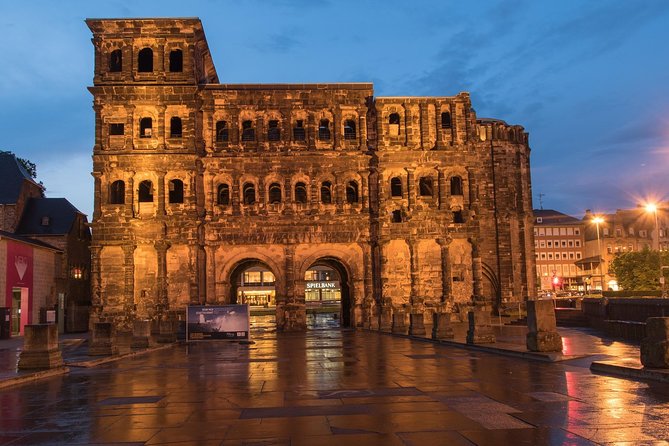
- Starting with the Porta Nigra, Trier’s Black Gate
- The Dreikönigenhaus and the walk to Hauptmarkt
- Trier Cathedral and the Church of Our Lady
- The Konstantin-Basilika and Constantine’s Roman hall
- The Electoral Palace, a Rococo contrast
- Ending below ground at the Imperial Baths
- How the private format changes the experience
- Price, timing, and what you still pay for
- Who should book this Trier walk?
- Should you book the private Trier walking tour?
- FAQ
- How long is the Trier private walking tour?
- Where does the tour start?
- Where does the tour end?
- Is this a private tour?
- Are entrance fees included?
- Can the tour be customized?
Key points to know before you book
- Start at Trier’s Roman gateway: The Porta Nigra makes an immediate impression and gives the tour a strong opening.
- See several eras in one compact route: Roman, medieval, Gothic, Renaissance, and Rococo sights appear within two hours.
- Your group stays private: You do not share the guide with other bookings, and the route can be adjusted on the spot.
- Expect visual teaching aids: Guide Michael used drawings and images to show how Trier’s buildings changed over time.
- The route ends at the Imperial Baths: You finish with subterranean corridors and an unusual look at Roman engineering.
- Plan for extra costs: Monument entrance fees and gratuities are not included in the tour price.
Why this two-hour route works in Trier
Trier is one of those cities where a short walk can feel like a compressed European history lesson. Roman power, Christian authority, medieval trade, princely wealth, and modern German life all sit close together. That makes a guided walk especially useful at the start of a visit.
You begin at Porta-Nigra-Platz, at the town’s famous Black Gate, and finish at the Kaiserthermen, or Imperial Baths. The route generally moves in one direction through the central sights rather than sending you back and forth. For you, that means less time spent finding landmarks and more time looking at them.
The private setup matters here. With a group of up to 15, you can ask the guide to explain a detail, pause for photographs, or adjust the emphasis. A private guide is also helpful if your group has mixed interests. One person can focus on Roman architecture, another on churches, and another on medieval Trier without being tied to a large public group’s pace.
Still, two hours goes quickly. You will see the city’s main symbols and receive useful context, but this is not a full archaeological visit. If you want to study every stone at the Roman sites or spend long periods inside the cathedral, you will need extra time before or after the tour.
More Walking Tours in Trier
- Trier: Guided City Walk with Wine Tasting
★ 4.8 · 979 reviews - Trier: Guided Old Town Highlights and History Walking Tour
★ 4.7 · 687 reviews - Trier: City Walking Tour
★ 4.6 · 118 reviews
Starting with the Porta Nigra, Trier’s Black Gate
The Porta Nigra is the right place to begin. Built in A.D. 180, this huge Roman gateway is one of Trier’s clearest reminders that the city was once a major center of the Roman Empire. Its dark stone gives the gate a stern, fortress-like look, and its scale makes an ordinary city street feel suddenly ancient.
Your guide can help you read the building beyond its name. The Porta Nigra was later converted into two churches, then renovated under Napoleon. Those changes are important because the gate is not just a preserved Roman shell. It also shows how later generations reused and reshaped an older monument.
This first stop should give you the basic pattern for the rest of the walk: Trier’s buildings often carry several periods at once. Look closely at the gate, listen for the changes made over time, and you will have a better eye for the later stops.
The Porta Nigra is also a practical meeting point. It is at Porta-Nigra-Platz, near public transportation, and easy to identify. Arrive ready to start walking rather than treating this as a long orientation session. The guide’s job is to move you into the center while explaining what you are seeing.
The Dreikönigenhaus and the walk to Hauptmarkt
On the way to the Main Market, the route pauses at the Dreikönigenhaus, or House of the Three Magi. This 13th-century building is a good example of why a guide adds value. It is not as famous as the Porta Nigra or the cathedral, so you could easily pass it without understanding why it matters.
The building’s unusual design gives the stop a different feel from the massive Roman gate. Here, you are looking at medieval urban life and architecture on a more human scale. It is also a natural photograph stop, so have your camera ready before the guide moves the group onward.
The Main Market, called the Hauptmarkt, brings a change in mood. Its half-timbered houses and medieval attractions create a more decorative setting than the Roman remains. The square is a place to look up and compare façades, not just to search for one single monument.
Your guide points out the Steipe, a Gothic building from the 15th century, and the 16th-century Market Fountain. These details help explain how the square developed as a civic and commercial center. The Steipe gives the market a strong medieval identity, while the fountain adds the kind of public ornament that marks a prosperous town.
I like this part of the tour because it links the grand monuments to everyday city space. You are not only seeing isolated historic buildings. You are walking through a square that still functions as part of Trier’s central life.
Trier Cathedral and the Church of Our Lady
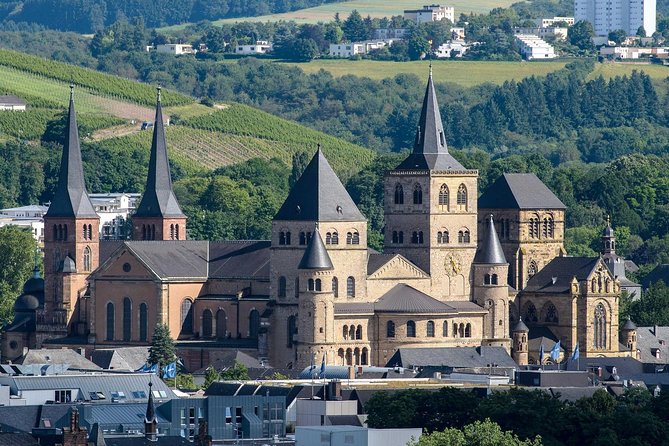
The next major stop is Trier Cathedral, built in the 4th century and considered Germany’s oldest church. Its age alone makes it one of the essential stops in the city, but the important point is how its long development reflects Trier’s changing religious and political role.
The cathedral is not presented as a single-period building. Your guide can explain how later construction altered the original church and how the site developed over many centuries. That layered story is more useful than simply hearing a date and moving on.
You also see the church’s south side, where an earlier section was destroyed in the 12th century. It was replaced by the Liebfrauenkirche, or Church of Our Lady, which is considered the earliest Gothic church in Germany.
The pairing is one of the strongest parts of the itinerary. The cathedral and Liebfrauenkirche sit beside each other, allowing you to compare different architectural ideas in a very small area. The cathedral carries the weight of early Christian Trier, while the Church of Our Lady introduces the upward, more delicate style associated with Gothic design.
Since entrance fees are not included, check with your guide about what the tour covers from the outside and what you may want to enter separately. The route is designed to show the main sights, but the two-hour schedule may not allow a long interior visit. If the cathedral is a priority for you, say so at the beginning.
Something different for another day:
- Trier: Discovery Tour – Germany’s Oldest Wine Cellar
★ 4.7 · 218 reviews - Trier: Solve the Mystery of the Merchant’s Gold!
★ 4.2 · 61 reviews - Trier: Private Guided Walking Tour
★ 4.2 · 32 reviews - Trier, Moselle: Wine excursion with boat trip
★ 3.9 · 13 reviews
The Konstantin-Basilika and Constantine’s Roman hall
The Konstantin-Basilika, also called the Roman Imperial Throne Room, brings the tour back to Trier’s Roman past. This enormous structure was built for Emperor Constantine and is described as the world’s largest remaining Roman hall.
The building’s scale is the main lesson. After smaller medieval façades and church details, you suddenly face a vast interior space built for imperial power. It helps to imagine the difference between a medieval town square and a Roman hall intended to project authority.
This stop is valuable even if you are not an architecture specialist. The guide can give the building a human and political setting, explaining why Constantine needed such a room and what its size communicated. You get more from the basilica when you see it as part of imperial government, not merely as a large old building.
The basilica also shows why Trier is rewarding for first-time visitors. You do not need to travel across town to find unrelated monuments. Roman structures, Christian buildings, medieval civic spaces, and later princely architecture appear in a tight sequence.
The Electoral Palace, a Rococo contrast
Right beside the Konstantin-Basilika is the Electoral Palace, a 17th-century Rococo building considered one of the most beautiful of its kind. Its polished style creates a sharp contrast with the blunt Roman mass of the basilica.
This is one of the places where the tour’s historical sequence becomes easy to see. The basilica speaks of imperial Rome. The cathedral complex speaks of early and medieval Christianity. The Electoral Palace reflects the wealth and taste of later rulers.
You do not need to memorize every architectural label to enjoy the comparison. Notice the shift in scale, decoration, and purpose. The Roman hall was built to impress through size. The palace aims to impress through ornament and refinement.
The palace stop is also a good reminder that Trier’s story did not end with the Romans. A tour that focused only on ancient remains would miss much of the city’s character. Here, the guide helps connect the Roman past to the later political life of Trier.
Ending below ground at the Imperial Baths
The final stop is the Kaiserthermen, or Imperial Baths. This is a fitting ending because the site lets you move from broad city history to the practical workings of Roman construction.
The baths include a subterranean labyrinth, where you can learn how the complex was built and used. Below-ground passages are often more revealing than a grand façade. They show the hidden systems that supported Roman public life and give you a clearer sense of the engineering behind the monument.
This stop also changes the physical feel of the tour. Much of the route takes place in open streets and public squares. At the baths, you enter a more enclosed archaeological setting, with underground spaces that require attention to footing and surroundings. The tour data does not specify the exact access conditions, so ask your guide about the portions available during your visit.
Ending here gives you a strong final image. You have moved from a Roman city gate through medieval and Gothic Trier, past imperial and Rococo buildings, and back into the remains of Roman public infrastructure. It is a tidy route, even if you will likely want more time at the baths afterward.
How the private format changes the experience
The guide is with your group only, which is the biggest practical difference from a standard group walk. You do not have to compete with strangers for questions or keep quiet while a guide addresses a large crowd. If your group is interested in one era, you can ask for more attention there.
The experience can also be customized on the spot. That does not mean every change will fit within two hours, so be realistic. Adding a major interior visit or skipping several listed stops could alter the balance of the route. The best use of the flexibility is to tell the guide what matters most before the walk begins.
The guides who have led this experience include Wolfgang and Michael. Wolfgang received praise for arriving on time and explaining historical facts and the background behind major events. Michael used a portfolio of drawings and images to show how buildings and areas looked in Roman, Gothic, and Renaissance periods.
That kind of visual material can be especially useful in Trier. Many historic buildings have changed function or appearance over time, and a drawing can make the missing pieces easier to picture. If your guide brings similar materials, take a moment to compare the image with the building in front of you.
Price, timing, and what you still pay for
The listed price is $290.70 per group of up to 15 people. For one or two people, that is a significant cost for a two-hour walk. For a family or larger private group, the arithmetic looks much better, since the price does not rise with each person up to the stated limit.
I would judge the value by your needs. If you want a fast, organized introduction and appreciate having a guide answer questions privately, the cost can make sense. If you are comfortable reading signs and exploring at your own pace, you may prefer to visit the public sights independently and spend the money on entrance tickets or a longer stay.
The price includes a local guide and private guided tour. It does not include gratuities or entrance fees. Keep that in mind when comparing the total cost, especially if you plan to enter more than one monument after seeing it from the route.
The tour lasts about two hours. Wear comfortable shoes, arrive at Porta-Nigra-Platz on time, and avoid planning a tightly timed activity immediately afterward. The tour ends at 54 Trier, listed as a central meeting point, and the exact finish details may be worth confirming when you book.
Confirmation is provided at booking. Free cancellation is available if you cancel at least 24 hours before the local start time. A cancellation or change made less than 24 hours ahead is not accepted for a refund.
Who should book this Trier walk?
I would recommend it most to first-time visitors who want the main story of Trier without spending a full day on a guided program. It also suits families, couples, and private groups that prefer to ask questions freely.
History fans will appreciate the range of periods, from A.D. 180 at the Porta Nigra to the 17th-century Electoral Palace. Architecture enthusiasts will find useful contrasts between Roman engineering, Gothic church design, half-timbered medieval buildings, and Rococo decoration.
You should think twice if you want long interior visits, a relaxed photography walk, or a deep study of one monument. The route covers a lot, and that breadth comes with a brisk pace. It works best as an orientation walk, followed by independent time at the places that catch your attention.
Should you book the private Trier walking tour?
Book it if you want Trier’s essential sights in one clear route, especially with a family or group large enough to share the cost. The private format, flexible emphasis, and strong guide commentary give the walk more value than a simple landmark checklist.
Skip it if the $290.70 group price feels high for two hours or if you prefer to explore independently. For most first visits, though, the route gives you a useful framework: start at the Roman gate, follow the city’s medieval and religious center, compare Roman and Rococo power, and finish underground among the Imperial Baths. That is a lot of Trier in a short time.
FAQ
How long is the Trier private walking tour?
The tour lasts approximately two hours.
Where does the tour start?
It starts at Porta-Nigra-Platz, 54290 Trier, Germany, beside the Porta Nigra.
Where does the tour end?
The listed end point is 54 Trier, Germany, described as a central meeting point.
Is this a private tour?
Yes. The guide is with your group only, and the group can include up to 15 people.
Are entrance fees included?
No. Entrance fees and gratuities are not included in the tour price.
Can the tour be customized?
Yes. Possible customization can be discussed with your local guide during the tour, subject to the available time.
Just added around Trier
- Trier: Express City Walking Tour with Local Guide★ 5.0 · 5 reviews
- Trier: Private Walking Tour with a Local Guide★ 5.0 · 5 reviews
- Trier – Private Guided Walking Tour★ 4.5 · 6 reviews
- Trier: early morning tour without the hustle and bustle and with less noise★ 5.0 · 6 reviews
- Luxembourg to Trier: Tour of Germany’s Oldest City.★ 4.6 · 9 reviews
- Trier Self Guided Sherlock Holmes Murder Mystery Game★ 4.0 · 9 reviews
- For the love of Riesling – Mosel Wine tour★ 5.0 · 11 reviews
- Trier: Your Adventure Awaits – The Return of the Elector★ 4.0 · 12 reviews
Walking Tours, compared.





Berlin’s Best: 2 Hour Walking Tour Third Reich and the Cold War
Read our review →


Third Reich Berlin: Hitler and WWII Walking Tour
Read our review →Browse the lists this tour appears in