
Reviewed · WALKING TOURS
Discover Berlin Half-Day Walking Tour
Berlin’s past is written into its streets. This 3.5-hour walking tour links Prussian grandeur, Nazi crimes, the Berlin Wall, and the city’s modern rebirth in one well-planned route. I like the strong mix of famous landmarks and sobering memorials, and I like that a guide supplies the context you would miss while walking alone.
I also like the price: $24.19 per person is a fair deal for several hours of guided sightseeing. The main drawback is simple: you cover a lot of ground, often outdoors, so cold, wet weather or tired feet can take the shine off the final hour.
- From Hackescher Markt to Checkpoint Charlie: The route crosses Berlin’s central districts and connects royal, Nazi, and Cold War sites.
- A serious look at difficult history: The Holocaust Memorial, former Gestapo headquarters, book-burning memorial, and Berlin Wall all receive attention.
- Berlin’s grandest boulevard: Unter den Linden brings together Museum Island, Neue Wache, Bebelplatz, Humboldt University, and Brandenburg Gate.
- A guide makes the difference: Guides such as Amanda, Tobi, Georgia, Rebecca, Ru, and Reuben have been praised for clear explanations, humor, and personal stories.
- A useful first-day orientation: You see enough of central Berlin to decide where you want to return for a longer visit.
- Small enough to stay personal: The advertised maximum is 25 people, with a professional English-speaking guide and a mobile ticket.
In This Review
- Berlin in one long, history-packed walk
- Hackescher Markt and Museum Island set the tone
- Unter den Linden brings royal Berlin into view
- Brandenburg Gate and the Reichstag anchor the middle of the walk
- The Holocaust Memorial and Führerbunker require care
- From the 1953 uprising to the Berlin Wall
- Topography of Terror and Checkpoint Charlie close the historical loop
- The pace, group size, and practical side
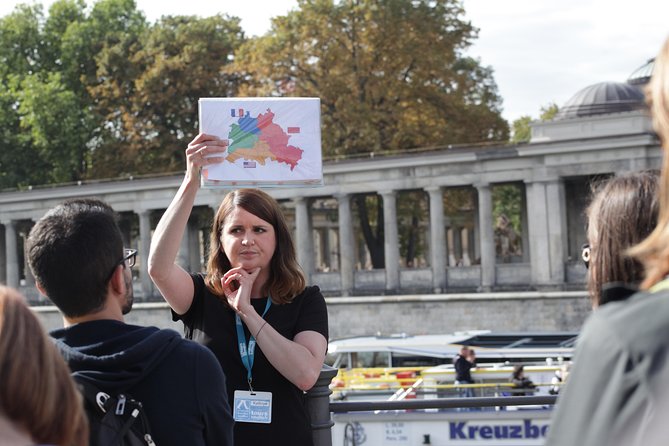
- What the guides add to the experience
- Is $24.19 a fair price?
- Who should book this Berlin walk?
- FAQ
- How long does the Discover Berlin Half-Day Walking Tour last?
- Where does the tour begin?
- Where does the tour finish?
- Is the tour conducted in English?
- Are meals and drinks included?
- How many people can join the tour?
- Should you book it?
Berlin in one long, history-packed walk
Berlin can feel confusing at first. Its major sights are spread across a large central area, and the city’s story does not move in a neat straight line. A grand square may sit beside the site of a dictatorship’s headquarters, while a modern building hides the scars of the Cold War.
This tour helps you connect those pieces. You begin at Neue Promenade 3, near Hackescher Markt, then move through the historic center toward Unter den Linden, Brandenburg Gate, the Reichstag, the Holocaust Memorial, the Berlin Wall, and Checkpoint Charlie.
The route is not a series of lengthy museum visits. Most stops last about five minutes, with longer pauses at Museum Island, the Reichstag, and the Holocaust Memorial. Think of it as a guided city walk with many short explanations, not a museum tour with time to study every exhibit.
That distinction matters. You get a broad picture of Berlin quickly, but you will not have time to enter each museum or read every memorial panel. I see this as a strength for a first visit, especially if you want orientation before choosing where to spend your remaining days.
Hackescher Markt and Museum Island set the tone
The opening section takes you around Hackescher Markt, James Simon Park, and Museum Island. Your guide explains how these places fit into Berlin’s development, rather than simply pointing out attractive buildings.
Museum Island gives you an early look at the city’s royal and cultural center. The route passes the Neues Museum, Pergamonmuseum, Altes Museum, Berliner Dom, Lustgarten, and the restored Stadtschloss area. You should not expect interior visits, but the outdoor views provide plenty to absorb.
The Berliner Fernsehturm adds a very different note. The television tower rises above the surrounding streets as a reminder of East Berlin’s urban identity. Its presence helps you see how the city’s older stone buildings and later socialist architecture share the same center.
The route also includes the Neue Synagoge and Centrum Judaicum. This adds an important Jewish history thread before the tour reaches the Nazi-era memorials. The short stop cannot explain every part of Berlin’s Jewish life, but it signals that the city’s story is broader than kings, war, and the Wall.
If you want to visit the museums, plan to return later. Five minutes outside the Neues Museum or Pergamonmuseum is enough for an introduction, not an art collection.
More Walking Tours in Berlin
- Berlin: Third Reich and Cold War 2 Hour Walking Tour
★ 4.9 · 6,830 reviews - Berlin: Discover Berlin Walking Tour
★ 4.9 · 5,998 reviews - Berlin’s Best: 2 Hour Walking Tour Third Reich and the Cold War
★ 5.0 · 5,486 reviews
Unter den Linden brings royal Berlin into view
From Museum Island, the walk follows the grand axis of Unter den Linden. This boulevard once linked the royal palace area with the western approach to Brandenburg Gate, and it remains one of the best places to see Berlin’s formal side.
Along the way, you pass Schlossbrücke, the German Historical Museum, Neue Wache, Staatsoper Unter den Linden, St. Hedwig’s Cathedral, Humboldt University, and the Ampelmann Shop.
Neue Wache is especially important. Its spare interior memorial honors victims of war and dictatorship, and the guide can place it within the larger story of Germany’s attempts to face its past. The stop is brief, but the setting invites a quieter pause after the architectural displays around Museum Island.
Bebelplatz adds one of the route’s clearest reminders that cultural institutions are not always safe from political power. The square is linked to the Nazi book burning of 1933, and the Book Burning Memorial sits below the pavement. You may only have a few minutes there, so listen closely to the explanation and return later if you want to consider the site at length.
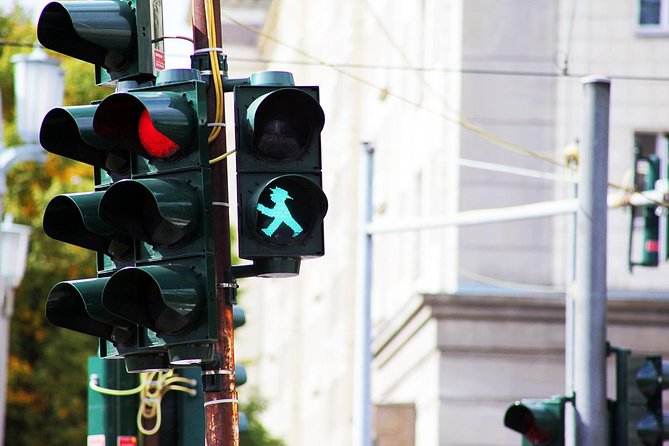
Humboldt University and the Staatsoper help show how Berlin’s intellectual and artistic life developed around the royal boulevard. The nearby Ampelmann shop is lighter in mood, offering a glimpse of one of East Berlin’s best-known design symbols.
This section works well because the buildings are not treated as isolated sights. You see how royal power, scholarship, religion, culture, and dictatorship all occupied the same few blocks.
Brandenburg Gate and the Reichstag anchor the middle of the walk
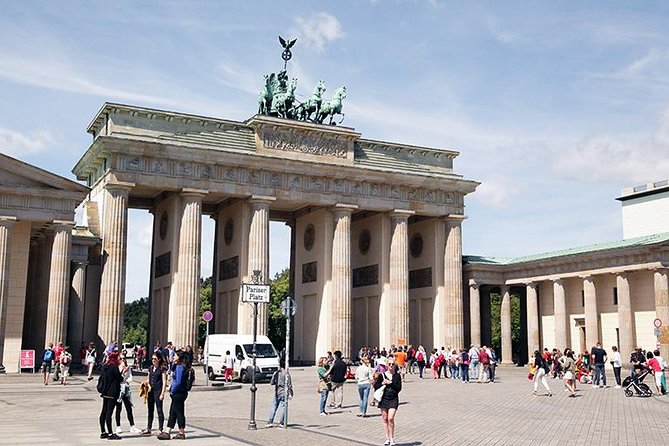
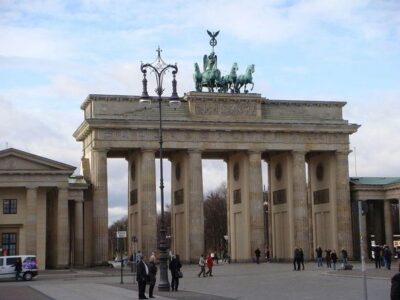
Pariser Platz leads you to Brandenburg Gate, Berlin’s most recognizable landmark. The gate once marked the edge of the city, later became a symbol of division, and now represents reunification. Your guide can explain those changing meanings while you stand beneath its columns.
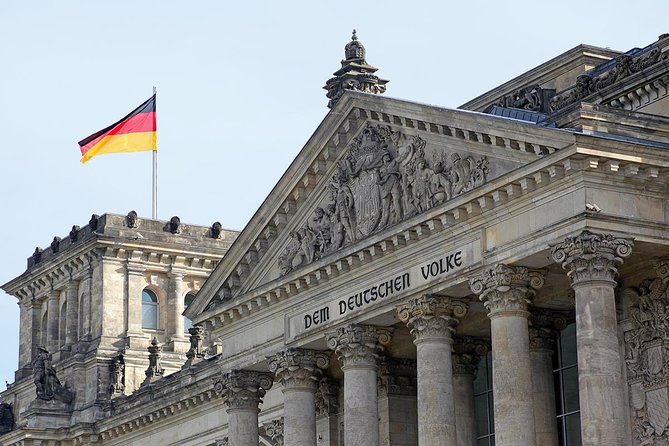
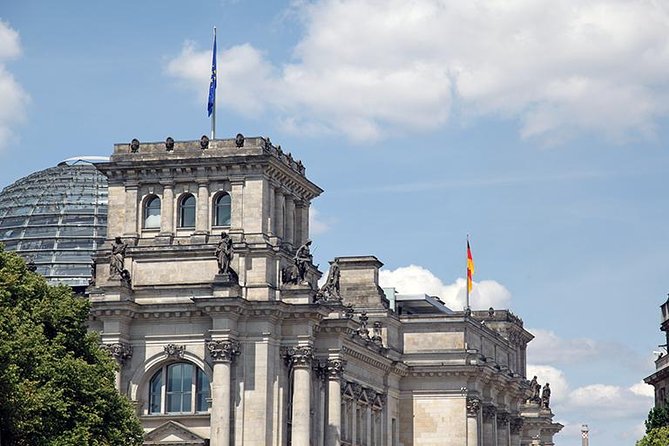
The nearby Reichstag is Germany’s parliament. You see the building from outside, with time for the guide to explain its place in modern German politics and the dramatic events that shaped its public meaning.
The Victory Column is also included in the route, though it is not necessarily a major stop. Its location and monumental design reflect a period when Prussia and the German Empire used architecture to celebrate military success.
This is one of the most photogenic sections, but it is not just a photo pause. The surrounding spaces have carried royal ceremonies, Nazi rallies, wartime destruction, divided-city symbolism, and reunification celebrations. That layering is what makes a guided explanation useful.
Bring your camera, but do not let it keep you from listening. Several of Berlin’s most important stories happened in places that now look calm and ordinary.
The Holocaust Memorial and Führerbunker require care
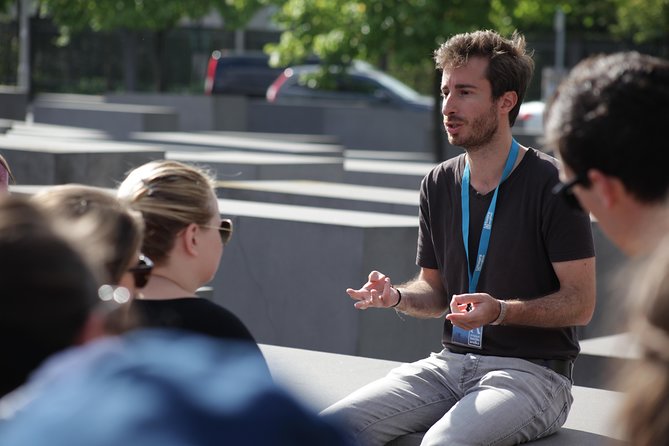
The Holocaust Memorial, officially the Memorial to the Murdered Jews of Europe, is one of the tour’s most serious stops. Its field of concrete stelae is designed to create unease and uncertainty rather than provide a simple statue with a single message.
A guide can help you understand the memorial’s purpose and the limits of any monument trying to represent the murder of Europe’s Jews. The scheduled pause is about ten minutes, longer than most stops, but the subject deserves your full attention.
Nearby, the route identifies the former Führerbunker site. There is no grand surviving entrance to visit. The significance lies in understanding the location and the final days of Hitler’s regime, while also recognizing how little physical evidence remains above ground.
This part of the walk can feel emotionally heavy. That is not a flaw, but you should know what you are signing up for. Berlin does not tidy away its worst crimes, and a good guide handles these subjects with care rather than sensational drama.
Guides named in the feedback, including Ru, Rebecca, and Gregor, have been praised for treating difficult German history respectfully while still making the material understandable. Their personal stories and, in some cases, East Berlin perspectives can add useful human scale.
Something different for another day:
- Berlin: Reichstag, Dome and Government District Guided Tour
★ 4.7 · 18,288 reviews - Berlin: 1-Hour City Tour by Boat with Guaranteed Seating
★ 4.3 · 16,993 reviews - Berlin: Boat Tour Along the River Spree
★ 4.4 · 11,252 reviews - Berlin: Hop-on Hop-off Bus Tour with Live Commentary
★ 4.3 · 8,579 reviews
From the 1953 uprising to the Berlin Wall
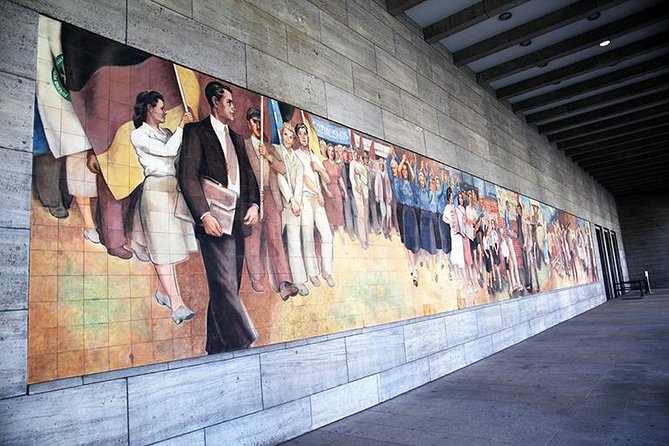
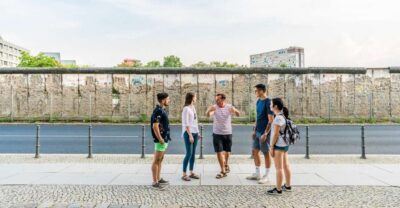
The route continues toward the former path of the Wall and the death strip. You pass the site connected with the 1953 East German uprising, the former Aviation Ministry, and a Berlin Wall memorial.
These places show that division was more than a concrete barrier. It involved surveillance, restricted movement, political fear, and competing versions of daily life. The guide’s job here is to connect the physical remains and memorials with what the border meant to people living on both sides.
The Berlin Wall section is one of the most valuable parts for first-time visitors. You hear how the barrier divided neighborhoods and families, then learn about its fall in 1989. The story is triumphant, but the tour does not need to pretend that reunification erased every difference overnight.
One useful feature is the range of guide perspectives. Gregor and the guide described by one participant as an East Berliner were praised for explaining daily life in the former East. That perspective can make the Cold War feel less like a textbook chapter and more like a lived reality.
You may find this section less visually dramatic than Brandenburg Gate. Give it time anyway. The Wall’s importance comes from what happened around it, not just from the fragments that remain.
Topography of Terror and Checkpoint Charlie close the historical loop
The Topography of Terror occupies the former site of the Gestapo and SS headquarters. The outdoor documentation and excavated cellars confront the machinery of Nazi persecution at the place where political prisoners were tortured and killed.
The route generally stops outside or near the museum rather than giving you a full museum visit. That is enough to understand why the location was chosen. Berlin’s leaders made a deliberate decision to expose this history instead of hiding it behind a polished new building.
If you want to explore the museum’s extensive material, return later with at least several hours. The walking tour gives you the setting and the essential explanation, but the exhibits reward slower study.
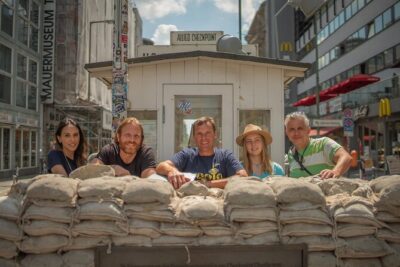
Checkpoint Charlie provides the final major Cold War landmark. The former crossing point between East and West Berlin has become highly commercial, and the modern scene can feel more touristy than authentic. Still, its historical role is clear, and the guide can separate the real border story from the souvenir-shop atmosphere.
The tour also includes the Französischer Dom, adding another landmark to the final stretch. Depending on the exact route and group pace, the ending may feel like a brisk finish after a great deal of information.
The pace, group size, and practical side
The advertised duration is about three hours and 30 minutes, though several people describe their walks as closer to four hours. You should plan for a full half-day, not a quick morning outing.
The route includes many short stops, so you will often walk for several minutes, listen for five minutes, then move on. The guide may need to speak clearly over city noise and keep the group together at busy crossings.
The maximum group size is 25. That is not private touring, but it is small enough for questions if the group stays attentive. One important practical point: the walk is genuinely long. Wear comfortable shoes and check the forecast before you go. A cold day can still be enjoyable, but you will want warm clothing and a willingness to remain outdoors.
Some groups have taken a short break at a bakery or coffee house for warmth, food, and a restroom. Treat that as a possible convenience, not a guaranteed included feature. Food and drinks are not included, so carry water and budget for your own snack.
The tour is offered in English and uses a mobile ticket. Service animals are allowed, the meeting point is near public transportation, and most people can take part. The end point is different from the starting point, so do not plan to leave a bag or vehicle at Neue Promenade.
What the guides add to the experience

The strongest part of this tour is the human guide. The route itself is easy to map, but Berlin’s history is too complex for a list of names and dates.
Amanda was praised for humor and passion. Tobi was singled out for staying attentive to individual needs and making a very cold day enjoyable. Georgia, Jonathan, Sarah, Phillip, Ben, Luisa, Walid, Anika, and Lewis were also praised for clear explanations, friendly delivery, personal insight, or useful advice about places to visit and eat.
That range matters because guide quality can vary. The tour company assigns different guides, so you cannot assume you will get a particular person. Still, the consistently high 4.9 rating from 9,624 reviews and recommendation from 98 percent of customers suggest that the guide program is a major strength.
I especially value the reports of guides using humor without making light of painful subjects. Berlin needs both warmth and restraint. The best guides make room for questions, offer everyday context, and explain what is known instead of turning every stop into a dramatic performance.
Is $24.19 a fair price?
At $24.19, this is strong value if you want a guided overview of central Berlin. You are paying for several hours of route planning, historical explanation, and help connecting sights that would otherwise feel scattered.
The price does not include meals, museum admission, or transport. That is reasonable because the experience is built around outdoor sightseeing, and most stops are free to view. You will need separate time and money if you want to enter the museums, climb viewpoints, or study the memorials in detail.
For me, the real value is time saved. You can cover Museum Island, Unter den Linden, Brandenburg Gate, the Reichstag, the Holocaust Memorial, the Wall, Topography of Terror, and Checkpoint Charlie without having to research the best order yourself.
Book early if your schedule is fixed. The tour averages booking 27 days ahead, which suggests popular dates can fill. Free cancellation is available up to 24 hours before the start time, while cancellations or changes inside that window are not refunded.
Who should book this Berlin walk?
I would book it near the beginning of a Berlin visit. The walk gives you a mental map, points out places worth returning to, and helps you choose between museums and memorials later.
It suits first-time visitors, families with older children or teenagers, and anyone who wants history explained in plain language. Several guides have made the experience enjoyable for mixed-age groups, and questions are welcomed.
It is less suited to anyone who wants an easy stroll with long café breaks, extensive museum time, or a private pace. The amount of walking is substantial, and the subject matter includes murder, dictatorship, torture, war, and political repression.
At the end, you should know where Berlin’s key districts fit together and which places deserve a second visit. That is exactly what a good introductory city walk should do.
FAQ
How long does the Discover Berlin Half-Day Walking Tour last?
The advertised duration is approximately 3 hours and 30 minutes. Some descriptions of the experience put the walk closer to four hours, so allow a full half-day.
Where does the tour begin?
The meeting point is Neue Promenade 3, 10178 Berlin, Germany, near Hackescher Markt.
Where does the tour finish?
The activity ends in a different location from the starting point. The exact ending details are provided with the booking.
Is the tour conducted in English?
Yes. The experience is offered in English.
Are meals and drinks included?
No. Food and drinks are not included unless specifically stated. Some groups may have a short break at a bakery or café, but any purchase is your responsibility.
How many people can join the tour?
The advertised maximum is 25 participants. A professional guide leads the walk.
Should you book it?
Book this tour if you want a lively, serious introduction to Berlin’s main historic center for a modest price. You will see far more than the Brandenburg Gate, and the guide’s explanations help connect royal Berlin, Nazi Germany, East Berlin, reunification, and the present city.
I would choose it for the first day or two of a visit, then return to the museums and memorials that caught your attention. Skip it only if you already know central Berlin well or if three and a half hours of steady walking sounds like punishment. For most first-time visitors, it is a smart way to get your bearings and understand what you are seeing.
Just added around Berlin
- Berlin: Private Guided Tour of the Main Sights★ 5.0 · 13 reviews
- Private Highlights of Berlin Bike Tour★ 5.0 · 13 reviews
- Modern Berlin Private Walking Tour: Diverse, Vibrant and Exciting German Capital★ 5.0 · 13 reviews
- Tour in Berlin from Warnemünde and Rostock Cruise Port★ 4.1 · 13 reviews
- Berlin: Stasi Museum Private Guided Tour with Entry Ticket★ 4.8 · 13 reviews
- Private Food Tour Experience with a born and bred Berliner★ 5.0 · 14 reviews
- Berlin: Rheinsberg Palace Entrance Ticket★ 4.8 · 14 reviews
- Berlin in one day – day tour with an expert guide★ 5.0 · 14 reviews
Walking Tours, compared.

Berlin’s Best: 2 Hour Walking Tour Third Reich and the Cold War
Read our review →
Third Reich Berlin: Hitler and WWII Walking Tour
Read our review →
Browse the lists this tour appears in