
Reviewed · THIRD REICH & WWII TOURS
Berlin’s Best: 2 Hour Walking Tour Third Reich and the Cold War
Berlin’s past is written into its pavements. This two-hour walk links the Brandenburg Gate, Hitler’s bunker site, the Berlin Wall, and Checkpoint Charlie while a local English-speaking guide explains how the city moved from Nazi dictatorship through division to reunification. I like the smart route and the fact that it reaches places a bus cannot. I also like the use of old photographs by some guides, which helps you picture streets and buildings as they once looked. The main drawback is the brisk pace: you cover a lot of ground in two hours, and most stops are outdoor explanations rather than extended visits inside museums.
At $24.07 per person, this is a strong-value introduction to Berlin’s 20th-century story. Guides such as Glen, Maggie, Mikey, James, Tom, Peter F., and Mikhail have been praised for making difficult subjects clear, thoughtful, and sometimes even funny without treating the crimes lightly. Bring good shoes, warm clothes in winter, and enough curiosity to ask questions.
In This Review
- Key points to know before you go
- Why this two-hour Berlin walk works
- Brandenburg Gate sets the story in motion
- The Reichstag and the danger of political power
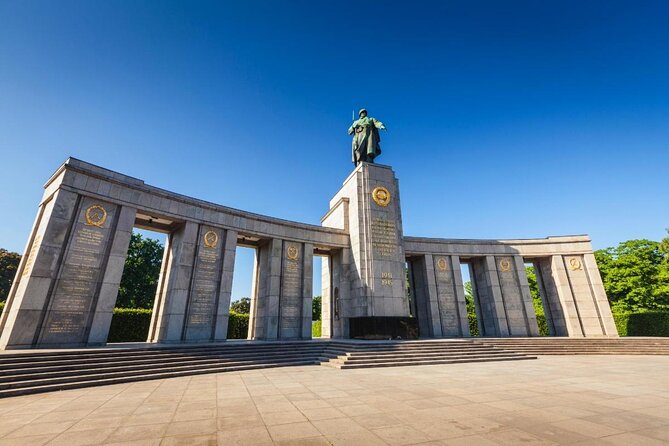
- Soviet tanks in the Tiergarten
- Victory Column and the dream of Germania
- Walking through the Holocaust Memorial
- Above Hitler’s bunker
- The former Aviation Ministry and East Germany’s birth
- Topography of Terror and the machinery of crime
- A piece of the Wall on Niederkirchnerstraße
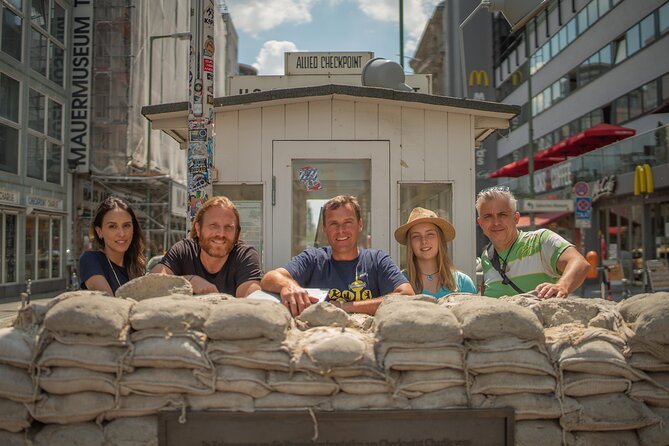
- Checkpoint Charlie closes the circle
- What the $24.07 price gives you
- Timing, footwear, and meeting advice
- Who should book this walk?
- Should you book Berlin’s Best?
- FAQ
- How long is the Berlin’s Best walking tour?
- Where does the tour begin?
- Where does the tour end?
- How early should I arrive?
- Is the tour offered in English?
- What landmarks are included?
- Is admission included?
- Can I cancel for a full refund?
Key points to know before you go
- A direct route through Berlin’s hardest history: Follow the story from the Nazi rise to power, through World War II, the Cold War, the Berlin Wall, and reunification.
- Nine major stops in about two hours: The route begins at Brandenburg Gate and finishes at Checkpoint Charlie, with a short explanation at each site.
- A guide makes the empty spaces speak: Hitler’s bunker is gone, the Wall is mostly gone, and many wartime buildings have changed. Clear commentary gives those places meaning.
- A good choice for a first Berlin day: You check off major sights while learning how they connect, rather than seeing them as separate photo stops.
- Expect an outdoor experience: Admission to the listed stops is free, but the tour does not include long indoor visits to the Reichstag or Topography of Terror.
- Meet the pink umbrella: Arrive 15 minutes early at the Tourist Information office on the Pariser Platz side of Brandenburg Gate.
Why this two-hour Berlin walk works
Berlin can feel like a history book with its pages scattered across a large city. One monument recalls Prussian power, another marks Nazi terror, and a strip of pavement may show where an entire country was divided. This walk gives you a clear line through those events.
The route is also well judged for a short tour. It starts at one of Berlin’s most famous landmarks and moves south toward Checkpoint Charlie. Along the way, you see the Reichstag, a Soviet war memorial, the Holocaust Memorial, the former Nazi government quarter, the Berlin Wall, and the site of Hitler’s bunker.
I like that the walk does not treat the past as a collection of grand buildings. Some of the most important places are now ordinary-looking streets or open spaces. That is precisely why a guide matters. At the bunker site, for example, there is no dramatic entrance to inspect. You stand above the former location and listen to what happened there.
The group can include up to 30 people. That is large enough to provide energy but may feel less personal than a private walk. Guides have been praised for answering questions, showing historical images, and adjusting their tone to suit the subject. Mikhail, Glen, and Peter F. were singled out for clear explanations and useful context, while Maggie and Mikey were praised for making the material accessible to different ages.
More Third Reich & WWII Tours in Berlin
- Berlin: Third Reich and Cold War 2 Hour Walking Tour
★ 4.9 · 6,830 reviews - Third Reich Berlin: Hitler and WWII Walking Tour
★ 5.0 · 3,301 reviews - Berlin: Third Reich, Hitler, and WWII Walking Tour
★ 4.9 · 1,133 reviews
Brandenburg Gate sets the story in motion
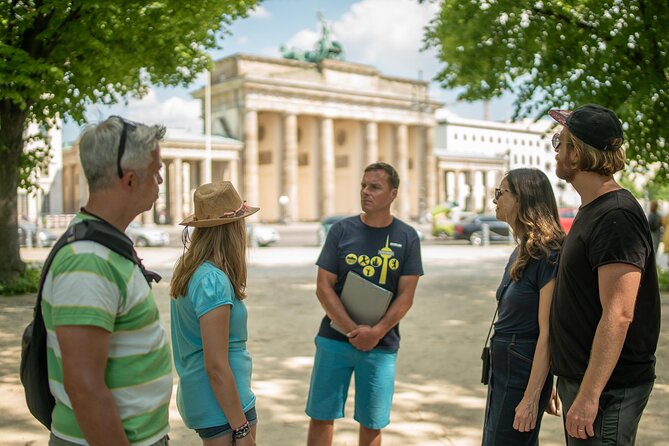
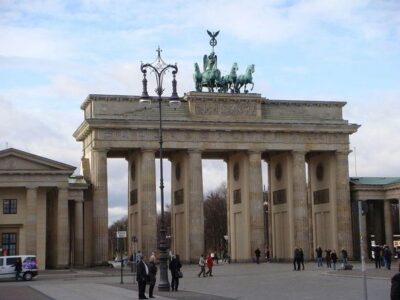
The meeting point is in front of the Tourist Information office at Brandenburg Gate, on Pariser Platz. Look for the guide with the pink umbrella, and arrive 15 minutes early so the group can gather without a frantic last-minute search.
Brandenburg Gate is an ideal starting point because it has served as a symbol of Berlin through several political eras. The guide explains why it now represents reunified Germany, a meaning that would have seemed unlikely when the gate stood beside the Berlin Wall.
You get about 15 minutes here. That is enough time to understand the monument’s role and take photographs, but not enough for a detailed architectural study. The value is the context. Once you know what the gate meant during division and what it means today, later stops on the walk become easier to place.
The Reichstag and the danger of political power
A short walk brings you to the Reichstag Building, Germany’s parliament. You spend around 10 minutes hearing how this building reflects the country’s political story over the last century.
The key subject is the Reichstag fire of 1933 and the way Hitler used the event to strengthen his dictatorship. The building becomes more than a grand government structure. It helps explain how democratic systems can be weakened through fear, emergency measures, and the misuse of political power.
You do not enter the Reichstag as part of this walk, so plan a separate visit if you want to see the interior or dome. Still, an outdoor explanation is useful because it connects the building to the wider story without taking up too much of your limited time.
Soviet tanks in the Tiergarten
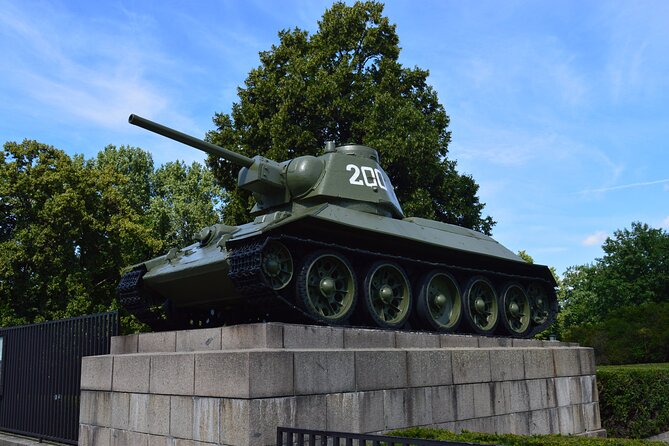
The Soviet Memorial in the Tiergarten is a compact but striking stop. You see T-34/76 tanks and field artillery placed at the World War II memorial.
The visit lasts about seven minutes, so expect a focused explanation rather than a long inspection. The memorial offers a reminder that Berlin’s final battle was not just a local event. Soviet forces captured the city, and the political consequences shaped Berlin for decades afterward.
This is one of the stops that bus tours may pass quickly or view from a distance. On foot, you can pause beside the military hardware and understand its place in the city. The short stop also helps keep the walk moving.
More Walking Tours in Berlin
- Discover Berlin Half-Day Walking Tour
★ 5.0 · 9,624 reviews - Berlin: Discover Berlin Walking Tour
★ 4.9 · 5,998 reviews - Berlin: Hidden Backyards Guided Walking Tour
★ 4.8 · 5,360 reviews - Berlin: Alternative Berlin Walking Tour
★ 4.6 · 1,204 reviews
Victory Column and the dream of Germania
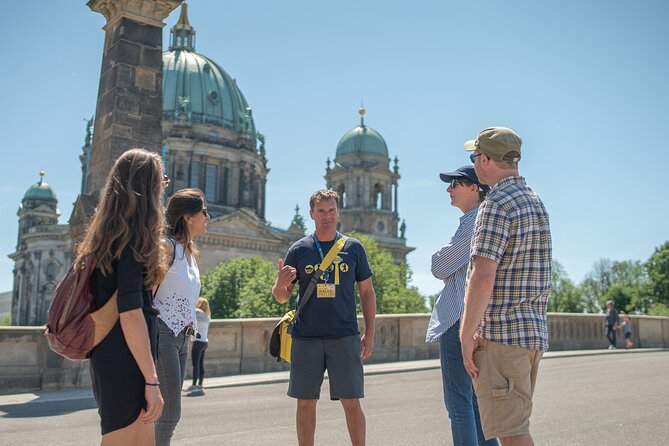
The route includes a view of the Victory Column and the story of its relocation by Albert Speer. The guide also explains Speer’s plans for Germania, the enormous redesign of Berlin that the Nazi regime imagined for a victorious Germany.
This section is valuable because it shows how architecture can serve political ambition. Germania was not simply a building project. It was intended to turn Berlin into a monumental capital of world power. The plan was never completed, but the idea reveals the regime’s hunger for control, spectacle, and permanence.
The stop is listed without a fixed duration, so the exact amount of time may depend on the guide and the group’s pace. You should think of it as part of the walk’s wider explanation rather than a full visit to the column.
Walking through the Holocaust Memorial
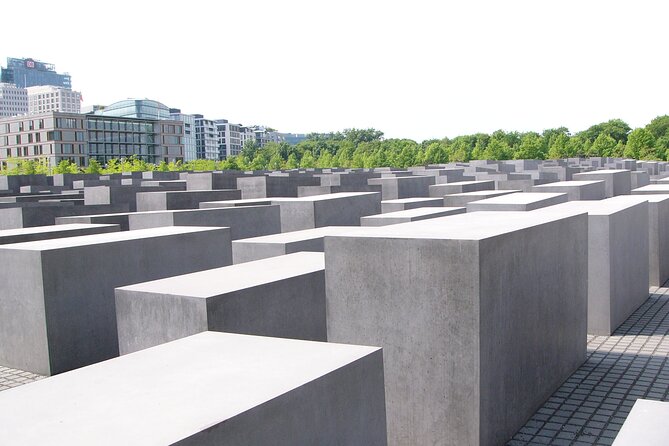
The Memorial to the Murdered Jews of Europe is one of the walk’s most affecting locations. You spend about 10 minutes walking through the field of concrete blocks, which commemorates the Jewish victims of the Holocaust.
A short guided visit cannot explain every aspect of the memorial’s design. What it can do is give you a respectful introduction and place the memorial within the city’s effort to face its crimes.
The open layout means you are not simply looking at a monument from the outside. You move through it. The changing height and arrangement of the blocks alter your sense of direction and scale. Allow yourself a little quiet here, even if the group continues nearby.
The memorial is also close to several other central sights, making it a useful place to return to later on your own. The tour’s brief visit is a starting point, not a substitute for spending more time if this subject matters to you.
Above Hitler’s bunker
The stop at the Führerbunker is unusual because almost nothing visible remains. You stand above the former bunker site and hear about Hitler’s last days, his suicide on April 30, 1945, and the end of the war in Europe.
This is an important lesson in how Berlin handles a destructive past. The site is not presented as a shrine, and there is no grand entrance to explore. Its plain appearance reflects a deliberate refusal to turn the dictator’s final headquarters into a place of fascination.
The guide also discusses how Germans have come to terms with the Nazi period. That makes the stop broader than a story about Hitler. It asks how a country remembers mass violence, how it marks criminal sites, and how it prevents memory from becoming myth.
The explanation takes about 10 minutes. Some people may find the subject grim, but the guide’s role is to treat it with care. James was praised for combining sensitivity with well-judged humour, and that balance matters on a route filled with painful material.
The former Aviation Ministry and East Germany’s birth
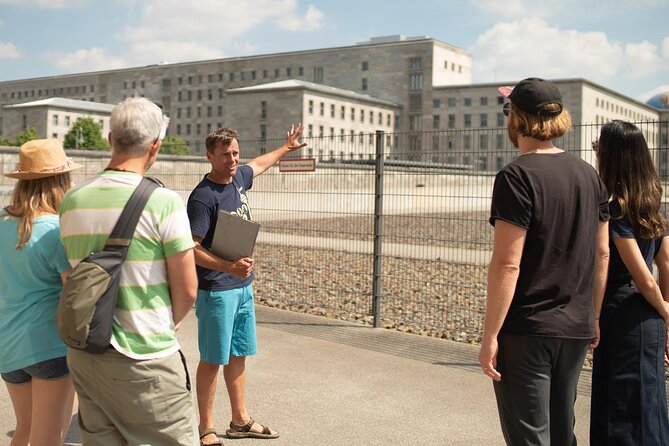
The walk continues to the former Aviation Ministry of Berlin, a long government building associated with Hermann Göring’s air force. You hear how the site was also used when East Germany, officially the German Democratic Republic, was proclaimed in 1949.
The stop lasts about five minutes. It is short, but it links two different chapters: Nazi military rule and the creation of a Soviet-aligned East German state.
This is typical of the route. Berlin’s buildings often outlive the governments that built them. One address can carry traces of the Nazi period, the postwar occupation, and the Cold War. The guide helps you see those layers instead of treating the building as just another old façade.
Topography of Terror and the machinery of crime
At the Topography of Terror, you reach the former headquarters of the SS, Gestapo, and SD. The outdoor portion takes about 15 minutes and introduces the institutions responsible for major crimes under Nazi rule.
The site is especially useful because it focuses on the machinery behind the dictatorship. The Nazi system depended on offices, records, police powers, and organized violence. Seeing where these agencies operated makes the crimes feel less abstract.
The Topography of Terror exhibition is nearby and is worth returning to if you have time. This walking tour gives you the location and the basic framework, but a short stop cannot replace a full museum visit. I would use the tour to decide which sites deserve a longer look later in your Berlin stay.
A piece of the Wall on Niederkirchnerstraße
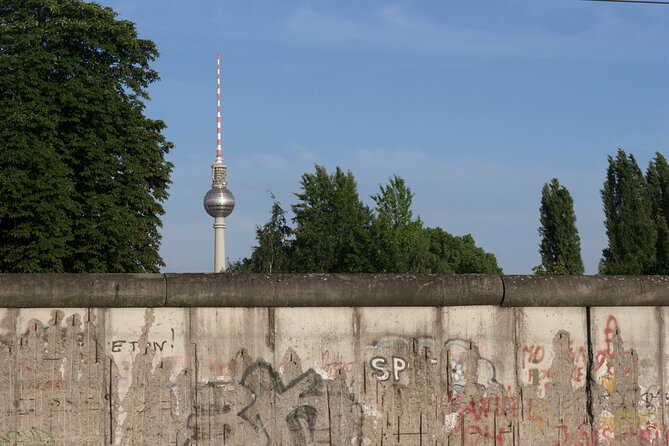
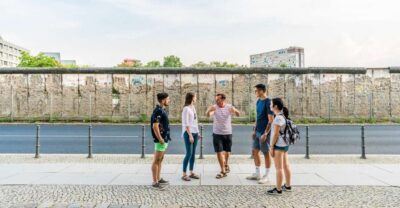
A large remaining section of the Berlin Wall appears on Niederkirchnerstraße. Here, the guide explains how people tried to escape, what happened to those who failed, and what daily life was like on both sides of the divide.
The Wall can be hard to understand when seen only in photographs. A surviving section gives you something solid to look at, but the stories provide the human scale. The subject shifts from state policy to choices made by ordinary people who faced surveillance, restricted movement, and the danger of escape.
The stop lasts around seven minutes. That is enough for a strong introduction, though you may want more time to examine the Wall and nearby historical displays afterward. The location also helps connect the Cold War to the earlier Nazi sites you have already seen.
Checkpoint Charlie closes the circle
The tour ends at Checkpoint Charlie on Friedrichstraße, about 15 minutes after the Wall section. This was the best-known crossing point through the Berlin Wall and the setting for a tense Soviet and American tank standoff in 1961.
The guide then explains the fall of the Wall on November 9, 1989, and considers how successful reunification has been in the more than three decades since. That final question gives the tour a useful present-day edge. Berlin’s history is not sealed away in museums. The city still lives with the results of division and reunification.
Checkpoint Charlie itself can feel busy and commercial, and the replica guard booth is more photo stop than preserved Cold War site. The historical explanation is what makes the ending worthwhile. Once the guide has described the standoff and the Wall’s collapse, the crossing point becomes easier to understand.
Finishing here is practical. Checkpoint Charlie is near public transportation, and you can continue exploring central Berlin, find food, or visit nearby museums without retracing the route.
What the $24.07 price gives you
At $24.07, the tour costs less than many longer guided excursions, yet it covers a wide stretch of central Berlin and explains several major sites. Since the stops are free to enter, you are paying mainly for the guide’s time, route planning, storytelling, and ability to connect events.
That is good value if you are visiting Berlin for the first time or have only a short stay. In two hours, you get a useful framework for the city’s Nazi and Cold War eras. You also save the effort of working out how the sites relate to one another.
The price is less compelling if you want lengthy museum visits, private attention, or a slow photographic walk. The group may reach 30 people, and the schedule leaves little room for extended questions at every stop. Still, guides such as Ben, Georgia, Rebecca, and Eyan have been praised for answering questions and keeping the tone friendly without losing respect for the subject.
Timing, footwear, and meeting advice
This is a walking tour with free admission at the listed stops. You need a mobile ticket, and the experience is offered in English only.
Wear sensible shoes. The route covers several central locations, and the pace is steady. In winter, add a warm coat, gloves, and layers. The walk operates outdoors, and cold weather can make two hours feel longer than it sounds.
A practical tip from the route’s own advice: use a restroom before you arrive. There are breaks when needed, but this is not built around frequent facilities. The pink umbrella makes the starting group easier to spot, and arriving early reduces stress.
Free cancellation is available if you cancel at least 24 hours before the start time. Changes or cancellations inside that period are not refunded.
Who should book this walk?
I would choose this tour if you want a clear first look at Berlin’s 20th-century story and prefer moving through real city streets instead of sitting on a bus. It suits adults, families with older children, and anyone who wants a strong introduction before visiting museums on their own.
The tour can work well for families because guides have kept younger participants involved, including children aged 11 and 16. The subject is serious, but the best guides use warmth and occasional humour to keep the group attentive.
You may want another option if mobility limits your ability to walk or stand outdoors for two hours, though the tour information says most people can participate and service animals are allowed. You should also pick a different experience if your main goal is interior access to the Reichstag, a long visit inside the Topography of Terror, or detailed time at each memorial.
Should you book Berlin’s Best?
Book it if you want many major sights, a sensible route, and a guide who can explain how Nazi Germany, the war, the Berlin Wall, and reunification fit together. The two-hour length is its great strength. You learn a lot without giving up an entire day.
Just set the right expectation. This is a brisk outdoor history walk, not a series of museum visits. Bring shoes suited to walking, dress for the weather, arrive early at Brandenburg Gate, and save time afterward for the sites that catch your attention. At $24.07, it is an efficient and worthwhile way to get your bearings in Berlin’s most history-filled center.
FAQ
How long is the Berlin’s Best walking tour?
The tour lasts approximately two hours.
Where does the tour begin?
It begins at Brandenburg Gate, at Pariser Platz, 10117 Berlin. Meet in front of the Tourist Information office on the Pariser Platz side.
Where does the tour end?
The tour ends at Checkpoint Charlie, at Friedrichstraße 43-45, 10117 Berlin.
How early should I arrive?
You should arrive 15 minutes before the tour begins. Look for the guide with the pink umbrella.
Is the tour offered in English?
Yes. The tour is offered in English only and includes an English-speaking local guide.
What landmarks are included?
The route includes Brandenburg Gate, the Reichstag Building, the Soviet Memorial in the Tiergarten, the Victory Column area, the Holocaust Memorial, the former Führerbunker site, the former Aviation Ministry, the Topography of Terror, a section of the Berlin Wall on Niederkirchnerstraße, and Checkpoint Charlie.
Is admission included?
The walking tour includes access to the listed outdoor stops, which have no admission charge. It does not state that interior museum or Reichstag entry is included.
Can I cancel for a full refund?
Yes. You can cancel at least 24 hours before the experience start time for a full refund. Cancellations or changes made less than 24 hours before the start time are not refunded.
Just added around Berlin
- Berlin: Private Guided Tour of the Main Sights★ 5.0 · 13 reviews
- Private Highlights of Berlin Bike Tour★ 5.0 · 13 reviews
- Tour in Berlin from Warnemünde and Rostock Cruise Port★ 4.1 · 13 reviews
- Modern Berlin Private Walking Tour: Diverse, Vibrant and Exciting German Capital★ 5.0 · 13 reviews
- Berlin: Stasi Museum Private Guided Tour with Entry Ticket★ 4.8 · 13 reviews
- Private Food Tour Experience with a born and bred Berliner★ 5.0 · 14 reviews
- Berlin: Rheinsberg Palace Entrance Ticket★ 4.8 · 14 reviews
- Berlin in one day – day tour with an expert guide★ 5.0 · 14 reviews
Third Reich & WWII Tours, compared.
Third Reich Berlin: Hitler and WWII Walking Tour
Read our review →
Walking Tour of Former Nazi Party Rally Grounds
Read our review →

Berlin Third Reich Sites: Half-Day Walking Tour
Read our review →Browse the lists this tour appears in