
Reviewed · THIRD REICH & WWII TOURS
Nuremberg: Walking Tour of Former Nazi Party Rally Grounds
Nuremberg’s ruins still speak loudly. This two-hour walking tour makes sense of the former Nazi Party Rally Grounds, linking the vast Congress Hall, the Great Road, and Zeppelin Field with clear explanations of propaganda, architecture, and Nazi power. At $15 per person, it offers a lot of historical context for very little money.
I like the way the tour uses old photographs to show how these places once looked, and I like that the guides focus on how propaganda worked rather than simply reciting dates. Guides such as Sylvia, Kai, Anita, and Andreas have been praised for thoughtful explanations and careful answers. The main drawback is simple: there is a lot of walking, and winter tours can finish in darkness before you properly see Zeppelin Field.
The subject is grim, but the approach is serious and measured. You will not get a theatrical performance or a light sightseeing stroll. You will walk through the actual spaces where the Nazi regime staged mass rallies, then consider how Germany deals with these remains today.
In This Review
- Key points at a glance
- Why these former rally grounds matter
- Meeting at the Documentation Center
- Congress Hall and the architecture of intimidation
- Walking the Great Road
- Zeppelin Field and the Tribune
- A serious guide makes the difference
- What the tour teaches beyond buildings
- Is $15 good value?
- Who should book this walk?
- Practical tips for a better visit
- Should you book the Nuremberg rally grounds tour?
- FAQ
- How long does the tour last?
- How much does the tour cost?
- Where does the tour meet?
- Which languages are available?
- Which sites are included?
- Is the tour suitable for people with mobility impairments?
Key points at a glance
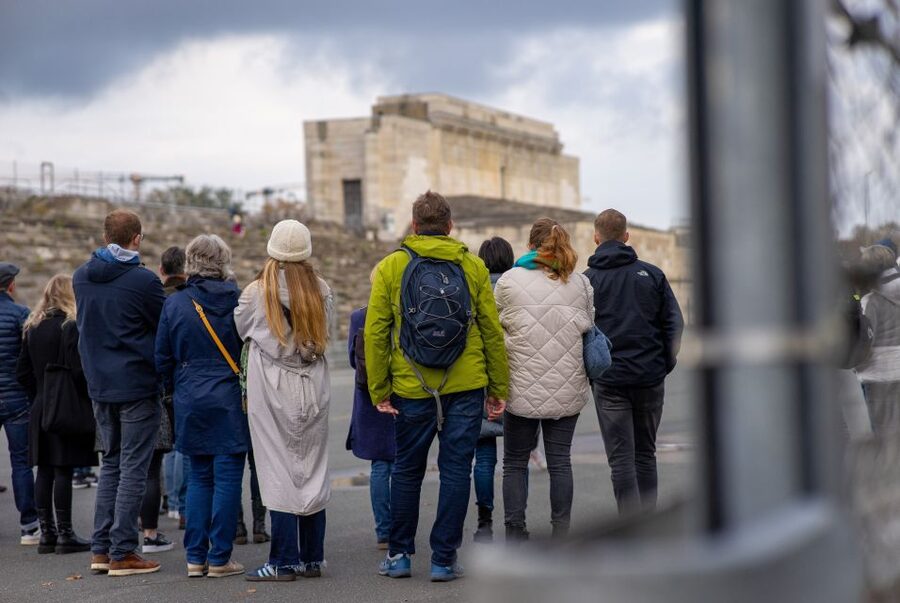
- Congress Hall rises 40 meters around you: The unfinished building shows the scale and ambition of Nazi architecture more powerfully than a photograph can.
- The Great Road reveals the planned scale: This broad north-south axis was designed for movement, order, and spectacle rather than ordinary city life.
- Zeppelin Field was a propaganda machine: The final section explains how the Tribune and huge open space were used to project power before crowds of up to 200,000 people.
- Old photographs make the ruins easier to read: Guides use images of the completed structures and rallies to help you compare past and present.
- The tour deals with crimes and propaganda directly: It covers Nazi ideology, the concentration camp system, mass rallies, and the effects of staged political theater.
- Good value, but not a short walk: Expect about two hours on foot, with roughly 10 minutes between Congress Hall and the Great Road and about 15 minutes onward to Zeppelin Field.
Why these former rally grounds matter
Nuremberg is closely linked with the Nazi period for two different reasons. The city hosted the enormous National Socialist Party rallies, but it also became the setting for the postwar Nuremberg Trials. This tour focuses on the rally grounds, where architecture and ceremony were used to make political power look permanent and unquestionable.
The site was planned as a vast stage. Buildings, roads, terraces, flags, lighting, uniforms, music, and carefully organized crowds all worked together. The point was not merely to hold a party meeting. The point was to create an emotional experience that made the Nazi movement appear larger than any single person.
That is why a guide adds so much. If you walk around alone, you can see concrete, grass, walls, and broad open spaces. With a guide, those same features become part of a calculated system of control and persuasion. You learn to ask why a building was placed there, why the route was so long, and why the crowd was positioned in a particular way.
The tour also explains the basic National Socialist view of history and how the regime presented itself as the force that would restore Germany’s supposed greatness. This helps connect the physical remains with the political message. The buildings were not neutral construction projects. They were tools.
More Third Reich & WWII Tours in Nuremberg
- Nuremberg: Historischer Kunstbunker WWII Art Bunker Tour
★ 4.8 · 921 reviews - Nuremberg Old Town and Nazi Party Rally Grounds Walking Tour in English
★ 4.5 · 504 reviews - Nuremberg Old Town and Nazi Rally Grounds Walking Tour
★ 4.7 · 377 reviews
Meeting at the Documentation Center
The usual meeting point is beside the entrance stairs to the Documentation Center Nazi Party Rally Grounds at Bayernstraße 110. Look for a guide holding a picture folder and wearing a name tag marked Geschichte Für Alle e.V.
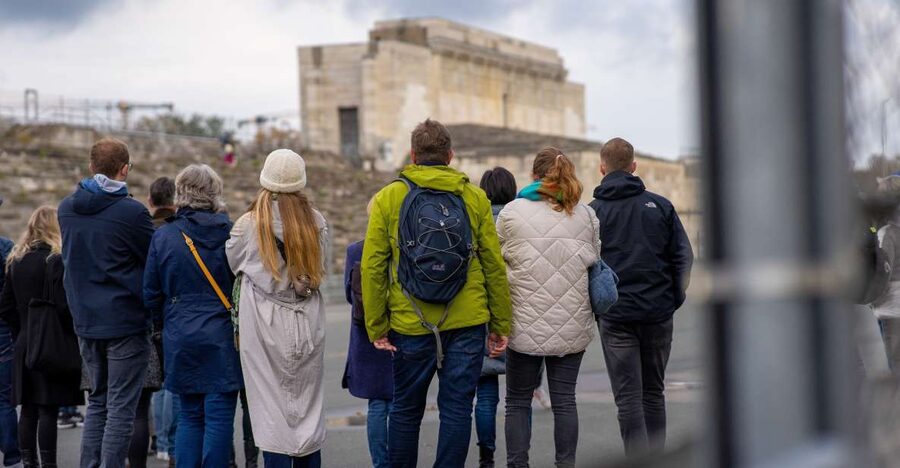
This is a useful place to begin because the Documentation Center is located inside the unfinished Congress Hall. The tour does not include food, drinks, or a separate indoor museum visit, but starting here gives you an immediate sense of the site’s scale.
Take a moment before the walk begins to look at the building around you. Congress Hall was designed as a monumental gathering place and reaches about 40 meters in height. Even in its unfinished state, it is difficult to view as an ordinary structure. Its size is the first lesson in how the Nazi regime tried to overwhelm the individual.
There are two stated starting-location options connected with the Documentation Center and Congress Hall. Follow the exact meeting details on your booking confirmation, but the guide should be easy to identify near the entrance stairs. Arriving a little early is sensible because the grounds are broad and the walk begins promptly.
Congress Hall and the architecture of intimidation
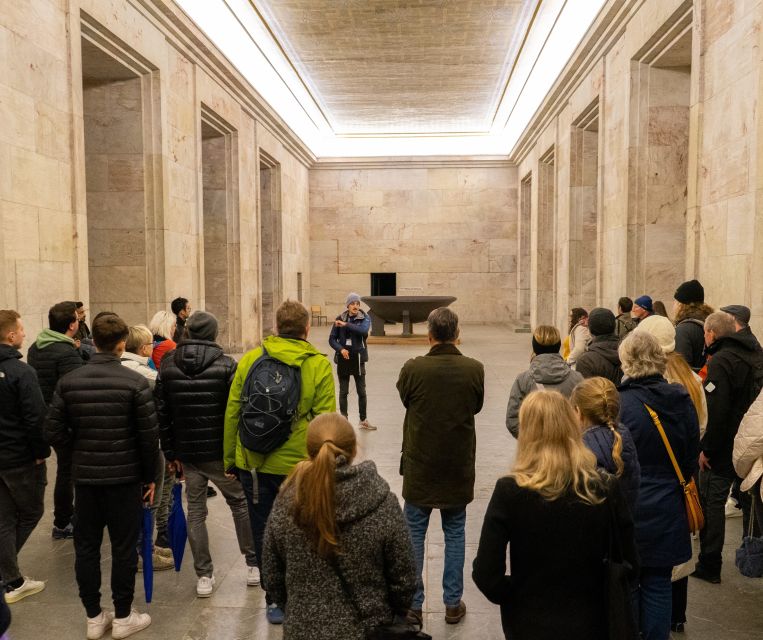
The first guided stop is Congress Hall. This is one of the most important parts of the tour because it lets you experience the physical scale of Nazi planning before moving through the wider grounds.
The building’s sheer size was part of its message. Monumental architecture can make a government seem permanent, powerful, and beyond question. Here, the unfinished walls still create that effect. You can see how the design was meant to dominate the people inside and outside it.
Your guide explains the building’s intended function, its place within the rally complex, and the way National Socialist architecture used scale and repetition. The discussion is not only about style. It is about the political purpose of style.
The old photographs are especially helpful here. A guide such as Kristina or Marina might show how the site looked during construction or during rally events, allowing you to compare the present ruins with the original propaganda image. This is a practical benefit of taking the tour rather than simply visiting the area alone.
One point to keep in mind: you should not expect a full indoor visit through every part of Congress Hall as part of this walking tour. The emphasis is on the exterior spaces and the historical meaning of the site. If you want more museum material, the Documentation Center itself is the logical place to spend additional time separately.
Walking the Great Road
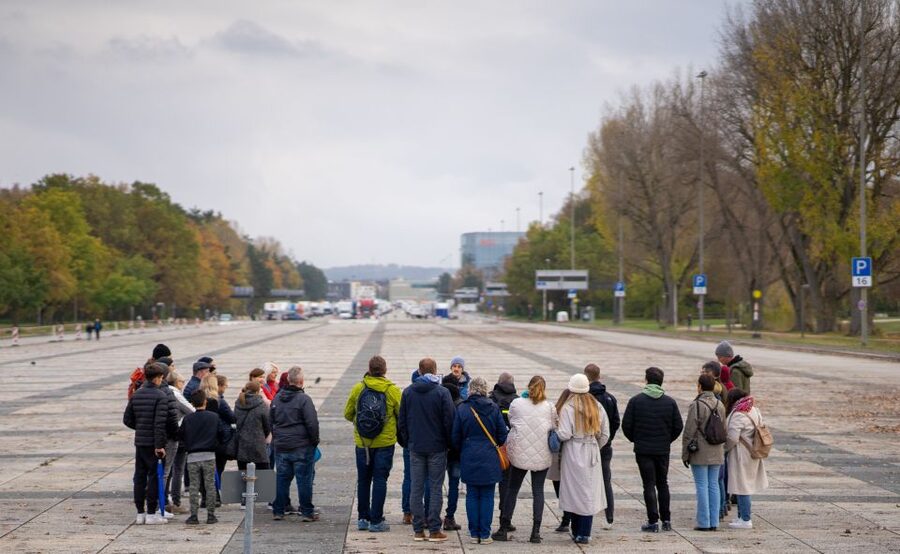
From Congress Hall, the group continues on foot toward the Große Straße, or Great Road. The walk takes about 10 minutes, but the distance matters more than the clock. You begin to understand that the rally grounds were not a compact monument. They were planned as a huge ceremonial zone.
The Great Road formed the main north-south axis. Its length and width were designed for organized movement and mass display. This was not a road built mainly to help residents get from one neighborhood to another. It was part of the choreography of political power.
As you walk, your guide interprets the relationship between the road, the buildings, and the crowds that once gathered here. This is where the tour’s focus on propaganda becomes especially useful. The open space was not empty by accident. It was prepared for a carefully staged human picture.
Guides often ask questions that make you think about the intentions behind the design. What would it feel like to be one person among a massive crowd? What would you see from the front? How would repetition, order, and ceremony affect your judgment? This approach was praised by people who found the tour engaging without turning the subject into entertainment.
The Great Road can also be the point where you notice the practical demands of the outing. The route is outdoors and exposed to the weather. One person described the total walk as roughly 5,000 steps in two hours, while other visitors simply felt it was a lot of walking. Both impressions can be true. It is manageable for many people, but it is not suitable for anyone who needs a short, flat indoor visit with frequent seating.
More Walking Tours in Nuremberg
- Bamberg: Guided Walking Tour
★ 4.6 · 3,202 reviews - Nuremberg: Old Town Guided Walking Tour
★ 4.6 · 2,416 reviews - Bamberg: City Highlights Walking Tour
★ 4.6 · 679 reviews - Bayreuth: German City Walking Tour (Tourist Info)
★ 4.7 · 202 reviews
Zeppelin Field and the Tribune
The route continues for about 15 minutes on foot to Zeppelin Field. This is the dramatic final section, and it is also the part most affected by seasonal daylight.
Zeppelin Field was designed for enormous Nazi Party rallies. The Tribune was intended to hold crowds of up to 200,000 people, a figure that helps explain why the open space feels so oversized. The point was to turn political support into a spectacle of numbers, discipline, and visual unity.
The tour explains the function of the Tribune and the way rally events were staged. You learn how speeches, formations, movement, architecture, and mass participation worked together. The regime wanted people to feel that they were part of an unstoppable national community. The design helped suppress the sense of the individual.
The remaining structures are striking, but they are not preserved as a polished monument. That roughness is part of the experience. You see what remains, what was left unfinished, and what has been repurposed. Guides also discuss what might have been built had the Nazi plans continued, which makes the site feel less like a single completed monument and more like evidence of an enormous project interrupted by war.
The Tribune is the final stop, and it gives the tour a strong ending. You can look across the field and grasp the relationship between speaker, architecture, and crowd. A photograph cannot fully show that distance. You need to walk it.
Plan this part carefully in winter. Several people found that tours finishing after sunset made it difficult to properly view Zeppelin Field. The guides still explained the site, but darkness reduced the visual impact. If you have a choice of departure times, an earlier tour is the better pick from late autumn through winter.
A serious guide makes the difference
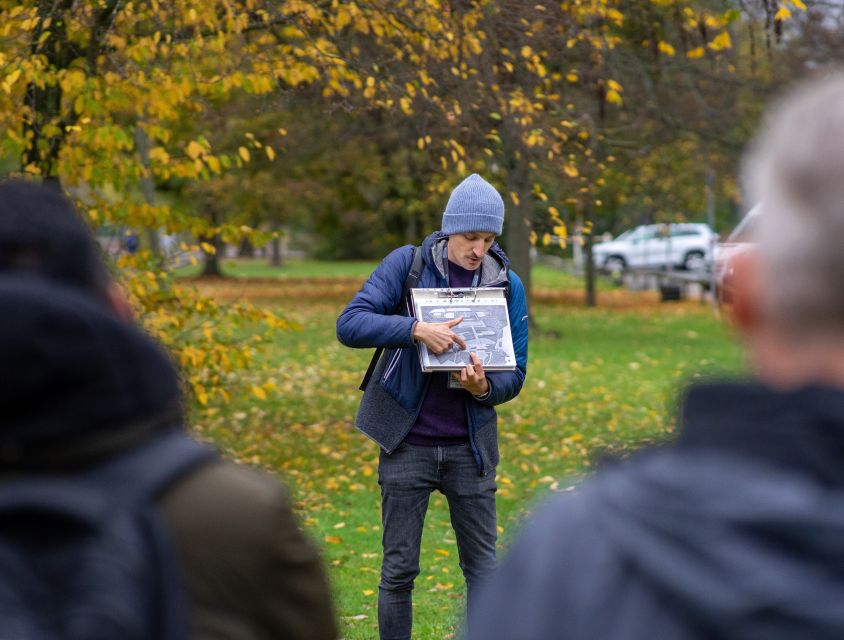
The quality of this experience depends heavily on the guide. The strongest guides do more than memorize facts. They explain how the regime used images, buildings, ceremony, and emotional pressure to shape public opinion.
Several guides have earned especially warm praise. Sylvia is described as clear, thoughtful, and able to handle questions in both English and German. Kai has been praised for precise, detailed answers and for keeping a rainy two-hour tour moving at a good pace. Anita was singled out for explaining Hitler’s rise to power and the role of the grounds in the propaganda system.
Andreas, a political scientist, has been praised for his command of the subject and fluent English. Frank was noted for being informative and kind, while Ralf added personal stories about life in Germany after the war. These details suggest a guiding team with a serious grasp of both the Nazi period and its aftermath.
The tone also matters. This is a difficult subject involving dictatorship, war, persecution, and mass murder. The best guides explain it with compassion and restraint. They do not soften the crimes, but they also do not turn suffering into spectacle.
You should expect questions from the group. Some guides actively invite them and use discussion to help people think through the material. That can make the tour more engaging, although the pace may vary depending on how many questions arise.
What the tour teaches beyond buildings
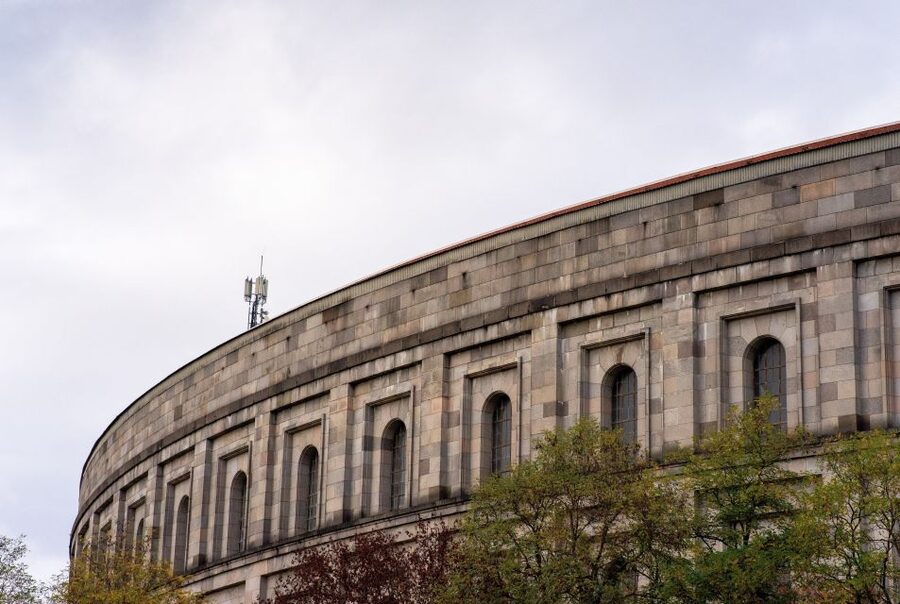
The walk is not just an architecture tour. It connects the rally grounds to the wider Nazi system, including the concentration camp system and the use of mass propaganda shows.
That wider connection is important. The rallies presented an image of unity and strength, but they existed alongside persecution, violence, imprisonment, and murder. The tour helps you place the polished public display beside the crimes carried out by the regime.
You also hear about current discussion over how the site should be used. The former rally grounds are not frozen in the 1930s. They are part of modern Nuremberg, and the city must decide how to explain, preserve, adapt, and live beside these remains.
That question gives the tour a present-day purpose. It asks how a democratic society should handle places connected with dictatorship. Should the ruins be preserved exactly, altered, used for education, or allowed to fade? The tour does not reduce this to a simple answer.
I find this especially valuable because it prevents the visit from becoming a morbid look at old ruins. You are encouraged to think about memory, responsibility, and how propaganda can work in any age. One guide also drew links to current events, a reminder that the lessons are not safely locked in the past.
Is $15 good value?
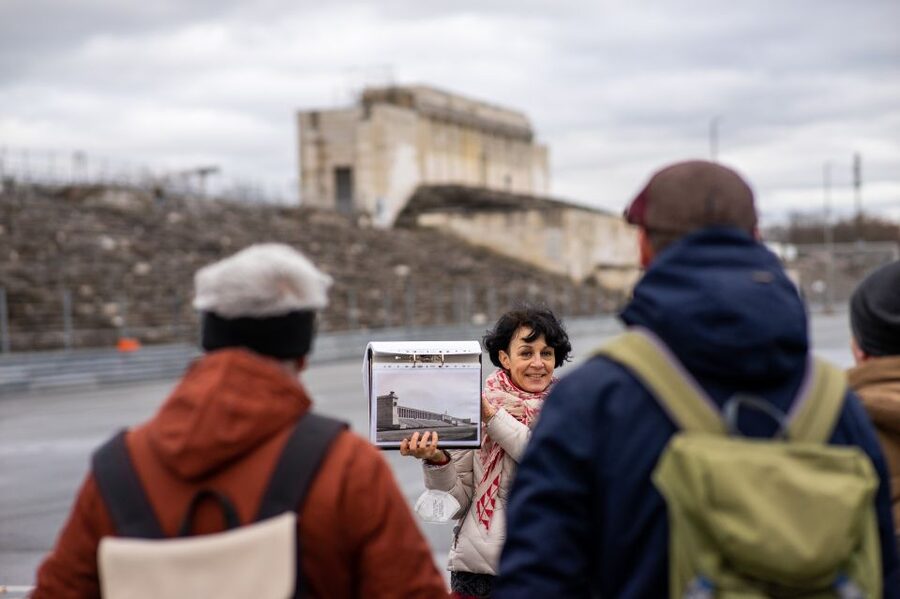
At $15, this is an excellent-value experience for anyone interested in twentieth-century history, political communication, architecture, or modern Germany.
The tour lasts two hours and covers several major parts of the rally grounds. You receive a live guide in either German or English, historical explanation at each site, and visual help from photographs. A self-guided visit can show you the same buildings, but it will not necessarily explain the intended route, the staging of the rallies, or the connection between architecture and ideology.
The price is particularly fair because the area is so large. Without a guide, it is easy to see the size without grasping the purpose. The tour gives you a framework for the rest of your visit.
Still, value depends on what you want. If you only want to take photographs of the ruins, you can visit the grounds independently. If you want a museum-heavy experience with extensive indoor displays, this walking tour may feel limited. Its strength is interpretation outdoors, not a full museum program.
Food and drinks are not included, so bring what you need for two hours outside. The tour runs in rain or shine. Wear shoes suited to walking and check the forecast before you leave.
Who should book this walk?
I would recommend it to:
- First-time visitors to Nuremberg who want context for the rally grounds
- People interested in Nazi Germany, propaganda, military history, or architecture
- Anyone who learns better by seeing places while a guide explains them
- Visitors who want a low-cost activity with serious content
- Students and teachers looking for a clear introduction to the site
- People interested in how Germany confronts its twentieth-century past
You may want to choose another activity if you have a mobility impairment, cannot comfortably walk for two hours, or strongly prefer indoor sightseeing. The tour is not suitable for people with mobility impairments, and the open grounds offer little protection from rain, cold, or darkness.
Families should also consider the subject matter carefully. The tour deals directly with Nazi crimes and propaganda. It is educational, but not light entertainment.
Practical tips for a better visit
Choose the earliest suitable departure, especially from November through February. Several tours ended after dark in winter, which made Zeppelin Field harder to see properly.
Arrive at the Documentation Center entrance stairs with enough time to locate the guide. Look for the picture folder and Geschichte Für Alle e.V. name tag.
Bring water and dress for outdoor conditions. The tour continues in bad weather, and even an excellent guide cannot make a cold, wet walk feel short.
Pay attention to the transitions between sites. The distances are not filler. The time spent walking helps you grasp how widely the rally grounds were spread and how much planning went into moving crowds through them.
If you have extra time, consider visiting the Documentation Center separately. The walking tour gives you the outdoor framework, while additional museum time can help you explore the subject at a slower pace.
Should you book the Nuremberg rally grounds tour?
Book it if you want to understand how architecture and mass gatherings helped the Nazi regime create political power. For $15, the tour offers unusually strong value, especially when the guide uses photographs and welcomes serious questions.
Skip it if you want a brief photo stop or if a two-hour outdoor walk would be uncomfortable. Also avoid a late winter departure if seeing Zeppelin Field clearly is important to you.
For most history-minded visitors, this is a worthwhile addition to Nuremberg. The ruins are large, stark, and sometimes hard to interpret alone. A good guide gives them meaning without softening the crimes committed under the regime. That is the real value of the walk.
FAQ
How long does the tour last?
The guided walking tour lasts two hours.
How much does the tour cost?
The price is $15 per person.
Where does the tour meet?
Meet next to the entrance stairs of the Documentation Center Nazi Party Rally Grounds at Bayernstraße 110. The guide carries a picture folder and wears a name tag marked Geschichte Für Alle e.V.
Which languages are available?
The tour is offered in German and English.
Which sites are included?
The route includes Congress Hall, the Great Road, and Zeppelin Field, ending at the Zeppelin Tribune.
Is the tour suitable for people with mobility impairments?
No. The tour is listed as unsuitable for people with mobility impairments because it involves an extended outdoor walk between the sites.
Just added around Nuremberg
- Bayreuth: Private Guided Walking Tour★ 5.0 · 15 reviews
- Nuremberg: St. Johannis Friedhof &Hesperidengärten IN GERMAN★ 4.4 · 15 reviews
- Nuremberg: Medieval Time Travel for Kids★ 4.9 · 15 reviews
- PRIVATE Nuremberg WW2 and Old Town Day Tour (Product code: 87669P16)★ 4.5 · 15 reviews
- Bayreuth City Walking Tour★ 4.6 · 16 reviews
- Nuremberg: Medieval Ages Tour in Spanish★ 4.5 · 16 reviews
- PLAYMOBIL®-FunPark Entrance Ticket★ 4.5 · 17 reviews
- Nuremberg: Private guided tour of the Old Town in German★ 4.9 · 17 reviews
Third Reich & WWII Tours, compared.

Berlin’s Best: 2 Hour Walking Tour Third Reich and the Cold War
Read our review →
Third Reich Berlin: Hitler and WWII Walking Tour
Read our review →

Berlin Third Reich Sites: Half-Day Walking Tour
Read our review →Browse the lists this tour appears in