
Reviewed · NUREMBERG TOURS
Nuremberg: Medieval Ages Tour in Spanish
Dark stories make Nuremberg feel startlingly close. This three-hour Spanish walking tour moves from the Frauenkirche to the Imperial Castle, using witch trials, punishments, old legends, and city defenses to show how ordinary people lived in medieval Nuremberg. I like the focus on Franz Schmidt, the city’s famous executioner, and the way guides such as Jonathan and Federico turn history into an active conversation. The $20 price is also fair for a long, guide-led walk.
The main consideration is the subject matter. Witch hunts, public executions, and medieval punishments are not light fare, and the tour may feel intense in hot weather because it takes place outdoors on foot. You will also pay separately for any museum admission, and the tour is conducted in Spanish only.
In This Review
- Key points to know before you book
- Why this Spanish tour gives Nuremberg a darker character
- Starting at the Frauenkirche and Hauptmarkt
- Witch trials, public punishments, and the cost of fear
- Trödelmarkt Island and the executioner Franz Schmidt
- Weissgerbergasse and the texture of everyday work
- Medieval legends, from flying horses to aliens
- City defenses and the road to the Imperial Castle
- What $20 buys you in practical terms
- Who will get the most from this walk
- My verdict on the Nuremberg medieval walk
- FAQ
- How long does the Nuremberg Medieval Ages Tour last?
- What language is the tour conducted in?
- Where does the tour begin?
- Does the meeting point change during the Christmas market period?
- Where does the tour finish?
- Is the house of Franz Schmidt included?
- Are museum tickets included?
- Is food or drink included?
- Is the tour wheelchair accessible?
- What should I bring?
- Can I cancel for a refund?
Key points to know before you book
- Franz Schmidt’s former home: Visit Trödelmarkt Island and learn about the life of Nuremberg’s most famous medieval executioner.
- Dark history with a human angle: The tour explains witch trials, public punishments, professions, customs, and daily routines.
- Spanish storytelling: Guides including Jonathan, Federico, and Víctor have been praised for enthusiasm, humor, detailed answers, and audience participation.
- A walk through central Nuremberg: The route begins at the Frauenkirche, passes cobbled streets and Weissgerbergasse, and ends at the Imperial Castle.
- Legends beyond the textbooks: Expect tales of devils, knights on flying horses, and even galactic aliens connected with Nuremberg.
- Good value at $20: Three hours with a live Spanish guide makes this a low-cost way to get historical context before exploring alone.
Why this Spanish tour gives Nuremberg a darker character
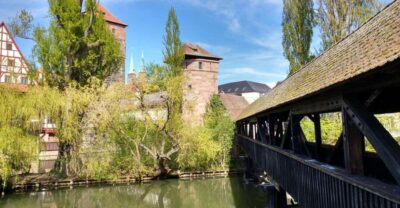
Nuremberg is easy to admire at street level. Its church, bridges, old lanes, island market area, and castle make a fine walking route even before anyone explains what happened there. This tour adds the harder stories, showing how law, religion, fear, work, and defense shaped daily life.
I like that the walk does not focus only on grand rulers or castle architecture. You hear about the citizens who worked, traded, followed medieval customs, faced punishment, and lived under the threat of invasion. That shift from famous buildings to ordinary lives gives the route more purpose.
The subject is also handled through storytelling. Alongside documented events, your guide shares popular medieval tales involving devils, knights flying through the sky, and galactic aliens. Those stories may sound strange beside serious history, but they help show how people explained the world before modern science and mass communication.
The Spanish format is important. The strongest comments about the guides praise their energy, humor, patience, and ability to answer questions. Jonathan is especially praised for making history feel lively during a very hot afternoon, while Federico is remembered for clear explanations and useful advice about restaurants and transport. Víctor also received warm praise.
Other Nuremberg trips people book alongside this one:
- Bamberg: Guided Walking Tour
★ 4.6 · 3,202 reviews - Nuremberg: City Tour with the Bimmelbahn Train
★ 4.4 · 2,475 reviews - Nuremberg: Old Town Guided Walking Tour
★ 4.6 · 2,416 reviews
Starting at the Frauenkirche and Hauptmarkt
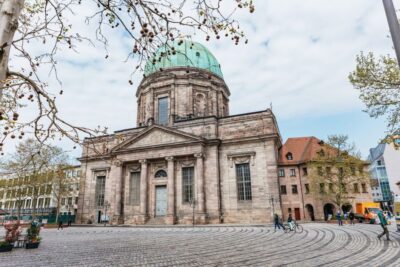
The meeting point is in front of the main entrance of the Frauenkirche, on Hauptmarkt. Look for the guide carrying a red and white umbrella. That detail matters in a busy square, where a clear meeting signal saves time and avoids the awkward first minutes of searching.
The Church of Our Lady is the first major reference point on the route. The schedule allows about 10 minutes for a photo stop, so you should expect an introduction to the setting rather than a long church visit. Bring your camera, but do not assume that the tour includes a formal interior visit or a museum-style presentation.
Hauptmarkt gives you a useful starting point because it places you in the heart of old Nuremberg. From here, the guide can explain how the city’s public spaces worked and how medieval life unfolded around churches, markets, streets, and bridges.
I recommend arriving ready to walk as soon as the tour begins. Comfortable shoes are specifically advised, and the cobbled streets make that practical advice, not a throwaway note.
From November 22, 2025, through January 6, 2026, the meeting point changes. During those dates, meet beside the Ship of Fools Fountain at Plobenhofstraße 10, between Museumsbrücke Bridge and Hauptmarkt. The red and white umbrella remains the visual clue.
Witch trials, public punishments, and the cost of fear
One of the tour’s main themes is Nuremberg’s witch hunts. You learn about the accusations against hundreds of women and the trials that followed. This part should appeal to you if you want more than a cheerful old-town walk, but it also demands attention because the topic deals with fear, injustice, and punishment.
The value here is context. A short explanation of witch trials can show how suspicion moved through a community and how official power gave those accusations force. Rather than treating the subject as a spooky story alone, the tour places it within the daily life and customs of medieval citizens.
Public executions and punishments form another major thread. In the Middle Ages, punishment was not hidden from public view in the way it often is today. The tour helps you consider what that meant for people who lived, worked, shopped, and gathered in the same city spaces.
This is one reason I would not choose the experience for someone seeking only architecture or gentle sightseeing. The darker material is central to the walk. For many people, that is exactly what makes it memorable. For others, it may be too grim, especially alongside stories about witchcraft and executions.
Trödelmarkt Island and the executioner Franz Schmidt
The stop at Trödelmarkt Island gives the tour a personal anchor. Here, you learn about Franz Schmidt, Nuremberg’s notorious executioner, and the house where he lived. That detail turns an abstract discussion of medieval justice into a story connected to one actual person and one actual place.
Franz Schmidt is a striking figure because the executioner occupied an unusual position in medieval society. He carried out public punishments, yet his work also placed him apart from ordinary citizens. The tour uses his home to explore that difficult social role.
You should expect a guided explanation rather than a museum visit. Museum tickets are not included, and the route does not promise entry to a dedicated Franz Schmidt exhibition. The important experience is seeing the place within the city and hearing how the executioner fitted into Nuremberg’s system of justice.
I like this stop because it adds a human face to the tour’s darkest material. It also gives you a better sense of how close medieval work and home life could be to the places where punishment was carried out.
Something different for another day:
- Nuremberg: Tunnels and Secret Passages in the City Wall Tour
★ 4.8 · 2,334 reviews - Nuremberg: Medieval Dungeons Guided Tour
★ 4.8 · 1,726 reviews - Nuremberg: Walking Tour of Former Nazi Party Rally Grounds
★ 4.7 · 1,665 reviews - Medieval Tour in Nuremberg in Spanish
★ 5.0 · 1,374 reviews
Weissgerbergasse and the texture of everyday work
The route includes Weissgerbergasse, one of the most attractive old lanes in Nuremberg. The walk allows about 15 minutes here, enough for your guide to discuss the street and connect it to the city’s working life.
This is where the tour’s focus broadens. You hear about professions, daily activities, and the customs that shaped the community. The goal is not simply to point at old façades. It is to explain how streets like this functioned as part of a working city.
That focus is useful because grand monuments can make medieval Nuremberg seem like a stage set. A lane associated with trade and craft helps restore the practical side of the past. People needed homes, workshops, markets, rules, and ways to earn a living. The guide’s job is to connect those needs with what you see around you.
The route is also visually rewarding. The cobblestones and old street pattern provide the setting for photographs, but the surface can be uneven. Wear shoes that you can manage for three hours, especially if you are not used to walking on historic paving.
Medieval legends, from flying horses to aliens
The tour does not stay strictly within court records and civic history. Your guide also shares popular legends associated with Nuremberg, including stories of devils, knights on flying horses, and galactic aliens.
That mix may surprise you. It is not the same as a standard chronological history walk, and you should not book it expecting every minute to be devoted to verified political events. The legends offer a look at the stories people carried through the city and the way later imagination can attach itself to old places.
I enjoy this kind of contrast when it is clearly presented. Serious material about witch trials and executions can become heavy. Folklore gives the walk a change of pace and lets you see Nuremberg as a place of imagination as well as law and warfare.
The quality of this section will depend heavily on your guide. The strongest guide comments praise enthusiasm, humor, questions, and detailed replies. Jonathan was especially appreciated for involving the group rather than giving a one-way speech. That interactive approach should help the legends feel like part of a conversation.
City defenses and the road to the Imperial Castle
Later parts of the walk explain the military tactics used by city officials to protect Nuremberg from invaders. The tour does not list every defensive feature in advance, so you should expect broad historical interpretation rather than a technical military lecture.
This section matters because it shows that medieval city life was shaped by danger as well as commerce and religion. Officials had to think about walls, access, threats, and the protection of the population. A city’s layout was not only a matter of beauty. It could also help control movement and resist attack.
The walk ends at the Imperial Castle of Nuremberg. Reaching the castle after hearing about daily life, punishment, legends, and defense gives the route a natural finish. You arrive with more questions to consider as you look at the city from its seat of power.
The schedule includes several shorter guided stops along the way, including sections of about 20, 15, 15, and 10 minutes. That suggests a varied walk rather than a single long talk in one place. You will keep moving, pause for explanation, and then continue through the old center.
The itinerary does not include castle museum tickets. If you want to enter paid museum areas, budget separately. The walk itself ends at the castle, so you can decide afterward how much more time and money to spend there.
What $20 buys you in practical terms
At $20 per person, this is a good-value experience if you want three hours of structure and interpretation. You are paying for a live Spanish guide, a planned central route, and historical connections that would be difficult to assemble from building plaques alone.
The price looks especially reasonable for couples and first-time visitors who want orientation without committing to a costly private tour. You get a long walk through major parts of old Nuremberg, plus stories about subjects that are easy to miss when sightseeing independently.
The value depends on your language needs. If you are comfortable in Spanish, the tour offers a focused way to learn. If you need English or another language, this is not the right choice because Spanish is the only listed tour language.
Food and drinks are not included. That is easy to manage, since the walk lasts three hours, but plan ahead if you are booking it around lunch. A hot afternoon can make the timing feel demanding. One participant described taking the tour at 3:30 p.m. in 33-degree heat and still finding the guide’s enthusiasm kept the experience engaging. Even so, water and sensible clothing are wise.
You can cancel up to 24 hours before the start for a full refund, and the reserve now, pay later option helps if your schedule is still changing. The tour is also listed as wheelchair accessible, although the historic cobblestone setting is worth keeping in mind when judging your own comfort.
Who will get the most from this walk
I would recommend this experience to you if you enjoy:
- Medieval social history, not just famous buildings
- Dark historical subjects presented through storytelling
- Spanish-language guiding
- Old streets, bridges, market areas, and castle views
- Guides who invite questions and keep the group involved
- A low-cost introduction to Nuremberg before exploring on your own
Families with older children may appreciate the legends and unusual stories, but the material about witch trials and executions may not suit younger children. The tour also works well for repeat visitors who have already seen Nuremberg’s main sights and want a different angle.
I would hesitate if you dislike walking on cobblestones, need frequent indoor breaks, or want a museum-heavy experience. The route is outdoors and the museum admissions are separate. I would also choose another tour if you prefer a tightly academic presentation with little folklore.
My verdict on the Nuremberg medieval walk
This is a strong choice for a Spanish-speaking visitor who wants Nuremberg’s old center explained through people, fear, work, punishment, legend, and defense. The most praised part is the guiding itself, with Jonathan, Federico, and Víctor all associated with warmth, energy, and clear storytelling.
The $20 fee is modest for a three-hour walk, and the route covers enough ground to make the experience useful on a first visit. The dark subject matter is the main warning, but it is also the reason this tour feels different from a standard photo walk.
Book it if you want history with a human voice, unusual stories, and plenty of context for the streets you see. Skip it if you want only light sightseeing, indoor exhibits, or a tour in a language other than Spanish.
FAQ
How long does the Nuremberg Medieval Ages Tour last?
The tour lasts three hours.
What language is the tour conducted in?
The live guide conducts the tour in Spanish.
Where does the tour begin?
The usual meeting point is in front of the main entrance of the Frauenkirche in Hauptmarkt. The guide carries a red and white umbrella.
Does the meeting point change during the Christmas market period?
Yes. From November 22, 2025, through January 6, 2026, meet beside the Ship of Fools Fountain at Plobenhofstraße 10, between Museumsbrücke Bridge and Hauptmarkt.
Where does the tour finish?
The walk finishes at the Imperial Castle of Nuremberg.
Is the house of Franz Schmidt included?
The route visits Trödelmarkt Island, where Nuremberg’s famous medieval executioner Franz Schmidt lived.
Are museum tickets included?
No. Museum tickets are not included in the $20 tour price.
Is food or drink included?
No. Food and drinks are not included.
Is the tour wheelchair accessible?
Yes, the activity is listed as wheelchair accessible.
What should I bring?
Wear comfortable shoes. The route includes historic cobblestone streets and lasts three hours.
Can I cancel for a refund?
Yes. You can cancel up to 24 hours in advance for a full refund. You can also reserve now and pay later.
Just added around Nuremberg
- Bayreuth: Private Guided Walking Tour★ 5.0 · 15 reviews
- Nuremberg: St. Johannis Friedhof &Hesperidengärten IN GERMAN★ 4.4 · 15 reviews
- Nuremberg: Medieval Time Travel for Kids★ 4.9 · 15 reviews
- PRIVATE Nuremberg WW2 and Old Town Day Tour (Product code: 87669P16)★ 4.5 · 15 reviews
- Bayreuth City Walking Tour★ 4.6 · 16 reviews
- PLAYMOBIL®-FunPark Entrance Ticket★ 4.5 · 17 reviews
- Nuremberg: Private guided tour of the Old Town in German★ 4.9 · 17 reviews
- Nuremberg: Medieval Darkness Exploration Game★ 4.0 · 18 reviews
Nuremberg Tours, compared.

Tunnels and Secret Passages in the City Wall Tour
Read our review →
Walking Tour of Former Nazi Party Rally Grounds
Read our review →
Browse the lists this tour appears in