
Reviewed · THIRD REICH & WWII TOURS
Third Reich Berlin: Hitler and WWII Walking Tour
Berlin keeps its darkest chapters in plain sight. This three-hour walking tour links Hitler’s bunker, Nazi ministries, wartime memorials, and the Reichstag into one clear story. I like the route because it shows how power operated across central Berlin, not just where the final battle ended. I also like the guides’ strong storytelling, with names such as Maria, Paul, Ru, Chris, Tom, and Ciarán praised for making difficult history easier to follow.
The main drawback is simple: you walk briskly outdoors for about three hours, often covering close to 5,000 steps. Cold weather can make the experience tough, and the sites themselves are mostly outdoor locations rather than grand interiors. Still, at about $24.07 per person, this is a strong value if you want context that you would be unlikely to piece together alone.
In This Review
- Key points to know before booking
- Why this Berlin history walk is worth your time
- Start at Friedrichstrasse and get the map of Nazi Berlin
- Trains to Life, Trains to Death: Berlin’s deported Jews
- The Reichstag, from democratic symbol to battlefield
- The Soviet War Memorial in Tiergarten
- Brandenburg Gate and the problem of political symbols
- The Academy of Arts and Albert Speer’s architectural vision
- The Holocaust Memorial: a place for quiet reflection
- Hitler’s bunker site and the last days of the regime
- Wilhelmstrasse, where Nazi decisions were made
- The former Air Ministry and the machinery of war
- Resistance figures and the limits of opposition
- Topography of Terror: ending at the SS and Gestapo headquarters
- What the $24.07 price really buys you
- Pace, weather, and practical comfort
- Who should book this tour?
- Should you book the Third Reich Berlin walking tour?
- FAQ
- How long does the Third Reich Berlin walking tour last?
- How much does the tour cost?
- What language is the tour offered in?
- Where does the tour begin?
- Where does the tour end?
- Is admission to the Reichstag included?
- What is included in the tour?
- How large can the group be?
Key points to know before booking
- Hitler’s bunker is an outdoor location: You see the area above the former bunker and Reich Chancellery, not an accessible underground room.
- The route connects power and persecution: Nazi ministries, Goebbels’ propaganda offices, the Gestapo headquarters site, and Holocaust memorials all fit into one historical account.
- The Reichstag has two major stories: The 1933 fire helped the Nazis crush civil liberties, while the Soviet flag over the building in 1945 symbolized the regime’s defeat.
- The guides are the heart of the experience: Paul, Ru, Maria, Chris, Tom, Ciarán, and others are praised for clear explanations, humor, patience, and strong command of the subject.
- Dress for the weather: The entire tour is on foot and outside, so comfortable shoes and warm layers matter.
- The group can include up to 25 people: That is small enough for a personal feel, though the guide’s position in the group may matter at busy stops.
Why this Berlin history walk is worth your time
Berlin has no shortage of historic buildings, but the story of the Third Reich can feel scattered. A former ministry may look like an ordinary government office. A memorial may seem abstract without knowing why it is there. This tour gives you the links between those places.
You begin near central Berlin and move through the government district, memorial sites, and the former Nazi headquarters area. The guide explains how Hitler’s party rose to power, how dictatorship changed daily life, how military decisions were made, and how resistance groups tried to stop the regime.
I especially like the balance between grand political events and ordinary life. You hear about military planning and the Nazi policy of Lebensraum, but also about air raids, dictatorship, propaganda, and what Berlin residents experienced as the war closed in. That wider view keeps the tour from becoming a parade of famous names.
The subject is grim, and the best guides appear to handle it with care. Paul is praised for keeping the subject accessible without making it lighthearted. Ciarán is praised for explaining complex events clearly and answering questions in depth. Other guides, including Tom, Jimmy, Hannah, Tina, and Pete, are described as friendly, engaging, and able to make a serious tour hold your attention.
More Third Reich & WWII Tours in Berlin
- Berlin: Third Reich and Cold War 2 Hour Walking Tour
★ 4.9 · 6,830 reviews - Berlin’s Best: 2 Hour Walking Tour Third Reich and the Cold War
★ 5.0 · 5,486 reviews - Berlin: Third Reich, Hitler, and WWII Walking Tour
★ 4.9 · 1,133 reviews
Start at Friedrichstrasse and get the map of Nazi Berlin
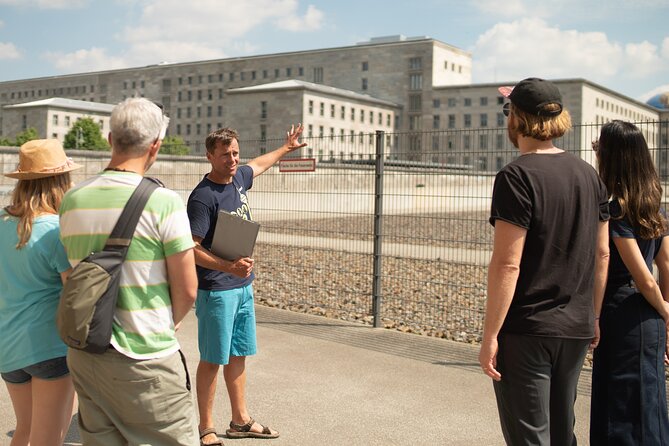
The tour begins at Reichstagufer 17, near Friedrichstrasse Station. The opening orientation helps you understand the route before the walking begins. You are introduced to the main sites ahead, including the Reichstag, Wilhelmstrasse, the former Nazi government quarter, Hitler’s bunker site, and the Soviet memorial.
This first section matters because Berlin’s central streets have changed greatly since 1945. Without explanation, it is easy to miss how close together the ministries, Chancellery, propaganda offices, and military departments once were. The guide turns a modern city walk into a map of Nazi power.
The route also introduces the Reichstag fire of 1933. The Nazis used the fire as a reason to suspend civil liberties and weaken Germany’s democracy. That opening discussion gives the rest of the tour a useful frame: the story is not only about war and Hitler’s final days, but also about how a political system was dismantled.
Trains to Life, Trains to Death: Berlin’s deported Jews
The memorial called Trains to Life, Trains to Death focuses on the deportation of Jewish people from Berlin to concentration camps during the Second World War. You stop for around 10 minutes, long enough for the guide to explain what the memorial represents and why the railway connection is so important.
This is one of the route’s most painful moments because it connects Nazi policy to individual lives. People were forced from their homes, taken to trains, and sent to camps where many were murdered. The memorial does not need a large building or long visit to make its point.
You should expect the tone to become more solemn here. The stop works best when you give it your full attention rather than treating it as a quick photo pause.
The Reichstag, from democratic symbol to battlefield
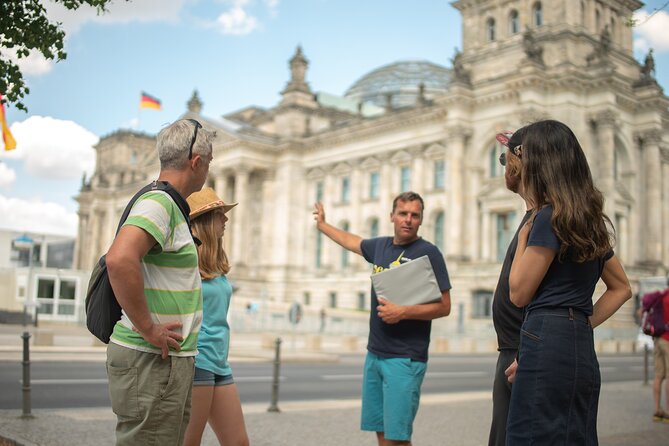
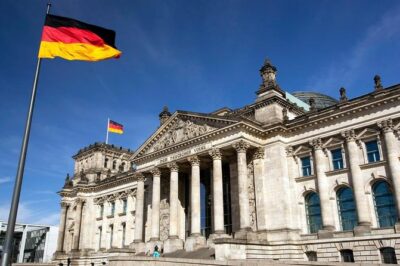
The Reichstag is one of the most useful stops because it carries two major chapters of German history. In 1933, the fire inside the building gave the Nazis a pretext to remove civil liberties and tighten their grip on government.
In 1945, the building became a symbolic target during the final Battle of Berlin. Soviet forces raised their flag over the Reichstag after fierce fighting, marking the collapse of Nazi Germany.
The tour does not include admission inside the building, so you should think of this as an exterior history stop. The value comes from the guide’s explanation of what happened here, not from an interior visit. That also keeps the walk moving and leaves you free to return later if you want to see more of the Reichstag on your own.
More Walking Tours in Berlin
- Discover Berlin Half-Day Walking Tour
★ 5.0 · 9,624 reviews - Berlin: Discover Berlin Walking Tour
★ 4.9 · 5,998 reviews - Berlin: Hidden Backyards Guided Walking Tour
★ 4.8 · 5,360 reviews - Berlin: Alternative Berlin Walking Tour
★ 4.6 · 1,204 reviews
The Soviet War Memorial in Tiergarten
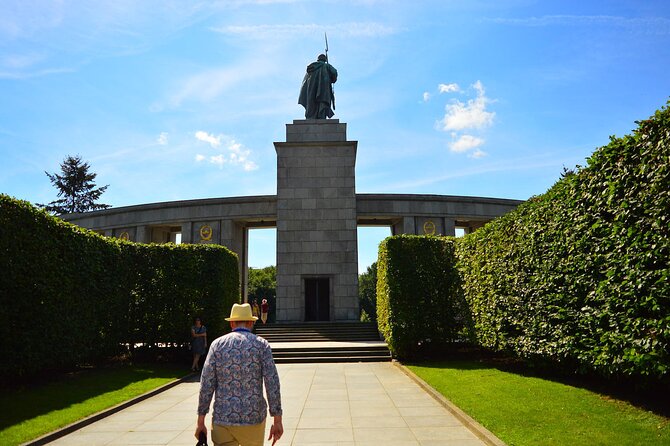
At the Soviet War Memorial in Tiergarten, the focus shifts from Nazi power to the human cost of the final battle. The memorial honors Soviet soldiers who died during the 1945 fight for Berlin. A large statue of a Soviet soldier holding a flag dominates the site, with the monument’s imagery presenting the defeat of Nazism.
The surrounding military cemetery gives the stop weight. It is not just a political monument. Many soldiers are buried here, and the site reminds you that the end of the war came through enormous loss of life.
This stop also adds balance to the route. The tour is centered on the Third Reich, but the final defeat of that regime involved the Allied armies, especially the Soviet assault on Berlin. You get a clearer sense of the scale of the last battle instead of hearing only about Hitler’s headquarters.
Brandenburg Gate and the problem of political symbols
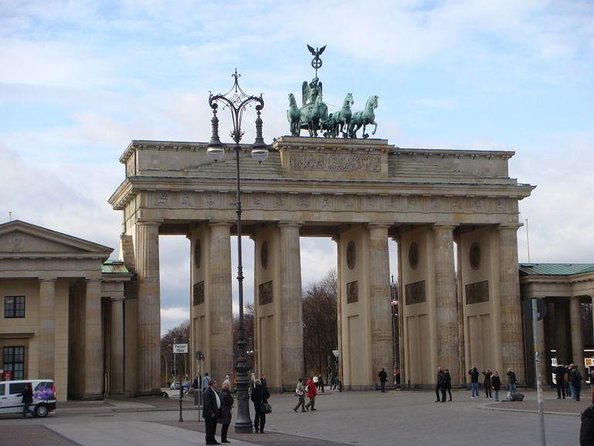
The Brandenburg Gate is now one of Berlin’s most familiar landmarks and a symbol of reunification. During the Nazi era, however, it was used as a backdrop for rallies, propaganda, and displays of authority. The gate was associated with the regime’s militaristic image and was decorated with Nazi symbols during that period.
The guide helps separate the monument’s older meaning from the way the Nazis used it. That is useful in Berlin, where the same building or square can carry several layers of political history.
The stop is brief, around 10 minutes. You will not spend long examining the gate itself, but the commentary gives it a sharper meaning when you return later for photographs.
The Academy of Arts and Albert Speer’s architectural vision
The Akademie der Künste adds an unusual angle: the role of art and architecture under dictatorship. Albert Speer, Hitler’s chief architect and later Minister of Armaments, promoted monumental neoclassical designs intended to express Nazi power and authority.
The Academy was part of the wider cultural world affected by that political climate. The stop does not suggest that the building itself was simply a Nazi headquarters. Instead, it helps explain how institutions connected with culture and design had to reckon with their relationship to the regime after the war.
I find this a worthwhile inclusion because it moves beyond battles and political offices. Dictatorships rely on visual messages as well as police and armies. Buildings, public events, and official art all helped create the image the Nazis wanted people to see.
The Holocaust Memorial: a place for quiet reflection
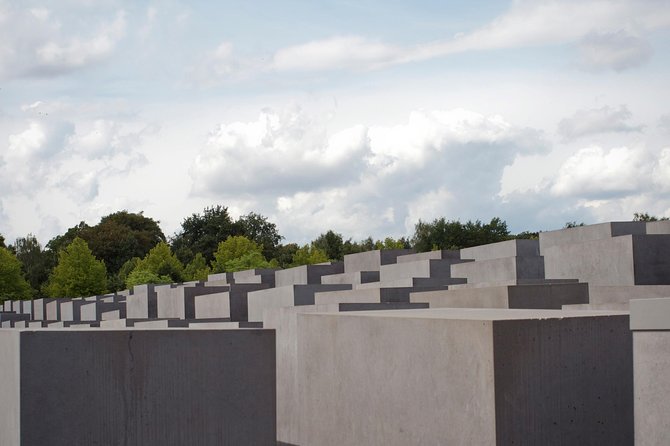
The Memorial to the Murdered Jews of Europe consists of 2,711 concrete slabs arranged across an uneven field. As you walk through the pathways, the changing height and narrow spaces create a disorienting effect.
The guide gives the memorial its historical setting, but this is also a stop where you should allow yourself some quiet time. The memorial honors Jewish victims of the Holocaust and invites personal reflection rather than offering a conventional museum-style display.
You spend about 10 minutes here. That is enough for an introduction, but not enough for a full visit to Berlin’s Holocaust documentation facilities. If you want more detail after the walk, plan separate time for museums and exhibitions in the city.
Hitler’s bunker site and the last days of the regime
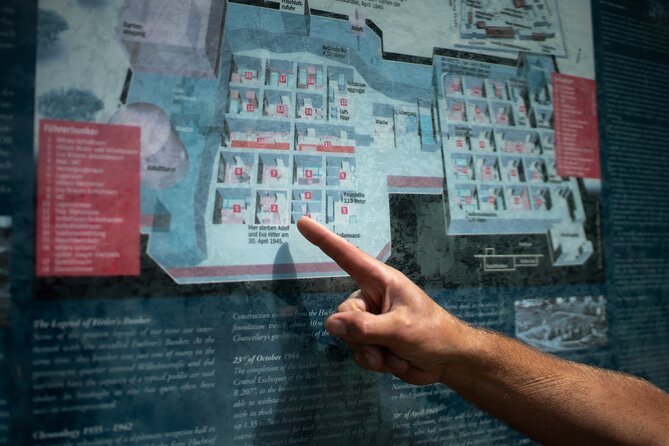
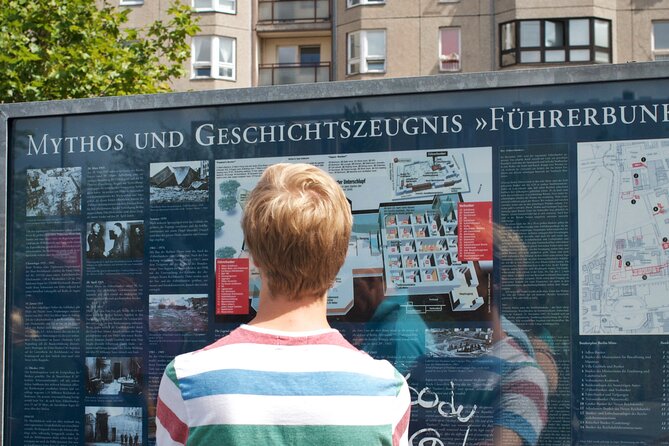
The tour takes you to the location above Hitler’s former bunker. This is also the area of the old Reich Chancellery, designed by Albert Speer. The bunker itself is not presented as an underground attraction. You are looking at the location and hearing what happened there during the final days of the war.
That distinction is important. Some people expect a preserved bunker room or a dramatic entrance. Instead, the site is deliberately ordinary, and the guide’s account supplies the meaning. You hear about Hitler’s last days and death in April 1945 as the Soviet assault closed around Berlin.
One guide, Eran, reportedly used the timing of the reveal well, pointing out the bunker sign only after reaching the location. That kind of presentation can make an otherwise plain patch of city feel unexpectedly powerful.
Wilhelmstrasse, where Nazi decisions were made
Wilhelmstrasse was the administrative core of Nazi Berlin. The street held major government buildings, including the Reich Chancellery, the Ministry of Foreign Affairs, and the Ministry of Propaganda. Joseph Goebbels and other senior officials worked in this area.
This is where the tour explains how military strategy, persecution, diplomacy, and propaganda were tied together. Goebbels’ propaganda office is especially important because it shows that Nazi rule depended not only on force, but also on speeches, messaging, staged events, and control of public opinion.
Much of the original district was destroyed or repurposed after the war. You may see modern buildings rather than a perfectly preserved Nazi quarter. That can feel anticlimactic if you want dramatic ruins, but it also makes the guide’s role more valuable. You need the explanation to read the traces that remain.
The former Air Ministry and the machinery of war
On Niederkirchnerstraße, you see the former Reich Air Ministry, associated with Hermann Göring and the Luftwaffe. The building housed the Nazi air force’s offices and helped manage air operations during the war.
Its large design reflected the authority the regime wanted to project. The building’s importance was administrative as much as architectural: it was part of the system that directed military operations and supported Nazi expansion.
Again, this is an exterior stop. You do not enter an aviation museum or tour a preserved wartime command center. The value is in seeing where the work of war was organized and connecting that office to the larger story of the Battle of Britain and the conflict that followed.
Resistance figures and the limits of opposition
Along the route, the guide discusses resistance leaders including Henning von Tresckow, Hans Oster, and Claus von Stauffenberg. Their stories add a needed human counterpoint to the otherwise overwhelming power of the Nazi state.
You learn about people within the German military and government who opposed Hitler and tried to remove him. These were dangerous efforts, and the tour gives attention to their courage and the risks they faced.
This part suits anyone who wants more than a story of Nazi leaders and Allied armies. It asks how people resisted, why opposition struggled, and what happened when attempts to stop the regime failed.
Topography of Terror: ending at the SS and Gestapo headquarters
The walk ends at the Topography of Terror on Niederkirchnerstraße 8, near Checkpoint Charlie. The museum and memorial occupy the former site of the SS and Gestapo headquarters, making it a fitting place to finish a route about state terror.
The exhibitions use photographs, documents, and personal accounts to explain how the SS and Gestapo enforced persecution and repression. The site connects the policies discussed earlier with the institutions that carried them out.
The tour itself ends here, and admission to the museum is not listed as part of the walking tour. That is useful to know because you may want to stay afterward and explore the exhibitions at your own pace. Ending near Checkpoint Charlie also makes it easy to continue sightseeing in central Berlin.
What the $24.07 price really buys you
At roughly $24.07, the tour is inexpensive for a three-hour guided experience in central Berlin. You are not paying for entry to a major attraction or transport. You are paying for a local guide who organizes a difficult subject, leads you between scattered sites, and provides the connections that make those sites meaningful.
That is good value for a first visit, especially if you have only half a day for this part of the city. Several guides have been praised for giving a large amount of information in a short time, while keeping the explanations clear rather than turning the walk into a list of dates.
The maximum group size is 25 people. It is not a private tour, but it is more manageable than a very large city walk. The experience will depend partly on the guide assigned to your departure. The guide team includes people praised for humor, patience, storytelling, and careful explanation, but you cannot choose a specific guide from the information provided.
Pace, weather, and practical comfort
Plan on walking briskly between points of interest. One detailed account estimated about 5,000 steps, and the route lasts around three hours. Comfortable shoes are essential.
The entire experience is outdoors, so Berlin’s weather matters. Cold conditions have not stopped people from enjoying the walk, but you should layer up, bring a warm drink if useful, and protect yourself from the wind. A winter coat is not excessive here.
You should arrive 15 minutes before the start time. The tour is offered in English, uses a mobile ticket, and begins near public transportation. Hotel pickup and drop-off are not included, so you need to make your own way to Reichstagufer 17.
Most people can take part, and service animals are allowed. The end point is Topography of Terror, close to Checkpoint Charlie, which gives you a practical place to continue your day.
Who should book this tour?
I would recommend it to anyone interested in the Second World War, Nazi Germany, the Holocaust, political history, or the final Battle of Berlin. It also works well for families with older teenagers. One account describes a 15-year-old staying fully engaged, especially because the guide connected historical facts to the fragility of democracy.
You do not need a strong background in history. The best part of the tour is the way it fills in gaps and links events together. If you already know a great deal about the period, you may still value the geography and the resistance stories, though you should not expect access to restricted interiors.
This is less suitable if you dislike long outdoor walks, need frequent indoor breaks, or want a museum-heavy experience. It is also not the right choice for a quick photo tour. The subject deserves attention, and the guide’s explanations are the main reason to book.
Should you book the Third Reich Berlin walking tour?
Book it if you want Berlin’s Nazi-era sites explained as one connected story. The route covers more ground than you are likely to find alone, from the Reichstag and Brandenburg Gate to the bunker site, Wilhelmstrasse, the Holocaust Memorial, and the Topography of Terror.
The strongest reason to go is the guiding. Names such as Paul, Ru, Maria, Chris, Tom, Ciarán, and others receive praise for clear, thoughtful presentations. At about $24.07, the tour offers a lot of historical context for the price.
Bring comfortable shoes, dress for the weather, and expect a serious three hours. If you do that, this is a useful and sobering introduction to Berlin’s darkest chapter.
FAQ
How long does the Third Reich Berlin walking tour last?
The tour lasts approximately three hours.
How much does the tour cost?
The listed price is $24.07 per person.
What language is the tour offered in?
The tour is offered in English.
Where does the tour begin?
The meeting point is Reichstagufer 17, 10117 Berlin, Germany, near Friedrichstrasse Station.
Where does the tour end?
The tour ends at the Topography of Terror, Niederkirchnerstraße 8, 10963 Berlin, very close to Checkpoint Charlie.
Is admission to the Reichstag included?
No. Admission to the Reichstag is not included.
What is included in the tour?
A local expert guide and the three-hour walking tour are included. Hotel pickup and drop-off are not included.
How large can the group be?
The tour can have a maximum of 25 people.
Just added around Berlin
- Berlin: Private Guided Tour of the Main Sights★ 5.0 · 13 reviews
- Private Highlights of Berlin Bike Tour★ 5.0 · 13 reviews
- Modern Berlin Private Walking Tour: Diverse, Vibrant and Exciting German Capital★ 5.0 · 13 reviews
- Tour in Berlin from Warnemünde and Rostock Cruise Port★ 4.1 · 13 reviews
- Berlin: Stasi Museum Private Guided Tour with Entry Ticket★ 4.8 · 13 reviews
- Private Food Tour Experience with a born and bred Berliner★ 5.0 · 14 reviews
- Berlin: Rheinsberg Palace Entrance Ticket★ 4.8 · 14 reviews
- Berlin in one day – day tour with an expert guide★ 5.0 · 14 reviews
Third Reich & WWII Tours, compared.
Berlin’s Best: 2 Hour Walking Tour Third Reich and the Cold War
Read our review →
Walking Tour of Former Nazi Party Rally Grounds
Read our review →
Berlin Third Reich Sites: Half-Day Walking Tour
Read our review →Browse the lists this tour appears in