
Reviewed · THIRD REICH & WWII TOURS
Berlin: Third Reich and Cold War 2 Hour Walking Tour
Berlin’s past is under your feet. This two-hour walk links Nazi sites, Soviet memorials, the Berlin Wall, and Checkpoint Charlie into one clear story of war, dictatorship, division, and reunification. I especially like the strong route through central Berlin and the way the guides use stories to make difficult history easier to understand.
I also like the small price of $23 per person for a live guide and roughly two kilometers of walking. Guides such as Hannah, Jimmy, Scott, Ru, Peter, Mikhail, and Marie have been praised for clear storytelling, good pacing, humor, and thoughtful answers. The main consideration is time: two hours moves quickly, and most stops are outdoor viewing points rather than indoor museum visits.
In This Review
- Key points to know before booking
- Why this Berlin history walk works
- Starting at Brandenburg Gate and the Reichstag
- The Soviet War Memorial in Tiergarten
- The Holocaust Memorial and Hitler’s bunker site
- Detlev-Rohwedder-Haus and the machinery of Nazi rule
- Topography of Terror and the former SS headquarters
- A 200-meter stretch of the Berlin Wall
- Checkpoint Charlie and the final Cold War chapter
- Guide quality, pace, and group choices
- Is $23 a fair price?
- Who should book this walking tour?
- FAQ
- How long is the Berlin Third Reich and Cold War walking tour?
- How much does the tour cost?
- Where does the tour start?
- How do I identify the guide?
- Which public transport stops are closest?
- Where does the walking route finish?
- Which languages are available?
- Is the tour wheelchair accessible?
- What should I bring?
- Should you book it?
Key points to know before booking
- Brandenburg Gate to Checkpoint Charlie: The route connects several of Berlin’s most important historical sites in a compact central walk.
- A 200-meter section of the Berlin Wall: You get time to consider escape attempts, border controls, and the human cost of division.
- Seven major historical stops: These include the Reichstag, Soviet War Memorial, Holocaust Memorial, Hitler’s bunker site, the former Ministry of Aviation, and the Topography of Terror area.
- Excellent guide-led storytelling: The strongest part of the experience is the live explanation, with guides praised for clear speech, humor, strong pacing, and useful answers.
- Only about two kilometers: This is a manageable walk, but comfortable shoes still matter because you will be outside for the full tour.
- A good first-day orientation: You finish with a clearer sense of how Berlin’s central monuments fit together and where to return for museums or longer visits.
Why this Berlin history walk works

Berlin can feel like a history book with its pages scattered across a large city. One monument recalls Nazi rule, another points to the Soviet victory, and a fragment of wall marks the Cold War. Without context, the connections can be hard to see.
This tour solves that problem with a logical route. You begin at the Brandenburg Gate and move south through the central government district, past memorials and former Nazi offices, before reaching the Berlin Wall and Checkpoint Charlie. I like this progression because it follows the broad shape of Berlin’s twentieth-century story.
The tour focuses on the Third Reich and the Cold War rather than trying to explain every period of Berlin’s past. That focus gives the walk purpose. You will hear about Hitler’s rise, the destruction of the Second World War, Soviet control, the division of Germany, escape attempts, and the events that led to reunification in 1989.
A guide makes a major difference here. The strongest descriptions of the experience praise guides for telling stories rather than simply listing dates. Jimmy was noted for a comfortable pace and easy-to-follow explanations. Scott was praised for making serious material both interesting and informative. Thomas reportedly kept speaking clearly even when rain arrived, while Mikhail adjusted the route’s stopping points to keep people in the shade on a hot day.
Those details matter. Berlin’s history is heavy, and a good guide must handle it with care without making the walk feel like a lecture. The best guides on this tour appear to mix facts with personal stories, unusual details, and room for questions.
More Third Reich & WWII Tours in Berlin
- Berlin’s Best: 2 Hour Walking Tour Third Reich and the Cold War
★ 5.0 · 5,486 reviews - Third Reich Berlin: Hitler and WWII Walking Tour
★ 5.0 · 3,301 reviews - Berlin: Third Reich, Hitler, and WWII Walking Tour
★ 4.9 · 1,133 reviews
Starting at Brandenburg Gate and the Reichstag
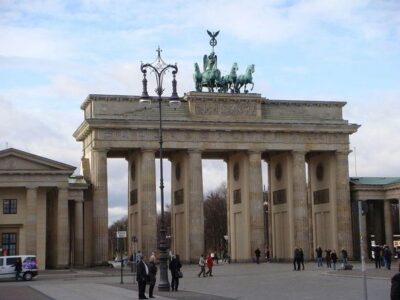
Meet in front of the tourist information point at Brandenburg Gate, at Pariser Platz 1. Look for the guide carrying a pink umbrella, a useful marker in a busy square.
The nearest public transport is Brandenburger Tor station, served by S-Bahn lines S1, S2, S25, and S26, plus U5. Buses 100 and 245 also stop nearby. Give yourself a little extra time to reach the square, especially if you are coming from another part of Berlin.
The Brandenburg Gate is a fitting starting point. It is one of Berlin’s most familiar monuments, but its meaning has changed sharply over time. The guide explains its place in Nazi parades, its position near the Cold War divide, and its role in the celebrations surrounding German reunification.
This is one of the tour’s best teaching points: the building itself did not change much, but the political world around it did. During the Cold War, the gate stood in the restricted zone near the Berlin Wall. In 1989, it became a powerful image of the wall’s collapse and Germany’s path toward unity.
From here, you pass the Reichstag. The building now houses Germany’s parliament, but the 1933 Reichstag Fire gave it a much darker place in modern history. The guide explains the fire and how it helped Hitler’s government claim emergency powers and tighten its grip on Germany.
You will not go inside the Reichstag on this walk. Instead, you view it from outside and learn how the building survived war, political upheaval, and years of division before becoming the seat of democratic government again. If you plan to visit the dome separately, this introduction gives you useful context before you enter.
The Soviet War Memorial in Tiergarten
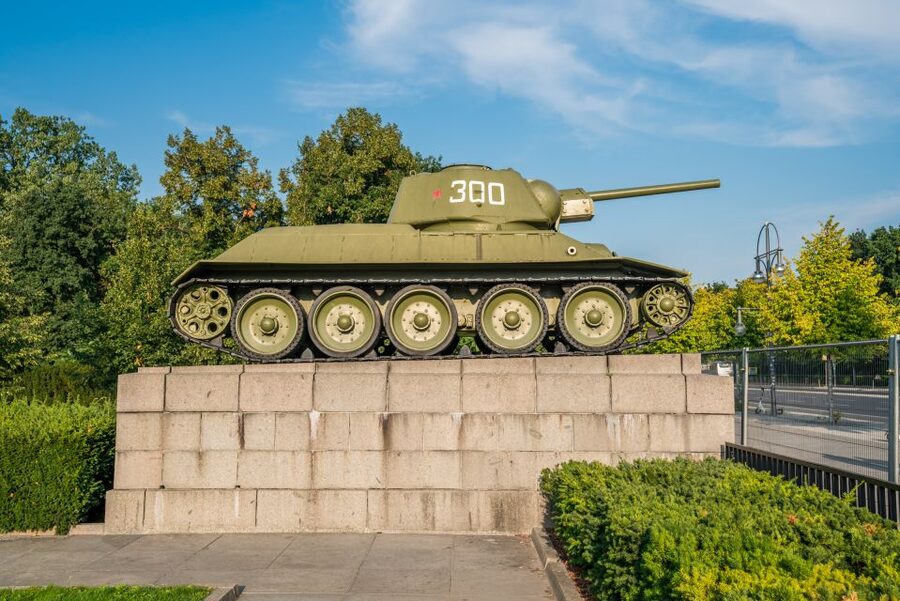
The route continues to the Soviet War Memorial in Tiergarten. This is not a polished, distant monument. Preserved Red Army tanks and other military features make the site direct and physical.
The memorial honors roughly 80,000 Soviet soldiers who died during the Battle of Berlin. Your guide explains the final battle and the role of Soviet forces in defeating Nazi Germany. The location also raises an uncomfortable question that runs through much of Berlin’s history: how should a city remember liberation when it was followed by occupation and political control?
The memorial is outdoors, so the weather matters. The tour runs in rain, sun, and on public holidays. Bring water in warm weather and an umbrella if rain is forecast. The guide may keep the group moving, but you should still expect to spend time standing while listening.
I find this stop valuable because it adds a military and Soviet perspective to a route that could otherwise focus mainly on German suffering. It also helps explain why the postwar division of Berlin was not simply an argument between two abstract political systems. It grew from the military defeat of Nazi Germany and the competing plans of the victorious powers.
The Holocaust Memorial and Hitler’s bunker site
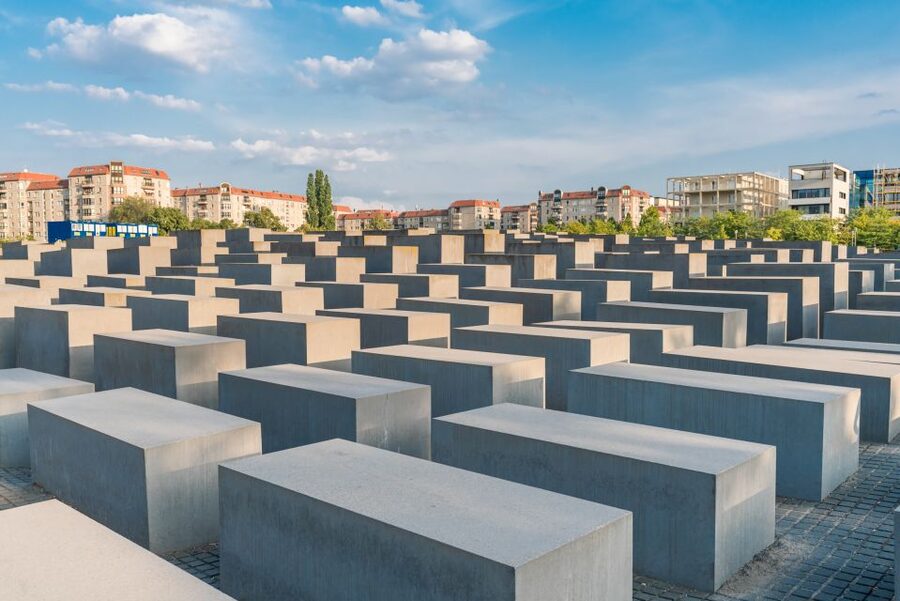
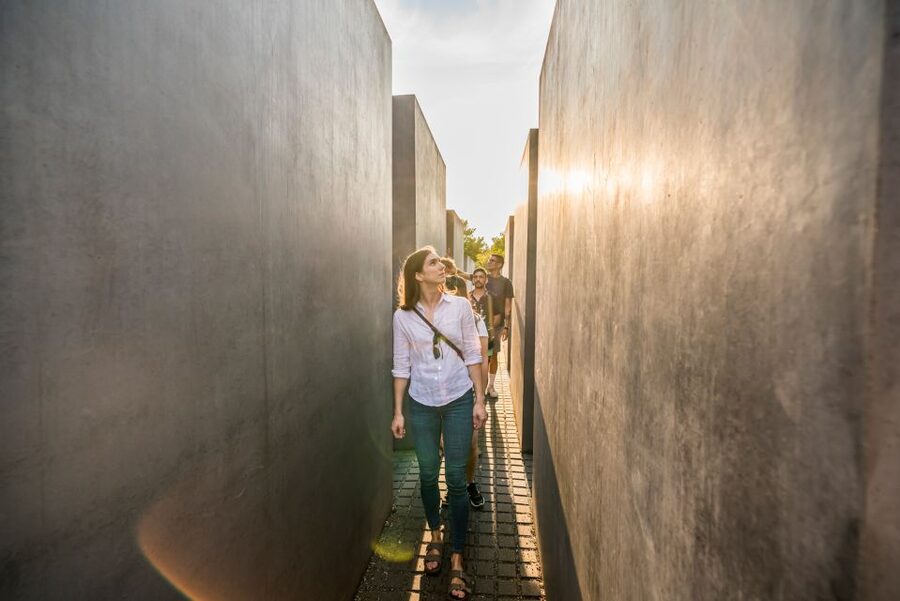
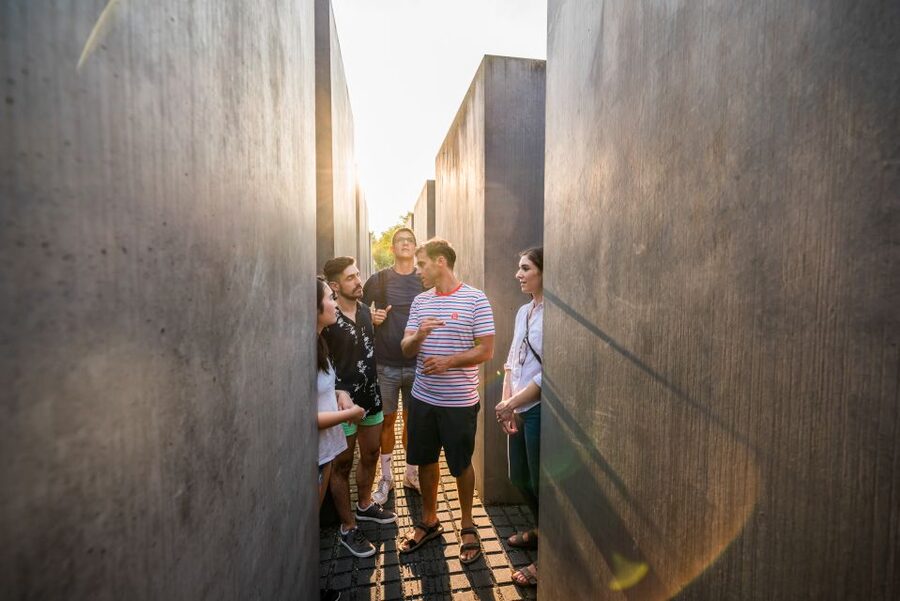
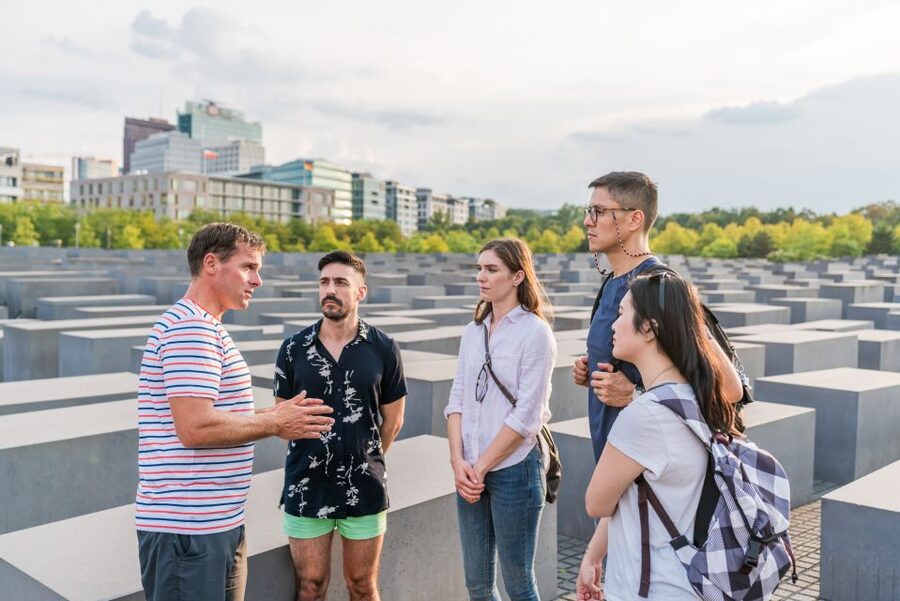
The Memorial to the Murdered Jews of Europe is one of Berlin’s most affecting sites. Rows of concrete blocks cover an open area near the Brandenburg Gate, creating an austere place for reflection.
The guide explains that the memorial honors the six million Jewish victims of the Holocaust. You may walk among the blocks, but this is not treated as a playground or a quick photo stop. The meaning comes from the scale, repetition, and lack of a single central statue or inscription.
Your time here is limited, so anyone wanting a fuller understanding should plan a separate visit to the underground information center. That is not included in the walking tour. The outdoor memorial still carries force, but two hours cannot cover the Holocaust in the depth it deserves.
Nearby is the site of Hitler’s bunker. There is no grand entrance or intact underground room to visit. The bunker was destroyed, and the location is marked in a deliberately low-key way. The guide explains where Hitler spent his final days as the Third Reich collapsed.
This modest setting can be more striking than a dramatic ruin. You are standing at the place where the Nazi leadership faced defeat, but there is no monumental building to glorify it. The guide’s explanation gives the site meaning without turning it into a spectacle.
This part of the route works best when you listen closely. The facts are familiar to many people, but the physical distance between the Holocaust Memorial and the bunker site creates a sharp contrast between the victims of the regime and the leaders who directed it.
More Walking Tours in Berlin
- Discover Berlin Half-Day Walking Tour
★ 5.0 · 9,624 reviews - Berlin: Discover Berlin Walking Tour
★ 4.9 · 5,998 reviews - Berlin: Hidden Backyards Guided Walking Tour
★ 4.8 · 5,360 reviews - Berlin: Alternative Berlin Walking Tour
★ 4.6 · 1,204 reviews
Detlev-Rohwedder-Haus and the machinery of Nazi rule
The next stop is the Detlev-Rohwedder-Haus, formerly Hermann Göring’s Ministry of Aviation. The building later became associated with the birth of East Germany in 1949.
That change in use captures Berlin’s political shifts in one address. First, it was linked to the Nazi state and its war machine. After the war, it became part of the government structure of the German Democratic Republic.
The building’s changing identity is a reminder that Berlin’s history is not divided into neat chapters. Nazi rule ended, but the city did not immediately become a stable democracy. It moved into occupation, ideological conflict, and separate political systems.
You view the building from outside, and the guide supplies the explanation. It is another stop where a good speaker matters more than a grand visual attraction. The architecture alone may not hold your attention for long, but the story gives it weight.
Topography of Terror and the former SS headquarters
At the Topography of Terror area, you learn about the former headquarters of the SS and Gestapo. This was one of the places where the Nazi regime organized persecution, surveillance, imprisonment, and terror.
The location is especially useful because it brings the machinery of dictatorship down to an administrative scale. Nazi crimes were not carried out only by men in military uniforms on battlefields. They depended on offices, records, orders, police work, and a network of institutions.
The Topography of Terror is also a separate documentation center and exhibition site. The walking tour gives you an outside introduction, but you may want to return later for more detailed displays. If you are planning your Berlin schedule, consider using the tour as a guide to the places that deserve a longer visit.
This stop helps tie together the earlier locations. The Reichstag shows the political crisis of 1933. The bunker site points to the regime’s final collapse. The Topography of Terror explains how state violence was organized in between.
A 200-meter stretch of the Berlin Wall
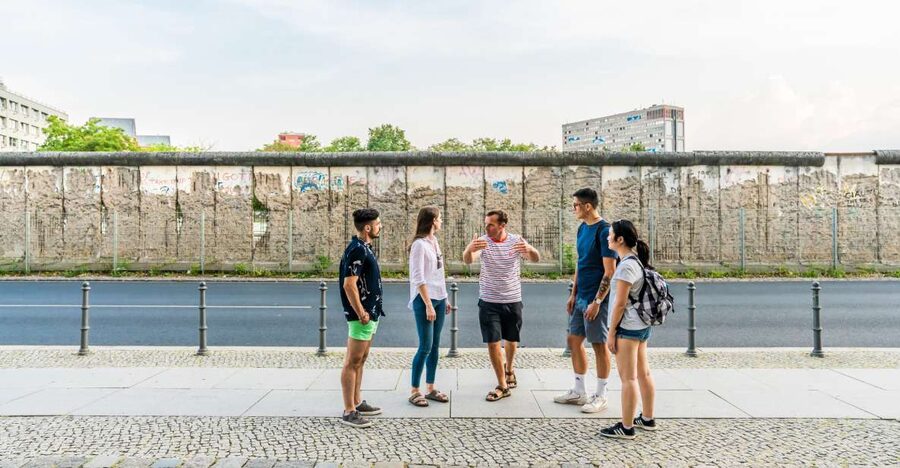
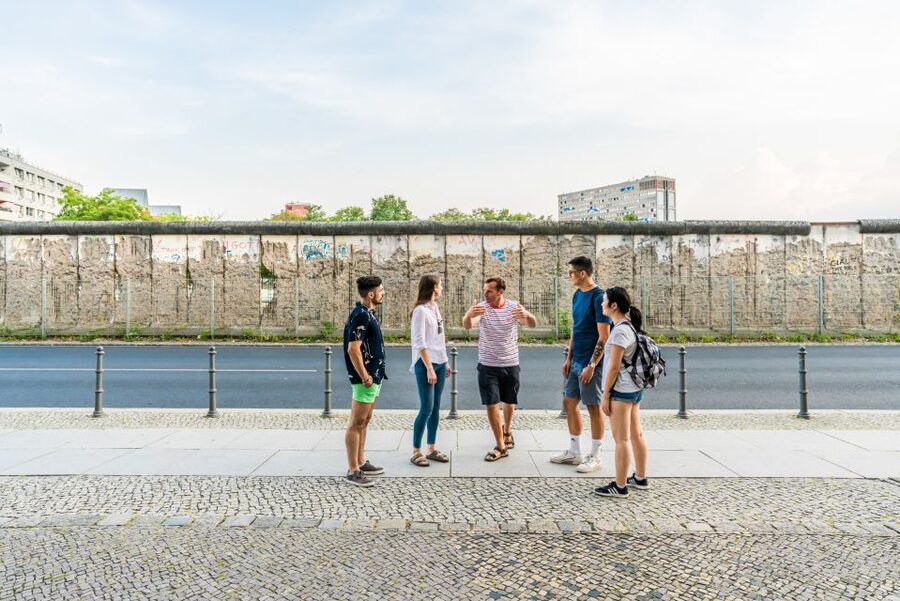
The tour then reaches a 200-meter section of the Berlin Wall. This is one of the most tangible parts of the walk. Instead of hearing only about the border on a map, you can stand beside a surviving section and consider how it divided neighborhoods, families, workplaces, and daily routines.
The guide tells stories of people who risked their lives to escape from East Germany. These accounts help explain why the wall was far more than a concrete barrier. It was backed by guards, restrictions, surveillance, and the threat of arrest or death.
The wall’s fall in 1989 is treated as a turning point, but the guide also addresses its longer effects. Reunification changed the political map quickly, yet the experience of division left a lasting mark on Berlin and on the people who lived on opposite sides.
You should expect this stop to be outdoors and exposed to the weather. The route covers about two kilometers in total, so this is not a strenuous hike, but there are several points where you pause to listen. Wear comfortable shoes and bring water.
The wall section is also a good place to ask questions. Guides such as Tina have been praised for making Cold War Berlin easier to understand, while Peter has been praised for explaining the context behind each site and adding small incidents that bring the locations to life.
Checkpoint Charlie and the final Cold War chapter
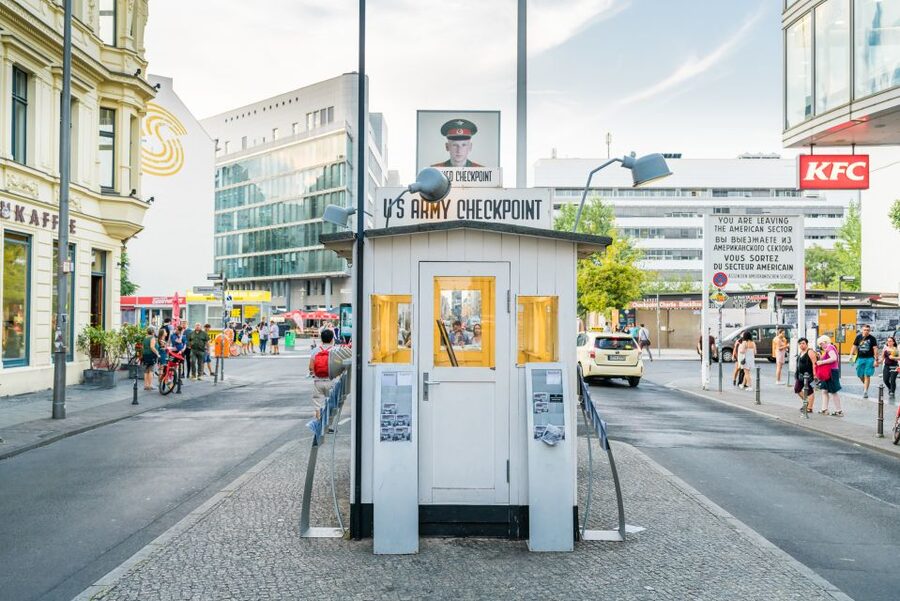
The walk concludes at Checkpoint Charlie, the former crossing point between the American and Soviet sectors. American and Soviet tanks once faced each other here during one of the most dangerous confrontations of the Cold War.
The modern checkpoint area is busy and commercial, so do not expect an untouched historical setting. Its value comes from the stories attached to the place: tense border crossings, escape attempts, and the final period before the wall came down.
Checkpoint Charlie works well as the ending because the tour has moved from Nazi dictatorship to postwar occupation, then to the division of Berlin and the eventual opening of the border. You finish with a clearer sense of how these events connect.
One practical point needs attention. The route description finishes at Checkpoint Charlie, while the meeting information also says the activity ends back at the meeting point. Confirm the final return arrangement when you book, since these details appear inconsistent. Checkpoint Charlie has public transport nearby, but the exact end point matters if you have a timed reservation afterward.
Guide quality, pace, and group choices
The guide is the heart of this experience. The repeated praise centers on storytelling, clear delivery, and a comfortable pace, not on elaborate equipment or access to restricted buildings.
Names specifically praised include Hannah, Jimmy, Scott, Ru, James, Klaus, Marie, Peter, Jamie G, Tina, Mikhail, Alex, Xavier, Joachim, Ariel, Raffaello, Thomas, Jasper, Ben, and Emma. You cannot choose a particular guide in advance based on the information provided, but the range of positive comments suggests a strong guide team.
The walk is offered in English and German. Shared and private options do not always offer the same languages, so check the language and group type carefully before booking. A private group may suit families or friends who want more control over questions and attention, while the shared option keeps the cost low.
The two-hour length is both a strength and a limit. It fits neatly into a first day in Berlin and gives you a useful framework before visiting museums. But you will not receive a full academic treatment of the Third Reich, the Holocaust, or the Cold War in this time.
The tour is wheelchair accessible. Still, because it is an outdoor walk with repeated stops, you may want to confirm the precise route conditions if you have specific mobility needs. It runs in all weather, so pack for the forecast rather than hoping for perfect skies.
Is $23 a fair price?
At $23 per person, this is good value if you want context rather than just photographs of famous places. You cover major central landmarks, hear a connected account of two defining periods, and can ask questions along the way.
The price is especially fair for first-time visitors who might otherwise see the Brandenburg Gate, Reichstag, Holocaust Memorial, and Checkpoint Charlie as unrelated sights. A guide gives you the political links and personal stories that are difficult to get from a quick walk on your own.
The value is lower if you already have strong knowledge of Berlin’s twentieth-century history or prefer to spend time inside museums. This tour does not replace the Topography of Terror exhibition, the Holocaust Memorial’s information center, or a longer Berlin Wall visit. Think of it as a guided introduction and orientation.
Free cancellation up to 24 hours before the start and the option to reserve now and pay later make it easier to fit into a changing schedule. Check starting times before booking, since they vary by availability.
Who should book this walking tour?
I would recommend it to first-time visitors, history-minded families, students, and anyone who wants to understand central Berlin before exploring it independently. It is also useful if your time in the city is short and you want several major sites connected in one outing.
You will get the most from it if you enjoy listening, asking questions, and thinking about difficult subjects. The tour is not designed as a light sightseeing stroll, although the guides often add humor and lively details to keep the pace human.
I would choose another format if you want extensive museum time, a slow photographic walk, or a detailed treatment of only one subject. Two hours gives you breadth, not full depth.
FAQ
How long is the Berlin Third Reich and Cold War walking tour?
The tour lasts two hours.
How much does the tour cost?
The price is $23 per person.
Where does the tour start?
Meet in front of the tourist information point at Brandenburg Gate, Pariser Platz 1.
How do I identify the guide?
Look for a guide carrying a pink umbrella at Brandenburg Gate.
Which public transport stops are closest?
The nearest station is Brandenburger Tor, served by S-Bahn lines S1, S2, S25, and S26, plus U5. Buses 100 and 245 also serve the area.
Where does the walking route finish?
The route description concludes at Checkpoint Charlie. The meeting information also says the activity ends back at the meeting point, so confirm the exact end arrangement when booking.
Which languages are available?
The live tour is available in English and German. Shared and private options may not offer the same languages.
Is the tour wheelchair accessible?
Yes, the activity is described as wheelchair accessible.
What should I bring?
Bring comfortable shoes, water, an umbrella, and a camera. The tour runs in all weather conditions and covers about two kilometers.
Should you book it?
Book this tour if you want Berlin’s central sights to make sense as one connected story. For $23, you get a compact route, a live guide, and direct contact with places tied to Nazi rule, the Holocaust, the Soviet victory, the Berlin Wall, and reunification.
I would schedule it early in your stay. Use the walk to get your bearings, note the places you want to revisit, and then return to the Topography of Terror or other museums with better preparation. Just confirm the final meeting-point details and prepare for outdoor conditions.
For a first look at Berlin’s difficult twentieth-century past, this is a practical and strongly priced choice.
Just added around Berlin
- Berlin: Private Guided Tour of the Main Sights★ 5.0 · 13 reviews
- Private Highlights of Berlin Bike Tour★ 5.0 · 13 reviews
- Modern Berlin Private Walking Tour: Diverse, Vibrant and Exciting German Capital★ 5.0 · 13 reviews
- Tour in Berlin from Warnemünde and Rostock Cruise Port★ 4.1 · 13 reviews
- Berlin: Stasi Museum Private Guided Tour with Entry Ticket★ 4.8 · 13 reviews
- Private Food Tour Experience with a born and bred Berliner★ 5.0 · 14 reviews
- Berlin: Rheinsberg Palace Entrance Ticket★ 4.8 · 14 reviews
- Berlin in one day – day tour with an expert guide★ 5.0 · 14 reviews
Third Reich & WWII Tours, compared.
Berlin’s Best: 2 Hour Walking Tour Third Reich and the Cold War
Read our review →
Third Reich Berlin: Hitler and WWII Walking Tour
Read our review →
Walking Tour of Former Nazi Party Rally Grounds
Read our review →

Berlin Third Reich Sites: Half-Day Walking Tour
Read our review →Browse the lists this tour appears in