
Reviewed · THIRD REICH & WWII TOURS
Third Reich Walking Tour Munich
History gets real on Munich’s streets. This 2.5-hour walking tour follows the places where Hitler and the Nazi Party built support, staged marches, and shaped propaganda before the horrors of World War II. I like the route’s focus on actual streets and buildings, not just dates in a lecture hall, and I like that it includes memorials to people who resisted the regime. The main drawback is simple: this is an outdoor tour, so cold, rain, or strong sun can affect your comfort.
At $45.95 per person, the tour is not the cheapest way to see central Munich. Still, I think the price is fair if you want context rather than a quick look at monuments. Guides such as Michael, Jake, Paul, Nicola, Scott, and Alex have been praised for clear explanations, thoughtful answers, and a good sense of when the subject needs seriousness and when a little humor can help.
In This Review
- Key Points Before You Book
- Why Munich Matters to This Story
- Starting Near Dachauer Strasse
- Königsplatz and the Power of Political Space
- Odeonsplatz and the Road to Power
- Hofbräuhaus and Beer Hall Politics
- The Old Town Hall and Munich’s Civic Center
- Marienplatz and the Tour’s Final Chapter
- What the Guides Add
- Walking Conditions, Group Size, and Comfort
- Is $45.95 a Fair Price?
- Who Should Book This Walking Tour?
- Should You Book the Third Reich Walking Tour?
- FAQ
- How long is the Third Reich Walking Tour Munich?
- How much does the tour cost?
- What language is the tour offered in?
- Where does the tour begin?
- Where does the tour end?
- How large can the group be?
- Can I cancel for a full refund?
Key Points Before You Book
- Königsplatz gives the tour a powerful start: This former Nazi landmark helps explain how architecture and public space were used for political theater.
- The route connects politics with ordinary gathering places: Odeonsplatz and Hofbräuhaus show how marches, meetings, speeches, and beer hall culture shaped Munich’s role in the Nazi rise.
- Guides bring visual aids and strong storytelling: Some guides use historical photographs to connect present-day streets with their earlier appearance.
- You finish at Marienplatz: The central ending point makes it easy to continue sightseeing, eat, or visit another Munich attraction.
- The group can reach 25 people: That keeps the outing manageable, though the experience may feel less personal when it is full.
- Dress for the forecast: The tour is conducted on foot and outside, with no indoor shelter built into the route.
Why Munich Matters to This Story
Munich was not merely a backdrop to the Nazi rise. It was one of the movement’s main political centers, and the city’s streets still hold the locations tied to its early growth. This tour helps you see how a modern city became connected to one of the darkest political movements in European history.
The subject is heavy, but the route gives it shape. You move from party beginnings and propaganda to public marches, political violence, persecution, war, and remembrance. That order matters. It helps you understand that the Nazi dictatorship did not appear overnight. It developed through speeches, symbols, public gatherings, fear, manipulation, and the gradual destruction of opposition.
I also value the tour’s attention to resistance. The itinerary is not limited to Hitler and party leaders. Memorials to people who opposed Nazi ideology give the walk a moral center and remind you that individuals made difficult choices under an oppressive system.
The tour is offered in English, and the strongest guide feedback points to clear speech and open discussion. Michael has been praised for answering uncomfortable questions honestly. Jake has been praised for making the material approachable without making light of it. Aileen reportedly brought photographs and allowed a short bathroom and coffee break after asking the group what it wanted.
More Third Reich & WWII Tours in Munich
- Munich: Third Reich & WWII Walking Tour
★ 4.6 · 6,181 reviews - Munich: Birthplace of the Third Reich Guided Walking Tour
★ 4.6 · 771 reviews - Munich World War II Sites Including Dachau Concentration Camp
★ 4.5 · 570 reviews
Starting Near Dachauer Strasse
The meeting point is Radius Tours at Dachauer Str. 4, 80335 Munich. You check in there before setting off on foot. The location is near public transportation and is described as easy to find, which is useful when you are still getting your bearings in Munich.
Arrive ready to walk from the start. The tour does not use a sightseeing bus or other transport between its main stops. One confusing piece of feedback referred to transportation and not having enough time, but this experience is presented as a walking tour, so you should plan around a steady urban walk rather than a vehicle-based outing.
The tour lasts about two and a half hours. That is enough time to cover several important locations, but not enough for a full academic treatment of Munich under National Socialism. I would treat it as a strong introduction or a useful framework for further visits, not as the final word on the subject.
Königsplatz and the Power of Political Space
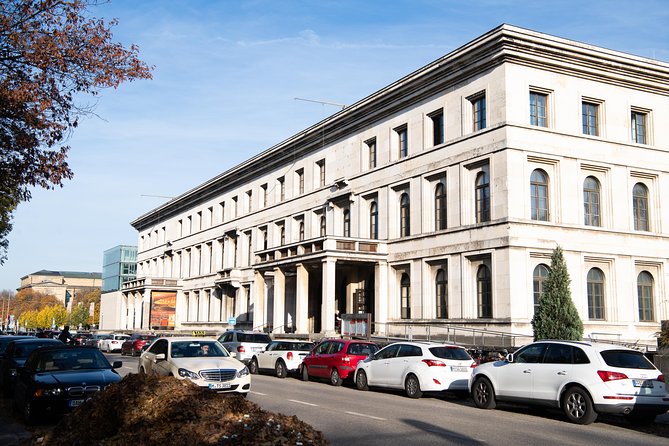
The first major stop is Königsplatz, where you spend about 15 minutes. The square was an important Nazi Party landmark, and its broad open design made it suitable for ceremonies, marches, and carefully staged public events.
This is one of the best places to consider how political movements use architecture. A square can be a pleasant city space, but it can also be turned into a stage. The guide explains how the Nazis used public settings, grand buildings, symbols, and mass gatherings to create an image of order and power.
The value here is less about one single building and more about learning to read the space. After the guide explains its political role, you may look at other ceremonial areas in Europe with a more careful eye. The stop is short, so listen closely and ask questions while the group is gathered.
Odeonsplatz and the Road to Power
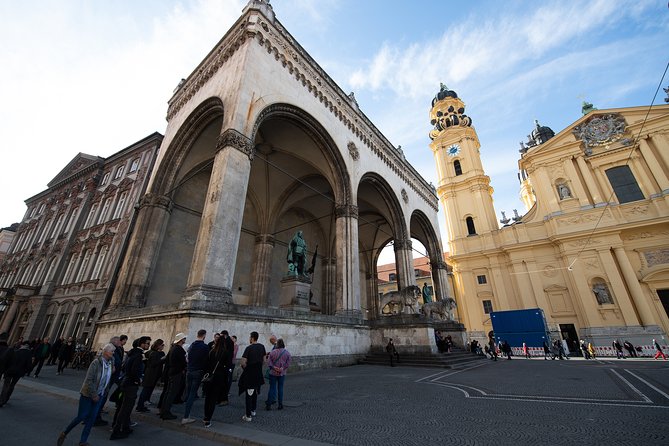
At Odeonsplatz, the tour pauses for roughly 30 minutes. This longer stop reflects the site’s importance to Nazi marches and memorial events. It also gives the guide room to explain how political conflict played out in Munich’s public spaces.
Odeonsplatz is a useful point for connecting ideology with action. Speeches and slogans alone do not create a dictatorship. Public displays of loyalty, organized marches, intimidation, and clashes with opponents all helped shape the movement’s path.
This part of the tour may be especially useful if you know the basic outline of Hitler’s rise but want a clearer sense of the setting. Several guides have been praised for explaining not only what happened, but also why Munich became fertile ground for the movement’s growth.
The group may pause here long enough for questions. That can make a big difference because the subject raises complicated issues about politics, society, and culture. Scott has been praised for going beyond a simple list of facts and explaining those wider forces.
More Walking Tours in Munich
- Munich: Old Town & Viktualienmarkt City Walk in German
★ 4.7 · 2,304 reviews - Munich: Night Watchman Walking Tour
★ 4.7 · 2,092 reviews - Munich Ghosts and Spirits Evening Walking Tour
★ 5.0 · 1,900 reviews - Munich Old Town Walking Tour
★ 4.5 · 1,287 reviews
Hofbräuhaus and Beer Hall Politics
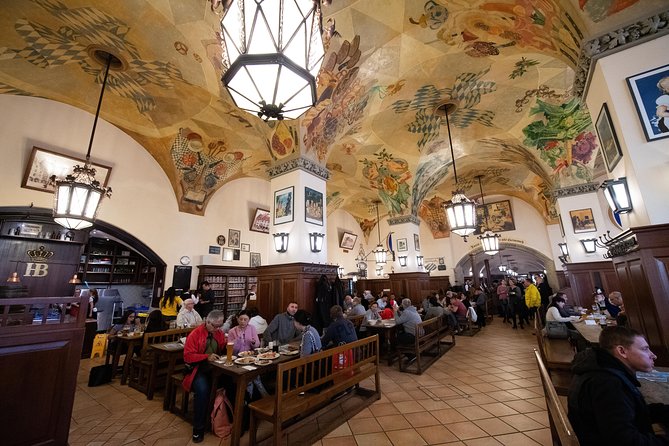
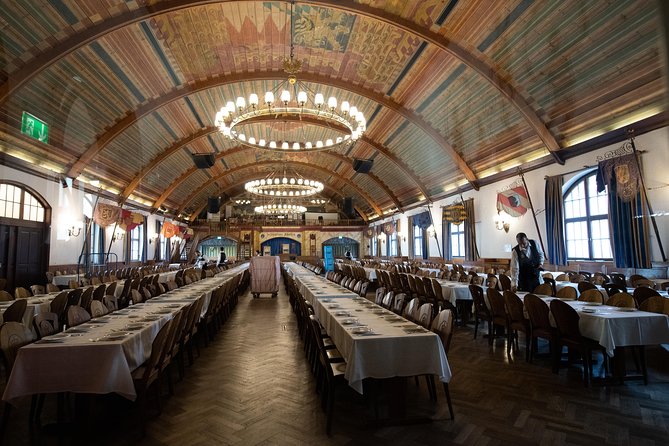
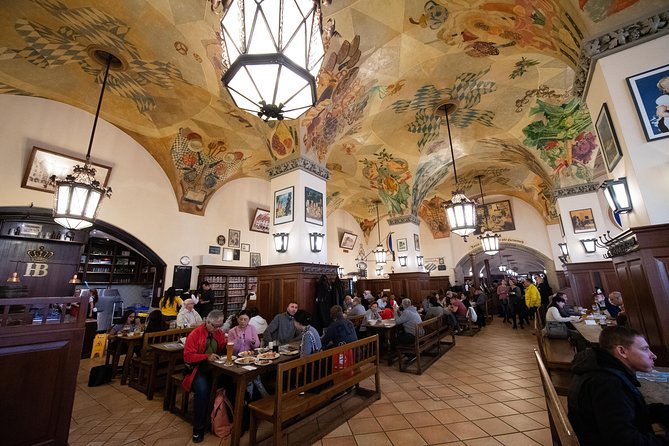
The stop at the Staatliches Hofbräuhaus lasts about 20 minutes. Munich’s beer halls were not just places for food and drink. They also served as political meeting spaces, and Hofbräuhaus became connected with the Nazi Party’s early public activity.
This stop gives the tour a valuable everyday setting. Political movements often grow in places where people gather regularly, and a beer hall offers a very different picture from a grand ceremonial square. You get a sense of how political messages could be presented in a social environment, among people who were already meeting, talking, and listening together.
The guide’s job here is to separate popular myth from historical explanation. The building’s fame can make it tempting to focus on atmosphere, but the important point is how social spaces became useful to political organizers.
This is also where the tour can feel most distinctly Munich. You are not only studying government buildings and monuments. You are looking at the relationship between city life, public speech, and political organization.
The Old Town Hall and Munich’s Civic Center
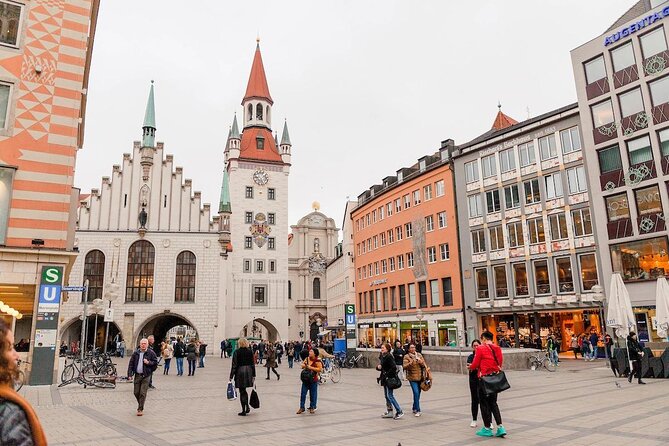
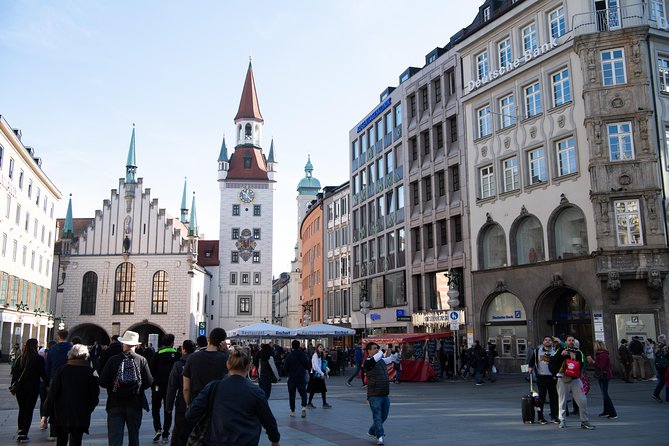
The walk continues to Munich’s Old Town Hall for about 15 minutes. The stop adds a civic and governmental setting to the route, helping you see how Nazi activity intersected with established institutions and the city’s public identity.
The Old Town Hall is also part of the transition from political beginnings to the broader story of Nazi rule. A well-paced guide uses this point to connect local events with the larger destruction that followed: persecution, war, and the loss of life across Europe.
Do not expect a long interior visit here. The itinerary describes a stop to see the building, and the tour remains outside. The value comes from the explanation given at the site rather than from an indoor museum experience.
Marienplatz and the Tour’s Final Chapter
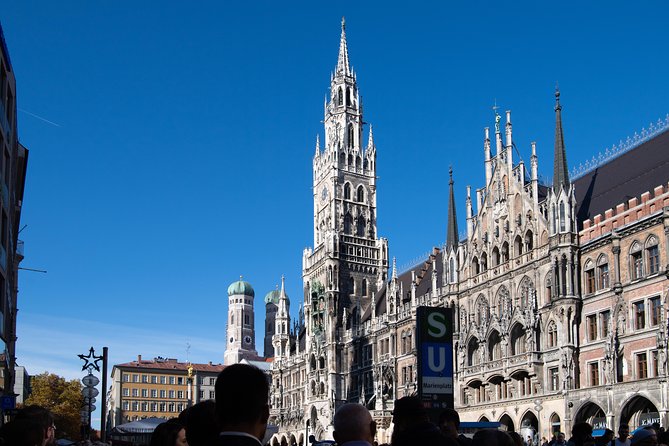
The tour ends at Marienplatz, Munich’s central square, after about 20 minutes there. This is a practical finish. You are left in the city center, with plenty of options for continuing your day.
The final stop can also help bring the subject into the present. Modern Munich exists among ordinary shops, restaurants, public buildings, and busy streets, yet the city has not erased its difficult past. The tour’s closing discussion and memorial references encourage you to think about how Germany remembers and teaches the Nazi era today.
Nick, one guide praised in the feedback, was noted for keeping the tour connected to modern Germany. That is an important quality. A walk about the Third Reich should not leave you with the idea that the story ended in 1945. It should help you consider remembrance, responsibility, and the warning signs of political extremism.
From Marienplatz, you can continue exploring Munich on foot. You are already in the heart of the Old Town, so the tour works well as a morning or afternoon activity paired with other central sights.
What the Guides Add
The guide is the main reason to book this experience. The buildings are accessible on your own, but the meaning behind them is not always obvious. A skilled guide turns a square, beer hall, or civic building into part of a connected story.
The strongest comments praise guides for four things:
- Clear English that is easy to follow outdoors
- Strong command of dates, events, and political context
- Willingness to answer difficult questions
- A careful balance between seriousness and occasional humor
Michael has been praised for sharing a large amount of information while remaining open to questions. Paul was noted for speaking clearly and showing real enthusiasm for the subject. Nicola received praise for balancing explanations with the walking time between stops.
Guide quality can vary from one departure to another, as it does with any scheduled walking tour. Still, the repeated praise across several named guides suggests that Radius Tours has a solid team for this topic. You may not receive the exact guide mentioned in a particular account, so book for the route and format rather than for one specific person.
Some guides use photographs to show how locations looked during the Nazi period. That is a small but useful feature. Present-day Munich has changed, and visual comparisons help you understand what has disappeared, what remains, and how public spaces were used.
Walking Conditions, Group Size, and Comfort
The tour has a maximum group size of 25 people. That is not a private outing, but it is small enough for a guide to gather the group at each stop and take questions. A full group may make it harder to hear or see the guide, especially near busy streets, so stay close when the explanation begins.
You should wear comfortable shoes. The route covers central Munich on foot, and the tour description makes clear that it is entirely outdoors. A cold-weather review specifically advises dressing warmly, while another account describes a bitterly cold day. Munich weather can change, so a coat, rain protection, and water are sensible choices depending on the season.
The guide may be able to include a short comfort break if the group agrees. One group voted for a bathroom and coffee pause halfway through. Do not treat that as a guaranteed scheduled stop, but it shows that the pace can sometimes respond to the group’s needs.
Most people can participate, and service animals are allowed. The tour is near public transportation, but the supplied information does not specify the route’s accessibility details or the amount of standing at each stop. If you have mobility concerns, contact the provider before booking.
Is $45.95 a Fair Price?
At $45.95 per person, you are paying for interpretation, not admission tickets. The stops themselves are public places, so you could walk to Königsplatz, Odeonsplatz, Hofbräuhaus, the Old Town Hall, and Marienplatz without buying entry tickets.
The value comes from the guide’s structure and explanation. A solo traveler who wants to understand Munich’s Nazi past may save hours of piecing together disconnected facts. A history student or serious reader may also appreciate seeing the places in person, though the 2.5-hour format will not satisfy someone seeking every detail.
I think the price works best when you schedule the tour early in your Munich visit. It gives you a useful framework for the city and may point you toward related museums or memorials afterward. Several people have enjoyed retracing the route later to take more photographs or think through the sites at their own pace.
If you only want attractive buildings and general city facts, choose a standard Munich city tour instead. This walk is focused, serious, and centered on political history.
Who Should Book This Walking Tour?
I would recommend it to:
- First-time Munich visitors who want historical context
- People interested in World War II and modern European history
- Readers who prefer places and stories over textbook summaries
- Visitors who want to understand how propaganda and public gatherings helped a political movement grow
- Anyone planning to visit additional museums or memorials connected with the Nazi era
You do not need to be a history major. One guide was praised for making the subject interesting and less heavy without weakening its importance. Another was noted for giving enough background without overloading the group.
I would hesitate to recommend it to someone who dislikes walking outside, has limited time for stops, or wants to visit indoor collections. The tour covers a lot in a short period, and one person wished for an outline to review afterward because there was so much to absorb. Bring a small notebook if you want to retain names and dates.
Should You Book the Third Reich Walking Tour?
Yes, if you want a serious and useful introduction to Munich’s role in the Nazi rise. The strongest features are the central walking route, the guide-led explanation at real political sites, the attention to resistance memorials, and the link between public spaces and propaganda.
Book it early in your Munich stay, dress for outdoor conditions, and keep your expectations realistic. You will not see every relevant site or receive a full university course in 150 minutes. You will, however, gain a clear framework for understanding how Hitler and the Nazi Party gained ground in Munich, and you will leave from Marienplatz with the rest of the city at your feet.
Free cancellation is available up to 24 hours before the start time. Cancellations within 24 hours are not refunded, and poor weather or too few bookings can lead to a date change or full refund.
FAQ
How long is the Third Reich Walking Tour Munich?
The tour lasts approximately 2 hours and 30 minutes.
How much does the tour cost?
The listed price is $45.95 per person.
What language is the tour offered in?
The tour is offered in English.
Where does the tour begin?
It begins at Radius Tours, Dachauer Str. 4, 80335 Munich, Germany.
Where does the tour end?
It ends at Marienplatz in central Munich.
How large can the group be?
The tour has a maximum group size of 25 people.
Can I cancel for a full refund?
Yes. You must cancel at least 24 hours before the experience start time for a full refund. Cancellations within 24 hours are not refunded.
Just added around Munich
- Munich: Private or Group Third Reich and WWII Walking Tour★ 4.9 · 13 reviews
- From Munich: Neuschwanstein Castle and Linderhof Private Tour★ 5.0 · 13 reviews
- Private Transfer from Munich to Salzburg with 2 hours for sightseeing★ 4.5 · 13 reviews
- Munich: Historical Walking Tour on the Rise of Hitler★ 5.0 · 13 reviews
- Private Scenic Transfer from Munich to Prague with 4h of Sightseeing★ 5.0 · 13 reviews
- From Munich: VIP day trip to Salzburg★ 5.0 · 14 reviews
- National Socialism WWII with licensed guide – private tour★ 5.0 · 14 reviews
- Munich: Walking Tour Old Town 3D VR Tour in GERMAN★ 4.3 · 14 reviews
Third Reich & WWII Tours, compared.
Berlin’s Best: 2 Hour Walking Tour Third Reich and the Cold War
Read our review →
Third Reich Berlin: Hitler and WWII Walking Tour
Read our review →
Walking Tour of Former Nazi Party Rally Grounds
Read our review →
Berlin Third Reich Sites: Half-Day Walking Tour
Read our review →Browse the lists this tour appears in