
Reviewed · WALKING TOURS
Trier – Private Guided Walking Tour
Trier rewards a good walking tour. This private outing brings the city’s Roman, medieval, and church landmarks into one clear route, with an official guide explaining what you are seeing instead of leaving you to decode old stones alone. I especially like the private format for up to 15 people and the chance to see major sights such as Porta Nigra, the cathedral, and Constantine’s Basilica in about two hours. The main drawback is the non-refundable booking policy, so you need to be sure of your plans.
Guide Andrea receives especially warm praise for making 2,000 years of history understandable and keeping three teenagers interested. You should also expect a brisk pace, since the tour covers a lot of ground and ends at the Imperial Baths. It is a strong choice for a first look at Trier, though anyone wanting long interior visits or a slow museum-style experience may find the schedule tight.
In This Review
- Key points to know before you book
- Why Trier works so well on foot
- Starting at Porta Nigra after 170 AD
- Frankenturm and the medieval market center
- St. Gangolf and the Kornmarkt fountain
- Trier Cathedral, built on Roman foundations
- Constantine’s Basilica and the Roman throne room
- Returning to the Main Market and Saint George’s Fountain
- The Electoral Palace and Imperial Baths finish
- What the two-hour pace feels like
- Guide style and the value of a private group
- Is $369.34 a fair price?
- Who should book this Trier walk?
- Should you book this private Trier tour?
- FAQ
- Where does the Trier walking tour begin?
- Where does the tour end?
- How long does the tour last?
- How many people can join the private tour?
- What language is the tour offered in?
- Is the tour private?
- What is included in the price?
- Are admission tickets included?
- Are refreshments and gratuities included?
- Can I cancel or change the booking?
Key points to know before you book
- Porta Nigra begins the story: You start at Trier’s massive Roman city gate, built from grey sand after 170 AD.
- One route covers many eras: Roman monuments, medieval buildings, Baroque decoration, churches, and market life all appear within two hours.
- A private group changes the feel: Your party alone takes part, with space for up to 15 people.
- Andrea earns high marks: Her approach combines clear historical facts with engaging explanations and stops away from the most obvious path.
- The price works best for groups: At $369.34 per group, the cost is easier to justify when shared by several people.
- The finish is at the Imperial Baths: The tour starts at Porta-Nigra-Platz and ends near the Roman bath complex.
Why Trier works so well on foot
Trier is compact enough for a walking tour, but its story is unusually dense. In a short distance, you move from Roman imperial power to medieval commerce, Catholic and Protestant landmarks, and the grand residence of the Electors of Trier.
I like this route because it gives you a useful framework for the city. Instead of seeing Porta Nigra, the cathedral, and the Electoral Palace as unrelated monuments, you learn how each belongs to a different period of Trier’s development.
The tour lasts about two hours. That is enough time to get oriented and see the main center, but not enough for long, detailed visits inside every building. You will spend much of the time walking, listening, and stopping for explanations.
The private setup is important here. A group of two, six, or 15 gets its own official guide rather than sharing the experience with strangers. The price is $369.34 per group, so a couple pays far more per person than a larger family or group of friends. For a full group of 15, the cost works out to roughly $25 per person, while two people would pay about $185 each.
More Walking Tours in Trier
- Trier: Guided City Walk with Wine Tasting
★ 4.8 · 979 reviews - Trier: Guided Old Town Highlights and History Walking Tour
★ 4.7 · 687 reviews - Trier: City Walking Tour
★ 4.6 · 118 reviews
Starting at Porta Nigra after 170 AD
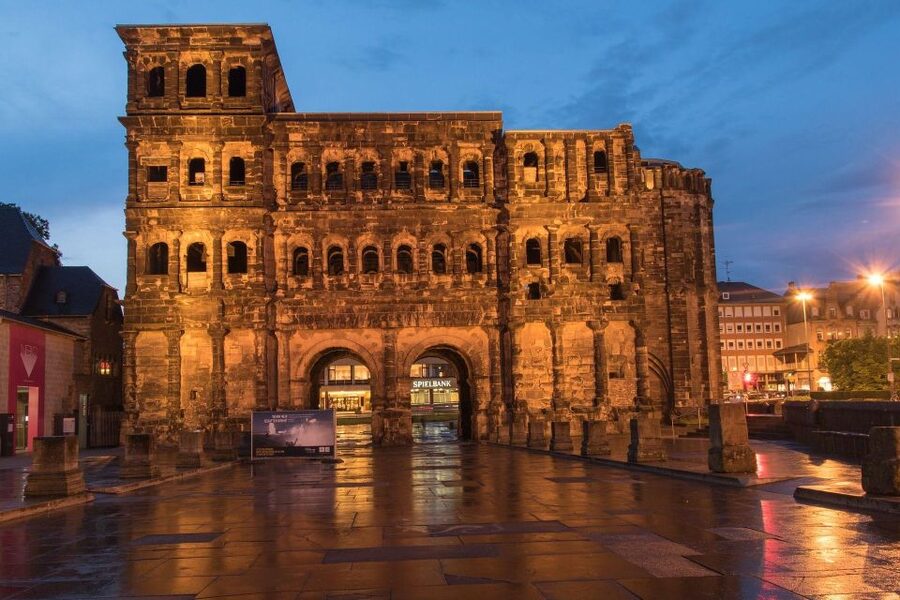
The tour begins at Porta-Nigra-Platz, outside Porta Nigra. This is the right place to start because the gate immediately shows you Trier’s Roman scale.
Porta Nigra is a UNESCO World Heritage Site and the largest city gate from the ancient world. Built with grey sand after 170 AD, it is not a delicate ruin. Its heavy blocks and broad structure make Rome’s presence feel practical and defensive.
Your guide can use the gate to set up the rest of the walk. Trier was not simply a pretty old town. It held serious importance in the Roman period, and the monuments that follow make more sense once you grasp that opening point.
Admission is listed as free for this stop, but the experience is mainly an exterior walking visit. If you hope to spend a long time exploring every part of the gate, ask the guide how much time is available before the tour begins.
Near Porta Nigra, you also pass the Dreikonigenhaus. This distinctive Trier house gives the opening section a more local, urban feel. It is a useful reminder that the city is not only about giant Roman structures. Smaller historic buildings also help explain how Trier changed over time.
Frankenturm and the medieval market center
From Porta Nigra, the route continues to Frankenturm, a fortified brick residential tower from the 11th century. It is a striking contrast to the Roman gate. Instead of imperial construction on a massive public scale, you see a medieval defensive home built for a later and less orderly period.
Frankenturm helps connect Trier’s Roman past with its medieval identity. I find stops like this valuable because they prevent the tour from becoming a parade of famous monuments with no sense of chronology.
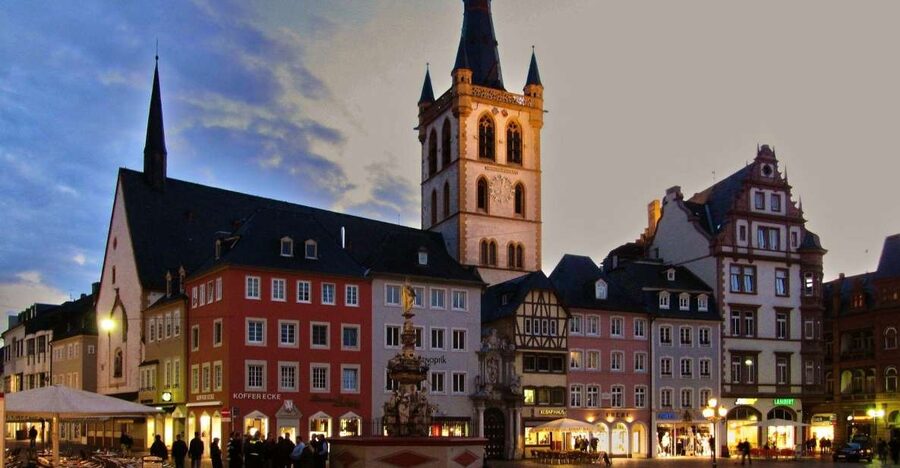
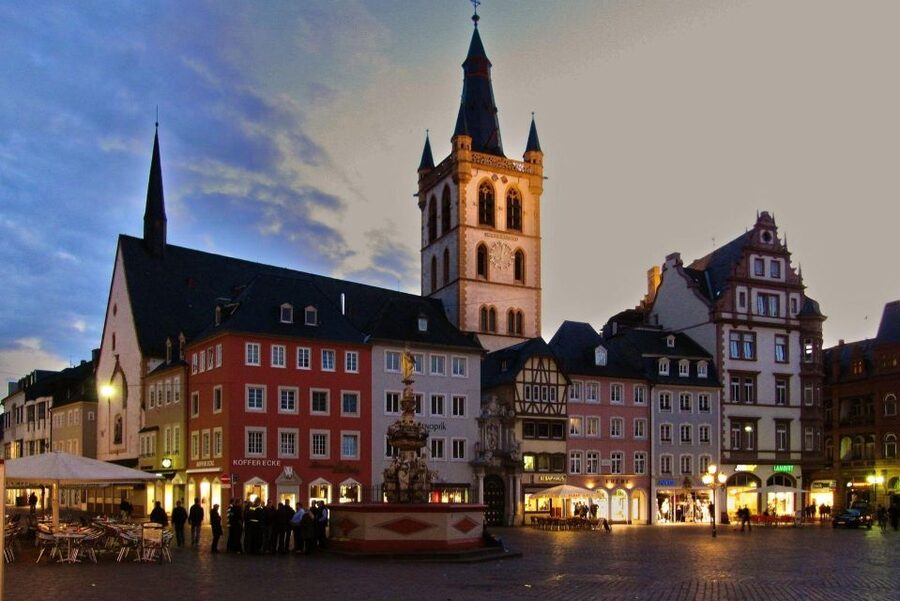
The walk then reaches the Market Cross on the Main Market. This square was known as a medieval trading hub and remains one of the city’s central public spaces. Shops and cafés now fill the area, giving you a chance to see Trier as a living town rather than an open-air history display.
The scheduled time here is short, about 10 minutes. Treat it as a guided orientation rather than a shopping break. You can note cafés and shops for later, but the tour keeps moving.
St. Gangolf and the Kornmarkt fountain
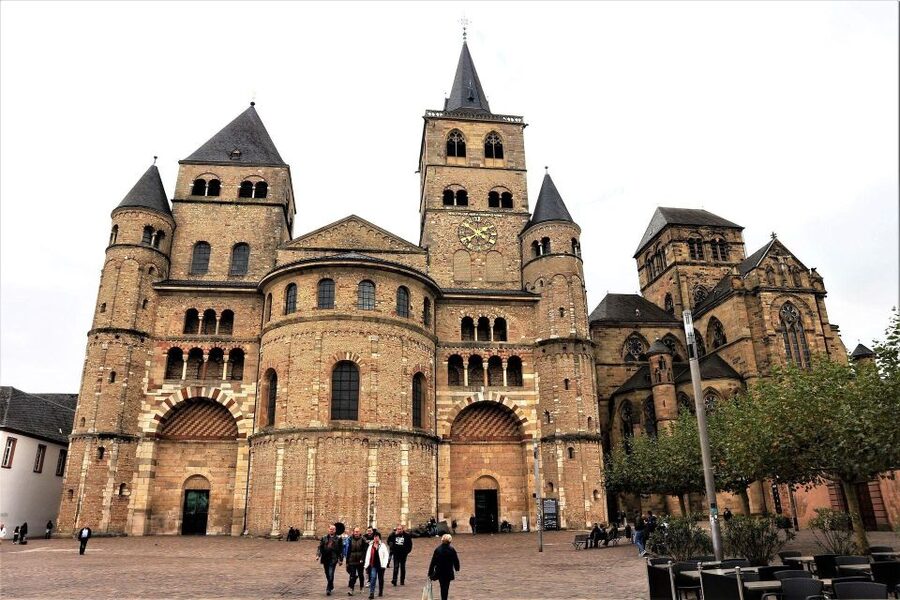
St. Gangolf Kirche is dedicated to St. Gangulphus and is described as the second-oldest church in Trier. Even if you are not focused on church architecture, this stop adds another layer to the city’s long religious story.
The visit is planned for about 15 minutes. That makes it a compact look, not an extended church study. Your guide’s explanation matters here because the building’s significance is easier to appreciate when you understand its place in Trier’s development.
The route also passes Saint George’s Fountain in the Kornmarkt. Built between 1750 and 1751, the fountain was made by the same builder associated with the Electoral Palace. This link gives the fountain more meaning than a quick photo stop. It connects the city’s public decoration with the power and taste of its archbishops and electors.
The fountain stop also breaks up the ancient and religious sights. You get a glimpse of later Trier, when grand civic and courtly design shaped the city center.
Something different for another day:
- Trier: Discovery Tour – Germany’s Oldest Wine Cellar
★ 4.7 · 218 reviews - Trier: Solve the Mystery of the Merchant’s Gold!
★ 4.2 · 61 reviews - Trier: Private Guided Walking Tour
★ 4.2 · 32 reviews - Trier, Moselle: Wine excursion with boat trip
★ 3.9 · 13 reviews
Trier Cathedral, built on Roman foundations
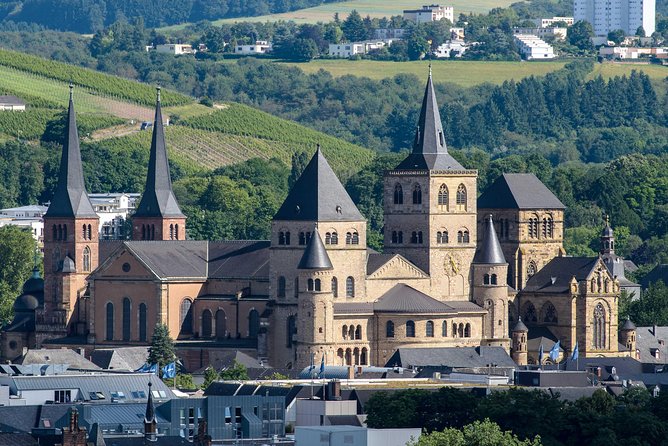
Trier Saint Peter’s Cathedral is one of the tour’s key stops. It is identified as the oldest church in Germany and the city’s largest religious structure, with foundations built using Roman brick in the early fourth century.
That Roman foundation is the important detail. The cathedral is not simply an old church placed in an old city. Its base reaches back to the period when Trier was a major Roman center, so the building links ancient construction with centuries of Christian worship.
The planned stop lasts about 15 minutes. You will receive useful historical context, but the timetable does not suggest a long, quiet interior visit. If the cathedral is your main reason for booking, keep your expectations realistic and consider returning on your own if you want more time.
For a first orientation, the short visit works well. You see how Rome’s building methods continued into later religious architecture, and you begin to understand why Trier has such an unusual concentration of major sites.
Constantine’s Basilica and the Roman throne room
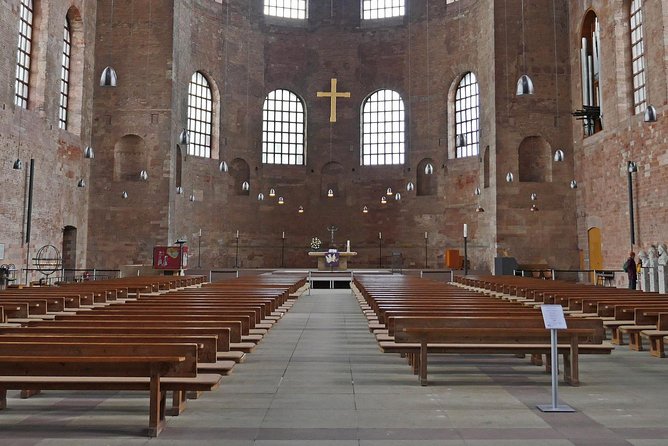
The Konstantin-Basilika, also known as the Evangelical Church of the Redeemer, is perhaps the most dramatic stop after Porta Nigra. Built around 310 AD, it was the throne room of Constantine the Great and later Roman emperors.
The scale is the point. This is the largest throne room described on the route, and its Roman structure remains remarkably clear. The building is now used as a Protestant church, which gives the space a second life and a striking change of purpose.
The inner walls were kept intact even after repairs following World War II. That detail helps you read the building as both an ancient monument and a survivor of modern damage.
The scheduled visit is about 20 minutes. I would want the guide to explain how the vast Roman hall functioned, who used it, and how it became a church. Andrea is praised for making complicated history easy to follow, and this is the sort of stop where that skill matters most.
You should not expect a full archaeological seminar. The value is in seeing the huge room, understanding its imperial role, and placing it in the larger story of Trier.
Returning to the Main Market and Saint George’s Fountain
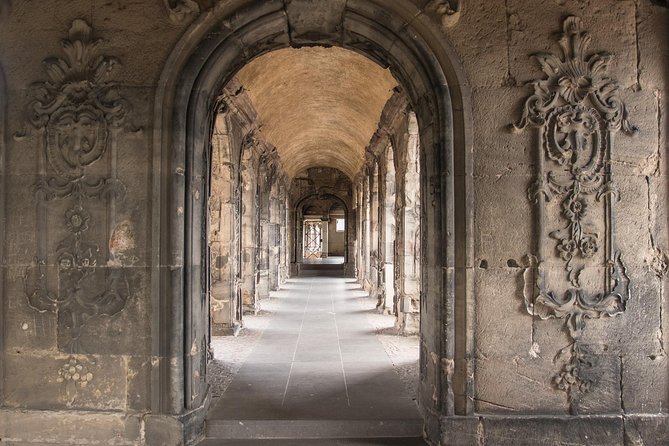
The route includes the Market Cross on the Main Market and Saint George’s Fountain as separate stops. The square appears earlier in the walk, while the fountain is given its own brief look later.
This repeated focus is not a problem, but it does mean the route is more structured than a simple straight line from one monument to the next. The Main Market is worth seeing twice because it works both as a medieval trading center and as a present-day urban square with cafés and shops.
The fountain, in the Kornmarkt, receives about 15 minutes. That gives you enough time for an explanation and photographs, though not necessarily time to sit down for a drink. Refreshments are not included, so plan to buy anything you want separately.
The route’s moving pace suits people who want a broad introduction. It may feel fast if you stop often for photographs or if someone in your group walks slowly.
The Electoral Palace and Imperial Baths finish
The walk continues to the Electoral Palace, the 16th-century residence of the Archbishops and Electors of Trier. Its role is different from the Roman sites and the churches. Here, the focus shifts to the political and religious rulers who shaped Trier centuries after the Roman period.
The palace helps explain why Trier’s center contains such a mix of monumental buildings. Power changed hands, but each era left its mark. The tour does not treat the city as a single-period attraction.
The final major destination is the large Roman Bath complex, constructed in the fourth century AD. The tour ends at the Imperial Baths, close to 54290 Trier. Ending here is practical because you finish with another major Roman site and can decide what to explore next.
The palace and bath section receives about 15 minutes in the schedule. Again, that is a guided overview rather than a long independent visit. If you want to study the baths carefully, you may need extra time after the tour, but the provided information does not specify admission arrangements for a separate visit.
What the two-hour pace feels like
The strongest feature of this experience is also its main limitation: it covers a lot. In roughly two hours, you see Porta Nigra, Frankenturm, St. Gangolf, the cathedral, Constantine’s Basilica, the Main Market, Saint George’s Fountain, the Electoral Palace, and the Imperial Baths.
That gives you a strong map of central Trier. You can decide later which building deserves more of your time. The route is especially helpful if you have only a short stay or want historical context before exploring independently.
The schedule adds up to more than two hours if each listed stop is counted literally, so the timing should be treated as approximate. Walking between sites takes part of the experience, and some stops may be brief passes rather than full visits.
I would wear comfortable shoes and keep your group ready to move. The tour is described as suitable for most people and near public transportation, but the supplied details do not specify a vehicle, hotel pickup, or special mobility arrangements.
Guide style and the value of a private group
The guide can make or break a history-heavy walk. Andrea receives particularly strong praise for being engaging, explaining architecture clearly, and fitting 2,000 years of history into two hours without losing the interest of three teenagers.
That detail matters if you are traveling with children or teens. The route has plenty of impressive buildings, but facts alone can blur together. A guide who connects Roman walls, medieval towers, churches, fountains, and palaces gives each stop a reason to matter.
The private format also lets your group keep its own rhythm. You are not joining a mixed crowd, and only your group participates. The maximum is 15 people, which is generous for a private booking. A large group should still stay close to the guide in busy parts of the center.
The tour is offered in English and includes an official tour guide and private guided service. Gratuities and refreshments are not included, so budget for those separately if you choose to add them.
Is $369.34 a fair price?
The price is high for a two-hour walk if you are booking for only one or two people. It becomes more reasonable as your group grows, since the $369.34 charge covers up to 15 people rather than charging each person separately.
For a family or group of friends, the value comes from the private attention and the amount of ground covered. You get a planned route, an English-speaking guide, and historical interpretation at major sites without joining strangers.
For a couple, I would compare this cost with a small-group or standard city tour. The private setting may still be worth it if you want your own guide and flexible interaction, but the per-person price is much steeper.
The experience has a 4.7 rating from six ratings, with four-star and five-star scores shown. The most consistent praise focuses on the guide’s clear historical explanations, engaging manner, efficient route, and ability to keep younger people interested.
Who should book this Trier walk?
I would recommend it to first-time visitors who want a strong introduction to Trier in a short period. It is also well suited to families, private groups, and anyone who prefers to ask questions without sharing a guide with strangers.
It works particularly well for:
- Groups splitting the cost among several people
- Visitors with only a few hours in Trier
- Families with teenagers
- History fans who want Roman and medieval sights in one route
- People who prefer a guide to provide context at each monument
I would be more cautious if you want extensive interior access, lots of free time, or a relaxed café-and-photography walk. The tour keeps moving, and the non-refundable policy means you should book only when your schedule is firm.
Should you book this private Trier tour?
Book it if you want an efficient, private introduction to Trier and your group can share the cost. The route delivers the city’s biggest historical themes, from Porta Nigra and the Imperial Baths to Constantine’s throne room, while Andrea’s praised teaching style adds real value.
Skip it if you are traveling alone or as a couple on a tight budget, or if you prefer to explore each building at your own pace. For everyone else, this is a practical way to get your bearings fast, understand what makes Trier special, and choose where to spend more time afterward.
FAQ
Where does the Trier walking tour begin?
The tour begins at Porta-Nigra-Platz, 54290 Trier, Germany.
Where does the tour end?
The walking tour ends at the Imperial Baths in Trier, near 54290 Trier, Germany.
How long does the tour last?
The tour lasts approximately two hours. Two tour lengths are available based on personal preference, but the specific lengths are not provided.
How many people can join the private tour?
The private experience can include up to 15 people in your group.
What language is the tour offered in?
The tour is offered in English.
Is the tour private?
Yes. Only your group participates in the private guided activity.
What is included in the price?
The price includes an official tour guide and a private guided tour.
Are admission tickets included?
The listed itinerary stops show free admission tickets. The provided details do not specify separate admission arrangements for any additional visits after the tour.
Are refreshments and gratuities included?
No. Gratuities and refreshments are not included.
Can I cancel or change the booking?
No. The experience is non-refundable and cannot be changed for any reason. The booking confirmation is received at the time of booking.
Just added around Trier
- Trier Private Walking Tour With A Professional Guide★ 5.0 · 4 reviews
- Trier: Express City Walking Tour with Local Guide★ 5.0 · 5 reviews
- Trier: Private Walking Tour with a Local Guide★ 5.0 · 5 reviews
- Trier: early morning tour without the hustle and bustle and with less noise★ 5.0 · 6 reviews
- Luxembourg to Trier: Tour of Germany’s Oldest City.★ 4.6 · 9 reviews
- Trier Self Guided Sherlock Holmes Murder Mystery Game★ 4.0 · 9 reviews
- For the love of Riesling – Mosel Wine tour★ 5.0 · 11 reviews
- Trier: Your Adventure Awaits – The Return of the Elector★ 4.0 · 12 reviews
Walking Tours, compared.





Berlin’s Best: 2 Hour Walking Tour Third Reich and the Cold War
Read our review →


Third Reich Berlin: Hitler and WWII Walking Tour
Read our review →Browse the lists this tour appears in