
Reviewed · THIRD REICH & WWII TOURS
Munich City Walking Tour, includes Third Reich & Viktualienmarkt
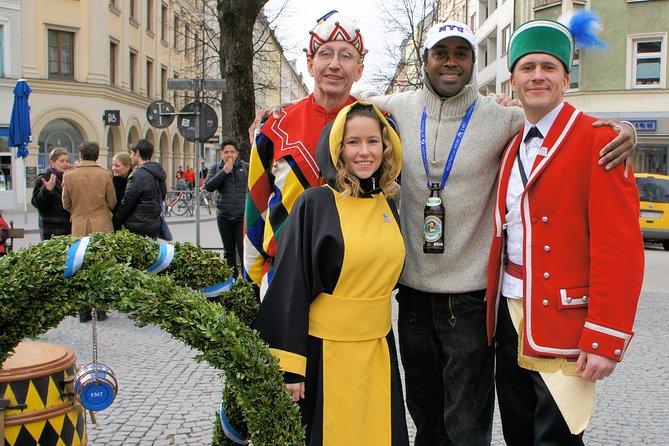
Munich reveals itself on foot. This 3-hour-15-minute walk links grand churches, medieval gates, royal squares, Nazi-era history, and the food stalls of Viktualienmarkt, giving you a useful first look at the city rather than a quick parade of postcard views. I especially like the practical city tips and the mid-tour stop for Bavarian sausage, potato salad, pretzel, and beer. The strongest praise goes to guides Ozzie and Patrick, with Ozzie repeatedly singled out for his humor, personal touch, and ability to connect Munich’s past with present-day life.
The tour costs $31.78 per person, which is fair for a long, small-group introduction with a maximum of 20 people. I also like that it covers the Third Reich in a serious, thoughtful way instead of treating Munich as only beer halls and palaces. The main caution is pace: several people found the explanations long, and you may spend a lot of time standing outdoors. In cold or snowy weather, that matters.
In This Review
- Key points at a glance
- Why This Tour Works Best on Your First Day
- Frauenkirche and the Shape of Munich
- Hofbräuhaus, Isartor, and Munich’s Medieval Edge
- Marienplatz and the City’s Public Stage
- Royal Munich, Bavarian Politics, and a Local Fountain
- St. Michael and St. Peter: Two Very Different Churches
- Odeonsplatz and Karlsplatz Put Munich in Perspective
- The Viktualienmarkt Break Is More Than a Snack
- What the Guides Add to the Walk
- Price, Weather, and Who Will Enjoy It
- Should You Book the Munich Walking Tour?
- FAQ
- How long is the Munich walking tour?
- What language is the tour offered in?
- What is the price?
- What food is available during the break?
- Is lunch included in the tour price?
- Where does the tour start?
- Where does the tour end?
- How large is the group?
- Can I cancel the booking?
Key points at a glance
- A useful first-day tour: You get orientation, transport advice, food suggestions, and a working sense of central Munich.
- History beyond the pretty buildings: The route includes Munich’s royal past, church architecture, Bavarian identity, and discussion of the Third Reich.
- A proper Bavarian pause: Viktualienmarkt provides a mid-tour break with sausage or potato salad, a pretzel, and Bavarian beer available from the market setting.
- A guide-led experience: Ozzie receives especially high praise for lively explanations, current affairs, and warm group management. Patrick is also named positively.
- Mostly outdoor sightseeing: Wear good shoes and dress for the forecast. The tour can feel chilly when the guide is speaking at length outside.
- A compact central route: The walk visits Frauenkirche, Marienplatz, Hofbräuhaus, St. Peter’s, Odeonsplatz, Karlsplatz, and other central landmarks.
Why This Tour Works Best on Your First Day
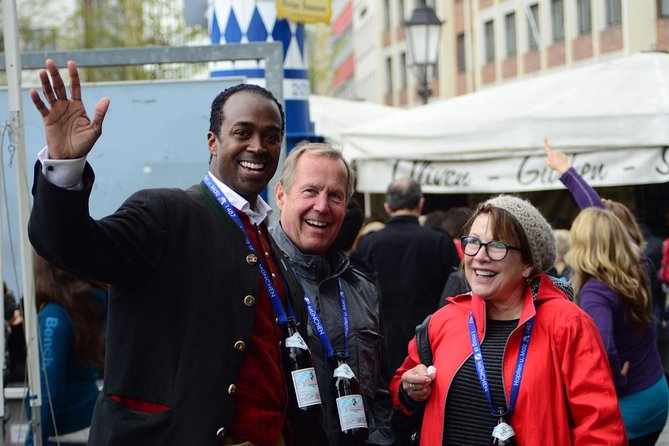
I would place this walk near the beginning of a Munich stay. It gives you a mental map of the center and helps you decide what deserves a longer visit later. The guides explain how to get around Munich, how to approach other sights, and how to save money when visiting additional attractions.
That practical layer is what lifts the tour above a basic sightseeing stroll. You are not only looking at a church facade. You are learning how Munich fits together, where the major squares sit, and how Bavarian customs connect to the city’s public life.
The format is social without being huge. With no more than 20 people, you have a reasonable chance to hear the guide and meet other people. It is still large enough to feel like a group outing, so anyone wanting a quiet private tour should choose something else.
The tour is offered in English. Confirmation arrives when you book, and most people can take part. The meeting point is Schützenstrasse 11, near public transportation, and the listed end point is Odeonsplatz, at Odeonsplatz 3. The route description also includes Karlsplatz and Viktualienmarkt, so check the exact day’s route and ending point with the guide if timing matters.
More City Tours in Munich
- Munich: Old Town & Viktualienmarkt City Walk in German
★ 4.7 · 2,304 reviews - Munich: City Bus Tour & FC Bayern Munich Allianz Arena Tour
★ 4.5 · 2,071 reviews - Munich City Hop-on Hop-off Tour
★ 3.5 · 1,233 reviews
Frauenkirche and the Shape of Munich
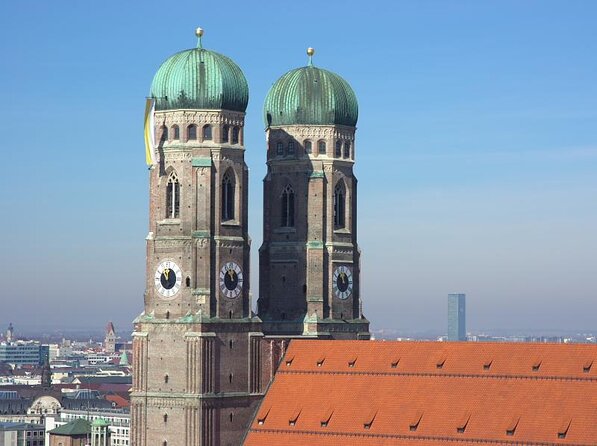
The Frauenkirche is a strong opening sight. Its twin towers define Munich’s skyline, and the late Gothic building dates from the 15th century. The church serves as the seat of the Archbishop of Munich and Freising, so it is both a city symbol and a working religious center.
Inside, you may hear about the historic crypt and the famous Devil’s Footstep, a local legend tied to the cathedral floor. The scheduled look here is brief, about 10 minutes, so think of it as an introduction rather than a full church visit.
That short stop is useful because the guide can explain what you are seeing before you return on your own. If church interiors matter to you, save time later for a longer visit.
Nearby, the German Hunting and Fishing Museum occupies a former Augustinian church. Its displays cover German hunting and fishing traditions across about 3,000 square meters, with stuffed wildlife, old weapons, and Bavarian Wolpertinger creatures. The museum is an unusual contrast to the grand churches and royal squares, though the tour does not list a separate admission visit or a fixed time inside.
Hofbräuhaus, Isartor, and Munich’s Medieval Edge
The Hofbräuhaus brings the beer culture into focus. Founded in 1589 as a royal brewery, it now operates as one of Munich’s best-known beer halls, with house-brewed Bavarian beer, traditional food, grand rooms, and live music.
The scheduled stop is only about 10 minutes and admission is free. Do not expect a long meal here. The value is in understanding why beer halls are part of Munich’s social identity, then returning later if you want the full dining experience.
Isartor offers a different piece of the city. Built in 1337, it is one of Munich’s remaining medieval gates and once formed part of the old fortifications. Its central tower and historic frescoes show how much older Munich is than its polished shopping streets suggest.
The gate also houses the Valentin-Karlstadt Museum, dedicated to Bavarian comedian Karl Valentin. The stop lasts about five minutes, so the museum is more of a pointer for a later visit than a full tour.
Marienplatz and the City’s Public Stage
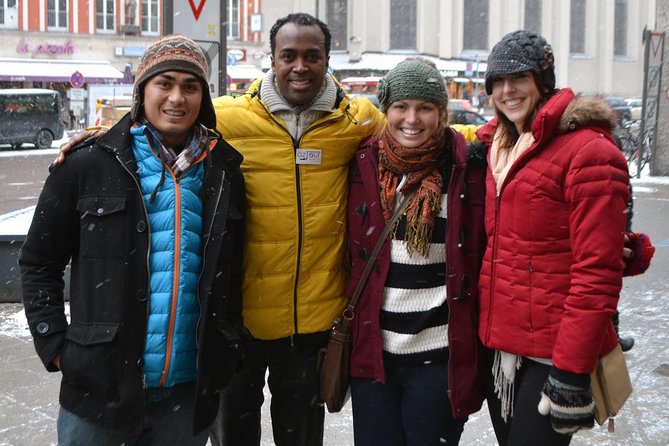
Marienplatz has been Munich’s central square since 1158. This is where the city’s power, commerce, celebrations, and daily movement meet. The New Town Hall and its Glockenspiel draw the biggest attention, while the Mariensäule adds another historic marker to the square.
The planned 25-minute stop gives the guide room to explain the buildings and the square’s role. You will also be close to shopping streets and other central sights, making this one of the most useful places to revisit after the walk.
The square can feel crowded, especially around the New Town Hall. That is not a fault of the tour, but it does mean you should keep close to the guide and listen carefully. A good explanation can be harder to follow when the city is noisy.
From there, the route touches Max-Joseph-Platz, home to the National Theatre and the Munich Residenz. The neoclassical setting and statue of King Maximilian Joseph introduce Munich’s royal and cultural side. The stop is only five minutes, so you get context rather than a palace visit.
More Third Reich & WWII Tours in Munich
- Munich: Third Reich & WWII Walking Tour
★ 4.6 · 6,181 reviews - Third Reich Walking Tour Munich
★ 4.5 · 4,291 reviews - Munich: Birthplace of the Third Reich Guided Walking Tour
★ 4.6 · 771 reviews - Munich World War II Sites Including Dachau Concentration Camp
★ 4.5 · 570 reviews
Royal Munich, Bavarian Politics, and a Local Fountain
The Maximilianeum rises above the Isar River and looks like a palace. King Maximilian II founded it in 1852 to support gifted students. Since 1949, it has housed the Bavarian State Parliament.
That detail helps explain Munich as more than a tourist center. The city has long been tied to royal government, education, and Bavarian political identity. You will see the building from the outside during the walk, with the guide supplying the meaning behind its grand appearance.
Platzl adds another dose of old Munich. Cobblestones, traditional buildings, restaurants, and the Hofbräuhaus give this small square a strong Bavarian feel. The ornate Orlandohaus is another detail to notice. It is a compact stop, but a good one for understanding how old-city streets and modern dining now share the same space.
At Wolfsbrunnen, look for the Art Nouveau design from 1904. Sculptors Heinrich Düll and Georg Pezold created the fountain with a bronze Little Red Riding Hood and wolf. The Wolf family commissioned it as a tribute to their name. It is the kind of small urban detail you could easily miss without someone pointing it out.
St. Michael and St. Peter: Two Very Different Churches
St. Michael’s Church is Munich’s largest Renaissance church. Built in the late 16th century for the Jesuit order, it has a powerful facade and a vast barrel-vaulted ceiling with early Baroque influence.
The church also contains a royal crypt connected with Bavarian rulers. The scheduled stop is about 10 minutes, enough to see the scale and hear the basic story, but not enough for a slow architectural study.
St. Peter’s Church, known locally as Alter Peter, is Munich’s oldest parish church and dates back to the 12th century. Its interior combines Gothic, Baroque, and Rococo features. The 91-meter tower is known for city views, but tower access is not included in this walking tour.
The stop is listed at only five minutes. If you want to climb the tower, plan a separate visit and do not assume the group will wait. The church is still worthwhile from the outside and gives you a clear contrast with St. Michael’s later design.
Odeonsplatz and Karlsplatz Put Munich in Perspective
Odeonsplatz is one of the city’s grandest squares. Leo von Klenze designed it in the early 19th century with Italian-inspired architecture in mind. The Theatine Church, Feldherrnhalle, and Residenz frame the space, while Ludwigstrasse begins here.
The 15-minute stop is one of the most important for understanding Munich’s political story. The area connects royal ambition, public ceremony, architecture, and the difficult events of the 20th century. The Third Reich portion is handled as part of the broader city history, and the guide’s job is to give context rather than reduce the subject to a quick photo stop.
That approach is a strong point, especially for anyone who wants to understand how Munich’s past still affects Germany today. At the same time, if your main goal is a detailed Third Reich tour, ask how much time will be devoted to that subject. Some people felt the tour offered less Third Reich coverage than the title suggested.
Karlsplatz, or Stachus, brings you back to a lively modern square. It developed after Munich’s medieval walls were removed in the 18th century. The Karlstor gate remains, while the square has a fountain in summer and an ice rink in winter.
The 15-minute stop helps connect old fortifications with present-day city life. It is also a useful orientation point if you are exploring Munich independently afterward.
The Viktualienmarkt Break Is More Than a Snack

Viktualienmarkt is the tour’s most hands-on moment. This open-air market began as a farmers’ market in the early 19th century and now sells produce, Bavarian specialties, and handmade goods around a beer garden and traditional maypole.
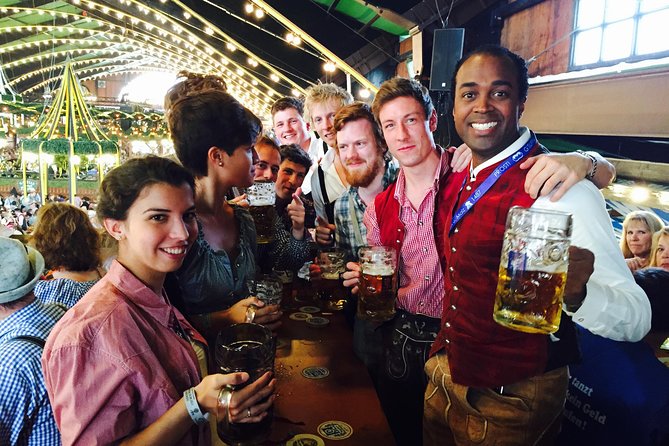
The group pauses here for about 30 minutes. The sample food is a Bavarian bratwurst, with options such as spicy, cheese, or regular, or Bavarian potato salad with a pretzel. A Bavarian beer is also part of the suggested meal, along with a reusable beer bottle holder.
Pay close attention to the wording around food. The guided walk is included, but snacks and lunch are not included in the stated price. You should budget extra for the market food and drink rather than assume the $31.78 covers the meal.
This break is valuable because it lets you experience Bavarian food culture in a working market instead of only hearing about it. One useful tip from the guide experience is the bratwurst sandwich stop. If you enjoy it, you may want to return later for another meal.
What the Guides Add to the Walk
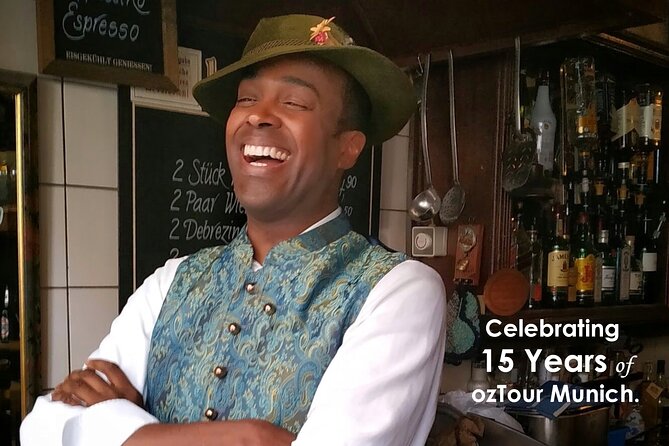
Ozzie is the guide most often praised by name. His style combines city orientation, historical storytelling, humor, and discussion of current German affairs. He is also described as giving advice on how to interact with Munich and how to plan visits to other attractions.
That range appeals to people who want more than dates and architectural labels. You might hear about Bavarian identity, the meaning of Munich’s white and blue colors, city planning, and the idea of Reich in a wider European context.
Ozzie also seems to pay attention to group comfort. Reports describe bathroom breaks and efforts to find shelter when the weather turns harsh. Patrick is also named as an engaging guide, so the exact tone may vary by departure.
The one consistent caution is talk time. Some people loved the detailed explanations, while others wanted more walking and fewer long talks. If you learn best through stories and discussion, that is a plus. If you prefer rapid movement and many interior visits, the tour may feel slow.
Price, Weather, and Who Will Enjoy It
At $31.78, the tour offers solid value if you use it as a city orientation session. You cover a large number of important places, receive local advice, and get a guided explanation of Munich’s difficult and proud chapters. It is not cheap compared with a free walk, but the smaller group and extended duration make the price reasonable.
The rating is 4.9 from 459 reviews, and 98 percent of customers recommend it. Those figures suggest a strong experience, but the lower ratings reveal the main risk clearly: cold weather, lengthy talks, and uncertainty about how much ground you cover.
Wear warm layers in winter. The tour is mainly outside, and one person found standing in freezing, snowy weather uncomfortable. Good walking shoes are sensible, though the pace is described as calm rather than strenuous.
This walk suits first-time visitors, solo travelers, couples, families with older children, and anyone who wants history tied to daily city life. It is less suitable for visitors seeking a museum-heavy tour, a private experience, or a tightly focused Third Reich itinerary.
You can cancel for a full refund up to 24 hours before the start time. Service animals are allowed, and the tour is near public transportation.
Should You Book the Munich Walking Tour?
Book it if you want a strong first look at Munich, especially with practical advice woven into the history. Ozzie’s warm, funny approach receives exceptional praise, and the route gives you a useful mix of churches, squares, gates, royal buildings, political history, and food.
Book something else, or ask questions first, if you want a detailed Third Reich study, frequent indoor stops, or very little standing. For most visitors, the best plan is to take this early in your stay, wear weather-ready clothing, bring money for the Viktualienmarkt break, and keep an afternoon free to revisit the places that catch your eye.
FAQ
How long is the Munich walking tour?
The tour lasts approximately 3 hours and 15 minutes.
What language is the tour offered in?
The tour is offered in English.
What is the price?
The listed price is $31.78 per person.
What food is available during the break?
The sample menu includes one Bavarian bratwurst, or Bavarian potato salad with a pretzel, plus one Bavarian beer and a reusable beer bottle holder.
Is lunch included in the tour price?
The guided tour is included, but snacks are listed as not included. You should plan to pay separately for food and drink at Viktualienmarkt.
Where does the tour start?
The meeting point is Schützenstrasse 11, 80335 Munich, Germany.
Where does the tour end?
The listed end point is Odeonsplatz, Odeonsplatz 3, 80539 Munich, Germany.
How large is the group?
The tour has a maximum of 20 participants.
Can I cancel the booking?
You can cancel at least 24 hours before the start time for a full refund. Cancellations or changes made less than 24 hours before the start time are not accepted.
More Walking Tours in Munich
- Munich: Night Watchman Walking Tour
★ 4.7 · 2,092 reviews - Munich Ghosts and Spirits Evening Walking Tour
★ 5.0 · 1,900 reviews - Munich Old Town Walking Tour
★ 4.5 · 1,287 reviews - Munich: Walking Tour Old Town and Viktualienmarkt
★ 4.7 · 839 reviews
Just added around Munich
- From Munich: VIP day trip to Salzburg★ 5.0 · 14 reviews
- National Socialism WWII with licensed guide – private tour★ 5.0 · 14 reviews
- Munich: Walking Tour Old Town 3D VR Tour in GERMAN★ 4.3 · 14 reviews
- Private Tour to Neuschwanstein & Linderhof, Skip The Line & Lunch★ 5.0 · 14 reviews
- Munich: Romantic Wine Experience for Two at Viktualienmarkt★ 4.2 · 14 reviews
- City Bike and English Garden Tour★ 4.0 · 14 reviews
- Munich: Food Tour Beer- 3 small beers & “Brotzeit” in GERMAN★ 4.5 · 14 reviews
- Private Munich Bike Tour: Flexible Times & Beer Garden Stop★ 5.0 · 15 reviews
Third Reich & WWII Tours, compared.
Berlin’s Best: 2 Hour Walking Tour Third Reich and the Cold War
Read our review →
Third Reich Berlin: Hitler and WWII Walking Tour
Read our review →
Walking Tour of Former Nazi Party Rally Grounds
Read our review →
Browse the lists this tour appears in