
Reviewed · WALKING TOURS
Walking tour Nuremberg
Nuremberg rewards slow walking. This 2.5-hour English tour links the old town’s best sights with stories about trade, religion, art, war, and rebuilding. I like the native guides, especially Daniella, Andreas, Alexandra, and Tom, who bring personal warmth and local detail. I also like the practical advice for food, drinks, photos, and the rest of your stay. The main drawback is the steep walk to the castle, which can be hard on knees or tiring legs.
At $3.63 per person, this is priced like a bargain introduction to Nuremberg. It is essentially a free walking tour supported by tips, so you should plan to reward your guide if the experience serves you well. Groups can reach 50 people, and that is large enough to affect how easily you hear every story.
In This Review
- Key points at a glance
- Why this walking tour works well in Nuremberg
- Starting beneath the Schöner Brunnen
- St. Sebaldus Church and the city’s religious story
- The Hauptmarkt, Frauenkirche, and Männleinslaufen
- The climb to Kaiserburg Nürnberg
- Albrecht Dürer House and the medieval artists’ quarter
- Tiergärtnertorturm and one of Nuremberg’s prettiest squares
- Weissgerbergasse and the hard story of reconstruction
- More of the old town beyond the main sights
- Guides, group size, and the feel of the experience
- Price, timing, and who gets the best value
- Should you book the Nuremberg walking tour?
- FAQ
- How long is the Nuremberg walking tour?
- What time and where does the tour begin?
- Is the tour conducted in English?
- Does the tour include admission tickets?
- Is the walk suitable for people with mobility issues?
- How many people can join the tour?
Key points at a glance
- A local route through medieval Nuremberg: See the Hauptmarkt, St. Sebaldus Church, Imperial Castle, Dürer House, Weissgerbergasse, and more.
- Guides with real local feeling: English-speaking guides are born and raised in Nuremberg, with Daniella, Andreas, Alexandra, Tom, and Dennis singled out for warmth, humor, and strong storytelling.
- The castle climb is the workout: The route includes steep hills, cobblestones, and steps or slopes that may trouble anyone with limited mobility.
- More than pretty buildings: Expect discussion of the city’s Golden Age, the Reformation, Albrecht Dürer, World War II destruction, and postwar reconstruction.
- Good orientation for a first day: The guide handles navigation and adds recommendations you can use after the walk.
- Low-cost, high-value format: The tour lasts about two and a half hours, begins at 11:30 a.m., and does not require admission tickets at the listed stops.
Why this walking tour works well in Nuremberg
Nuremberg’s old town is compact enough to explore on foot, but its story is not simple. A handsome church may lead into the Reformation. A market square may point to imperial ceremony, trade, and a famous mechanical clock. A picturesque street may also carry the story of wartime destruction and careful rebuilding.
That is where a guide earns the tip. I like this experience because it gives you a framework before you wander on your own. You do not need to keep checking a map, and you are less likely to walk past an important building without understanding why it matters.
The focus is not limited to medieval architecture. The guides cover Nuremberg’s economic peak, its craftsmen and merchants, religious change, music, art, Nazi-era history, World War II, and the city’s recovery afterward. That range makes the tour useful for a first visit, especially if you want more than a collection of attractive façades.
The tone also seems well judged. Andreas is praised for dry humor and careful treatment of serious subjects. Alexandra mixes facts, personal insight, and warmth. Daniella is noted for pacing the group and allowing breaks. Dennis uses pictures to help explain the city. Those details matter because Nuremberg’s past includes painful material that deserves more care than a string of sensational anecdotes.
More Walking Tours in Nuremberg
- Bamberg: Guided Walking Tour
★ 4.6 · 3,202 reviews - Nuremberg: Old Town Guided Walking Tour
★ 4.6 · 2,416 reviews - Nuremberg: Walking Tour of Former Nazi Party Rally Grounds
★ 4.7 · 1,665 reviews
Starting beneath the Schöner Brunnen
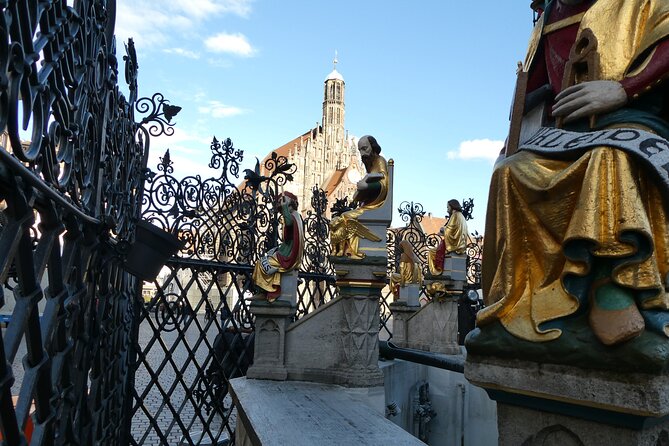
Meet at the Schöner Brunnen in the Hauptmarkt at 11:30 a.m. The fountain is an excellent starting point because it gives you an immediate look at Nuremberg’s Gothic style and one of the city’s best-known legends.
The meeting point is central, easy to recognize, and close to public transportation. The fountain itself is free to view, so you begin with the city’s character rather than a ticket queue.
Your guide uses the fountain to introduce the late medieval city and its ambitions. Allow about ten minutes here, though the real value comes from the explanation around the monument. Without context, it is simply an ornate structure. With context, it becomes an entry point into Nuremberg’s civic pride and old legends.
The Hauptmarkt is also useful for orientation. You are in the heart of the old town, and the route from here moves through major landmarks rather than sending you across distant parts of the city.
St. Sebaldus Church and the city’s religious story
St. Sebaldus Church is described as Nuremberg’s most important church, a Romanesque-Gothic building with a long connection to the city. The stop lasts about ten minutes and is free.
I appreciate that religion is treated as part of the city’s working story, not as a separate subject for specialists. Here, the guide connects the church with the Reformation and with Nuremberg’s best-known musicians. That gives you a better sense of how faith, public life, and culture overlapped.
The short stop means you should not expect a full interior tour or a detailed architectural lecture. Instead, you get the main points while standing in the old town. If you want more time inside the church, you will need to return later on your own.
This is also a good example of the tour’s overall method. You get a quick look at a major sight, then move on with enough background to recognize its place in the city’s story.
The Hauptmarkt, Frauenkirche, and Männleinslaufen
The Hauptmarkt deserves its own attention even though it is also the starting area. It is Nuremberg’s central old-town square and the setting for several important sights, including the Frauenkirche and the Schöner Brunnen.
The guide points out the Männleinslaufen, a famous mechanical display associated with the church. Timing may matter if you want to see the figures in motion, but no exact performance time is supplied, so I would not plan your entire day around catching it during the tour.
This stop can feel busy, particularly with a group of up to 50 people. Stay close enough to hear, and do not be surprised if the guide pauses at the edge of the square rather than directly beside every detail.
The value here is scale. From one open space, you see how medieval civic, religious, and commercial life came together. It also gives you a useful reference point for returning later to shop, eat, or photograph the square at a quieter moment.
Something different for another day:
- Nuremberg: City Tour with the Bimmelbahn Train
★ 4.4 · 2,475 reviews - Nuremberg: Tunnels and Secret Passages in the City Wall Tour
★ 4.8 · 2,334 reviews - Nuremberg: Medieval Dungeons Guided Tour
★ 4.8 · 1,726 reviews - Medieval Tour in Nuremberg in Spanish
★ 5.0 · 1,374 reviews
The climb to Kaiserburg Nürnberg
The route then heads uphill toward Kaiserburg Nürnberg, the city’s landmark. The castle complex is known as a triple castle, made up of the Imperial Castle, the Burggrafenburg, and the imperial city buildings.
This is the part to prepare for. Several people specifically point out the steep climb, cobblestones, and uneven ground. The distance is not described as long, but the slope can be strenuous. Wear supportive shoes, keep water handy, and tell yourself that the view is your reward.
The guides seem to handle the climb with care. Daniella is praised for slowing the pace and taking breaks, while Andreas is noted for being patient with people managing the hills at different speeds. Still, a considerate guide cannot remove the physical demands of the route.
A 10 to 15 minute pause at the castle may give you time for photos or a drink. That break is practical, not wasted time. It lets the group catch its breath and gives you a moment to enjoy the city from above.
The tour does not state that admission to the castle interiors is included. The listed stops have free admission, so treat this as an exterior visit and guided introduction unless your booking information says otherwise. If you want museum rooms or interior exhibits, plan a separate visit.
Albrecht Dürer House and the medieval artists’ quarter
The Albrecht Dürer House is a medieval home built around 1420. After modernization by Bernhard Walther, it became Albrecht Dürer’s home and workplace from 1509 until his death in 1528.
The stop lasts about ten minutes. That is enough for a strong introduction to Dürer, Nuremberg’s most famous son, but not enough for a full museum visit. I would use the tour to decide if you want to return and spend more time inside.
Alexandra receives particular praise for her enthusiasm about Dürer and the arts. Her approach may help if the artist is new to you. Instead of treating him as a name on a plaque, the guide places him within Nuremberg’s commercial and creative life.
The house also adds a human scale to the walk. After seeing churches, squares, and a castle, you encounter the place connected with one person’s daily work. That shift makes the old town feel less like a preserved backdrop and more like a place where people lived and made things.
Tiergärtnertorturm and one of Nuremberg’s prettiest squares
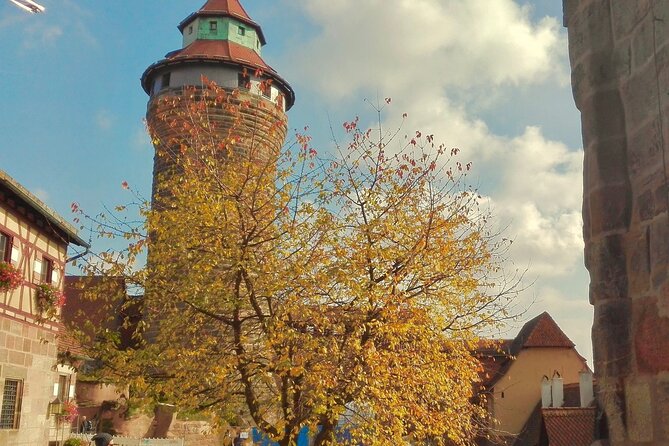
Tiergärtnertorturm is a defensive tower from the 14th century, rising above one of the old town’s most attractive squares. The stop takes about ten minutes.
This is a fine place for photographs, but the guide’s explanation gives the scene more weight. The tower shows how defense shaped the city, while the square reveals how fortifications and ordinary urban life fit together.
The route may require more uphill and downhill walking around this section. Cobblestones can slow the group, and a larger party may spread out. I would stay near the guide, particularly if you want to catch comments about architectural details or local recommendations.
Weissgerbergasse and the hard story of reconstruction
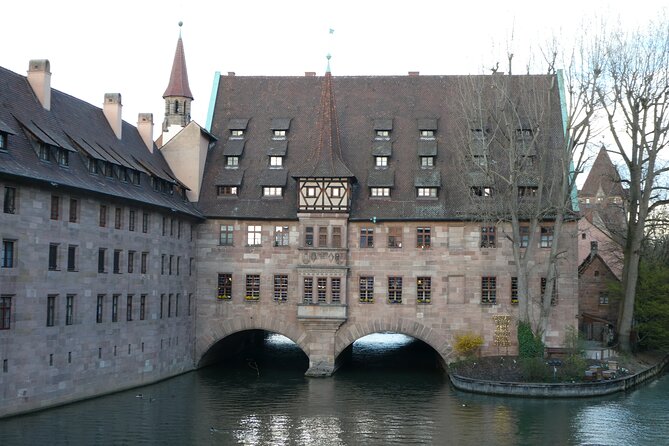
Weissgerbergasse is known as Nuremberg’s most beautiful craftsmen’s street. Its narrow buildings and historic character make it an essential part of a medieval old-town walk.
The important lesson here is that the old town is not simply untouched. The guide explains the destruction caused during World War II and the rebuilding that followed. This is one of the strongest parts of the experience because it changes how you see the charming street.
Andreas has used before-and-after photo books to show what Nuremberg looked like before and after the war. That visual aid can make the scale of the damage easier to grasp than words alone. The subject is handled with sensitivity, according to the praise given to several guides.
I value this context. Without it, you may assume every historic-looking building survived intact. The story of reconstruction gives the city another layer, one involving memory, judgment, and the difficult choice of how to rebuild.
More of the old town beyond the main sights
The tour’s old-town route also includes St. Lorenz Church, the castle gardens, and the executioner’s house. These spots help keep the experience from becoming a simple march between famous monuments.
The castle gardens offer a calmer change after the climb and may provide another angle on the city. The executioner’s house points toward less polished parts of medieval life, where law, punishment, and social boundaries were real parts of the city’s daily order.
St. Lorenz adds another major church to the route and broadens the religious story beyond St. Sebaldus. The exact amount of time at each additional location is not specified, so think of them as guided highlights rather than guaranteed extended visits.
This is also where local recommendations can pay off. Daniella provided a Google Maps QR code with suggestions from the guides, which is a useful follow-up tool. A map like that can help you choose where to eat, drink, or continue exploring after the formal walk ends.
Guides, group size, and the feel of the experience
The guide makes the largest difference here. The English-speaking guides are native to Nuremberg, and the strongest praise centers on personal enthusiasm, clear explanations, humor, and care with difficult history.
Andreas is described as witty, well prepared, and especially good on medieval trade and World War II. Alexandra is friendly, polished, and strong on art and culture. Daniella is praised for her warmth, pacing, and local recommendations. Tom is noted for explaining the route clearly and pointing out good photo spots.
Those names do not guarantee who will lead your departure, but they show the level of guide the tour can provide. The style is not just a list of dates. It is a spoken introduction to the city, with room for questions and occasional jokes.
The maximum group size is 50. That is the main practical weakness. A group this large can make it harder to hear beside a busy square, and it may take longer to gather after crossing streets or climbing the hill. The upside is that the route is simple enough for a guide to manage, and the activity avoids traffic by keeping you on foot.
Price, timing, and who gets the best value
At $3.63, the financial value is excellent if you want a broad introduction without paying for museum admission or a private guide. Since this operates as a free tour supported by tips, your final cost depends on what you choose to give the guide.
The 11:30 a.m. start is useful for a first full day in Nuremberg. You can have breakfast, reach the old town without rushing, and still finish with time for lunch or another museum. The two-and-a-half-hour length gives the guide room to cover several periods, though one person wished the walk were about 30 minutes shorter.
I think the duration is fair for the route, but you should not expect a quick orientation lasting only an hour. You will be on your feet for most of the experience, with hills and pauses along the way.
The tour is best for first-time visitors, history fans, art lovers interested in Dürer, and anyone who wants local suggestions before exploring alone. It is less suitable if you have a serious knee problem, tire quickly on hills, or want extended indoor visits at the churches and castle.
Confirmation is normally sent when you book, subject to availability for bookings made within 12 hours of departure. Service animals are allowed, and the tour is near public transportation. Most people can participate, but mobility is the point to consider carefully.
Should you book the Nuremberg walking tour?
I would book this tour if you want a low-cost, human introduction to Nuremberg before setting off on your own. The best reasons are the native English-speaking guides, the balanced treatment of medieval life and World War II, the castle views, and the practical recommendations for the rest of your visit.
I would skip it only if steep hills and cobblestones would make two and a half hours uncomfortable. If you can manage the climb, wear good shoes and stay with the group. You can cancel for a full refund up to 24 hours before the start time, but last-minute changes are not accepted, and the tour requires a minimum number of participants.
For most first visits, this is a smart way to get your bearings, understand what you are seeing, and decide where to spend more time later.
FAQ
How long is the Nuremberg walking tour?
The tour lasts approximately 2 hours and 30 minutes.
What time and where does the tour begin?
It starts at 11:30 a.m. at the Schöner Brunnen, Hauptmarkt, 90403 Nürnberg, Germany.
Is the tour conducted in English?
Yes. The walking tour is offered in English and includes an English-speaking guide born and raised in Nuremberg.
Does the tour include admission tickets?
The listed stops show free admission. The experience includes a walking tour of the old town, but admission to paid interior attractions is not stated as included.
Is the walk suitable for people with mobility issues?
Most people can participate, but the route includes steep hills, cobblestones, and a climb to the castle. People with knee or mobility problems may find parts of it difficult.
How many people can join the tour?
The maximum group size is 50 people. The tour ends back at the meeting point.
Just added around Nuremberg
- Bayreuth: Private Guided Walking Tour★ 5.0 · 15 reviews
- Nuremberg: St. Johannis Friedhof &Hesperidengärten IN GERMAN★ 4.4 · 15 reviews
- Nuremberg: Medieval Time Travel for Kids★ 4.9 · 15 reviews
- PRIVATE Nuremberg WW2 and Old Town Day Tour (Product code: 87669P16)★ 4.5 · 15 reviews
- Bayreuth City Walking Tour★ 4.6 · 16 reviews
- Nuremberg: Medieval Ages Tour in Spanish★ 4.5 · 16 reviews
- PLAYMOBIL®-FunPark Entrance Ticket★ 4.5 · 17 reviews
- Nuremberg: Private guided tour of the Old Town in German★ 4.9 · 17 reviews
Walking Tours, compared.


Berlin’s Best: 2 Hour Walking Tour Third Reich and the Cold War
Read our review →
Third Reich Berlin: Hitler and WWII Walking Tour
Read our review →Browse the lists this tour appears in