
Reviewed · THIRD REICH & WWII TOURS
Small-Group 2-Hour Munich and The Third Reich Walking Tour
Munich’s polished center has a dark underside. This two-hour walk connects familiar squares and beer halls to the rise of Hitler and the Nazi Party, making the city’s past easier to understand in its actual streets. I like the small group of no more than 15 and the way guide Alun Evans explains difficult events with care, humor, and plenty of room for questions. The main drawback is that you spend nearly the entire tour on foot, with few chances to sit.
I also like the central Marienplatz meeting point and the route’s clear historical arc, from the Nazi movement’s early beginnings to its public ceremonies and political power. This is not a general city sightseeing walk with a few Nazi references added on. The Third Reich is the main subject, so you should choose another tour if you want a broad introduction to Munich’s churches, markets, and royal sights.
In This Review
- Key points to know before you book
- Why this Munich history walk is worth your afternoon
- Starting at Marienplatz and the Old Town Hall
- Hofbräuhaus and the Nazi movement’s early days
- Odeonsplatz and the failed Beer Hall Putsch
- Königsplatz and the public display of Nazi power
- What the guide adds to the experience
- Walking conditions, timing, and what to bring
- Who will get the most from this walk
- Is $60.07 a fair price for two hours?
- Should you book the Munich Third Reich walking tour?
- FAQ
- How long is the Munich and Third Reich walking tour?
- What time does the tour begin?
- Where does the tour start?
- Where does the tour end?
- What places are visited during the walk?
- Is the tour offered in English?
- How large is the group?
- Is hotel pickup included?
- Can I cancel for a full refund?
Key points to know before you book
- The tour begins at Marienplatz at 3 p.m., beside the Munich city administration building at Marienplatz 8.
- The route links four important locations, including the Old Town Hall, Hofbräuhaus, Odeonsplatz, and Königsplatz.
- Alun Evans is the named guide, praised for clear explanations, friendly conversation, and a sensitive approach to painful history.
- The group is capped at 15 people, a useful size for hearing the guide and asking questions.
- No entry tickets are needed during the walking route, but the Documentation Centre of National Socialism can be visited afterward if you want more.
- Plan for two hours outdoors, in rain or cold as well as fair weather, and wear comfortable shoes.
Why this Munich history walk is worth your afternoon
Munich is often introduced through beer halls, grand squares, and elegant buildings. Those sights are real, but they tell only half the story. This tour shows how ordinary-looking places became part of the Nazi movement’s early political story.
I find that approach useful because the subject is easier to grasp when it is tied to physical places. You are not only hearing dates and names. You are looking at the square where decisions were made, the beer hall where Hitler spoke, and the streets connected with the failed 1923 putsch.
The experience costs about $60.07 per person. That is not bargain-priced for a two-hour walk, especially since there is no food, transport, or museum admission included. Still, the price can make sense if you want a focused history lesson with a local guide rather than a large, general-purpose tour.
A private tour would usually cost more, while a self-guided walk gives you less opportunity to ask questions or connect the events. The small group helps justify the fee. You are more likely to hear clearly, follow the explanations, and steer part of the conversation toward your own interests.
The tour receives strong marks for Alun Evans’s personal style. He is described as warm, animated, and highly informed, without treating the subject as a dry lecture. That matters here. The topic is grim, and a guide who can remain human and approachable makes two hours of difficult material easier to absorb.
One practical note: the experience is booked well ahead, on average around 42 days before the date. If your Munich plans are fixed, it would be sensible to reserve early rather than assume you can fit it in at the last minute.
More Third Reich & WWII Tours in Munich
- Munich: Third Reich & WWII Walking Tour
★ 4.6 · 6,181 reviews - Third Reich Walking Tour Munich
★ 4.5 · 4,291 reviews - Munich: Birthplace of the Third Reich Guided Walking Tour
★ 4.6 · 771 reviews
Starting at Marienplatz and the Old Town Hall
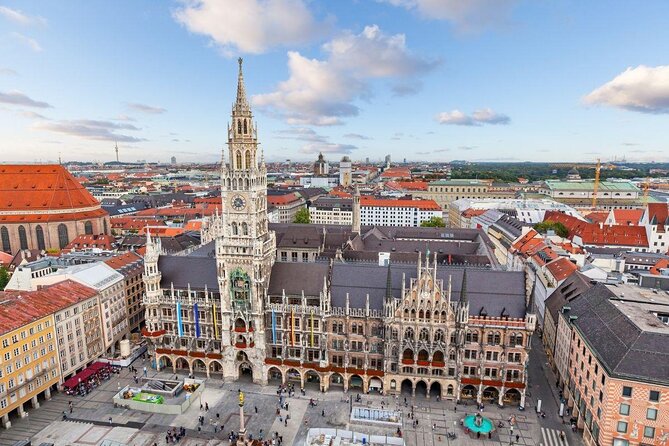
The meeting point is at Landeshauptstadt München Stadtkämmerei, Marienplatz 8, 80331 Munich. Marienplatz is one of the simplest places in the city to find, but it can be crowded, so give yourself time to locate the exact building and guide before the 3 p.m. start.
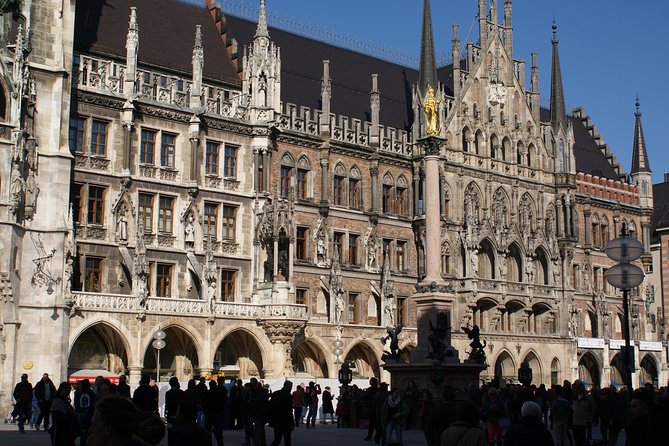
The square begins the story in a powerful way. Your guide points out the Old Town Hall and explains its connection to the 1938 pogrom against Germany’s Jewish population. This is a serious opening, and it immediately frames the tour around state violence, propaganda, and persecution rather than nostalgia for the Nazi period.
You should expect roughly 30 minutes here. That may sound long for one square, but Marienplatz gives the guide room to set the political scene before the walk moves on. You learn about the people and places connected with Adolf Hitler and the Nazi Party, then see how the old city center became part of that story.
The strength of this stop is context. On your own, you might photograph the buildings and move on. With the guide, the square becomes a place where Munich’s civic life, Nazi power, and the persecution of Jewish people intersected.
The weakness is also clear. If you are hoping to cover lots of Munich sightseeing in two hours, this extended introduction may feel slow. It is designed for historical understanding, not a quick checklist of landmarks.
Hofbräuhaus and the Nazi movement’s early days
The walk continues to Staatliches Hofbräuhaus, with about 10 minutes devoted to the stop. You pass the location where Hitler regularly gave speeches, after learning about the founding location of the Nazi Party and the SS.
Hofbräuhaus is one of Munich’s most famous names, usually linked with beer, music, and traditional Bavarian atmosphere. Here, the guide asks you to consider the building in a different light. Political meetings and speeches could take place in settings that also functioned as popular social spaces.
That contrast helps explain how extremist politics reached ordinary public life. The tour does not treat the Nazi movement as something that appeared fully formed. Instead, you follow its growth through places where people gathered, listened, argued, and organized.
This stop is short, but it works as a bridge between the opening at Marienplatz and the more dramatic political events ahead. Alun Evans’s strength, based on the way the tour is presented, is linking a visible building to the larger story instead of simply pointing and naming it.
You will not enter the Hofbräuhaus as part of the stated tour. The walk passes the location, and food and drinks are not included. If you want to eat there, plan that separately rather than expecting a tasting or meal during the experience.
Odeonsplatz and the failed Beer Hall Putsch
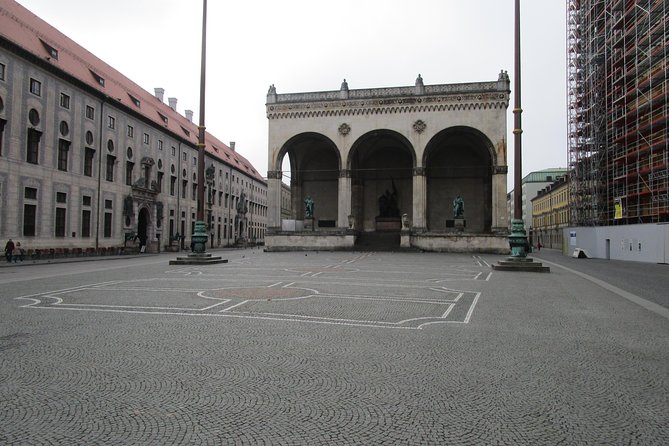
At Odeonsplatz, the focus shifts to the Beer Hall Putsch of 1923. You see the location of the gun battle between Nazi supporters and the Bavarian police, an event tied to Hitler’s failed attempt to seize power.
Around 15 minutes are planned here. The stop is valuable because it shows that the Nazi rise was not a smooth or inevitable march to control. There was resistance, failure, and open conflict before the movement gained national power.
For anyone interested in military or political history, this is likely one of the most compelling points on the route. You are standing at a real location connected with an armed confrontation, not just hearing about it in an abstract timeline.
The guide’s role matters particularly here. The facts can become confusing quickly, especially when a short event has long-term consequences. A well-structured explanation helps you understand how the failed putsch became part of Nazi mythology and later public ceremony.
Odeonsplatz is also a busy city space, so you should be ready to listen while standing. One piece of practical criticism is worth taking seriously: the tour offers little seated time. If you need regular rests, speak with the guide at the beginning and pace yourself.
More Walking Tours in Munich
- Munich: Old Town & Viktualienmarkt City Walk in German
★ 4.7 · 2,304 reviews - Munich: Night Watchman Walking Tour
★ 4.7 · 2,092 reviews - Munich Ghosts and Spirits Evening Walking Tour
★ 5.0 · 1,900 reviews - Munich Old Town Walking Tour
★ 4.5 · 1,287 reviews
Königsplatz and the public display of Nazi power
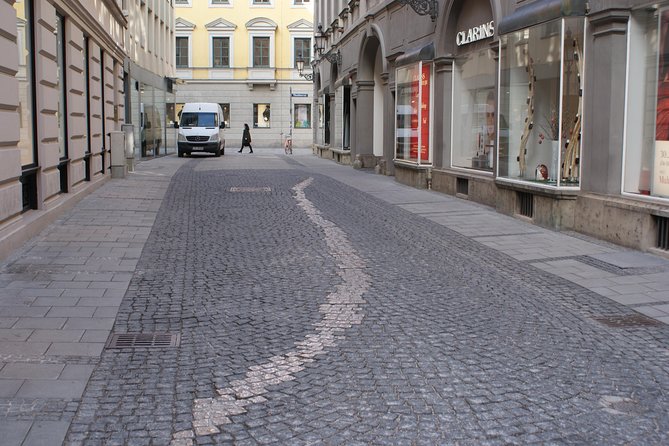
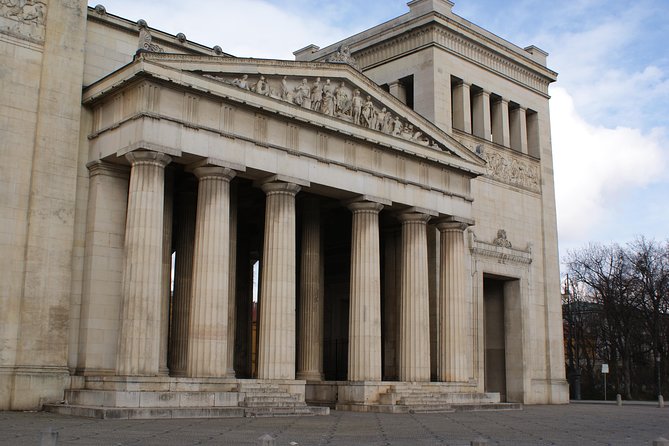
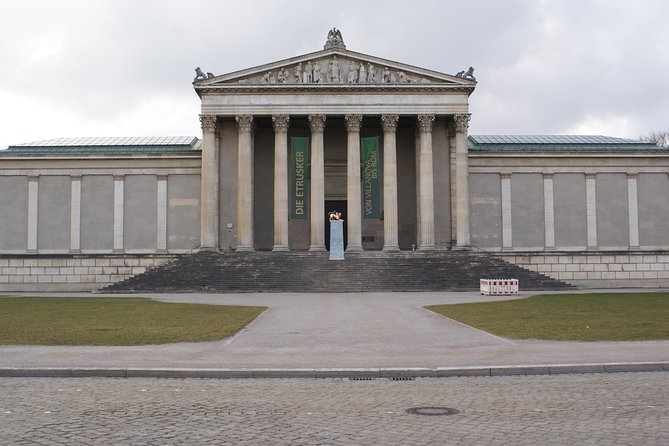
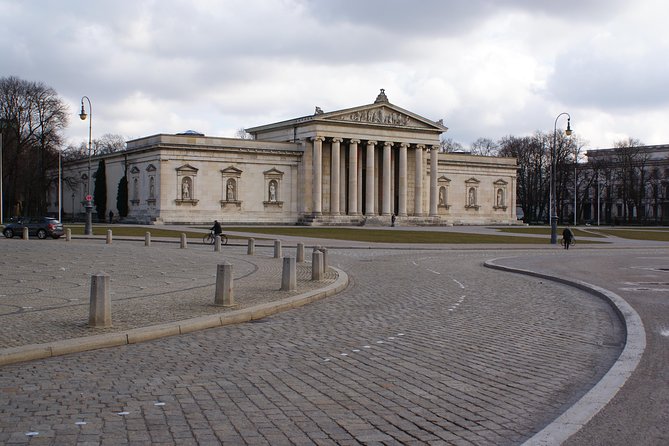
Königsplatz brings the tour to its final major stop, with around 20 minutes planned here. The guide points out the building connected with the Munich Agreement of 1938 and the place where the Nazis held ceremonies honoring those who died during the failed 1923 putsch.
This is where the route’s themes come together. Early political organizing, public speeches, violence, propaganda, and official commemoration all connect through Munich’s streets and buildings. The physical setting helps you see how political movements use architecture and public space to create authority.
The Munich Agreement is especially important because it places Munich within the wider international story of 1938. The tour does not simply stay at the level of local city history. It shows how events in Munich connected with decisions affecting Europe.
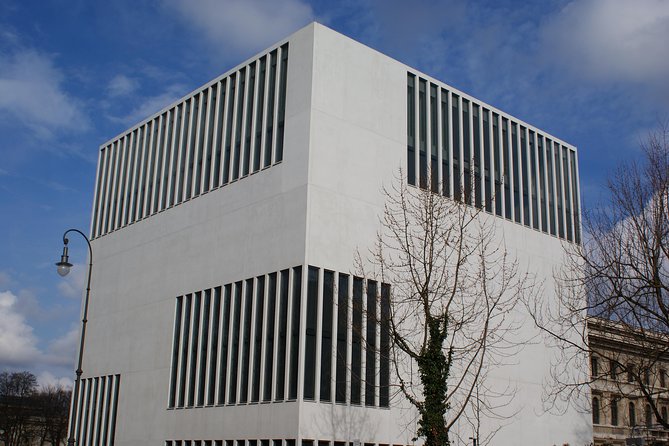
Königsplatz is also a useful ending because you can continue your study after the guide finishes. The Documentation Centre of National Socialism is available for an optional visit at the end of the tour. The experience does not include a museum visit in its two-hour schedule, so you should allow extra time if you want to go inside.
This optional extension is one of the best reasons to schedule the walk earlier in your Munich stay rather than on your departure afternoon. You can use the tour to get oriented, then return to the Documentation Centre with a clearer sense of the people and events it presents.
What the guide adds to the experience
The tour’s success depends heavily on the guide. Historical sites alone do not guarantee a good walk. You need someone who can explain difficult material without turning it into either a dry classroom session or a sensational story.
Alun Evans is the named provider and guide, and his approach is described as friendly, animated, and sensitive. He also makes room for questions. That can make a big difference if you already know something about the Third Reich and want to explore a particular event, or if you are encountering the subject for the first time.
The tone appears serious but not stiff. Occasional wit can help maintain attention, but the subject is handled with appropriate care. You should expect history presented in human terms, including the consequences of political choices and the persecution behind the buildings and ceremonies.
A small group supports that style. With a maximum of 15 people, the walk should feel more personal than a large coach-based outing. You can ask a question without interrupting a crowd, and the guide can respond to the interests of the group.
The experience has also worked for families with young children, including a group with a five-year-old and a three-year-old. That does not mean every child will enjoy two hours of serious history. It does suggest the guide can be accommodating, including allowing brief bathroom breaks when needed.
Walking conditions, timing, and what to bring
The tour begins at 3 p.m. and lasts about two hours. The route is central, and the activity ends at the meeting point according to the stated arrangements, so you will not need a separate ride back to an outlying hotel or attraction.
There is no hotel pickup or drop-off. You are responsible for reaching Marienplatz and for arranging any transport after the walk. Since the meeting point is in central Munich, you can pair the tour with other old-town plans, but leave enough time to arrive without rushing.
The walking requirement is listed as moderate physical fitness. That is a fair warning. You should be comfortable standing and walking through the city for two hours, with limited opportunities to sit.
The tour operates in all weather. Bring suitable clothing for the forecast, including rain protection when needed. Cold, wet weather has not prevented the experience from being useful, but it can make standing and listening much less comfortable.
I would bring:
- Comfortable walking shoes
- Water
- A weatherproof jacket or umbrella
- A small notebook if you like recording names and dates
- Extra time afterward for the Documentation Centre of National Socialism
There is no food or drink included. Eat before the 3 p.m. start if you tend to get hungry, or plan a meal afterward. A beer hall stop does not mean a beer hall break.
Who will get the most from this walk
This tour suits you best if you have a serious interest in modern European history, political movements, World War II, or the history of Munich. It is also useful if you want to understand the city beyond its pleasant squares and famous beer halls.
Military history fans should find the Beer Hall Putsch section at Odeonsplatz especially worthwhile. People with a broader interest in politics and civic life may prefer the links between Marienplatz, Hofbräuhaus, and the rise of the Nazi Party.
You do not need to arrive as an expert. The guide explains the growth of the Nazi movement and places each location in its historical setting. The walk is also a good choice if you have already read about the period and want to see locations that previously existed only in books.
I would be more cautious about booking it if you want a relaxed city introduction. The tour is not centered on shopping, architecture, royal Munich, or food. Even though you pass major city sights, the main subject remains the Third Reich.
Families can consider it, but think about your children’s age and attention span. The guide has shown flexibility with young children, yet the material includes persecution, political violence, and war. It is not a light family activity.
Is $60.07 a fair price for two hours?
At $60.07 per person, this is a premium walking tour rather than a low-cost orientation stroll. You are paying for a specialist subject, a small group, and a guide who can answer questions in real time.
The value is strongest if you would otherwise spend hours trying to connect the sites yourself. A guide gives you a sequence, explains what happened at each place, and points out details you might pass without noticing.
The value is weaker if you want access to interiors or included refreshments. The listed stops are visited from public areas, and food, drinks, transport, and hotel transfers are separate. You should judge the fee as payment for interpretation, not admission to a series of attractions.
The full refund window is 24 hours before the start time. After that point, cancellation or changes are not accepted for a refund, so check your schedule before the final day.
Should you book the Munich Third Reich walking tour?
Book it if you want a focused, serious look at Munich’s role in the Nazi era, and if you prefer learning through real streets and public spaces. The route is compact, central, and logically arranged, while the small group and Alun Evans’s personal approach make it easier to ask questions.
Skip it if your priority is a broad Munich overview, a seated museum visit, or a food-focused afternoon. Also think twice if two hours of standing in uncertain weather would be uncomfortable.
For the right audience, this is a strong use of an afternoon. It does not soften Munich’s past or turn it into a spectacle. Instead, it connects the city you see today with the political choices and crimes that shaped its darkest period.
FAQ
How long is the Munich and Third Reich walking tour?
The tour lasts approximately two hours.
What time does the tour begin?
It begins at 3 p.m.
Where does the tour start?
The meeting point is Landeshauptstadt München Stadtkämmerei, Marienplatz 8, 80331 Munich, Germany.
Where does the tour end?
The activity ends back at the meeting point in the central area.
What places are visited during the walk?
The route includes Marienplatz, the Old Town Hall, Staatliches Hofbräuhaus, Odeonsplatz, and Königsplatz.
Is the tour offered in English?
Yes. The tour is offered in English.
How large is the group?
The maximum group size is 15 people.
Is hotel pickup included?
No. Hotel pickup and hotel drop-off are not included. You must make your own way to the central meeting point.
Can I cancel for a full refund?
Yes. You can cancel for a full refund up to 24 hours before the experience start time. Changes or cancellations made less than 24 hours before the start are not accepted for a refund.
Just added around Munich
- Munich: Private or Group Third Reich and WWII Walking Tour★ 4.9 · 13 reviews
- From Munich: Neuschwanstein Castle and Linderhof Private Tour★ 5.0 · 13 reviews
- Private Transfer from Munich to Salzburg with 2 hours for sightseeing★ 4.5 · 13 reviews
- Munich: Historical Walking Tour on the Rise of Hitler★ 5.0 · 13 reviews
- Private Scenic Transfer from Munich to Prague with 4h of Sightseeing★ 5.0 · 13 reviews
- From Munich: VIP day trip to Salzburg★ 5.0 · 14 reviews
- National Socialism WWII with licensed guide – private tour★ 5.0 · 14 reviews
- Private Tour to Neuschwanstein & Linderhof, Skip The Line & Lunch★ 5.0 · 14 reviews
Third Reich & WWII Tours, compared.
Berlin’s Best: 2 Hour Walking Tour Third Reich and the Cold War
Read our review →
Third Reich Berlin: Hitler and WWII Walking Tour
Read our review →
Walking Tour of Former Nazi Party Rally Grounds
Read our review →
Browse the lists this tour appears in