
Reviewed · THIRD REICH & WWII TOURS
Private Walking Tour Berlin Third Reich Hitler and World War II
Berlin’s darkest chapters are written into its streets. This private tour brings together Nazi government sites, wartime battle points, Holocaust memorials, and places of resistance in one focused route. I like the hotel pickup and drop-off, which saves you from sorting out the day’s starting point, and I like the chance to shape the tour around your interests with a private guide such as Daniel, Jimmy, Georgia, or Jasper.
The main thing to consider is the pace. You cover a large part of central Berlin in three to four hours, with several stops lasting only 10 or 15 minutes. The tour is excellent for building a clear framework, but you may want to return later to the Topography of Terror or Holocaust Memorial for a slower visit.
In This Review
- Key points to know before booking
- What this Berlin history tour does well
- Starting with the Soviet Memorial in Tiergarten
- Wilhelmstraße and the machinery of Nazi government
- The Topography of Terror and the mechanics of repression
- Resistance at the Bendlerblock
- Bebelplatz and the May 1933 book burning
- The Reichstag and the Reichstag Fire
- The Holocaust Memorial and the meaning of remembrance
- The Führerbunker and Hitler’s final days
- Anhalter Bahnhof and deportation from Berlin
- The T4 Memorial and Nazi murder of disabled people
- Moltkebrücke and the final battle for Berlin
- How much does the $192.97 price buy you?
- Pace, weather, and practical planning
- Who should book this private Berlin tour?
- Should you book it?
- FAQ
- How long does the private Berlin Third Reich tour last?
- What is the price per person?
- Is hotel pickup included?
- Is the tour private?
- What language is the tour offered in?
- Are entrance tickets included?
- Is food included?
- Does the tour operate in bad weather?
- Can I cancel for a full refund?
Key points to know before booking
- The private format matters: Your guide can adjust the route, pace, starting point, and amount of detail to suit your group.
- You cover 12 major locations: The route links Nazi power, wartime destruction, resistance, persecution, remembrance, and the final battle for Berlin.
- The tour is built around outdoor history: Most stops are viewed from outside or at memorial sites, so good clothing and comfortable shoes matter.
- The Topography of Terror and Holocaust Memorial deserve extra time: The planned stops are brief, making a return visit worthwhile.
- Hotel pickup and drop-off add real convenience: This is especially useful if you are unfamiliar with Berlin or traveling with children.
- The price reflects private attention: At $192.97 per person, the cost makes most sense for a small group that values flexibility and detailed questions.
What this Berlin history tour does well
The strength of this experience is its structure. Berlin’s Nazi and World War II sites are scattered across the city, and visiting them alone can leave you with disconnected fragments. Here, the locations form a story: Soviet forces close in on Berlin, Nazi ministries direct the regime, opposition is crushed, victims are deported and murdered, and the city becomes a battlefield.
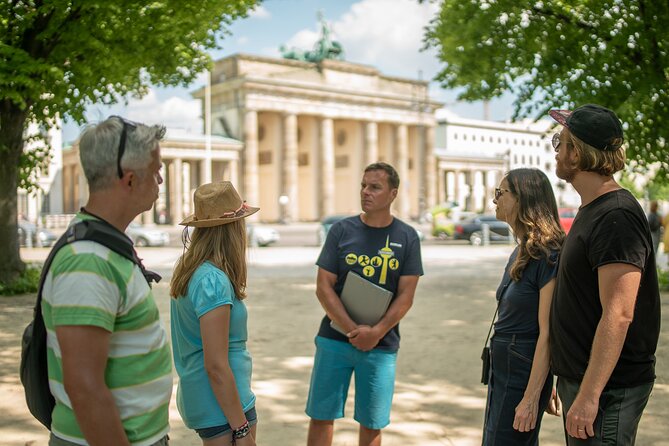
I also like the human scale of the private format. You are not trying to hear a guide over a large crowd. You can ask about a family connection, pause over a difficult subject, or request more time at a place that matters to you.
Guides have received especially warm praise for their ability to explain difficult material in plain language. Daniel is described as warm and flexible, while Jimmy is praised for engaging children and using memorable stories. Georgia adapted the route to her group and offered practical ideas for the rest of their stay. Simon helped one group identify places worth revisiting in greater detail.
The guides come from different backgrounds. One guide, Ariel, was an Israeli émigré rather than a native Berliner. That may matter if you expect local family stories, but it does not by itself determine the quality of the tour. The important question is how well your guide listens, explains, and responds to your interests.
More Third Reich & WWII Tours in Berlin
- Berlin: Third Reich and Cold War 2 Hour Walking Tour
★ 4.9 · 6,830 reviews - Berlin’s Best: 2 Hour Walking Tour Third Reich and the Cold War
★ 5.0 · 5,486 reviews - Third Reich Berlin: Hitler and WWII Walking Tour
★ 5.0 · 3,301 reviews
Starting with the Soviet Memorial in Tiergarten
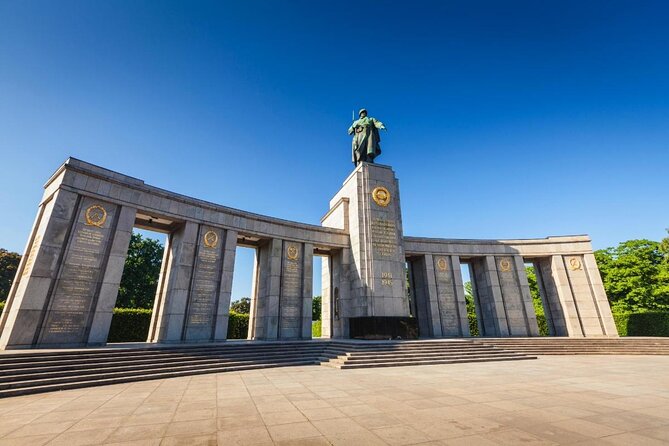
The Soviet Memorial in Tiergarten gives the tour a strong opening point. Built in 1949, it honors Soviet soldiers who died during the Battle of Berlin in 1945. Its central statue shows a soldier holding a sword and shield, a clear symbol of military victory and sacrifice.
You spend about 10 minutes here, enough for an introduction rather than a full study of the memorial. Your guide can place the final battle in context, explain the Soviet role in defeating Nazi Germany, and point out how the memorial reflects both Soviet and German memory.
This is a useful first stop because it shifts the focus away from Hitler alone. World War II in Berlin was also a military campaign, and the Soviet advance shaped the city’s postwar fate. The memorial helps you understand that the war ended here through combat, occupation, and enormous loss.
Wilhelmstraße and the machinery of Nazi government
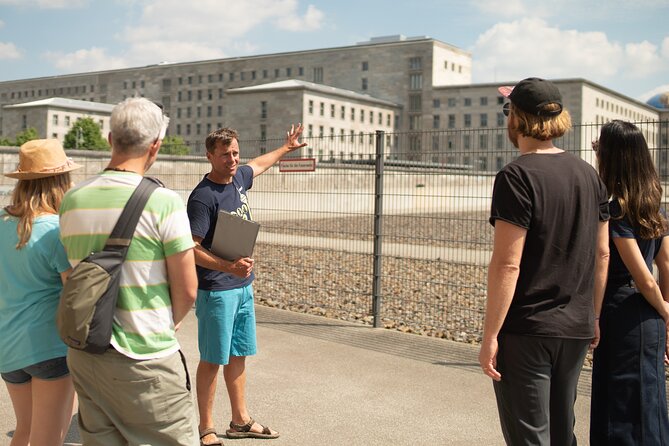
The tour then turns toward the former center of Nazi administration. Wilhelmstraße was lined with ministries and government offices, making it one of the most important political streets in Berlin during the Third Reich.
At the Detlev-Rohwedder-Haus, your guide explains the building’s earlier role as the Reichsbank and its later use by the Ministry of Aviation under Hermann Göring. The building also became the German Federal Treasury after the war. That change of function gives the site an unusually direct link between Nazi rule, postwar Germany, and the country’s modern government.
The stop lasts about 10 minutes, followed later by roughly 20 minutes walking along Wilhelmstraße. Together, these visits show how dictatorship worked through offices, ministries, budgets, military planning, and public ceremony. Nazi power was not only expressed through rallies and speeches. It also depended on paperwork, policy, money, and people carrying out orders.
Because these are mainly exterior stops, the guide’s explanation is central. If you prefer grand interiors or museum displays, this portion may feel spare. If you like seeing ordinary streets while learning what happened there, it is one of the tour’s most useful sections.
The Topography of Terror and the mechanics of repression
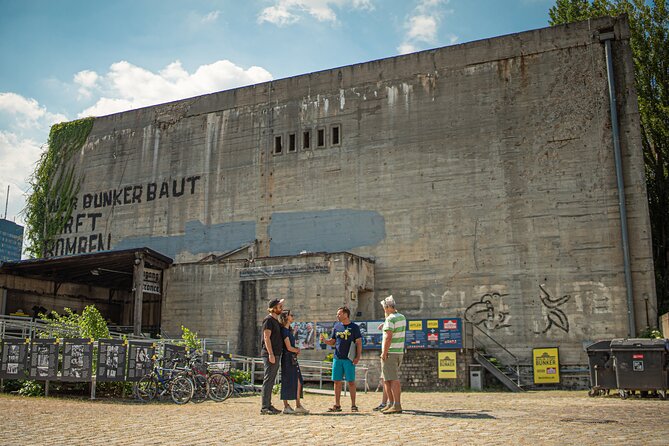
The Topography of Terror occupies the former grounds of the SS and Gestapo headquarters. Its indoor and outdoor displays use photographs, documents, and personal testimony to explain how the Nazi regime maintained power through surveillance, imprisonment, violence, and fear.
The scheduled visit is about 20 minutes. That is enough to identify the purpose of the site and absorb a few key exhibits, but not enough to read the displays at a leisurely pace. I would treat the guide-led visit as an introduction, then return on your own if the subject holds your attention.
This stop adds needed detail to the broader political story. It shows how repression operated against political opponents and other people the regime marked as enemies. The emphasis is not on dramatic military scenes. It is on institutions, orders, and the damage done to ordinary lives.
The subject matter is heavy, so this is not a casual sightseeing stop. Families with older children may find it valuable, especially if the guide explains the material with care. Parents should expect serious photographs and accounts of state violence.
More Walking Tours in Berlin
- Discover Berlin Half-Day Walking Tour
★ 5.0 · 9,624 reviews - Berlin: Discover Berlin Walking Tour
★ 4.9 · 5,998 reviews - Berlin: Hidden Backyards Guided Walking Tour
★ 4.8 · 5,360 reviews - Berlin: Alternative Berlin Walking Tour
★ 4.6 · 1,204 reviews
Resistance at the Bendlerblock
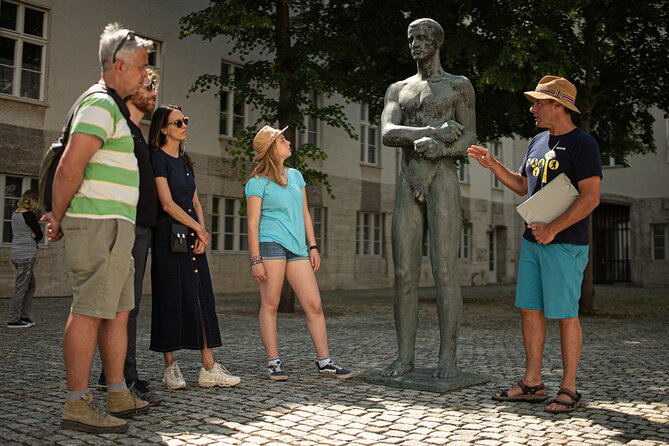
At the German Resistance Memorial Center, located in the Bendlerblock, the story turns to people who opposed Hitler and the Nazi government. The exhibits cover several resistance movements, including the circle around Claus von Stauffenberg and the failed July 20, 1944, attempt to kill Hitler.
The visit lasts about 20 minutes. Your guide can explain why people resisted, what they hoped to change, and the severe consequences they faced. This prevents the tour from presenting Germans only as followers or perpetrators. It also raises a difficult question: what does moral courage look like when opposition may cost you your life?
The memorial area offers a quieter pause after the Topography of Terror. I find that contrast useful. You move from the machinery of persecution to the choices made by individuals who challenged it.
The stop may be particularly meaningful for visitors interested in ethics, political history, or the problem of obedience under dictatorship. It also gives younger people a way to discuss responsibility without reducing the past to a list of dates.
Bebelplatz and the May 1933 book burning
Bebelplatz is associated with the Nazi book burning held on May 10, 1933. Thousands of books considered un-German were destroyed there, making the square a lasting symbol of censorship and the attack on free thought.
A memorial below the pavement shows empty bookshelves. From above, the installation can be easy to miss, which is one reason a guide helps. Your guide also points out the State Opera House and Humboldt University, giving the square an architectural setting rather than treating it as an isolated monument.
You spend around 10 minutes here. That is enough to explain what happened and locate the memorial, though you may want to pause afterward and look down into the underground chamber yourself.
This is a compact stop with a clear lesson. The destruction of books came early in the Nazi period, before the regime’s worst crimes had reached their full scale. It shows how attacks on language, education, and public debate helped prepare the ground for wider repression.
The Reichstag and the Reichstag Fire
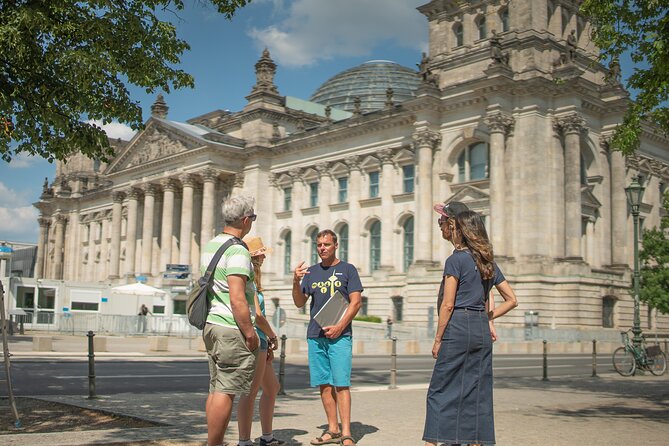
The Reichstag is one of Berlin’s best-known political buildings, completed in 1894. On this tour, the focus is not the building’s modern dome visit but its role during the Nazi rise to power.
Your guide explains the 1933 Reichstag Fire and how the Nazis used the event to suppress political opposition and tighten their control. The building was badly damaged during World War II and later restored as a symbol of German democracy.
The stop lasts about 15 minutes, and admission is not included. Since the itinerary describes a focused historical visit rather than entry into the building, you should not assume that a dome visit is part of this experience.
The Reichstag is valuable because it connects a physical building with a legal and political turning point. The Nazi dictatorship did not appear fully formed overnight. It used crisis, fear, and emergency measures to dismantle opposition. That is easier to grasp when you are looking at the place tied to the story.
The Holocaust Memorial and the meaning of remembrance
The Memorial to the Murdered Jews of Europe covers a large open area with 2,711 concrete slabs of different heights. Walking among them creates a changing sense of space, visibility, and uncertainty. The design offers no simple explanation, which is fitting for a memorial to a crime on such a vast scale.
The planned visit is about 15 minutes. Your guide explains the memorial’s purpose and the Nazi persecution and murder of Europe’s Jews. You will have a chance to walk among the blocks, but the short stop is not enough to read every part of the associated information center.
I strongly suggest returning at another time if you want to take in the site slowly. The memorial works best when you are not being hurried, and the underground information center adds personal stories and historical detail.
This is one of the tour’s essential locations, but it should be approached with care. It is not a photo backdrop or a dramatic piece of city design. Give yourself room to think, and follow the site’s quiet tone.
The Führerbunker and Hitler’s final days
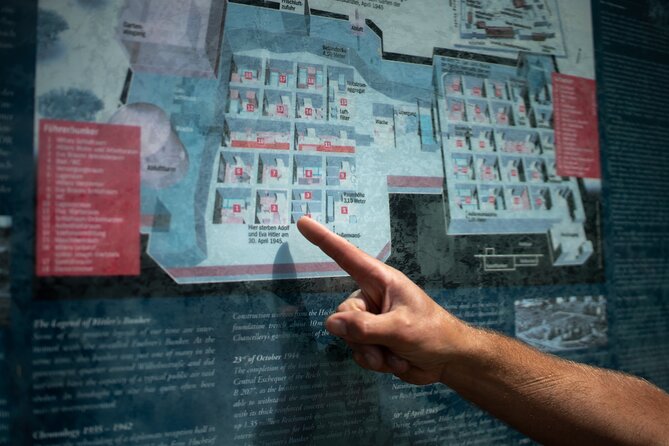
At the Führerbunker site, you stand above the location of Hitler’s final headquarters beneath the former Reich Chancellery. Most of the original structure was destroyed after the war, so there is no grand underground attraction to enter.
The guide explains the bunker’s layout, the final months of the war, and the decisions made as Allied forces closed in on Berlin. The stop lasts about 10 minutes.
This can be an oddly anticlimactic place. There is little visible evidence, and that is part of the point. The site has no surviving spectacle to reward fascination with Hitler. Instead, the guide must explain what happened and place the bunker within the collapse of the Nazi regime.
I appreciate that the stop keeps attention on consequences rather than myth. The bunker was a refuge for Nazi leaders during a catastrophe they had helped create. A short visit is enough to mark the location without giving the site more importance than it deserves.
Anhalter Bahnhof and deportation from Berlin
Anhalter Bahnhof was once one of Berlin’s major railway stations. The tour uses the remaining structure and nearby memorial references to discuss its role in the deportation of Jews during the Nazi period.
The visit takes about 10 minutes. Your guide connects the station to the families who were forced onto trains and separated from their homes, communities, and relatives. That human focus is important. Deportation was carried out through transport systems and ordinary-looking departure points, not only at distant camps.
The surviving station façade can help you picture the scale of the old terminal, but you should not expect a complete functioning station or a large museum visit here. The value is in the story and the connection between Berlin’s daily infrastructure and the Holocaust.
This is a particularly sobering stop because railway travel normally suggests movement and possibility. Here, the same system became part of organized persecution.
The T4 Memorial and Nazi murder of disabled people
At Tiergartenstraße 4, the T4 Memorial commemorates victims of the Nazi euthanasia program. The program targeted people with disabilities and mental illnesses, whom the regime falsely labeled unworthy of life.
The memorial explains the program’s history, its victims, and the moral questions raised by state-directed murder. The visit lasts about 10 minutes.
This site broadens your understanding of Nazi persecution. The regime’s victims were not limited to racial and political groups. Disabled people were also targeted through medical abuse, bureaucracy, propaganda, and murder.
The memorial is compact, but its subject is crucial. It encourages you to think about how discrimination can become official policy when a government strips people of their dignity. I would give this stop your full attention, even though the timetable is short.
Moltkebrücke and the final battle for Berlin
The walk across Moltkebrücke connects the tour back to military history. Soviet troops crossed this bridge during their assault on Berlin in April 1945, using it as a route into the city during the final battles.
Your guide recounts the fighting nearby and explains why the bridge mattered to the Soviet advance. The visit lasts about 10 minutes.
This is a good reminder that Berlin’s final days were not only about Hitler’s bunker. Soldiers fought block by block, civilians endured destruction, and the city’s bridges and roads became military objectives. Looking at the crossing helps turn the final battle from an abstract event into a series of physical locations.
How much does the $192.97 price buy you?
At $192.97 per person, this is not a budget walking tour. The price is easiest to justify when you are traveling as a small private group and want a guide who can answer specific questions and adjust the route.
The value comes from personal attention, hotel pickup and drop-off, and the amount of ground covered. You are not paying admission to a long list of attractions. Most stops are free, and admission to the Reichstag is not included.
For a couple or family that wants a history-focused day without managing Berlin’s transport and route planning, the cost may feel fair. For a solo visitor or someone happy to use museums and public transport independently, a group tour or self-guided plan may offer better value.
The tour is frequently reserved well ahead of time, with bookings averaging about 34 days in advance. That suggests you should not leave it until the last moment if your dates are fixed.
Pace, weather, and practical planning
The tour runs for about three to four hours and operates in all weather. Wear shoes suited to extended walking and dress for Berlin’s conditions. A group completing about 10,000 steps should expect a genuine city walk, not a short stroll between nearby monuments.
Hotel pickup and drop-off are included, but the exact meeting arrangement can be worth confirming. Georgia’s group arranged a hotel start even though it was not initially shown as a possible starting point, and the route was then adjusted around that meeting place.
Food and drinks are not included. Plan to eat before or after the tour, since the schedule moves through several locations and does not list a meal break.
The experience is offered in English and is private, with only your group taking part. Most people can participate, but the long outdoor route and serious subject matter may not suit every young child or anyone who has difficulty walking for several hours.
Who should book this private Berlin tour?
I would choose this tour if you want a clear introduction to Berlin’s Nazi and World War II sites, especially on a first visit. It also suits families, history students, and groups with different levels of background knowledge because the guide can adjust explanations and respond to questions.
It is less suitable if you want long museum visits, access inside every building, or a relaxed sightseeing walk with little serious discussion. The schedule is broad rather than slow.
The best use of the tour is as a foundation. Let the guide connect the sites, then return to the Topography of Terror, the Holocaust Memorial information center, or another place that deserves more time. Several guides also offer ideas for what to see during the rest of your Berlin stay, which makes the experience useful beyond its four-hour route.
Should you book it?
Book this private Berlin Third Reich and World War II tour if you value a flexible guide, hotel service, and a serious route through the city’s most important Nazi-era locations. Guides such as Daniel, Jimmy, Jasper, Georgia, Simon, and Tobi have been praised for clear explanations, patience, warmth, and the ability to tailor the day.
I would be cautious only if $192.97 per person feels high or if you prefer to spend an hour or more inside each museum. For most small groups seeking context, personal questions, and a well-organized introduction to Berlin’s difficult past, the private format earns its cost.
Free cancellation is available up to 24 hours before the start time. After that point, the payment is not refunded, so keep the local cut-off time in mind when making changes.
FAQ
How long does the private Berlin Third Reich tour last?
The tour lasts approximately three to four hours.
What is the price per person?
The listed price is $192.97 per person.
Is hotel pickup included?
Yes. Hotel pickup and hotel drop-off are included.
Is the tour private?
Yes. Only your group participates in the private activity.
What language is the tour offered in?
The tour is offered in English.
Are entrance tickets included?
Most listed stops have free admission. Admission to the Reichstag is not included.
Is food included?
No. Food and drinks are not included.
Does the tour operate in bad weather?
Yes. The tour operates in all weather conditions, so you should dress appropriately.
Can I cancel for a full refund?
Yes. You can cancel at least 24 hours before the experience starts for a full refund. Changes or cancellations made less than 24 hours before the start time are not accepted for a refund.
Just added around Berlin
- Berlin: Private Guided Tour of the Main Sights★ 5.0 · 13 reviews
- Private Highlights of Berlin Bike Tour★ 5.0 · 13 reviews
- Modern Berlin Private Walking Tour: Diverse, Vibrant and Exciting German Capital★ 5.0 · 13 reviews
- Tour in Berlin from Warnemünde and Rostock Cruise Port★ 4.1 · 13 reviews
- Berlin: Stasi Museum Private Guided Tour with Entry Ticket★ 4.8 · 13 reviews
- Private Food Tour Experience with a born and bred Berliner★ 5.0 · 14 reviews
- Berlin: Rheinsberg Palace Entrance Ticket★ 4.8 · 14 reviews
- Berlin in one day – day tour with an expert guide★ 5.0 · 14 reviews
Third Reich & WWII Tours, compared.
Berlin’s Best: 2 Hour Walking Tour Third Reich and the Cold War
Read our review →
Third Reich Berlin: Hitler and WWII Walking Tour
Read our review →
Walking Tour of Former Nazi Party Rally Grounds
Read our review →
Browse the lists this tour appears in