
Reviewed · THIRD REICH & WWII TOURS
Inside the Third Reich (Private Tour)
Munich’s past is closer than you think. This private walking tour links beer halls, memorials, government buildings, and war damage to the story of Hitler’s rise and the Nazi regime’s collapse. I like the way Curt Milburn uses an iPad filled with films and historic images to show how familiar streets once looked. I also like the private format, which gives you room to ask direct questions and adjust the discussion to your interests.
The main drawback is time. Nine stops in roughly two to three hours means some places receive only a short explanation. The subject is also grim and serious, so this is not a light city stroll. Still, for anyone wanting a focused look at Munich’s role in the Third Reich, the tour offers strong value at $180.72 for a group of up to 15.
In This Review
- Key points to know before booking
- Why this Munich tour is different
- Starting at Isartor and Platzl
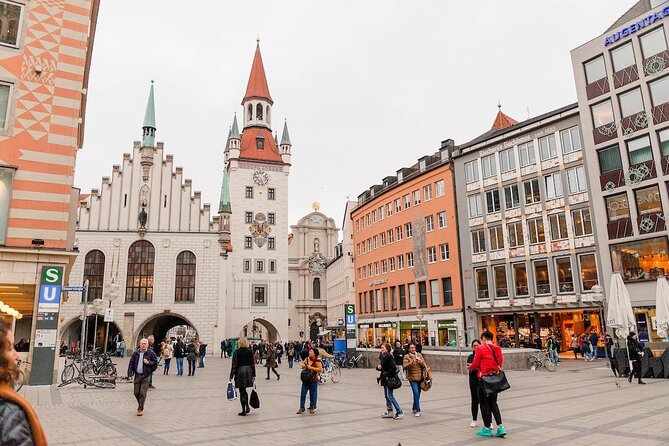
- The Old Town Hall and the beginning of Kristallnacht
- Reading war damage in Munich’s buildings
- Odeonsplatz and the violence of political power
- A memorial at Platz der Opfer des Nationalsozialismus
- Glyptothek and the surviving fascist buildings
- Nazi symbols near the Alter Botanischer Garten
- The Residenz and Hitler’s failed putsch
- Curt Milburn’s guiding style and the private format
- Timing, walking, and what to bring
- Who should choose this experience?
- Should you book the private Munich Third Reich tour?
- FAQ
- Where does the tour begin?
- What time does the tour start?
- Where does the tour end?
- How long does the experience last?
- Is this a private tour?
- What is the price?
- Are entrance tickets included or required?
- Can I cancel for a full refund?
Key points to know before booking
- See nine Nazi-era locations in central Munich, including Isartor, Odeonsplatz, the Old Town Hall, and the Residenz.
- Use historic films and images on an iPad to compare present-day streets with the past.
- Ask questions throughout, since only your group takes part.
- Follow Hitler’s rise and fall, from early political activity to the failed putsch and later resistance.
- Spot wartime scars and surviving Nazi architecture that are easy to miss on your own.
- Meet at Marienplatz at 10:30 am, then finish back at the same meeting point.
Why this Munich tour is different
Munich is often sold through beer halls, royal rooms, and handsome squares. Those are real parts of the city, but they tell only half the story. Munich was also the place where the Nazi movement gained power, developed its public image, and turned political violence into government policy.
This tour helps you connect those facts to actual streets and buildings. That matters because Nazi history can feel distant when you read it in a book. At Isartor, Platzl, and the Old Town Hall, the subject becomes tied to particular rooms, squares, speeches, attacks, and public gatherings.
Curt Milburn has more than seven years of guiding experience and is described as Munich’s top-rated guide, with more than 700 strong guest ratings. The praise focuses less on a rehearsed speech and more on his ability to explain difficult material clearly, answer questions, and shift between broad events and small personal details.
That flexibility is one of the tour’s best features. If you already know the basic timeline, you can ask about individual figures, resistance, or the effect on ordinary residents. If your background is limited, Curt can build the story from the beginning. The supplied iPad adds useful visual proof, with hundreds of films and images drawn from more than 1,000 years of European history.
More Third Reich & WWII Tours in Munich
- Munich: Third Reich & WWII Walking Tour
★ 4.6 · 6,181 reviews - Third Reich Walking Tour Munich
★ 4.5 · 4,291 reviews - Munich: Birthplace of the Third Reich Guided Walking Tour
★ 4.6 · 771 reviews
Starting at Isartor and Platzl
The meeting point is Marienplatz 18, in the center of Munich. From there, the tour begins with Isartor, one of the city’s historic gates. The stop lasts about 15 minutes and focuses on the original beer hall where Hitler met with the Nazis.
This is a useful opening because it places the movement in a social setting rather than beginning with its later power. You get a sense of how political organization grew through meetings, speeches, and personal networks. The stop is brief, so you should expect an introduction rather than a full lecture on early Nazi organization.
The next stop is Platzl, for about 20 minutes. Here, the focus shifts to Hitler’s first speech and his rise to political success. The square is also one of Munich’s best-known areas, which makes the contrast especially sharp. You may have passed through it for food or atmosphere without realizing its political importance.
I like this early sequence. It shows how the tour will work: ordinary public spaces become evidence when you know what happened there. The guide does not need to lead you into a distant museum to explain the subject. The city itself provides the setting.
The Old Town Hall and the beginning of Kristallnacht
The Old Town Hall receives another 20-minute stop. This location is tied to the beginning of Kristallnacht, the coordinated anti-Jewish violence carried out across Nazi Germany, and to an assassination attempt on Hitler’s life.
That combination makes the stop especially important. It places state persecution and opposition to Hitler in the same urban setting. A good guide can help you understand that the Third Reich was not simply a story of one leader issuing orders. It involved public events, propaganda, fear, forced conformity, and people who tried to resist.
The building itself is attractive, which creates a difficult but valuable contrast. Munich’s architectural beauty can hide the violence connected to it. Curt’s use of period images should help you notice details that a standard sightseeing walk would pass over.
The pace remains brisk. Twenty minutes can cover the main events, but it will not allow every question to receive a long answer. The private format helps here, since you can decide if this is a point where you want to pause longer.
Reading war damage in Munich’s buildings
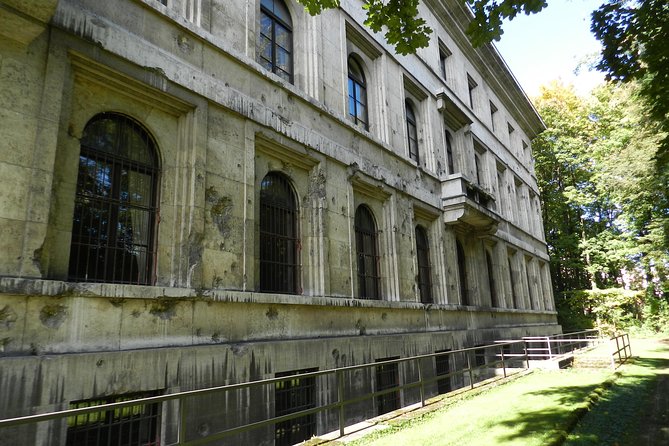
The route returns to Platzl for about 15 minutes, this time to look at evidence of war damage on Munich’s beautiful buildings. That may sound like a small part of the tour, but it is one of the more useful practical features.
Munich today can look polished and complete. Without guidance, you might miss repaired facades, altered sections, or signs of destruction that are not obvious at first glance. The point is not simply to find damage. It is to understand how the city’s appearance changed through war and rebuilding.
This is where the iPad can make a real difference. A historic photograph held against a present-day view can show what disappeared, what survived, and what was repaired. You will likely get more from the buildings because you are not only looking at them as architecture. You are comparing past and present.
Something different for another day:
- From Munich: Neuschwanstein & Linderhof Castle Full-Day Trip
★ 4.5 · 12,494 reviews - Neuschwanstein & Linderhof Castle-Fairytale Day Tour from Munich
★ 4.5 · 7,275 reviews - Dachau Concentration Camp Memorial Site Tour from Munich by Train
★ 4.5 · 5,637 reviews - Neuschwanstein Castle Tour from Munich
★ 4.5 · 5,117 reviews
Odeonsplatz and the violence of political power
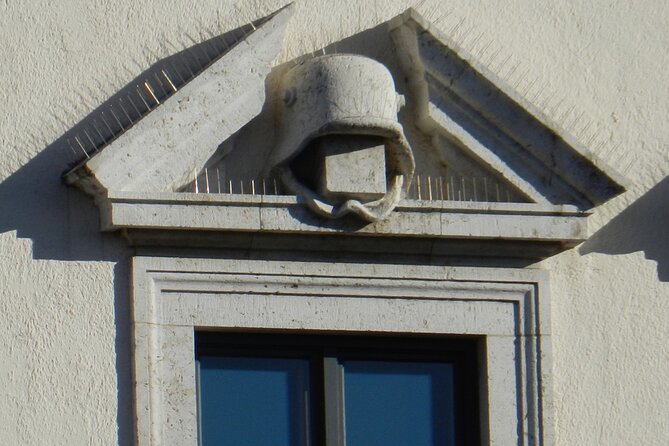
At Odeonsplatz, the tour spends about 10 minutes discussing Hitler’s purge of the SA and the site’s use for his speeches. This is the shortest stop, so expect a compact explanation.
Odeonsplatz is a broad, formal public space, well suited to speeches and political display. The location helps explain how architecture and open squares could be used to project authority. The discussion of the SA purge also points to the internal violence of the Nazi movement. Power was not secured only by winning public support. It was also enforced by removing threats inside the organization.
If you want extended discussion of the purge, this is a good moment to ask for it. Since this is a private tour, you do not have to save questions for the end. The guide can also connect the event to the wider story of Hitler’s consolidation of power.
A memorial at Platz der Opfer des Nationalsozialismus
The stop at Platz der Opfer des Nationalsozialismus lasts around 15 minutes. This memorial honors people who died at the hands of the Third Reich.
After visiting sites linked to Nazi power, this stop shifts the focus to victims. That change is essential. A tour about Hitler’s rise can accidentally give too much attention to speeches, personalities, and political drama. A memorial keeps the human cost in view.
You should expect a sober pause rather than a sensational story. The value here comes from placing Munich’s political history beside remembrance. It also gives you a chance to think about the earlier locations in a different way.
The memorial is especially useful for people who want the tour to include more than military and political history. Curt’s style, as described by the supplied comments, includes both large events and their effect on the general population. That broader frame makes the tour more than a parade of famous Nazi locations.
Glyptothek and the surviving fascist buildings
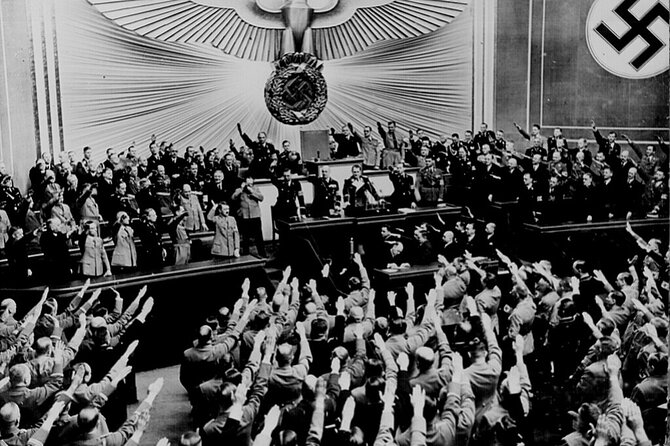
The Glyptothek stop lasts about 20 minutes and covers Munich’s rally grounds, along with fascist buildings connected to Hitler that still remain. This is one of the tour’s strongest architecture-focused sections.
Buildings can reveal political ideas. Monumental design, formal spaces, and carefully planned public settings were used to suggest order, strength, and permanence. Seeing these structures in person can help you understand how the regime used the city as a stage.
The word rally grounds may suggest a single location, but the larger point is how public space was organized for mass politics. Curt’s images should help you see how these settings functioned during the Third Reich, rather than viewing them only as attractive buildings today.
Some visitors may find this section more abstract than the stops tied to a specific speech or attack. I would pay close attention to the visual comparisons. They can explain how propaganda worked without relying only on dates and names.
Nazi symbols near the Alter Botanischer Garten
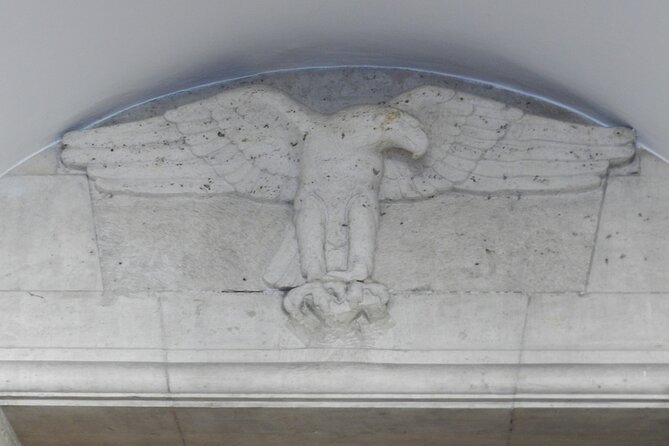
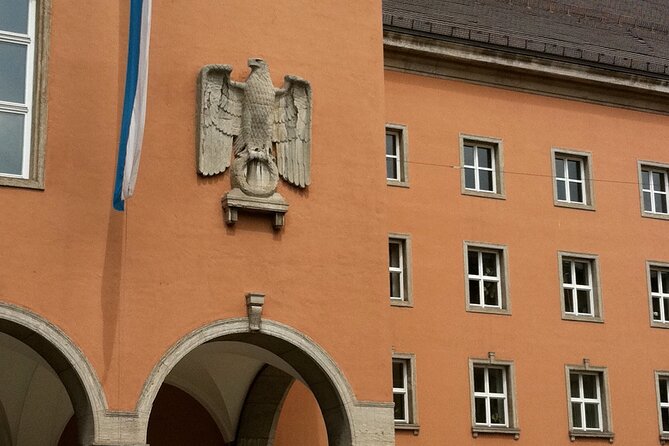
Near the Alter Botanischer Garten, the tour highlights the largest Nazi eagle still on public display in Germany, as well as Nazi architecture and art. The stop lasts about 15 minutes.
This is a striking reminder that traces of the regime have not vanished from the city. You are not being shown a reconstructed exhibit behind glass. You are looking at a surviving public object and considering what it meant, how it was used, and how it is viewed now.
The stop also raises an important question about memory. What should be preserved, explained, or left visible? The tour does not appear to treat the eagle as a curiosity alone. Instead, it uses the object to discuss the visual language of Nazi power.
The information provided does not say whether the eagle is inside a museum or part of a ticketed site, so you should think of this as an outdoor viewing stop rather than a separate museum visit. Admission is listed as free for all stops.
The Residenz and Hitler’s failed putsch
The final major stop is the Residenz München, with about 20 minutes devoted to Hitler’s failed putsch and resistance during the Third Reich. The Residenz is a grand royal complex, and its connection to political failure and opposition adds another layer to the tour.
The failed putsch is important because Hitler’s path to power was not smooth or inevitable. His early attempt to seize power collapsed. The later story of resistance also reminds you that opposition existed, even though the regime made it dangerous.
This stop provides a fitting end because it brings together two themes: the limits of political force and the choices made by individuals under dictatorship. It also prevents the tour from ending with Nazi spectacle alone. You finish with a wider view of resistance and the difficulty of confronting an authoritarian government.
The tour then ends back at the meeting point. Since the route begins and ends in central Munich, you can continue sightseeing from Marienplatz afterward.
Curt Milburn’s guiding style and the private format
The strongest praise for Curt centers on his teaching style. He is described as able to move from broad Nazi history to small, less familiar details, then adjust the depth to match your interests. That is valuable on a subject where some people want a clear introduction and others already know the major events.
You can also expect an engaging, conversational manner. The comments describe him as patient with questions, passionate about the subject, and easy to talk with. One couple found that the iPad images made their history lessons feel more immediate and helped them appreciate the buildings and spaces.
A private tour is especially useful here. Only your group takes part, and the group can include up to 15 people. A small couple or family can ask more freely, while a larger group can share the cost. The price of $180.72 is per group, not per person, so the value improves sharply when several people join.
For one person or a couple, the price is less of a bargain than a standard group walk. For a family, a group of friends, or a private study visit, it can be reasonable because you receive a dedicated guide for two to three hours. The ability to shape the conversation is the main benefit, not a special entrance or included meal.
Timing, walking, and what to bring
The start time is 10:30 am. The experience lasts approximately two to three hours, though the listed stop times already add up to more than two hours. Allow room for walking between locations and for questions.
The tour takes place in central Munich and is near public transportation. All admission tickets are listed as free, so your main cost is the guide service. You receive a mobile ticket, and confirmation is provided when you book.
Because the route covers nine stops, comfortable walking shoes make sense. The information does not provide a precise walking distance or a detailed accessibility statement. It does state that service animals are allowed and that most people can participate.
I would bring a phone for the meeting details and a willingness to ask questions. The iPad is supplied by Curt, so you do not need to prepare a large set of images yourself. If you have a particular interest, such as resistance, architecture, Kristallnacht, or daily life under the regime, mention it at the start.
Who should choose this experience?
I would recommend this tour to anyone who wants more context than a general Munich sightseeing walk provides. It suits adults, older teenagers, students, and history-minded families who can handle a serious subject for several hours.
It is also a good match if you prefer conversation over a fixed script. The private setting lets you ask about details that might be skipped in a large group. The iPad helps if you learn best through photographs and films rather than a spoken timeline.
You may want something else if you prefer a museum-based experience, a longer academic lecture, or a tour focused mainly on art and architecture. The itinerary is broad, and some stops are short. You will see many locations, but no single site receives a full museum-style treatment.
The tone is thoughtful rather than theatrical. That is a strength for me. Nazi history needs clear facts and moral seriousness, not dramatic gimmicks.
Should you book the private Munich Third Reich tour?
Book it if you want a personal, place-based introduction to Munich’s Nazi past, especially if you are traveling with a group of up to 15 and value time for questions. Curt Milburn’s image-based explanations, flexible teaching, and strong record of praise are the main reasons to choose it.
Think twice if you want a long visit inside historical buildings or need every event covered in detail. The tour moves quickly, and the subject is dense. At $180.72 per group, it offers good value for a family or group of friends, while couples should decide how much a private guide is worth to them.
For the right audience, this is a serious and engaging way to see Munich beyond its postcard center. You leave with a clearer sense of how political power, public space, war, memory, and resistance shaped the city.
FAQ
Where does the tour begin?
The tour begins at Marienplatz 18, 80331 München, Germany.
What time does the tour start?
The start time is 10:30 am.
Where does the tour end?
The activity ends back at the meeting point.
How long does the experience last?
The tour lasts approximately two to three hours.
Is this a private tour?
Yes. Only your group takes part, with a maximum group size of 15 people.
What is the price?
The price is $180.72 per group of up to 15 people.
Are entrance tickets included or required?
Admission is listed as free at each stop.
Can I cancel for a full refund?
Yes. You can cancel at least 24 hours before the start time for a full refund. Cancellations or changes made less than 24 hours before the start time are not accepted for a refund.
Just added around Munich
- Munich: Private or Group Third Reich and WWII Walking Tour★ 4.9 · 13 reviews
- From Munich: Neuschwanstein Castle and Linderhof Private Tour★ 5.0 · 13 reviews
- Private Transfer from Munich to Salzburg with 2 hours for sightseeing★ 4.5 · 13 reviews
- Munich: Historical Walking Tour on the Rise of Hitler★ 5.0 · 13 reviews
- Private Scenic Transfer from Munich to Prague with 4h of Sightseeing★ 5.0 · 13 reviews
- From Munich: VIP day trip to Salzburg★ 5.0 · 14 reviews
- National Socialism WWII with licensed guide – private tour★ 5.0 · 14 reviews
- Munich: Walking Tour Old Town 3D VR Tour in GERMAN★ 4.3 · 14 reviews
Third Reich & WWII Tours, compared.
Berlin’s Best: 2 Hour Walking Tour Third Reich and the Cold War
Read our review →
Third Reich Berlin: Hitler and WWII Walking Tour
Read our review →
Walking Tour of Former Nazi Party Rally Grounds
Read our review →
Browse the lists this tour appears in