
Reviewed · WALKING TOURS
Walking Tour on Origins of Nazism in Munich – English
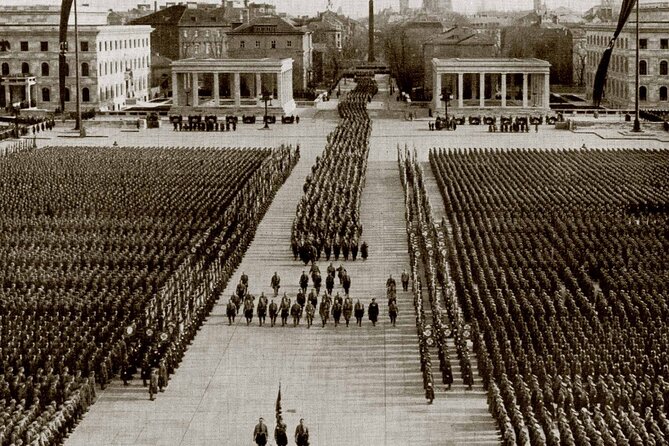
History feels different when you are standing where it happened. This two-hour walking tour connects Munich’s Nazi origins with the city squares, buildings, and memorials that still carry the weight of that era.
I like the clear route from Marienplatz to Königsplatz, which gives you a useful timeline rather than a jumble of names and dates. I also like the chance to see both Nazi sites and monuments to resistance and war victims. The main drawback is simple: Nazism is a huge subject, and two hours can only provide an introduction.
The tour costs $20.16 per person, a fair price for an expert guide leading you between six important locations. Still, you should plan to visit a museum afterward if you want documents, photographs, and fuller historical detail. The tour has a 4.4 rating from 19 reviews, and one especially useful comment describes the guide as very good while noting that the subject is too broad for a single outing.
In This Review
- Five things to know before you go
- Why Munich is the right place for this history
- Starting at Marienplatz and the victims’ memorial
- Hofbräuhaus and the movement’s early base
- Haus der Kunst and the power of propaganda
- Hofgarten and the changing meaning of public space
- Odeonsplatz and the failed coup attempt
- Königsplatz and the Third Reich’s monumental city plan
- How much history fits into two hours
- Price, group size, and practical value
- Who will get the most from this walk
- My booking advice
- FAQ
- How long does the walking tour last?
- What time does the tour begin?
- Where does the tour start?
- Where does the tour end?
- What locations are included?
- Is lunch included?
- What happens if I need to cancel?
Five things to know before you go
- The tour begins at Mariensäule in Marienplatz: You meet at Marienplatz 22 at 3:00 pm, placing you in central Munich from the first minute.
- The route follows the growth of the Nazi movement: Stops move from a memorial to the victims toward places linked with party organization, propaganda, the failed coup, and the Third Reich.
- Hofbräuhaus is part of the political story: This famous brewery is presented not only as a beer hall, but also as a place where the Nazi party established its base.
- Königsplatz provides the strongest closing scene: The tour ends at a square that formed part of the monumental city plan created under the Third Reich.
- You need comfortable walking shoes and an open mind: Admission is included where noted, but lunch is not, and the emotional subject calls for attention rather than a quick sightseeing pace.
Why Munich is the right place for this history
Munich is closely tied to the early growth of National Socialism. The tour begins with the story of Adolf Hitler as a young soldier sent to spy on the German Workers’ Party. Instead of simply observing the group, he joined it, took a leading role, and helped turn it into the Nazi Party.
That opening gives you an important frame. The Nazi movement did not appear fully formed. It grew through political organizing, speeches, propaganda, public ceremonies, and attempts to control important spaces in the city. Munich became a key setting for that process.
I appreciate that the tour is not limited to Adolf Hitler’s biography. It also addresses the meaning of Nazism and its consequences. The focus includes the failed coup attempt, the burning of books associated with Joseph Goebbels, Kristallnacht, resistance, and memorials to people who suffered during the war.
Those subjects can feel overwhelming when studied as a list. On foot, they gain a physical order. You move from one place to the next, and the guide can explain how the city’s political spaces were used. That makes the history easier to follow, especially if you are beginning with only a general understanding of the period.
More Walking Tours in Munich
- Munich: Third Reich & WWII Walking Tour
★ 4.6 · 6,181 reviews - Third Reich Walking Tour Munich
★ 4.5 · 4,291 reviews - Munich: Old Town & Viktualienmarkt City Walk in German
★ 4.7 · 2,304 reviews
Starting at Marienplatz and the victims’ memorial
The meeting point is the Mariensäule at Marienplatz 22. The tour itself begins at 3:00 pm, so you should arrive early enough to locate the meeting spot without rushing through Munich’s busy center.
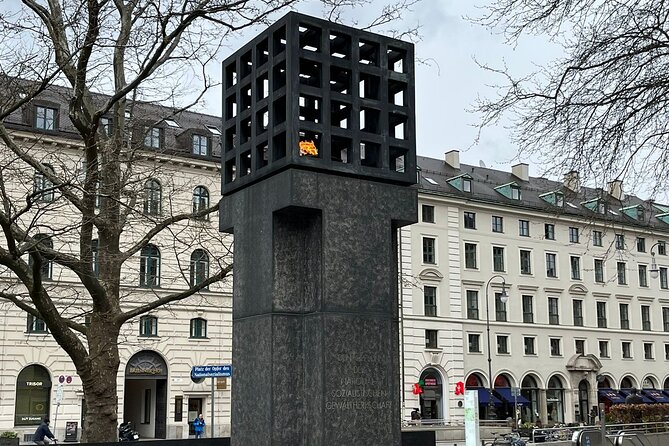
The first listed stop is Platz der Opfer des Nationalsozialismus, or Square of the Victims of National Socialism. You spend about 15 minutes here, with no admission charge.
This is a fitting opening because it places the victims at the front of the story. Rather than beginning with Nazi leaders or grand buildings, the route starts with remembrance. That choice matters. It helps keep the tour from becoming a parade of political personalities and military events.
The square also gives the guide a chance to explain the broader cost of the ideology. You can expect an introduction to the people and communities harmed by Nazi rule, along with the role of public memorials in modern Munich.
Fifteen minutes is not long, so do not expect a full memorial visit. Think of it as the moral and historical starting point for the walk. If you want time to read every detail or reflect quietly, you may need to return later on your own.
Hofbräuhaus and the movement’s early base
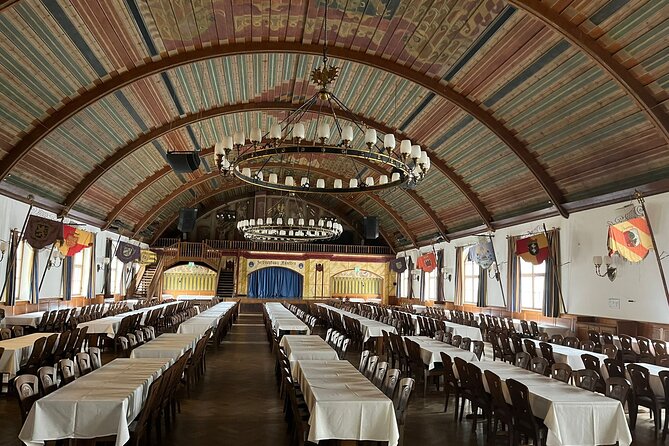
The next stop is Staatliches Hofbräuhaus, the famous brewery associated with Munich’s beer culture. The tour allows about 15 minutes here and includes admission.
This stop adds a less obvious layer to the story. Hofbräuhaus is usually linked with beer, food, and Munich tradition. On this route, you see its political importance as a place where the Nazi party established its base.
That contrast is useful. Political movements do not grow only in government offices. They also use familiar public meeting places, social networks, speeches, and large gatherings. A famous beer hall offers a way to understand how politics could enter everyday public life.
Do not expect this part of the tour to function as a meal stop. Lunch is not included, and the schedule gives you a short historical visit rather than time for a leisurely beer. If you want to eat at Hofbräuhaus, plan to return after the walk or arrange a separate meal.
I like this stop because it connects Munich’s modern tourist identity with a darker chapter. The same city known for beer halls and grand squares also played a major role in the rise of a violent political movement. That tension is uncomfortable, but it is exactly why the site deserves careful explanation.
Haus der Kunst and the power of propaganda
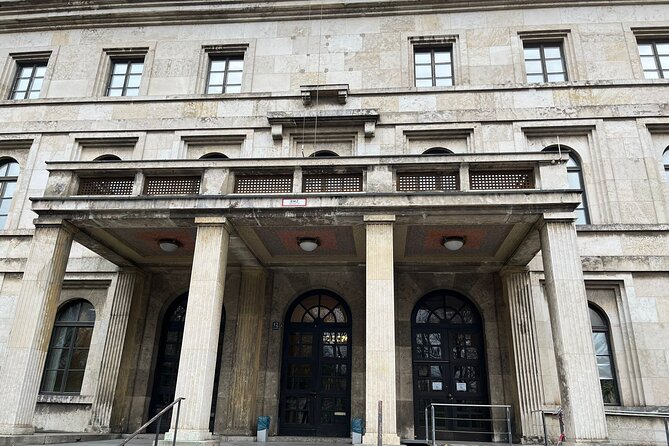
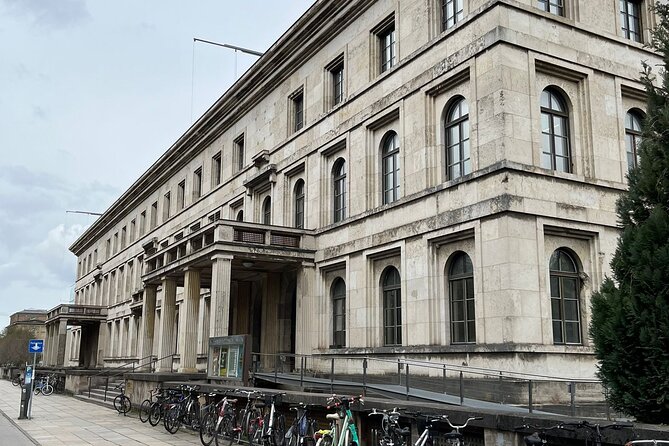
The route then reaches Haus der Kunst, now a museum and one of the first propaganda buildings of the Third Reich. The scheduled visit lasts about 15 minutes, with admission included.
This stop shifts the focus from party organization to visual power. Buildings, exhibitions, and cultural institutions can help a government present an image of order, strength, and national purpose. The architecture and original political role of Haus der Kunst make that idea easier to grasp than an abstract lecture would.
The brief timing means the guide will likely concentrate on the building’s role rather than offer a full museum visit. If you are interested in art, architecture, or Nazi cultural policy, you may want to set aside separate time for a longer look.
For me, this is one of the most valuable parts of the route because it shows that propaganda was not only printed on posters or spoken from platforms. It also appeared in grand public buildings and official ideas about culture. The tour helps you see how art and architecture were used to support political power.
Something different for another day:
- From Munich: Neuschwanstein & Linderhof Castle Full-Day Trip
★ 4.5 · 12,494 reviews - Neuschwanstein & Linderhof Castle-Fairytale Day Tour from Munich
★ 4.5 · 7,275 reviews - Dachau Concentration Camp Memorial Site Tour from Munich by Train
★ 4.5 · 5,637 reviews - Neuschwanstein Castle Tour from Munich
★ 4.5 · 5,117 reviews
Hofgarten and the changing meaning of public space
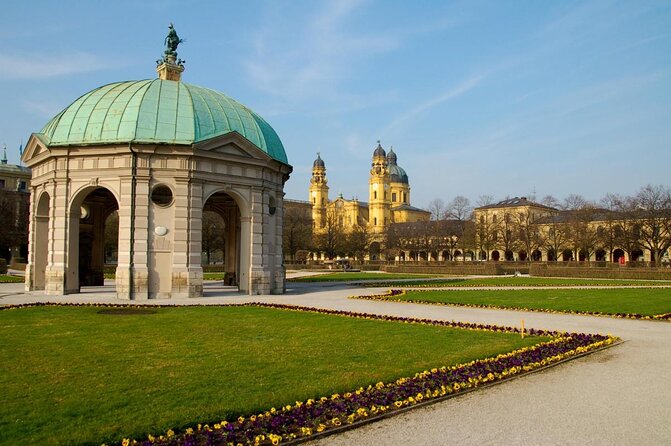
The walk continues to Hofgarten, one of Munich’s major parks. About 20 minutes are allotted here.
A park may seem less directly connected to Nazi history than a party headquarters or monumental square. That is precisely why it can be an interesting stop. Public spaces carry different meanings at different times. A park can be a place for ordinary daily life, political display, commemoration, or resistance.
The guide uses the location to broaden the story beyond leaders and buildings. The tour description specifically includes monuments dedicated to resistance and war victims, and Hofgarten helps connect those themes to the city’s public memory.
The 20-minute pause is the longest at any listed stop. That gives the guide more room to explain the setting and the people who opposed the regime. It may also give you a moment to absorb the difficult material before the route moves toward Odeonsplatz.
Because this is an outdoor stop, the experience depends partly on the weather. The tour is not presented as a museum program, so dress for a normal walking outing and be prepared to remain outside for much of the afternoon.
Odeonsplatz and the failed coup attempt
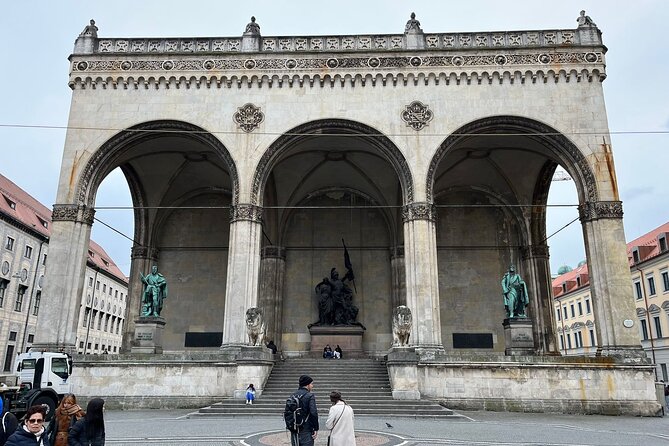
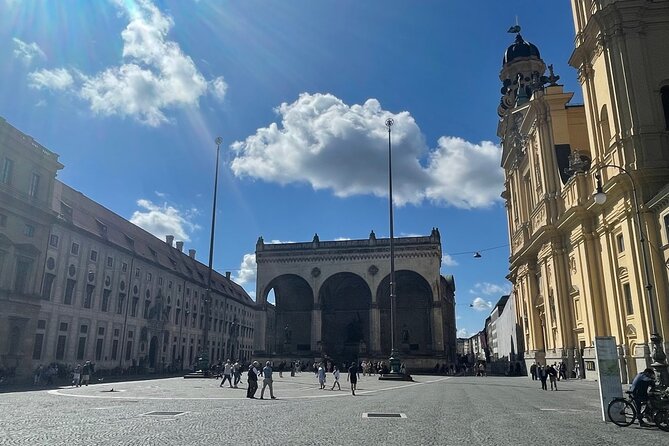
Odeonsplatz is next, with roughly 15 minutes devoted to the square. It is one of Munich’s major public spaces and an important location for understanding the failed coup attempt associated with Hitler and the Nazi movement.
This is where the political story becomes more confrontational. The route helps explain how the Nazi leadership tried to seize power and how that attempt failed. That episode matters because it reveals both the movement’s ambitions and the limits it faced before later events changed Germany.
Odeonsplatz also shows why public squares were so important. Large open spaces could host rallies, ceremonies, confrontations, and displays of authority. A guide can point out how the setting supported the political theater of the period.
The 15-minute stop is enough for a concise explanation, but not for every detail of the coup. If this is the part of the subject that interests you most, write down the names and events the guide mentions and use them as a starting point for further reading.
Königsplatz and the Third Reich’s monumental city plan
The final stop is Königsplatz, where the tour ends after about 15 minutes. The address is Königsplatz 1, 80333 Munich.
Königsplatz is a strong place to finish because it formed part of the backbone of the city planned by the Third Reich. Here, scale and design become political tools. The square helps show how a government can use monumental spaces to create a sense of authority and permanence.
Ending here also gives the walk a clear arc. You begin with victims and remembrance, pass through party organization and propaganda, examine resistance and the failed coup, and finish with the grand public spaces linked to Nazi power.
The end point is different from the meeting point, so you should note the change before setting off. The route begins in the Marienplatz area and finishes at Königsplatz. Both are central Munich locations, and the tour is near public transportation, but the supplied details do not specify a particular station or onward route.
Königsplatz is also a useful place to continue your own study. The walking tour can explain what you are seeing, but the square alone cannot provide the full record of the period. Pairing the walk with a museum visit is a sensible plan.
How much history fits into two hours
Two hours is a good length for an introduction. You get six stops, a clear geographic route, and an expert guide who can connect the locations instead of leaving you to decode them alone.
At the same time, two hours puts a firm limit on detail. The tour touches on Hitler’s rise, the Nazi Party’s early base, the failed coup, propaganda, the burning of books, Kristallnacht, resistance, and wartime victims. Each subject could fill an entire lecture or museum visit.
One Spanish-language review captures the central tradeoff well: the subject is so broad that the full duration can feel short, even while the guide provides a very good introduction. I would treat that not as a flaw in the concept, but as a reason to plan your expectations carefully.
You are booking a guided orientation, not a complete course on Nazi Germany. The value comes from learning where Munich’s key sites fit into the story. Once you have that map in your mind, museum visits and further reading become easier.
The English format also matters. You can ask questions and resolve confusion as the tour progresses, which is useful with a subject full of similar names, political groups, and dates. The description says the guide will answer questions about this complex and controversial topic, though it does not identify the guide by name.
Price, group size, and practical value
At $20.16 per person, the tour offers reasonable value if you want a guided introduction to Munich’s Nazi past. You are paying for an expert guide, a two-hour route, and the structure that links six locations. The price is especially fair for people who would otherwise spend time researching a route themselves.
The group can have up to 35 participants. That is a manageable size for a city walk, but it is not an intimate private tour. You may need to stay close to the guide, listen carefully near busy public spaces, and accept that questions may take a little time.
Most people can take part, and the experience is near public transportation. A mobile ticket is provided, which keeps the booking simple. The tour starts at 3:00 pm, making it easy to pair with morning sightseeing or a museum visit later in the day.
Free cancellation is available up to 24 hours before the start time for a full refund. Changes or cancellations made within 24 hours are not accepted for a refund. The experience also requires a minimum number of participants, so a cancellation by the provider can result in another date or experience, or a full refund.
Who will get the most from this walk
I would recommend this tour to anyone visiting Munich for the first time who wants historical context before visiting museums. It is also a good fit if you prefer learning through places rather than reading a long guidebook before you arrive.
You will get the most from it if you:
- Want a focused introduction to the origins of Nazism in Munich
- Prefer an English-speaking guide to independent research
- Are comfortable walking between public squares, parks, and buildings
- Want to understand both Nazi power and resistance to it
- Plan to add a museum or further reading afterward
This may not suit you if you want a quiet architectural walk with only light historical commentary. The subject is violent, political, and emotionally serious. It is not a casual sightseeing loop with a few dramatic anecdotes added for flavor.
Families and school-age participants may find the topic useful, but the supplied information does not give a recommended minimum age or a special children’s format. Use your own judgment based on how much difficult history you want to discuss during the walk.
My booking advice
I would book this tour if you want a practical first look at Munich’s role in the rise of Nazism. The route is well organized, the price is moderate, and the mix of memorials, political sites, parks, and monumental squares gives you more than a single narrow angle.
I would not book it as your only study of the subject. The 4.4 rating from 19 reviews is encouraging, and the praise for the guide’s introduction is useful, but the two-hour format cannot cover every event in enough detail. Add a museum, return to a memorial, or set aside time for reading.
The best plan is to arrive at Marienplatz with enough time to find the Mariensäule, wear comfortable shoes, and keep the afternoon open through the 3:00 pm start. After the final stop at Königsplatz, you will have a clearer map of Munich’s Nazi past and a better sense of where to continue.
FAQ
How long does the walking tour last?
The tour lasts approximately two hours.
What time does the tour begin?
The tour begins at 3:00 pm.
Where does the tour start?
It starts at Mariensäule, Marienplatz 22, 80331 München, Germany.
Where does the tour end?
It ends at Königsplatz 1, 80333 München, Germany.
What locations are included?
The route includes Platz der Opfer des Nationalsozialismus, Staatliches Hofbräuhaus, Haus der Kunst, Hofgarten, Odeonsplatz, and Königsplatz.
Is lunch included?
No. Lunch is not included in the tour price.
What happens if I need to cancel?
You can cancel up to 24 hours before the start time for a full refund. Cancellations or changes made less than 24 hours before the start time are not refunded or accepted.
Just added around Munich
- Munich: Private or Group Third Reich and WWII Walking Tour★ 4.9 · 13 reviews
- From Munich: Neuschwanstein Castle and Linderhof Private Tour★ 5.0 · 13 reviews
- Private Transfer from Munich to Salzburg with 2 hours for sightseeing★ 4.5 · 13 reviews
- Munich: Historical Walking Tour on the Rise of Hitler★ 5.0 · 13 reviews
- Private Scenic Transfer from Munich to Prague with 4h of Sightseeing★ 5.0 · 13 reviews
- From Munich: VIP day trip to Salzburg★ 5.0 · 14 reviews
- National Socialism WWII with licensed guide – private tour★ 5.0 · 14 reviews
- Munich: Walking Tour Old Town 3D VR Tour in GERMAN★ 4.3 · 14 reviews
Walking Tours, compared.
Berlin’s Best: 2 Hour Walking Tour Third Reich and the Cold War
Read our review →
Third Reich Berlin: Hitler and WWII Walking Tour
Read our review →Browse the lists this tour appears in