
Reviewed · THIRD REICH & WWII TOURS
Nuremberg Third Reich Tour in Spanish
Nuremberg’s stones still carry the Nazi era. This Spanish-language walking tour links the city’s medieval power, antisemitism, Nazi propaganda, wartime destruction, and postwar justice in about three hours. I like the clear historical progression and the fact that the route ends at the Street of Human Rights, a fitting modern response to the city’s past.
I also like the personal, energetic guiding style praised in comments about Federico, who is described as well prepared, flexible, and able to make difficult material approachable. The main consideration is the amount of information packed into a three-hour walk, especially in hot weather, and the tour requires good weather to operate.
In This Review
- Key points to know before you book
- Why Nuremberg became Hitler’s chosen propaganda city
- Starting at Frauenkirche and Hauptmarkt
- St. Sebaldus Church and the long road to Nazi antisemitism
- Nuremberg Rathaus and Hitler’s bond with the city
- The main synagogue memorial and Kristallnacht
- Katharinenkirche and the city after the war
- St. Lorenz and the concentration camp connection
- The State Theater and opera under National Socialism
- Charterhouse Gate and the Nuremberg Trials
- Ending at the Street of Human Rights
- Is $19.70 good value for three hours?
- Language, pace, weather, and practical details
- Who will get the most from this walking tour?
- Should you book the Nuremberg Third Reich Tour in Spanish?
- FAQ
- Where does the tour begin?
- Where does the tour end?
- What time does the tour start?
- How long does the tour last?
- What language is the tour conducted in?
- What is the price?
- What is the maximum group size?
- Can I cancel for a full refund?
Key points to know before you book
- The route connects nine important sites, beginning at Hauptmarkt and ending near Nuremberg’s central train station.
- The focus reaches beyond Hitler, covering medieval antisemitism, the destruction of the main synagogue, the concentration camp connection, and the Nuremberg Trials.
- Spanish is the tour language, making this a useful choice for Spanish-speaking visitors who want more than a basic city walk.
- Federico receives strong praise for his preparation, warmth, flexibility, and ability to keep the three hours moving.
- The price is $19.70 per person, a reasonable rate for a guided history walk of this length.
- The group can include up to 30 people, so expect a shared walking experience rather than a private tour.
Why Nuremberg became Hitler’s chosen propaganda city
Nuremberg was not selected by accident. For centuries, it held an important place in the Holy Roman Empire, and the city hosted the famous Imperial Diets, where the emperor met with prince electors. The Nazi regime used that older political symbolism to present itself as the heir to Germany’s medieval power.
That is the central idea of this tour. You are not simply looking at Nazi-era buildings. You are following the way the regime borrowed older symbols, stories, and places to build its public image.
Nuremberg was presented as the German city par excellence, the loyal center of the movement. It was also home to Julius Streicher, one of the regime’s most extreme representatives of antisemitism and the owner of the weekly newspaper Der Stürmer. The route helps you connect that hateful ideology with the streets and institutions of the old city.
I find that approach useful because it gives the tour more shape than a simple list of wartime dates. You begin with the city’s medieval identity, then see how that past was twisted for political use. From there, the route moves toward persecution, war, destruction, and justice.
More Third Reich & WWII Tours in Nuremberg
- Nuremberg: Walking Tour of Former Nazi Party Rally Grounds
★ 4.7 · 1,665 reviews - Nuremberg: Historischer Kunstbunker WWII Art Bunker Tour
★ 4.8 · 921 reviews - Nuremberg Old Town and Nazi Party Rally Grounds Walking Tour in English
★ 4.5 · 504 reviews
Starting at Frauenkirche and Hauptmarkt
The tour begins at Hauptmarkt 14, beside the Frauenkirche. This is a practical meeting place in the old center, and it lets the guide begin with a medieval setting before discussing the Third Reich.
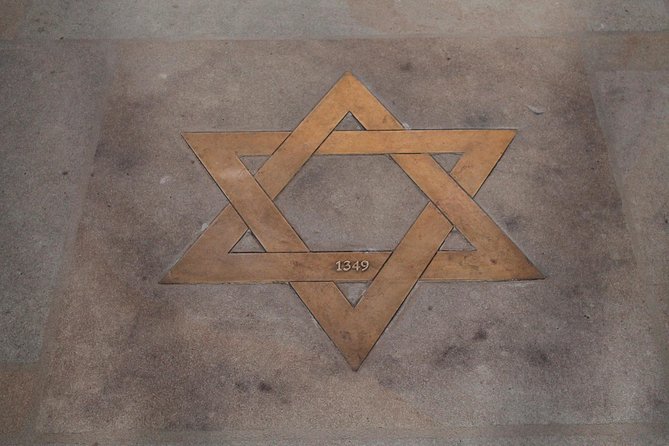
The first stop covers the Jewish quarter and the pogrom of 1349. That subject matters because it places antisemitism in a longer timeline. The tour does not treat Nazi persecution as something that appeared without warning. Instead, it explains how hostility toward Jewish communities had earlier roots in the city’s history.
You spend about 15 minutes here. That is enough for an introduction, though anyone wanting a long examination of medieval Nuremberg will need a separate museum visit or walking tour. The value here is the connection between place and theme: the square is not just a convenient starting point, but a way to understand how older religious and political ideas were later exploited.
St. Sebaldus Church and the long road to Nazi antisemitism
At St. Sebaldus Church, the discussion continues from medieval antisemitism to National Socialism. This is one of the most important transitions in the walk, since it asks you to consider both continuity and change.
The stop lasts around 15 minutes. You can expect the guide to explain how antisemitic ideas developed over time and how the Nazi regime turned prejudice into state policy. That is a difficult subject, but the route’s steady pace helps keep it understandable.
I like this part of the itinerary because it avoids reducing the period to Hitler alone. The Nazi system depended on older prejudices, political organization, propaganda, and public support. A walking tour cannot explain every part of that system, but this stop gives you a useful framework for the rest of the afternoon.
Nuremberg Rathaus and Hitler’s bond with the city
The Rathaus, or city hall, brings the story closer to Hitler and Nuremberg’s role in the regime. You spend another 15 minutes learning about Hitler’s relationship with the city and why Nuremberg was so useful as a symbolic center.
This is where the earlier discussion of imperial diets becomes important. The Nazi leadership wanted to connect its movement with the power of the medieval German Empire. Nuremberg’s old status made it suitable for that message.
A guide-led explanation is especially helpful here because the significance is not always obvious from the building itself. You may see an attractive historic city hall, while the tour explains how the city’s image was used for political theater. That contrast is one of the walk’s strongest features.
Something different for another day:
- Bamberg: Guided Walking Tour
★ 4.6 · 3,202 reviews - Nuremberg: City Tour with the Bimmelbahn Train
★ 4.4 · 2,475 reviews - Nuremberg: Old Town Guided Walking Tour
★ 4.6 · 2,416 reviews - Nuremberg: Tunnels and Secret Passages in the City Wall Tour
★ 4.8 · 2,334 reviews
The main synagogue memorial and Kristallnacht
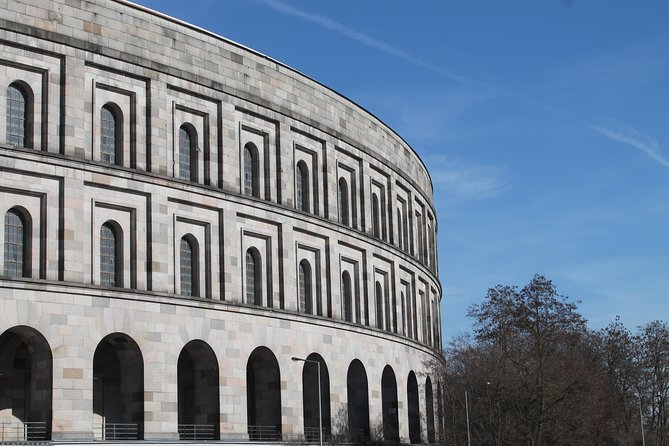
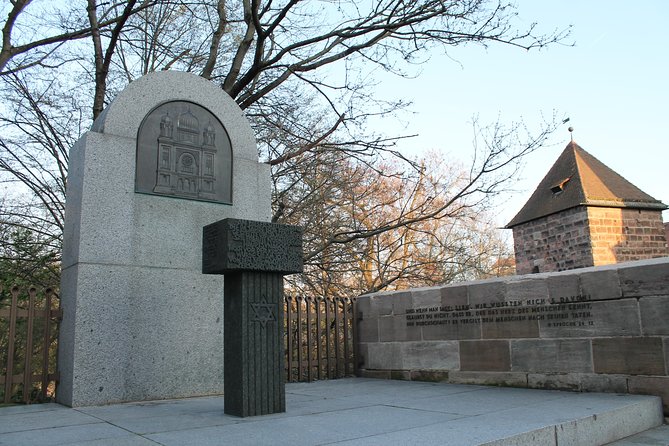
The stop at the memorial for Nuremberg’s main synagogue lasts about 10 minutes. The focus is its destruction and the Night of Broken Glass, commonly known as Kristallnacht.
This is a short stop, but it carries considerable weight. The tour moves from antisemitism as an ideology to a specific act of destruction against a Jewish place of worship. The memorial gives the subject a clear location within the city.
You should expect the tone to become more serious here. The route does not treat the period as a collection of dramatic Nazi stories. It keeps attention on the people and institutions targeted by the regime. That makes the stop an important counterbalance to the discussion of Hitler’s political use of Nuremberg.
Katharinenkirche and the city after the war
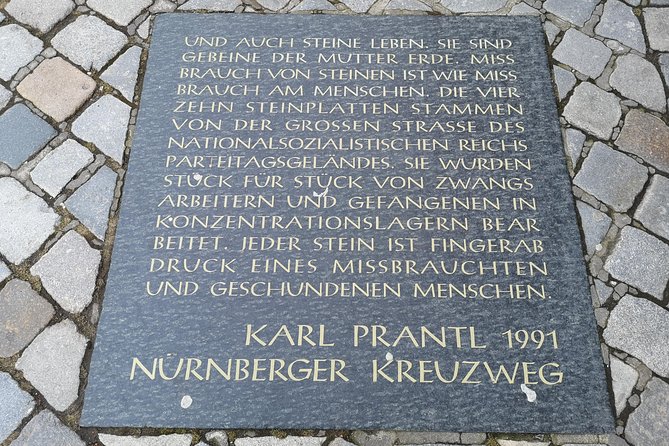
At the ruins of Katharinenkirche, the subject changes to the battle and liberation of Nuremberg, followed by the city’s reconstruction. The stop takes about 10 minutes.
The ruined church offers a visible way to discuss wartime destruction. You are no longer looking only at political speeches and ideology. The route shows what war did to Nuremberg itself and introduces the long process of rebuilding.
The word reconstruction is important here. The city had to decide how to live with its damaged buildings and its difficult past. A short stop cannot cover every rebuilding decision, but it helps you see that the end of the war did not end the story. Nuremberg also had to redefine itself after being closely tied to the Nazi regime.
St. Lorenz and the concentration camp connection
The walk continues to St. Lorenz, where the guide explains the church’s Via Crucis and its relationship with the Nuremberg concentration camp. This stop lasts around 10 minutes.
The connection between a major church and a concentration camp gives the discussion a powerful local focus. Rather than treating the camp system as something distant, the tour links it to the city you are walking through.
The Via Crucis also adds a religious dimension to the route. The stop is not presented as a separate sightseeing moment. It becomes part of the tour’s larger question: how did Nuremberg’s religious, civic, and political institutions relate to the period’s persecution and violence?
This is another place where a Spanish-speaking guide can add real value. The subject needs careful explanation, and Federico is praised for handling difficult material with depth while keeping the walk active and understandable.
The State Theater and opera under National Socialism
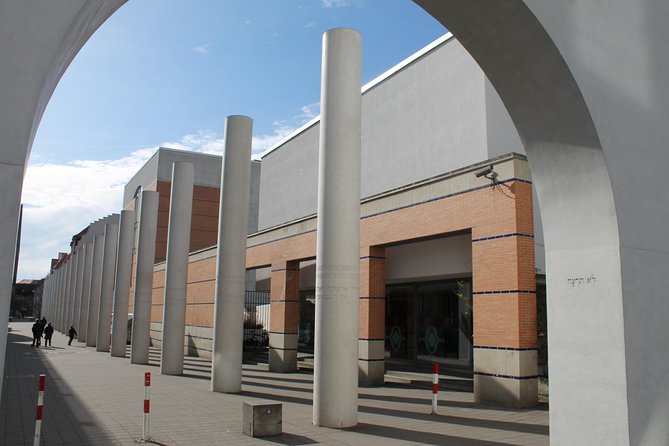
The Nuremberg State Theater receives about 10 minutes. Here, the focus is the opera house and its link with National Socialism.
This stop broadens the tour beyond government buildings and religious sites. Culture and entertainment were also part of the regime’s public image. The theater helps you consider how art and performance could be connected to political power.
I appreciate this inclusion because it shows that propaganda did not operate only through rallies and speeches. A city’s cultural institutions could also support the image a regime wanted to project. The theater stop is brief, but it adds another layer to the story and keeps the walk from becoming too narrowly focused on military history.
Charterhouse Gate and the Nuremberg Trials
At Charterhouse Gate, the tour turns to the Nuremberg Trials. You spend about 15 minutes on this subject, which is one of the walk’s key historical points.
The trials matter because they represent the effort to hold leading figures of the Nazi regime legally accountable after the war. Placing this discussion late in the route creates a clear movement from medieval symbolism, to Nazi power, to persecution and destruction, and finally to justice.
The stop also helps explain why Nuremberg’s identity did not end with its role as a propaganda center. The same city became associated with an international attempt to establish responsibility for crimes committed by the regime.
You should keep your expectations realistic. This walking tour does not include a long indoor visit to a courtroom or a museum session. The stop provides context and location as part of the broader route. If the trials are your main interest, you may want to allow extra time elsewhere in Nuremberg after the tour.
Ending at the Street of Human Rights
The final stop is the Street of Human Rights, near Kartäusergasse 1. The tour ends close to the central train station, about a 10-minute walk from the starting point.
This is a strong ending. After beginning with medieval persecution and moving through Nazi antisemitism, wartime destruction, and the trials, the route finishes with a public statement about human rights. The location gives the tour a forward-looking close without pretending that the past can be erased.
The ending is also practical. You are left near the station and central transport links, so it is easy to continue your day from there. The finish is not an isolated monument at the edge of town. It returns you to the modern city.
Is $19.70 good value for three hours?
At $19.70 per person, this is a low-cost way to spend an afternoon in Nuremberg. The fee covers a Spanish-speaking guide and a route through nine historically important locations. Since admission tickets are not listed for the stops, you are paying mainly for explanation, structure, and local context.
That matters. You could walk past these sites on your own, but the connections between them would be harder to see. The guide explains why Nuremberg was chosen, how antisemitism developed, how the city was destroyed, and why the trials were held here.
The group size can reach 30 people. That keeps the price accessible, but it also means the experience may feel less personal than a small private walk. If you want to ask many questions or move at your own pace, a larger group could be a limitation.
The three-hour duration is also worth considering. It is long enough to cover a serious amount of material, but not long enough for every stop to receive equal depth. The tour is best for a structured overview with strong links between locations, not for an exhaustive study of each site.
Language, pace, weather, and practical details
The guide is in Spanish, so this is best suited to you if Spanish is your preferred language for historical subjects. The comments about Federico describe an engaging guide who is well prepared, flexible, and able to make the route feel dynamic even while covering a great deal of information.
The start time is 3:30 pm. That can work well if you spend the morning at museums or arrive in Nuremberg later in the day. Check your schedule carefully, since the walk lasts approximately three hours and can run into the evening.
Wear comfortable shoes. The experience is a walking tour through the city, and the amount of material means you will want to stay focused rather than worry about tired feet. On hot days, bring water and sun protection. One especially positive comment praised the tour despite the heat, but hot weather can still make a long historical walk more demanding.
A mobile ticket is provided, and confirmation arrives when you book. Service animals are allowed, the route is near public transportation, and most people can take part. The activity depends on good weather and a minimum number of participants. If it is canceled for either reason, you are offered another date or experience, or a full refund. You can also cancel for a full refund up to 24 hours before the start time.
Who will get the most from this walking tour?
I would choose this tour if you want a serious introduction to Nuremberg’s Nazi past but prefer learning in Spanish. It suits first-time visitors who need a clear route and students or history-minded visitors who want the city’s medieval and modern stories connected.
It is also a good fit if you want to understand the role of propaganda, not just see famous Nazi locations. The tour includes the synagogue memorial, the concentration camp connection, the theater, and the Street of Human Rights, so the subject is wider than military history.
You may want something else if you dislike walking, prefer private guiding, or want long indoor visits. The group can reach 30 people, the stops are relatively short, and the experience depends on the weather.
Should you book the Nuremberg Third Reich Tour in Spanish?
I would book it if you want a focused Spanish-language introduction to Nuremberg’s difficult past at a modest price. The route is thoughtfully arranged, the final stop gives the story a meaningful modern direction, and Federico’s praised style adds warmth and clarity to heavy material.
The best reason to choose it is the range of subjects. In three hours, you move from the 1349 pogrom and medieval antisemitism to Hitler’s relationship with Nuremberg, the destroyed synagogue, the war, the concentration camp connection, the opera house, the trials, and human rights.
Just arrive ready to walk, listen, and absorb a lot. If you want a first framework for understanding Nuremberg, this tour offers strong value. If you want detailed museum time or a private conversation with the guide, use it as an introduction and continue your research afterward.
FAQ
Where does the tour begin?
The tour begins at Hauptmarkt 14, 90403 Nürnberg, Germany.
Where does the tour end?
It ends at the Street of Human Rights at Kartäusergasse 1, 90402 Nürnberg, near the central train station.
What time does the tour start?
The start time is 3:30 pm.
How long does the tour last?
The experience lasts approximately three hours.
What language is the tour conducted in?
The tour includes a guide in Spanish.
What is the price?
The listed price is $19.70 per person.
What is the maximum group size?
The tour can have a maximum of 30 participants.
Can I cancel for a full refund?
Yes. You can cancel at least 24 hours before the start time for a full refund. Cancellations or changes made less than 24 hours before the start time are not refunded or accepted.
Just added around Nuremberg
- Bayreuth: Private Guided Walking Tour★ 5.0 · 15 reviews
- Nuremberg: St. Johannis Friedhof &Hesperidengärten IN GERMAN★ 4.4 · 15 reviews
- Nuremberg: Medieval Time Travel for Kids★ 4.9 · 15 reviews
- PRIVATE Nuremberg WW2 and Old Town Day Tour (Product code: 87669P16)★ 4.5 · 15 reviews
- Bayreuth City Walking Tour★ 4.6 · 16 reviews
- Nuremberg: Medieval Ages Tour in Spanish★ 4.5 · 16 reviews
- PLAYMOBIL®-FunPark Entrance Ticket★ 4.5 · 17 reviews
- Nuremberg: Private guided tour of the Old Town in German★ 4.9 · 17 reviews
Third Reich & WWII Tours, compared.
Berlin’s Best: 2 Hour Walking Tour Third Reich and the Cold War
Read our review →
Third Reich Berlin: Hitler and WWII Walking Tour
Read our review →
Walking Tour of Former Nazi Party Rally Grounds
Read our review →
Browse the lists this tour appears in