
Reviewed · WALKING TOURS
Munich in the 3rd Reich and WW2 private walking tour
Munich’s beauty hides a brutal political past. I like the way this private walking tour links the Great War, postwar unrest, Hitler’s rise, and the Nazi regime to real places in central Munich. I also like the use of old photographs, documents, and memorabilia, which help you compare today’s streets with the city of the 1920s and 1930s. The main drawback is simple: this is a serious history tour, taken entirely on foot, and Munich weather can make the experience tiring.
For a group of up to six, the private format gives you time to ask questions and shape the discussion. Guides including Taff Simon, Kevin, David Simon, and Joanne have been praised for their warmth, humor, dramatic storytelling, and ability to keep teenagers interested. Plan on about four hours, wear good shoes, and expect a thoughtful look at how an attractive German city became the Nazi movement’s political home.
In This Review
- Key points at a glance
- Why Munich is the right place for this history
- Starting at Isar Gate and setting the historical frame
- Following the Nazi Party’s early years
- Seeing how public places became political stages
- The White Rose and additional historical questions
- Taking a break in a historic beerhall
- Understanding Munich during the Allied bombing campaign
- Ending at Odeonsplatz in 1945
- How the private format affects the experience
- Weather, walking, and what to bring
- Which guide might lead your walk?
- Is this Munich WWII tour worth booking?
- FAQ
- Where does the Munich Third Reich walking tour start?
- Where does the tour end?
- How long does the tour last?
- How much does the private tour cost?
- Is the tour conducted in English?
- Is this a private tour?
- Does the price include a guide?
- Are food and drinks included?
- Is much walking involved?
- Can I cancel for a full refund?
Key points at a glance
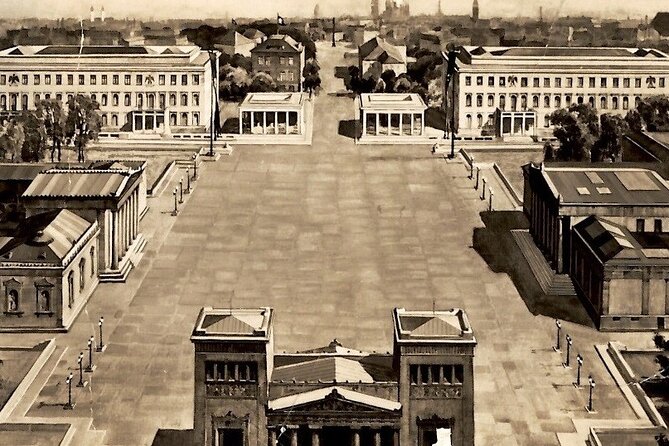
- Munich was the Nazi movement’s political home: The tour explains why the city became known as the Capital of the Movement.
- Old photographs make the past easier to see: Guides use visual material and memorabilia to connect present-day streets with wartime Munich.
- The route covers more than battlefield facts: You’ll hear about the Treaty of Versailles, the Beer Hall Putsch, the SS, Kristallnacht, the Munich Pact, bombing, and the city’s surrender in 1945.
- Private guiding changes the pace: Your group can ask questions, request extra topics, and shorten or reshape the walk when needed.
- A beerhall stop may be part of the afternoon: Refreshments are not included, and you can request a cafe instead.
- The tour suits families as well as serious history fans: Guides have kept 11-year-olds and teenagers engaged through stories, props, and a lively delivery.
Why Munich is the right place for this history
Munich is often introduced through churches, grand palaces, beer halls, lederhosen, and Oktoberfest. That pleasant image is real, but it leaves out the city’s central role in the rise of National Socialism.
After the First World War, Germany faced political violence, economic strain, and humiliation connected with the Treaty of Versailles. Munich became a center of radical politics. The city briefly experienced a Soviet Republic, and competing groups fought over Germany’s future.
This unsettled period created room for the Nazi Party to grow. Adolf Hitler, an Austrian by birth, found an audience here and developed the political network that eventually carried him to national power. Munich was later given the Nazi title Capital of the Movement, a reminder that the city was not merely an early stop in the story. It was a key stage.
I find that this context gives the walk its real value. You are not simply checking off locations connected with Hitler and the Second World War. You are looking at how political extremism took hold in a functioning city, how ordinary public spaces became tied to propaganda and violence, and how memory remains part of Munich’s modern identity.
More Walking Tours in Munich
- Munich: Third Reich & WWII Walking Tour
★ 4.6 · 6,181 reviews - Third Reich Walking Tour Munich
★ 4.5 · 4,291 reviews - Munich: Old Town & Viktualienmarkt City Walk in German
★ 4.7 · 2,304 reviews
Starting at Isar Gate and setting the historical frame
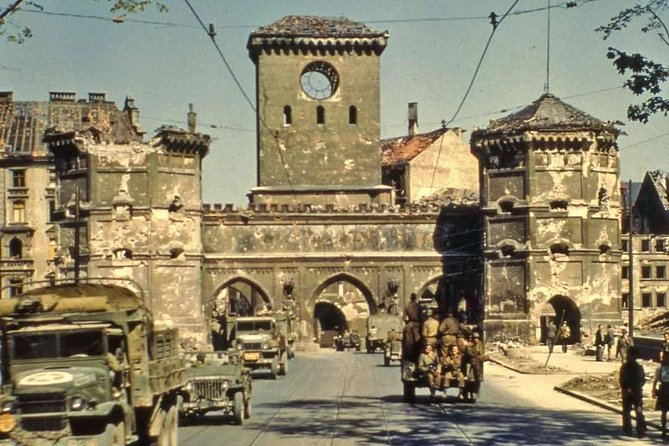
The listed starting point is Isar Gate, at Tal 50. The tour may also arrange pickup at Munich’s main train station or Marienplatz, so confirm the exact meeting point when you book.
Beginning near Isar Gate places you in the historic center, where modern shops, restaurants, and daily city life sit close to major historical sites. That contrast matters. This is not a remote battlefield or an isolated memorial circuit. The story unfolds amid the same urban fabric that residents and visitors use today.
The opening section deals with the Great War and its aftermath. This is important because the Nazi rise did not happen in a vacuum. You’ll hear how defeat, anger over the peace settlement, and social disorder shaped the political mood.
A good guide should help you follow the chain of events without making the period feel like a list of dates. Taff Simon is particularly praised for explaining the subject in clear language and responding to questions rather than rushing through a fixed script. Kevin has also been singled out for his humor and ability to work with younger participants.
Following the Nazi Party’s early years
The Munich route focuses heavily on the origins of the Nazi Party. You’ll learn how the movement developed in the city and how Hitler built support during a time of political confusion.
One of the main subjects is the Beer Hall Putsch, the failed 1923 attempt by Hitler and his supporters to seize power in Bavaria. The event is often treated as a footnote in broader accounts of the Nazi era, but in Munich it becomes more tangible. The tour shows how an unsuccessful revolt could still be used for publicity and political mythmaking.
The route also covers the birthplace of the SS. That subject needs careful treatment, and the private format helps. You can ask about how Nazi organizations operated, how they gained authority, and how their early development connected to later terror.
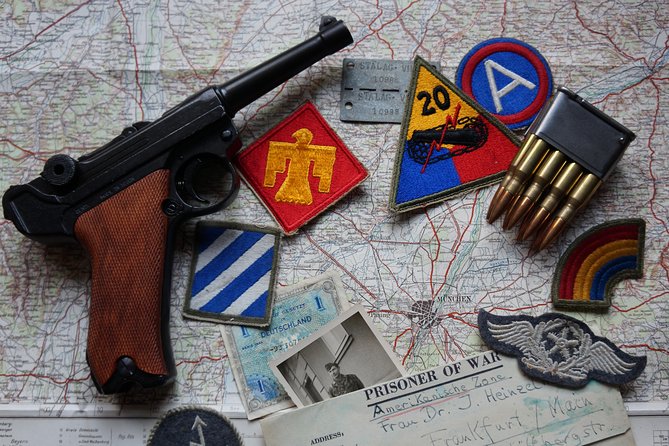
The guides do not rely only on spoken explanation. Several participants have praised the photos, printed material, and historical objects brought along during the walk. These aids are especially useful at locations where no obvious wartime structure remains. A present-day street can look ordinary until you see an old image of the same place filled with uniforms, banners, or crowds.
Seeing how public places became political stages
A strong feature of this experience is the way it connects big events with everyday urban spaces. You’ll discuss the Nazi Party headquarters and the signing of the Munich Pact, one of the major diplomatic moments before the Second World War.
The Munich Pact belongs to the wider story of appeasement and the failure of European powers to stop Hitler’s expansion. Seeing this chapter in Munich adds a local angle to a subject often taught only through maps and textbooks.
You’ll also hear about Kristallnacht and the origins of the Holocaust. This part of the walk is likely to be the most emotionally difficult. The value lies in understanding the progression from political extremism and organized prejudice to state-backed persecution and mass murder.
I appreciate that the tour description frames this history as a warning rather than a spectacle. The purpose is not to make Nazi imagery or Hitler into objects of fascination. It is to examine how destructive ideas gained public space, political support, and institutional power.
Because the tour is private, you can ask for more explanation if the subject feels rushed or too general. You can also tell the guide before starting if your group wants more attention on Jewish persecution, resistance, military history, or Munich’s political culture.
Something different for another day:
- From Munich: Neuschwanstein & Linderhof Castle Full-Day Trip
★ 4.5 · 12,494 reviews - Neuschwanstein & Linderhof Castle-Fairytale Day Tour from Munich
★ 4.5 · 7,275 reviews - Dachau Concentration Camp Memorial Site Tour from Munich by Train
★ 4.5 · 5,637 reviews - Neuschwanstein Castle Tour from Munich
★ 4.5 · 5,117 reviews
The White Rose and additional historical questions
The advertised subjects include the main Nazi story, but the guides may also bring in related topics. David Simon has been praised for adding information about the White Rose, the student resistance group connected with Munich.
The White Rose is a useful counterpoint to the story of Nazi power. It reminds you that opposition existed, even under a dictatorship that made dissent dangerous. If this subject matters to you, mention it when arranging the tour. A private walk gives you a better chance of receiving more than the standard overview.
The guides also have interests beyond the Third Reich period. David Simon has worked in archaeology and has taken part in digs in Germany, while the company also offers medieval tours. That broader background can add useful local context, though the amount of time spent on other periods will depend on your questions and the day’s schedule.
Some groups have asked to see places not originally planned, and the guide adjusted the route. That flexibility is one of the strongest reasons to pay for a private tour rather than join a large public group.
Taking a break in a historic beerhall
The walk generally includes a break in a beerhall associated with the history being discussed. Hofbräuhaus has been specifically praised as part of the experience, and a stop there can add a distinctly Munich touch to a difficult afternoon.
Keep your expectations practical. Refreshments are not included, so you pay for your own drink or food. If a beerhall does not suit your group, you can ask for a cafe instead.
This pause is useful for more than a drink. Four hours of political history and walking is a lot to absorb, particularly with children or older family members. It gives you a chance to sit, ask follow-up questions, and take stock before continuing.
If you are interested in beer culture, this is an enjoyable addition. If you prefer a strictly memorial-focused experience, the break may feel less essential. Tell your guide what balance you want.
Understanding Munich during the Allied bombing campaign
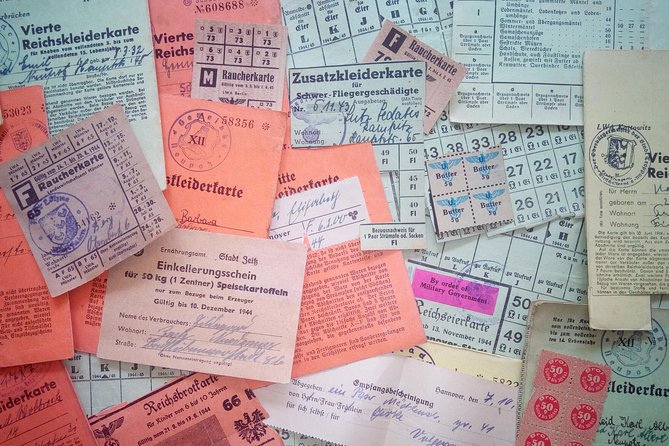
The tour turns from the Nazi rise to the war itself, including the Allied bombing campaign. This helps explain the physical changes you see in central Munich and the difficult choices faced by residents during the final years of the conflict.
The subject is not presented as a simple tale of one side suffering and the other side acting without context. Munich was a major center of the Nazi state, and the bombing formed part of the Allied effort to defeat Germany. At the same time, civilians lived through destruction, fear, and loss.
A walking tour is well suited to this part of the story because you can look at the modern city while considering how much was damaged, rebuilt, or altered. The exact buildings and viewpoints depend on the guide’s route, but the emphasis is on making the wartime city understandable through its streets.
This section can be particularly useful if you know the military timeline but want a better sense of what the war meant inside a German city. It shifts the experience away from personalities alone and toward the wider effects of dictatorship and war.
Ending at Odeonsplatz in 1945
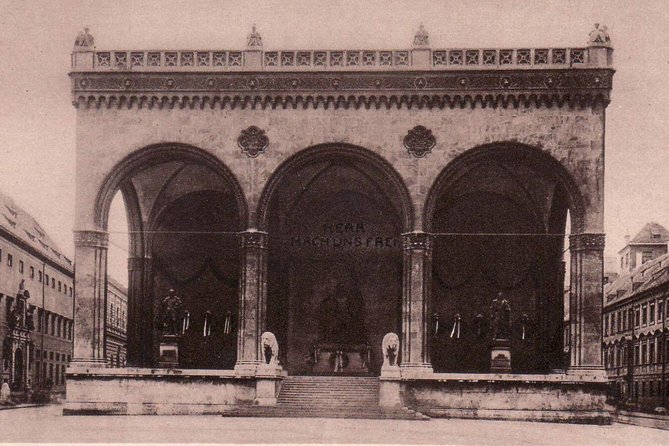
The listed endpoint is Odeonsplatz, at the large plaza beside the Residenz palace and only a few minutes from Marienplatz. It is a convenient place to finish because you are near central transport, restaurants, shopping, and other Munich sights.
The final historical subject is how Munich fell to US forces in 1945. Ending with the city’s defeat gives the walk a clear arc, from postwar unrest and political extremism to dictatorship, war, bombing, and occupation.
Odeonsplatz is also a good practical endpoint. You can continue sightseeing in the old center without arranging a return transfer. Remember that this is a walking tour, not a vehicle-based route. The meeting and finishing points are central, but you still need to walk between the stops.
How the private format affects the experience
The advertised price is $423.44 per group of up to six people. That is expensive for one or two people, but the calculation changes with a full group. Six people pay about $70.57 each, while two people pay about $211.72 each.
For a group of relatives or friends, the value comes from the guide’s full attention. You can stop for questions, ask for more detail about the White Rose or the Munich Pact, and request a different balance between political, military, and social history.
The private setup also helps with family groups. Guides have kept an 11-year-old and three teenagers engaged, using photos, stories, humor, and occasional dramatic acting. That does not mean every child will enjoy four hours of Nazi history, but it gives you a better chance than a formal lecture with a fixed script.
The duration is listed as approximately three hours and 30 minutes to four hours and 30 minutes. Allow the longer end of that range, especially if your group asks many questions or takes a break. One family had the tour shortened in freezing, snowy weather without losing the main substance, which shows the value of having a guide who can adjust the plan.
Weather, walking, and what to bring
You should treat this as a real walking outing. A moderate amount of walking is involved, and the tour does not use a car or bus between sites.
Wear supportive shoes and dress for the forecast. The tour operates in all weather, so rain, cold, or snow can affect your comfort. The December 24 experience in freezing and snowy conditions still went ahead, but the group requested a shorter route after the weather became difficult.
Bring water and money for the optional refreshment stop. A phone is useful for the mobile ticket and for meeting the guide, though the most important item is suitable clothing.
The tour is near public transportation, and most people can participate. Service animals are allowed. If someone in your group has difficulty walking for several hours, discuss that before booking rather than assuming the route can be covered by vehicle.
Which guide might lead your walk?
Taff Simon is the name most closely associated with the experience. His strengths are clear communication, strong preparation, visual aids, humor, and a dramatic delivery that can make complicated events easier to follow.
Kevin has also received praise for being punctual, funny, and effective with an 11-year-old. Joanne has led the tour as a substitute and was praised for using photographs, explaining the history clearly, and keeping a family interested.
You may not be able to choose a particular guide, so focus on the company and the private format rather than booking solely for one name. If a specific guide matters to you, ask about availability before confirming.
Is this Munich WWII tour worth booking?
I would recommend it if you want to understand Munich’s role in the rise of Nazism rather than simply visit a museum or memorial. The tour is especially useful for history fans, families with older children, and anyone who values the chance to ask questions without a large group setting.
I would think twice if you dislike long walks, want a light sightseeing experience, or expect entrance tickets and meals to be included. The subject is dark, the weather may be uncomfortable, and the price is hard to justify for only one or two people.
For six people sharing the cost, the private arrangement is much more attractive. Book well ahead if possible, since the experience is often reserved around 54 days before the date. You can cancel for a full refund up to 24 hours before the start time, but last-minute changes and cancellations are not accepted.
FAQ
Where does the Munich Third Reich walking tour start?
The listed starting point is Isar Gate at Tal 50, 80331 Munich. Pickup can also be arranged at Munich Hauptbahnhof or Marienplatz.
Where does the tour end?
The tour ends at Odeonsplatz, beside the Residenz palace and a few minutes from Marienplatz.
How long does the tour last?
The approximate duration is three hours and 30 minutes to four hours and 30 minutes.
How much does the private tour cost?
The price is $423.44 per group of up to six people.
Is the tour conducted in English?
Yes. The experience is offered in English.
Is this a private tour?
Yes. Only your group participates, with a maximum of six people.
Does the price include a guide?
Yes. A professional guide is included.
Are food and drinks included?
No. The tour generally stops for a break in a related beerhall, but refreshments are not included. You can request a cafe instead.
Is much walking involved?
Yes. This is a walking tour, with a moderate amount of walking between sites. No car or bus is used.
Can I cancel for a full refund?
Yes, if you cancel at least 24 hours before the experience start time. Cancellations or changes made less than 24 hours before the start time are not accepted.
Just added around Munich
- Munich: Private or Group Third Reich and WWII Walking Tour★ 4.9 · 13 reviews
- From Munich: Neuschwanstein Castle and Linderhof Private Tour★ 5.0 · 13 reviews
- Private Transfer from Munich to Salzburg with 2 hours for sightseeing★ 4.5 · 13 reviews
- Munich: Historical Walking Tour on the Rise of Hitler★ 5.0 · 13 reviews
- Private Scenic Transfer from Munich to Prague with 4h of Sightseeing★ 5.0 · 13 reviews
- From Munich: VIP day trip to Salzburg★ 5.0 · 14 reviews
- National Socialism WWII with licensed guide – private tour★ 5.0 · 14 reviews
- Munich: Walking Tour Old Town 3D VR Tour in GERMAN★ 4.3 · 14 reviews
Walking Tours, compared.
Berlin’s Best: 2 Hour Walking Tour Third Reich and the Cold War
Read our review →
Third Reich Berlin: Hitler and WWII Walking Tour
Read our review →Browse the lists this tour appears in