
Reviewed · WALKING TOURS
Love and War in Berlin: Self-Guided Story Puzzle Walk
Berlin turns its past into a walking puzzle. This self-guided story game links Alexanderplatz, Nazi-era memorials, grand civic squares, and the site of Hitler’s former bunker in about an hour. I like the freedom to begin when it suits you, pause for a coffee, and continue later. I also like that the route uses real streets and monuments rather than keeping you inside a tour group.
The low $6 price is another strong point, especially for couples, families, or friends who want a short activity between bigger Berlin plans. The trade-off is clear: there is no human guide to explain a difficult question or add context on the spot. A few puzzles may also demand very exact answers, so patience helps.
In This Review
- Key points to know before you start
- A short Berlin history lesson with a game attached
- Starting beneath the World Clock at Alexanderplatz
- Neptune Fountain and the layered center of Berlin
- Marx and Engels, then the former Pleasure Garden
- Neue Wache and the puzzle at Bebelplatz
- Gendarmenmarkt and the quieter political stops
- Ending at the Memorial to the Murdered Jews of Europe
- What the $6 price gives you
- Solving the questions without losing your patience
- Who will enjoy this Berlin walk
- Should you book Love and War in Berlin?
- FAQ
- How much does the experience cost?
- How long does the walk take?
- Where does the walk begin?
- Where does the walk end?
- What time can I take the experience?
- Is the experience guided by a person?
- Do I need an internet connection while playing?
- Is this a private activity?
- What language is offered?
- Can I cancel for a refund?
Key points to know before you start
- Alexanderplatz is the starting point: Begin at the World Clock, a useful meeting spot in the middle of Berlin’s Mitte district.
- The route mixes several eras: You move from Prussian architecture and communist monuments to Nazi crimes and postwar remembrance.
- The puzzles make you look closely: Answers come from details around each stop, not from simply following a map.
- The walk ends near Hitler’s former bunker site: The final area includes the Memorial to the Murdered Jews of Europe.
- You control the timing: Start any time during the operating hours, stop when you wish, and resume later.
- It works offline and stays private: No physical guide, no shared group, and no internet connection is needed during play.
A short Berlin history lesson with a game attached
This experience is best understood as a compact city walk with story prompts. You use your phone to move from one location to the next, inspect the surroundings, and solve a challenge before the next part opens.
That format changes how you see familiar sights. Instead of walking past the Neptune Fountain or the Red Town Hall while thinking about your next photo, you stop and study the details. The game gives you a reason to look up, read inscriptions, count features, and notice how Berlin’s public spaces have changed purpose over time.
The subject is mainly Berlin’s wartime and political past, but the route reaches further back. You encounter Prussian Neoclassicism, imperial civic buildings, communist-era monuments, Nazi censorship, and modern memorial design. That mix gives you a useful first look at central Berlin, even though no one-hour route can explain every period fully.
The title suggests a story about love and war, but you should expect a serious route. It deals with the Nazi period, the destruction of Jewish life, wartime memory, and Hitler’s former bunker. The puzzle format keeps the walk active, yet it does not turn these places into light entertainment. Bring the right mood and allow extra time at the memorials.
More Walking Tours in Berlin
- Discover Berlin Half-Day Walking Tour
★ 5.0 · 9,624 reviews - Berlin: Third Reich and Cold War 2 Hour Walking Tour
★ 4.9 · 6,830 reviews - Berlin: Discover Berlin Walking Tour
★ 4.9 · 5,998 reviews
Starting beneath the World Clock at Alexanderplatz
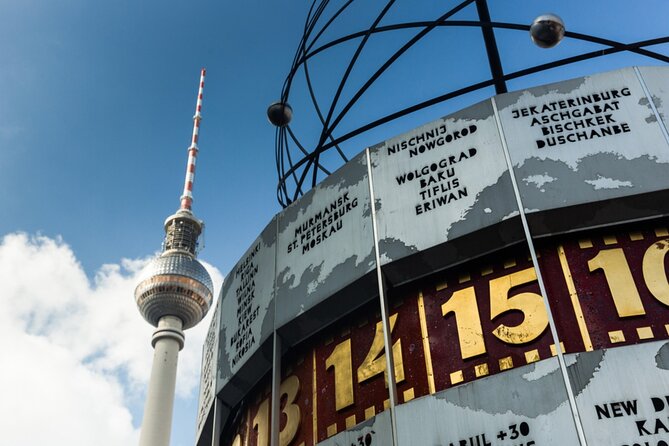
The walk begins at the World Clock, also called the Urania World Clock, in Alexanderplatz. Its metal rotunda shows the current time in 148 major cities. That makes it more than a practical meeting point. It also reflects East Berlin’s former interest in presenting itself as part of a global socialist world.
Your first task asks you to examine the clock and find the answer needed to continue. This is a good opening puzzle because the object is large, public, and easy to locate. Alexanderplatz itself can feel sprawling, so starting beside a distinctive landmark helps you get your bearings fast.
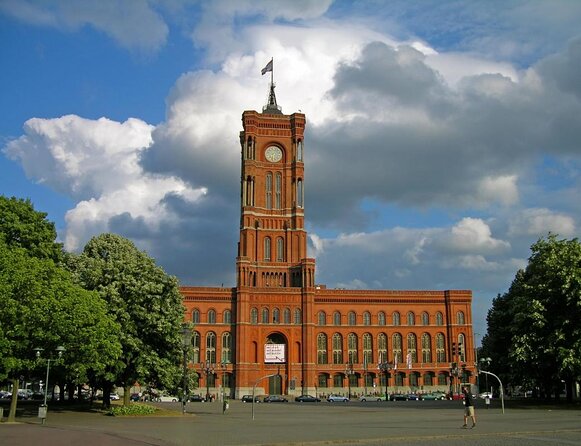
From here, the route introduces the Rathaus, Berlin’s red-brick town hall. Built between 1861 and 1869, it follows the Northern Italian High Renaissance style. Its tower was influenced by the cathedral tower at Laon in France, while the building itself was modeled on the old town hall in Toruń, now in Poland.
I like this early contrast. Alexanderplatz is often associated with modern Berlin and the television tower, but the Rathaus points you toward the city’s nineteenth-century ambitions. The puzzle asks you to look closely at the building, so you get a reason to notice its design rather than treating it as background scenery.
Neptune Fountain and the layered center of Berlin
The Neptune Fountain is one of the route’s more approachable stops. Created in 1891 by Reinhold Begas, it places the Roman god Neptune at the center of a large sculptural group.
You have about 10 minutes listed for this stop, though the game lets you work at your own speed. The challenge again depends on observation. Look around the fountain and its figures, then enter the answer precisely.
This is also a useful reminder that Berlin’s public spaces have not had one fixed purpose. Monuments, fountains, gardens, and squares have been altered, renamed, or used by different governments. The game’s strength is its ability to connect those changes without requiring a long lecture.
One caution: public spaces can be affected by temporary events, markets, or construction. A seasonal market once made parts of the route harder to follow, requiring some maneuvering. If an area is blocked, do not assume you have made a wrong turn. Check the surroundings carefully and give yourself time to work around the obstruction.
Marx and Engels, then the former Pleasure Garden
The Marx-Engels Forum shifts the tone. This public park was created by East German authorities in 1986 and named for Karl Marx and Friedrich Engels, the authors of The Communist Manifesto. The monument and open space reflect the German Democratic Republic’s effort to present socialist history in the center of Berlin.
This stop matters because it shows how public memory was shaped before reunification. Berlin is not only a city of Nazi memorials and Prussian palaces. It also contains visible reminders of the forty years when the city was split between different political systems.
The route then continues to the Lustgarten on Museum Island. The name means Pleasure Garden, although the square has served many purposes. It was once part of the Berlin City Palace grounds, and at different times it became a parade ground, a place for mass rallies, and a public park.
I find this pairing effective. Marx and Engels point to East Germany, while the Lustgarten carries traces of monarchy, militarism, mass politics, and public life. You are not just checking off monuments. You are seeing how the same central spaces can be claimed by very different ideas about power.
Something different for another day:
- Berlin: Reichstag, Dome and Government District Guided Tour
★ 4.7 · 18,288 reviews - Berlin: 1-Hour City Tour by Boat with Guaranteed Seating
★ 4.3 · 16,993 reviews - Berlin: Boat Tour Along the River Spree
★ 4.4 · 11,252 reviews - Berlin: Hop-on Hop-off Bus Tour with Live Commentary
★ 4.3 · 8,579 reviews
Neue Wache and the puzzle at Bebelplatz
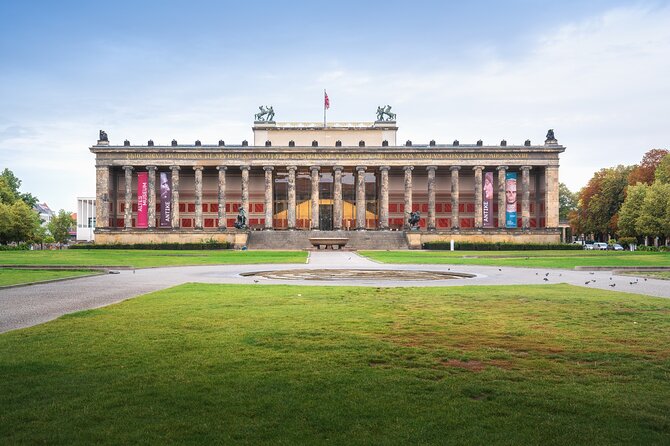
The Neue Wache sits along Unter den Linden and is one of the key buildings on the route. Karl Friedrich Schinkel designed it between 1816 and 1818 as a guardhouse for the royal palace and as a memorial to the wars of liberation.
Its severe Neoclassical design suits Berlin’s formal central boulevard. The building also carries later layers of remembrance, which makes it an important stop for anyone trying to understand how Germany has changed the way it honors war and loss.
Next comes Bebelplatz, one of the most sobering locations in the walk. It was the site of a Nazi book burning on May 10, 1933, when nationalist German students burned works considered politically or culturally dangerous. The event took place in Berlin and in other German university cities.
The game gives this stop about 10 minutes. Use that time. Bebelplatz is easy to cross quickly, but its significance deserves a pause. The challenge may draw your eyes toward a particular detail, yet the setting itself is the main lesson: censorship and public intimidation were staged in the heart of the capital.
The route’s puzzle system can help younger participants engage with the site, but adults should provide added context if needed. A phone prompt cannot replace a careful explanation of what happened or why book burning was such a powerful act of control.
Gendarmenmarkt and the quieter political stops
Gendarmenmarkt is one of central Berlin’s grandest squares. Its name comes from the Gens d’armes cuirassier regiment, whose stables once occupied the area. Friedrich II later had the stables demolished, and a theater, now the Konzerthaus Berlin, was built between the two churches.
The square is a strong visual stop, with its formal arrangement and imposing buildings. It also gives the walk a change of pace after Bebelplatz. The question here is likely to make you inspect the architecture and public space, so take a moment before rushing onward.
The route then passes the representation of the Free and Hanseatic City of Hamburg in Berlin. This classicist town house is still used for political meetings and public events. The minister-presidents of Germany’s 16 federal states meet in Berlin, and the Hamburg representation takes part in federal political life through the Bundesrat.
This may seem less famous than the major squares, but I appreciate its inclusion. It shows that Berlin’s government district is not only made of parliament buildings and headline monuments. Regional governments maintain offices here, host events, and take part in national legislation.
This section also illustrates one limitation of a short walking game. Some locations reward a quick look, while others need more explanation than the format can provide. If political institutions interest you, note the building and return later with more time.
Ending at the Memorial to the Murdered Jews of Europe
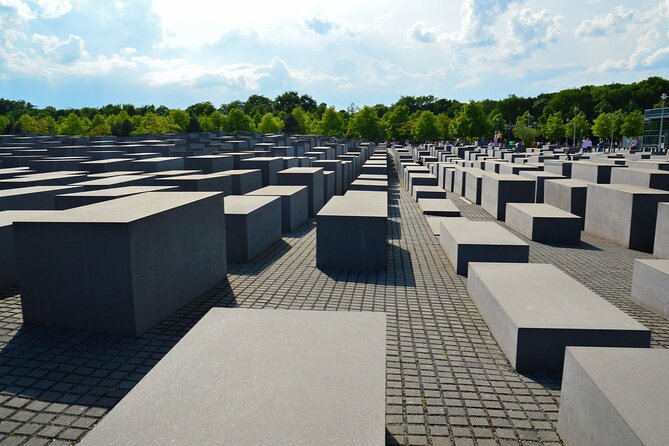
The walk ends at the Memorial to the Murdered Jews of Europe on Cora-Berliner-Straße. In 1999, after lengthy debate, the German parliament approved a central memorial site. New York architect Peter Eisenman won the design competition, and the memorial opened in 2005.
The memorial’s field of concrete stelae creates a powerful, unsettled experience. The route brings you to the site of Hitler’s former war bunker, making the ending especially direct. You move from places where Nazi ideas were promoted and enforced to a memorial dedicated to the people murdered under that regime.
Do not treat the final stop as just the finish line for the game. Once you solve the last challenge, pause and walk through the memorial at your own pace. The listed duration is about one hour, but this is the place where adding time gives the experience more weight.
The final location is also practical for continuing your day. It sits near major central Berlin sights, so you can continue exploring after the game. The experience does not include a physical guide, museum admission, or a formal closing talk, so plan your own follow-up if you want more detail about the memorial or the bunker site.
What the $6 price gives you
At $6 per person, this is inexpensive by Berlin tour standards. The cost is especially fair if you are traveling with a group and want a private activity without paying for a guide by the hour. Group discounts are available, which may make the price even better for families or friends.
The value comes from structure rather than personal commentary. You receive a route, a sequence of story challenges, and the freedom to explore without waiting for a group. The game is available every day, and you can begin at any hour during the stated operating period of 5:00 AM to 9:00 PM.
That flexibility can save a day. You might play before a museum visit, stop for lunch, or pause when a square becomes crowded. You can also resume later, a useful feature if you are traveling with children or combining the walk with other plans.
The price is less attractive if you want detailed historical discussion. A local guide could explain political context, architecture, and memorial culture in far greater depth. I would see this game as an affordable introduction, not a replacement for a dedicated history tour or museum visit.
Solving the questions without losing your patience
The challenges are designed to make you inspect each place. Some are very easy. Others require an exact answer, and a small difference in wording can prevent the game from accepting your solution.
That precision is part of the fun, but it can also be the main source of frustration. Enter answers carefully and read the prompt closely. If a response does not work, check spelling, numbers, and the exact detail the question asks for before moving on.
The route is generally manageable and not described as too far apart, but a one-hour estimate leaves little room for long stops. I would budget extra time if you want photos, coffee, or a thoughtful visit at Bebelplatz and the Holocaust Memorial.
You do not need an internet connection to play once the game is set up. That is useful in a foreign city, where mobile data can be unreliable. You still need a functioning mobile device to access the experience, and confirmation arrives at booking.
Who will enjoy this Berlin walk
I would recommend it most to:
- First-time visitors who want a quick introduction to central Berlin
- Couples or friends who enjoy puzzles and independent sightseeing
- Families looking for an activity that gives children a reason to observe buildings
- Berlin residents who want to notice familiar places in a new way
- Budget-minded visitors who do not need a live guide
- People who prefer private activities and flexible timing
It may not suit you if you want a detailed account of WWII from a historian, a slow architectural tour, or help at every step. The subject is serious, and the game format requires you to do some work yourself.
The experience is private, so only your own group participates. Service animals are allowed, most people can take part, and the route is near public transportation. The provided information does not give full details about step-free access at every stop, so check directly if that is important for your group.
You can cancel for a full refund up to 24 hours before the scheduled start time. Cancellations or changes within 24 hours are not refunded or accepted.
Should you book Love and War in Berlin?
Book it if you want a low-cost, self-paced way to connect Berlin’s central sights. The strongest feature is the route itself. You move from Alexanderplatz to the Holocaust Memorial while seeing how monarchy, socialism, Nazism, war, and modern Germany occupy the same city center.
I especially like the mix of famous locations and less obvious stops, such as the Hamburg state representation. The puzzles also make the walk more active than a standard audio route. Just keep your expectations realistic: this is a phone-based game, not a guided seminar.
For $6, it is an easy addition to a Berlin day. Give yourself more than the advertised hour, slow down at the serious memorials, and be ready for a few exact-answer puzzles. If you value independence and a bit of play, this is a smart buy. If you want a human voice and fuller historical explanation, choose a live tour instead.
FAQ
How much does the experience cost?
The experience costs $6 per person. Group discounts are available.
How long does the walk take?
The estimated duration is about one hour.
Where does the walk begin?
It begins at the World Clock at Alexanderplatz, listed as Alexanderpl. 1, 10178 Berlin, Germany.
Where does the walk end?
It ends at Cora-Berliner-Straße 1, 10117 Berlin, near the Memorial to the Murdered Jews of Europe and the site of Hitler’s former bunker.
What time can I take the experience?
It is available Monday through Sunday during the stated operating hours of 5:00 AM to 9:00 PM.
Is the experience guided by a person?
No. It is a self-guided activity and does not include a physical tour guide.
Do I need an internet connection while playing?
No. The game can be played offline.
Is this a private activity?
Yes. Only your own group participates, with no shared group.
What language is offered?
The experience is offered in English.
Can I cancel for a refund?
Yes. You can receive a full refund if you cancel at least 24 hours before the scheduled start time. Cancellations within 24 hours are not refunded.
Just added around Berlin
- Kreuzberg Private Walking Tour: Immigrants, Artists & Hipsters★ 5.0 · 3 reviews
- Private Photo Tour in Kreuzberg★ 5.0 · 3 reviews
- Individual city tour Berlin for max. 8 persons★ 5.0 · 3 reviews
- Berlin’s Jewish Heritage: Private Tour of the Vibrant Jewish District★ 5.0 · 3 reviews
- Berlin & The Third Reich Private Guided Tour★ 5.0 · 3 reviews
- Private Analogue Photography Experience in Berlin★ 5.0 · 3 reviews
- Spy Mission in Berlin: Self-Guided Espionage Puzzle Quest★ 5.0 · 3 reviews
- Berlin Christmas Markets Walking Tour with Local Guide★ 5.0 · 3 reviews
Walking Tours, compared.





Berlin’s Best: 2 Hour Walking Tour Third Reich and the Cold War
Read our review →


Third Reich Berlin: Hitler and WWII Walking Tour
Read our review →Browse the lists this tour appears in