
Reviewed · THIRD REICH & WWII TOURS
Hitler to Stalin – WWII & Cold War Tour (Small Group)
Berlin keeps its hardest stories in plain sight. This 2.5-hour walking tour links Nazi-era sites, Soviet memorials, and Cold War landmarks in one focused route. I like the clear historical arc from the Brandenburg Gate to Checkpoint Charlie, and I like that the group is limited to 15 people. At $23, the price is especially appealing for a guided look at so many central sights.
The strongest feature is the guide-led storytelling. Mark receives repeated praise for bringing the Battle of Berlin to life with old photographs and confident answers. I also like that the tour deals with German crimes, Jewish suffering, Soviet power, Berlin’s division, and reunification without treating the city as a collection of pretty buildings. The main drawback is pace: nine stops in 150 minutes leaves only a short time at each one, and much of the experience takes place outdoors.
In This Review
- Key points to know before you book
- Why this Berlin history walk works
- Starting at the Brandenburg Gate
- The Reichstag and the road to dictatorship
- The Soviet War Memorial in Tiergarten
- Walking among the concrete blocks at the Holocaust Memorial
- The Führerbunker site and the final days of Hitler
- An unusual Cold War connection at the North Korean Embassy
- Remembering the June 17, 1953 uprising
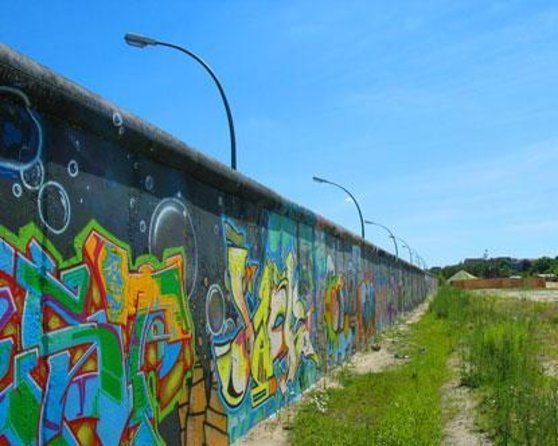
- The Berlin Wall Memorial and the human cost of division
- Finishing at Checkpoint Charlie
- What the guide adds to the walk
- Timing, walking conditions, and group size
- Who should book this $23 experience?
- Should you book the Hitler to Stalin tour?
- FAQ
- Where does the tour begin?
- Where does the tour end?
- How long does the tour last?
- How much does the tour cost?
- How many people can join the tour?
- Is this a walking tour?
- Are admission tickets included?
- Is the Reichstag interior visit included?
- Are service animals allowed?
- Can I cancel for a full refund?
Key points to know before you book
- Nine major sites in 150 minutes: The route covers the Brandenburg Gate, Reichstag, Soviet War Memorial, Holocaust Memorial, Führerbunker site, North Korean Embassy, June 17 Uprising memorial, Berlin Wall Memorial, and Checkpoint Charlie.
- A strong WWII to Cold War timeline: You move from Nazi power and the end of the war into Soviet control, the 1953 uprising, the Berlin Wall, and the Cold War border.
- Mark is a highly praised guide: His use of historical photographs and his ability to answer questions add useful visual context to the walk.
- Small group size: A maximum of 15 people should make it easier to hear the guide and ask questions than on a large city tour.
- No attraction admission fees: The listed stops are viewed from public areas, so your $23 mainly pays for the guide and the organized route.
- Simple central finish: The tour begins at Pariser Platz by the Brandenburg Gate and ends at Checkpoint Charlie on Friedrichstraße.
Why this Berlin history walk works
Berlin has enough wartime and Cold War sites to fill several days. The challenge is understanding how they fit together. This walk gives you a useful framework in one sitting, moving from the symbols of Prussian and Nazi Germany to the physical and political scars left by division.
I like the route because it does not focus only on Hitler. It also gives space to the Soviet victory, the murder of Europe’s Jews, resistance to communist rule, the Berlin Wall, and the uneasy border between East and West. That wider view matters. Berlin’s 20th-century story was shaped by several powers and by ordinary people caught between them.
The tour costs $23, with free admission at the listed stops. That is strong value if you want an introduction to Berlin’s central historical district without paying separate entrance fees. You are paying for the guide’s knowledge, the sequence of locations, and the chance to ask questions as the story unfolds.
Still, keep the price in perspective. This is an outdoor walking tour, not a museum visit. You will not spend long inside major buildings, and the Reichstag stop is a look at the building rather than a parliamentary tour. If you want extended time with exhibits, plan a museum visit separately.
More Third Reich & WWII Tours in Berlin
- Berlin: Third Reich and Cold War 2 Hour Walking Tour
★ 4.9 · 6,830 reviews - Berlin’s Best: 2 Hour Walking Tour Third Reich and the Cold War
★ 5.0 · 5,486 reviews - Third Reich Berlin: Hitler and WWII Walking Tour
★ 5.0 · 3,301 reviews
Starting at the Brandenburg Gate
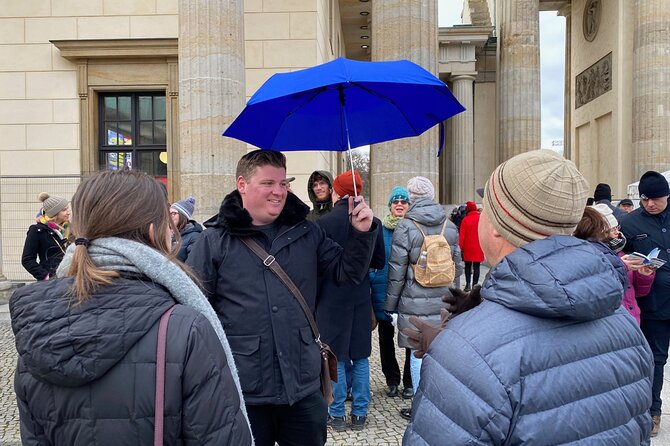
The Brandenburg Gate is a natural place to begin. Built in the 18th century under Frederick William II, it once marked a city entrance. Today, it is one of Berlin’s clearest symbols of peace and European unity.
The guide has about 10 minutes here. That is enough to set the scene and explain why the gate became more than an architectural monument. Its position near Unter den Linden, Pariser Platz, and the Reichstag makes it an ideal opening point for the political story of Berlin.
You should arrive ready to look beyond the columns. The gate has witnessed major political events, and its meaning changed as Berlin moved through monarchy, dictatorship, division, and reunification. The short stop works best as a historical introduction, not as a full architectural lesson.
The Reichstag and the road to dictatorship
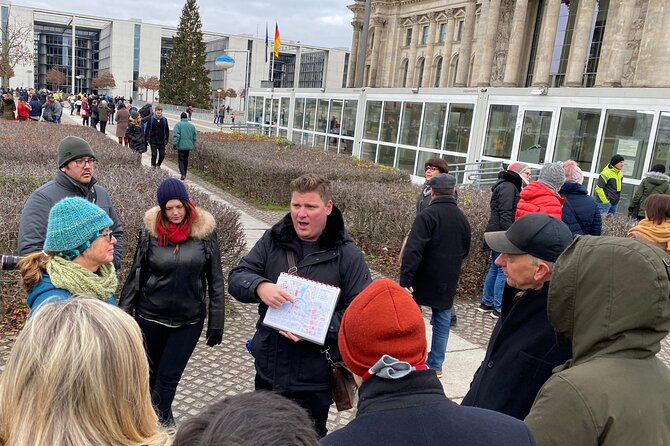
The Reichstag is only a short part of the walk, with about 15 minutes allocated to it. The building was opened in 1894 for the Imperial Diet, Germany’s national political body at the time. It later became closely linked with the fire of 1933, an event that helped the Nazi government tighten its grip on power.
The building suffered heavy damage during World War II and was restored in 1999. Today it houses the Bundestag, Germany’s lower house of parliament. That contrast gives the stop its force: a structure once associated with imperial politics and Nazi-era crisis now serves a democratic government.
I would treat this as a viewpoint stop rather than a chance to enter the parliament. The tour description does not include interior admission, and the stop is brief. Your guide’s explanation is the real reason to pay attention here.
The Soviet War Memorial in Tiergarten
The Soviet War Memorial in the Großer Tiergarten shifts the story toward the end of World War II. The Soviet Union built it in 1945 to honor soldiers killed during the Battle of Berlin.
You get about 15 minutes at the memorial. That short pause helps connect the final fighting in Berlin with the Soviet role in defeating Nazi Germany. It also prepares you for the complicated postwar story, when the victorious Soviet Union became the dominant power in East Berlin and Eastern Europe.
This is one of the places where a good guide matters. The memorial is not simply a war monument. Its presence in central Berlin raises questions about victory, occupation, memory, and the different ways nations remember the same conflict.
Something different for another day:
- Berlin: Reichstag, Dome and Government District Guided Tour
★ 4.7 · 18,288 reviews - Berlin: 1-Hour City Tour by Boat with Guaranteed Seating
★ 4.3 · 16,993 reviews - Berlin: Boat Tour Along the River Spree
★ 4.4 · 11,252 reviews - Discover Berlin Half-Day Walking Tour
★ 5.0 · 9,624 reviews
Walking among the concrete blocks at the Holocaust Memorial
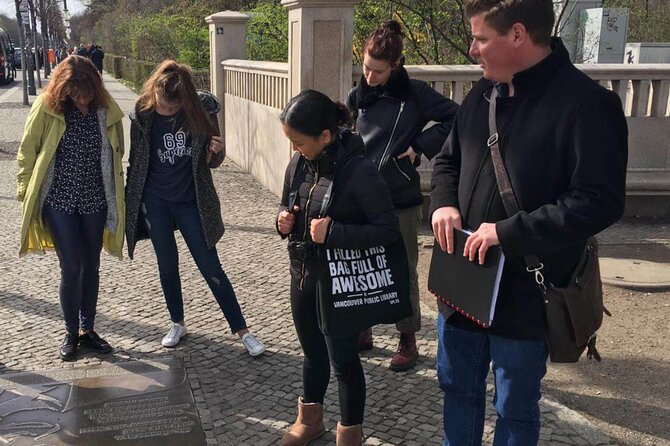
The Memorial to the Murdered Jews of Europe is one of the tour’s most emotionally difficult stops. Architect Peter Eisenman designed the site, which contains 2,711 concrete slabs across roughly 19,000 square meters.
You have around 15 minutes here. The uneven ground and changing height of the slabs can create uncertainty or even a sense of dizziness. The abstract design does not provide a long written account of the Holocaust. Instead, it asks you to confront the scale and seriousness of the subject in your own way.
The guide’s role is important, but this is also a place where you need a quiet moment. The schedule gives you limited time, so do not expect a full Holocaust education session. You will get more from the stop if you listen closely, avoid rushing, and understand that the memorial is part of a larger remembrance system across Berlin.
The Führerbunker site and the final days of Hitler
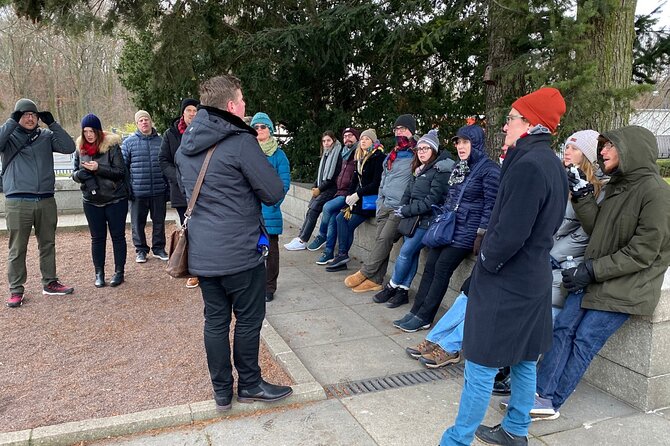
The former Führerbunker is among the most compelling stops because almost nothing visible remains. It was an air-raid shelter and Hitler’s final headquarters. Hitler moved there on January 16, 1945, married Eva Braun on April 29, and the couple died by suicide less than 40 hours later.
The old Chancellery buildings were later levelled by the Soviets. The underground complex remained mostly undisturbed until 1988, but the site has since been altered and built over. The tour gives you about 15 minutes to understand what happened here and why the physical absence of a dramatic ruin is part of the story.
This stop works against the usual expectation that a historic place must look impressive. You are seeing an ordinary modern setting tied to the collapse of Nazi Germany. A skilled guide can help you picture the bunker without turning the location into a shrine.
An unusual Cold War connection at the North Korean Embassy
The stop at the Embassy of the Democratic People’s Republic of Korea adds an unexpected Cold War detail. The address given is Glinkastraße 5 in Berlin’s Mitte district, and the tour allows about 10 minutes here.
This is a brief stop, but it broadens the Cold War story beyond the familiar Berlin Wall. Berlin was not only a divided German city. It was also a place where competing political systems and international alliances were visible in diplomatic form.
Because little time is assigned here, expect context rather than an extended visit. The value comes from seeing how global rivalries touched Berlin’s streets.
Remembering the June 17, 1953 uprising
The memorial for the June 17, 1953 uprising explains one of the first major challenges to communist rule after the war. Workers and other citizens resisted the regime, and Soviet tanks suppressed the revolt. About 15,000 people were arrested afterward.
The tour gives this site 15 minutes. That makes it a useful bridge between the end of the war and the later construction of the Berlin Wall. The uprising shows that division was not just imposed by distant governments. People inside East Germany also pushed back against the system controlling them.
I find this stop especially useful because it can be overlooked by visitors focused only on Checkpoint Charlie. It gives you a clearer sense of the pressure and resistance that shaped East Berlin before the wall became the city’s most famous symbol.
The Berlin Wall Memorial and the human cost of division
The Berlin Wall Memorial commemorates the division of Berlin and the deaths connected with the wall. The tour allows about 15 minutes here.
This is where the broad political story becomes personal. The wall separated neighborhoods, families, workplaces, and daily routines. A memorial focused on the deaths also reminds you that the border was not just a concrete barrier. It was a controlled system backed by force.
The stop is brief, so you should listen for the guide’s explanation of what the wall meant in practice. The tour does not promise a long visit to every section or exhibit. Instead, it gives you a solid introduction before moving to the more famous Checkpoint Charlie.
Finishing at Checkpoint Charlie
Checkpoint Charlie receives the longest stop, about 20 minutes. During the Cold War, it was the best-known crossing point where East and West Berlin faced one another. Western Allied forces called it Checkpoint C, while the name Charlie came from the military phonetic alphabet.
The location is an effective ending because it brings the tour to the heart of the Cold War. After beginning with the Brandenburg Gate as a symbol of Berlin and Europe, you finish at a former border crossing that represented suspicion, military tension, and divided power.
Do not expect the checkpoint alone to explain the entire Cold War. Its fame can make it feel more theatrical than other sites, and the tour’s real strength is the sequence leading up to it. By the time you arrive, the gate, parliament, war memorials, Nazi sites, communist repression, and Berlin Wall have given the crossing a much stronger meaning.
What the guide adds to the walk
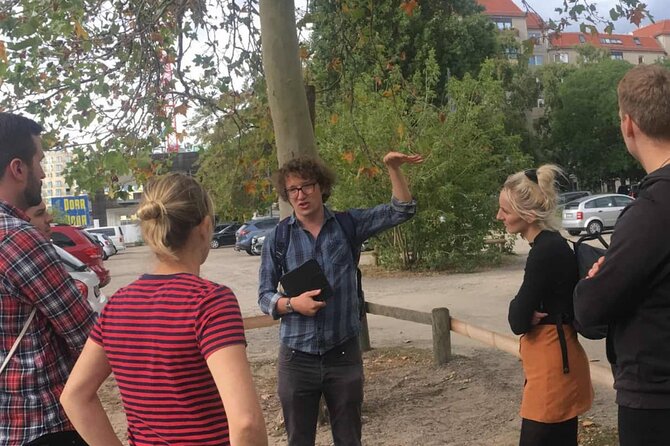
The guide is the key variable in any history tour, and Mark receives particularly strong praise. His approach includes historical photographs that show how Berlin’s streets and buildings looked during the war compared with today.
That visual aid can be extremely useful. Berlin has been rebuilt, altered, and filled with modern buildings, so you often need help seeing the vanished city. Old images can turn an open pavement or ordinary street corner into a place connected to bombing, occupation, dictatorship, or escape attempts.
Mark is also praised for handling questions and telling the story with energy. That matters on a serious subject. The tour covers death, persecution, dictatorship, and state violence, so a guide needs to be clear without becoming theatrical. The available feedback suggests that his passion is one of the tour’s strongest assets.
The experience is not dependent on Mark alone, since the company describes its guides as historians. Still, guide quality can vary on any scheduled walk. If Mark is leading your departure, expect a particularly strong presentation based on the feedback available.
Timing, walking conditions, and group size
The tour lasts approximately two hours and 30 minutes. Nine stops are packed into that period, with individual visits ranging from 10 to 20 minutes. You should think of it as a brisk overview rather than a slow inspection of each site.
The group maximum is 15 people. That is small enough to make questions practical and should help you stay close to the guide in busy central areas. It is not a private tour, though, and the pace may feel quick if you like to take many photographs or read every nearby plaque.
The meeting point is Brandenburg Gate at Pariser Platz, and the tour ends at Checkpoint Charlie, Friedrichstraße 43 to 45. That one-way route is useful because you finish in another central part of Berlin rather than returning to the start.
Wear comfortable shoes and prepare for changing weather. The experience requires good weather, and there is no indication that indoor alternatives are built into the route. Service animals are allowed, public transportation is nearby, and most people can participate, but the tour is still a walking experience with outdoor stops.
Who should book this $23 experience?
I would recommend it to a first-time Berlin visitor who wants a clear introduction to the city’s 20th-century past. It also suits anyone who prefers a human guide over reading disconnected plaques and museum labels.
History students, families with older children, and visitors interested in World War II or the Cold War should find plenty to discuss. The route is also useful early in a Berlin stay because it gives you a mental map for later visits to museums and memorials.
I would be more cautious if you already know these sites well or want lengthy time at the Holocaust Memorial, Berlin Wall Memorial, or Reichstag. The tour touches many places, but it cannot explore each one in depth during 150 minutes.
Booking is flexible if your plans change. You can cancel for a full refund up to 24 hours before the start time. Cancellations or changes within 24 hours are not refunded, and the tour may be rescheduled or refunded if bad weather or insufficient bookings cause cancellation.
Should you book the Hitler to Stalin tour?
Book it if you want a well-priced, tightly organized introduction to Berlin’s Nazi and Cold War history. The route is broad, the stops are central, and the $23 cost is hard to fault when admissions are not charged separately.
The main reason to choose it is the guide-led interpretation, especially if Mark is leading. His photographs, command of the subject, and ability to answer questions can make the difference between looking at a building and understanding why it matters.
Skip it if you want an unhurried museum-style experience or have difficulty with brisk outdoor walking. For most visitors with two and a half hours to spare, though, this is a practical way to connect Berlin’s most important political scars into one understandable story.
FAQ
Where does the tour begin?
It begins at the Brandenburg Gate, Pariser Platz, 10117 Berlin, Germany.
Where does the tour end?
It ends at Checkpoint Charlie, Friedrichstraße 43 to 45, 10117 Berlin, Germany.
How long does the tour last?
The experience lasts approximately two hours and 30 minutes.
How much does the tour cost?
The listed price is $23.
How many people can join the tour?
The group has a maximum of 15 participants.
Is this a walking tour?
Yes. The itinerary connects nine historical locations on foot between the Brandenburg Gate and Checkpoint Charlie.
Are admission tickets included?
The listed stops have free admission. The experience is focused on viewing and discussing these sites during the walk.
Is the Reichstag interior visit included?
The provided tour information lists a stop at the Reichstag but does not include interior admission.
Are service animals allowed?
Yes, service animals are allowed.
Can I cancel for a full refund?
Yes, you can receive a full refund if you cancel at least 24 hours before the experience start time. Cancellations within 24 hours are not refunded.
Just added around Berlin
- Private Photo Tour in Kreuzberg★ 5.0 · 3 reviews
- Kreuzberg Private Walking Tour: Immigrants, Artists & Hipsters★ 5.0 · 3 reviews
- Individual city tour Berlin for max. 8 persons★ 5.0 · 3 reviews
- Berlin’s Jewish Heritage: Private Tour of the Vibrant Jewish District★ 5.0 · 3 reviews
- Berlin & The Third Reich Private Guided Tour★ 5.0 · 3 reviews
- Private Analogue Photography Experience in Berlin★ 5.0 · 3 reviews
- Spy Mission in Berlin: Self-Guided Espionage Puzzle Quest★ 5.0 · 3 reviews
- Berlin Christmas Markets Walking Tour with Local Guide★ 5.0 · 3 reviews
Third Reich & WWII Tours, compared.



Berlin’s Best: 2 Hour Walking Tour Third Reich and the Cold War
Read our review →

Third Reich Berlin: Hitler and WWII Walking Tour
Read our review →
Walking Tour of Former Nazi Party Rally Grounds
Read our review →
Browse the lists this tour appears in