
Reviewed · WALKING TOURS
Berlin Walking Tour with Audioguide on Your Smartphone
Berlin rewards a careful walk. This low-cost smartphone tour links the Brandenburg Gate, Holocaust Memorial, Checkpoint Charlie, Bebelplatz, Museum Island, and Alexanderplatz with 24 audio recordings and an offline map. I like the freedom to pause for coffee or lunch, and I like that the route points out details you could easily miss, such as the underground book-burning memorial at Bebelplatz. The main drawback is that the app has frozen for some users, and the advertised two-hour walk may take closer to four hours if you stop properly.
This is not a traditional guided tour. You download the app, activate your purchase, bring your own phone and headphones, and follow the route yourself. The price is just $6.61 per person, which makes it an inexpensive introduction to central Berlin, but you should allow extra time and keep a backup plan for navigation.
In This Review
- Key points before you book
- A self-guided walk through Berlin’s central story
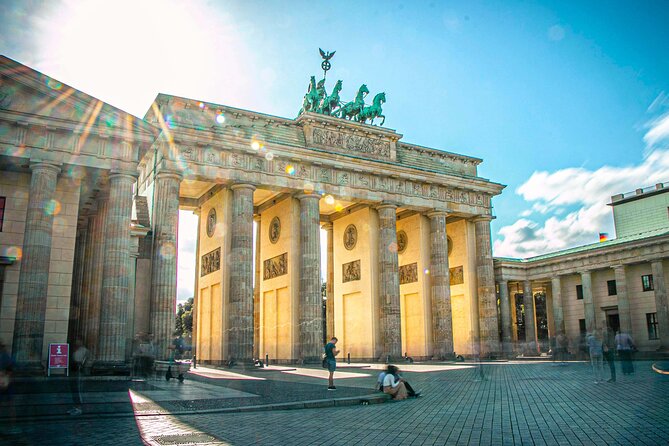
- Starting at Pariser Platz and the Brandenburg Gate
- Reichstag views and the politics of transparency
- A quiet pause at the Holocaust Memorial
- The Führerbunker and the danger of spectacle
- Ampelmännchen, Trabants, and East Berlin memories
- Checkpoint Charlie and the Cold War city
- Gendarmenmarkt’s architectural balance
- Bebelplatz and the underground book-burning memorial
- Frederick the Great and Unter den Linden
- Berlin Cathedral and Museum Island
- Marx and Engels Forum, the Red Town Hall, and East Berlin
- Alexanderplatz and the Television Tower finish
- How long does the walk really take?
- App performance and navigation tips
- Is $6.61 good value?
- Who should book this Berlin audio walk?
- Should you book it?
- FAQ
- Where does the Berlin audio tour begin?
- Where does the activity end?
- How long is the tour?
- Is a human guide included?
- What devices support the audio guide?
- Do I need headphones?
- Are entrance tickets included?
- Can I pause the tour?
- How long can I access the tour?
Key points before you book
- A central Berlin route: Begin at Pariser Platz and finish at Alexanderplatz, passing major political, cultural, and Cold War sites.
- Flexible timing: Pause the audio for photos, meals, or coffee, then restart when ready.
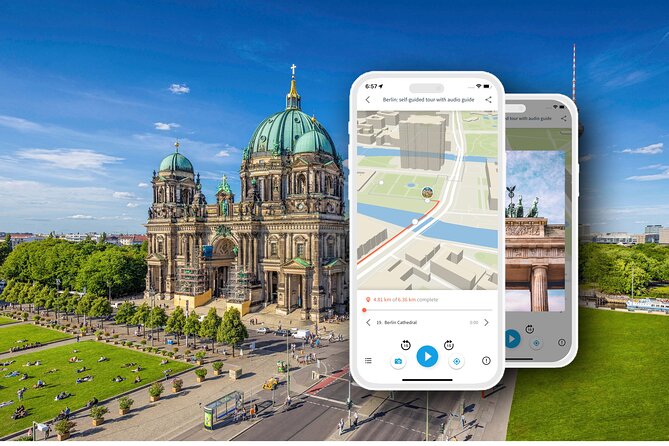
- Useful offline map: GPS navigation helps you move between stops without a human guide.
- Strong value: At $6.61, the tour costs less than many guided walks and remains available for one year.
- Bring your own equipment: You need a smartphone and headphones. Transportation, food, drinks, and admission tickets are not included.
- Allow more than two hours: The route can take about four hours with normal stops, meals, and time inside or around landmarks.
A self-guided walk through Berlin’s central story
This experience is best understood as a route through Berlin’s changing identity. You move from Prussian grandeur to Nazi terror, from Cold War division to German reunification, then onward through East German symbols and modern city life.
The audio guide gives you information as you walk, while the map shows where to go next. You are not tied to a group, a guide’s pace, or a fixed starting time. The tour is available whenever you choose during the one-year access period, so it can fit around museum visits, weather, and your own energy.
The format also has limits. A human guide can answer questions, adjust the route, or point out something unexpected. Here, you get prepared commentary and GPS support, but you must manage the walk yourself.
More Walking Tours in Berlin
- Discover Berlin Half-Day Walking Tour
★ 5.0 · 9,624 reviews - Berlin: Third Reich and Cold War 2 Hour Walking Tour
★ 4.9 · 6,830 reviews - Berlin: Discover Berlin Walking Tour
★ 4.9 · 5,998 reviews
Starting at Pariser Platz and the Brandenburg Gate
The route begins at Pariser Platz, the grand square in front of the Brandenburg Gate. This is a sensible meeting point because the square puts you at the heart of Berlin’s ceremonial center from the first minute.
The Brandenburg Gate needs little introduction. Its neoclassical columns and Quadriga statue make it one of the city’s most recognizable sights, but the audio commentary adds useful context by explaining how the monument shifted from a symbol of division to one of reunification.
You are given about ten minutes at Pariser Platz and another ten at the gate. That is enough for a first look and photographs, but not enough if you want to examine every building around the square. I would treat the listed times as a guide, not a strict schedule.
This opening section is especially good for first-time visitors. You quickly get your bearings and begin with Berlin’s most famous image before moving into more difficult chapters of the city’s past.
Reichstag views and the politics of transparency

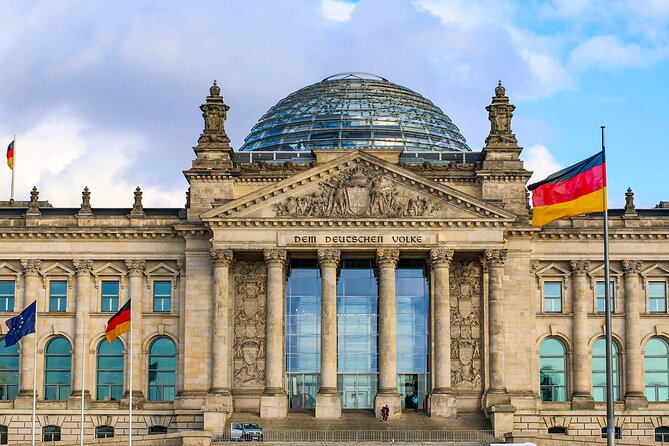
The Reichstag is included as part of the route, with attention to its historic shell and modern glass dome. The dome represents openness in government and offers broad views over central Berlin.
The important practical point is that entry is not included. The tour can explain what you are seeing from outside, but any visit inside the Reichstag requires its own arrangements and ticket process. Do not assume the audio tour includes access simply because the building appears on the route.
This is a good example of the tour’s overall approach. It connects architecture with political history rather than treating every stop as a photo opportunity. Still, if you want an extended explanation of the building’s design or a full visit inside, you may want separate information.
A quiet pause at the Holocaust Memorial
The Memorial to the Murdered Jews of Europe is one of the most serious stops. Its field of concrete slabs creates an unsettling experience as you walk among changing heights and narrow passages.
The audio guide encourages remembrance and gives the memorial a historical frame. You should not rush this section. Ten minutes may be enough for a quick walk through the memorial, but many people will want longer, especially if they visit the underground Information Centre.
The Information Centre is not included as an admission feature, so check separately if you want to enter. The memorial itself is free to see, and the open-air portion works well with a walking tour because the audio can guide your thoughts while you move through the site.
I appreciate that this stop is not treated as a cheerful sightseeing break. Berlin’s central sights are often close together, but the emotional distance between them can be enormous.
Something different for another day:
- Berlin: Reichstag, Dome and Government District Guided Tour
★ 4.7 · 18,288 reviews - Berlin: 1-Hour City Tour by Boat with Guaranteed Seating
★ 4.3 · 16,993 reviews - Berlin: Boat Tour Along the River Spree
★ 4.4 · 11,252 reviews - Berlin: Hop-on Hop-off Bus Tour with Live Commentary
★ 4.3 · 8,579 reviews
The Führerbunker and the danger of spectacle
The Führerbunker site offers a sobering lesson in how Berlin handles a place tied to Hitler’s final days. Today, the location is a parking area with an information display rather than a preserved underground attraction.
That can surprise you. There is no dramatic bunker interior to explore, and the stop may feel plain compared with the grand monuments nearby. Its value comes from the historical explanation and from understanding how an infamous place can become an ordinary part of the city.
If you expect a major physical attraction, this may disappoint. If you want a restrained reminder of the end of the Nazi era, the stop has purpose. The audio format is useful here because it supplies context without turning the site into entertainment.
Ampelmännchen, Trabants, and East Berlin memories
Berlin’s Ampelmännchen figures bring a lighter note to the route. These cheerful pedestrian signals began in East Germany and became a familiar symbol after reunification. The guide helps you notice them, which is exactly the kind of small urban detail an audio tour can add.
The route also discusses the Trabant, the famously modest East German car known as the Trabi. In Berlin, colorful Trabants can be linked with nostalgic city tours, giving this once-common vehicle a new life as a cultural object.
These stops break up the heavy political material. You are not only looking at monuments and government buildings. You are also learning how everyday objects can carry memories of a vanished state.
Checkpoint Charlie and the Cold War city
Checkpoint Charlie is one of Berlin’s most famous Cold War locations. The current border crossing display is a replica, but the place still communicates the tension of a city divided by ideology, walls, and armed checkpoints.
The audio guide covers the crossing and the escape stories associated with it. That background matters because the site itself can feel commercial and crowded, with souvenir shops and photo opportunities competing for attention.
I recommend listening before you decide how long to stay. The physical checkpoint is relatively small, while the historical subject is enormous. A separate museum is nearby, but entrance is not included, so budget extra if you want a fuller account of escape attempts and daily life beside the Wall.
This is one of the route’s most useful stops for anyone who knows Berlin mainly through photographs. The commentary helps turn a replica booth into a doorway to the city’s divided past.
Gendarmenmarkt’s architectural balance

Gendarmenmarkt shifts the mood again. The square is known for its formal arrangement, with the German Cathedral and French Cathedral facing the Konzerthaus and Schiller Monument.
This is one of the prettiest areas on the walk, and the audio guide gives you a chance to understand the relationships among the buildings rather than seeing them as isolated facades. Cafes around the square also make it a sensible place for a break.
Check current conditions before you go, since buildings and public spaces can occasionally have restoration work or access limits. Even from outside, Gendarmenmarkt earns its place on the route because it shows Berlin’s polished architectural side after several stops focused on conflict and loss.
Bebelplatz and the underground book-burning memorial
Bebelplatz is a particularly rewarding stop because its most important feature is easy to miss. The square is surrounded by the State Opera, St. Hedwig’s Cathedral, and Humboldt University, but look down for the glass panel set into the pavement.
Through it, you can see an underground room lined with empty bookshelves. The memorial recalls the Nazi book burning and the attack on intellectual freedom. The audio guide points out this detail, saving you from walking past without noticing.
This is one of the tour’s strongest moments. It demonstrates the practical value of commentary: you do not simply arrive at a famous square, take a photograph, and leave. You learn where to look and why it matters.
The State Opera also appears in the route, giving you a chance to consider Berlin’s musical life and neoclassical architecture. Performance tickets are not part of the tour, but the building’s place on Unter den Linden adds cultural depth to the walk.
Frederick the Great and Unter den Linden
The equestrian monument to Frederick the Great introduces Prussian power and royal ambition. The large statue dominates part of Unter den Linden, Berlin’s historic boulevard, and gives the audio guide a chance to explain the king’s role in the city’s development.
This section may appeal most to people interested in military and political history. If statues are not your priority, the commentary still helps connect the monument with the wider setting instead of leaving it as a name on a pedestal.
The route continues through a district where grand buildings sit close to reminders of war and dictatorship. That contrast is a defining feature of central Berlin. You can cross a street and move from imperial ceremony to twentieth-century trauma.
Berlin Cathedral and Museum Island
Berlin Cathedral brings the route to one of the city’s most imposing religious buildings. Its large dome, ornate interior, and terrace views make it more than an exterior photo stop.
The tour explains its place in Berlin’s architectural story, but entrance is not included. If you want the interior or terrace, allow extra time and pay the admission fee separately.
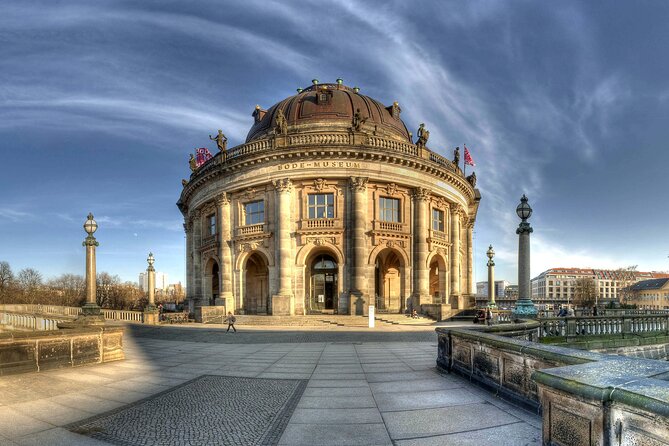
Nearby Museum Island contains five museums and is a UNESCO World Heritage site. The route introduces the island and its major cultural role, including museums such as the Pergamon Museum and Neues Museum.
Do not expect to visit the museums during a two-hour walking tour. This section works better as an orientation stop. You learn what is here, decide which museum deserves a separate visit, and continue along the route without trying to squeeze an entire museum district into one afternoon.
Marx and Engels Forum, the Red Town Hall, and East Berlin
The Marx and Engels Forum presents another side of Berlin’s political past. Statues and reliefs honor the founders of communist theory, while remnants of the Berlin Wall help connect the park with the former East German capital.
The area offers a calmer pause after the busy central monuments. It also reminds you that Berlin’s Cold War story is not limited to Checkpoint Charlie. East German political life shaped streets, buildings, public art, and daily routines across the city.
The nearby Red Town Hall, or Rotes Rathaus, has a distinctive red-brick Neo-Renaissance facade. It remains the seat of Berlin’s city government, and the Neptune Fountain adds another formal landmark to the area.
These stops may not be as immediately famous as the Brandenburg Gate, but they broaden the tour. You get a more complete picture of Berlin’s civic identity, including the years when East Berlin served as the capital of the German Democratic Republic.
Alexanderplatz and the Television Tower finish
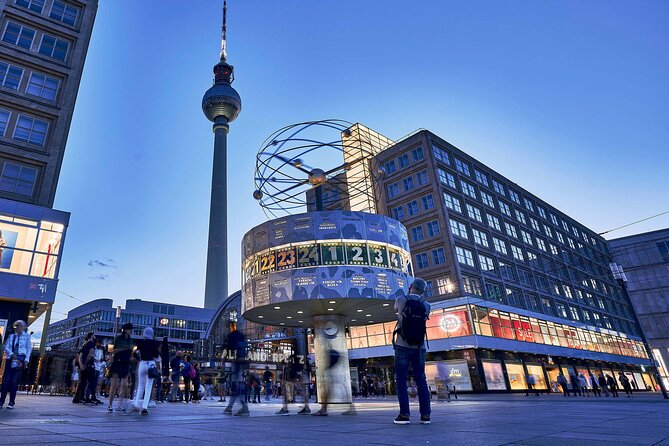
The final section reaches Alexanderplatz, one of Berlin’s major public and transport centers. The square is energetic, practical, and less formal than Pariser Platz, making it a fitting endpoint for a route that has crossed so many periods of the city’s past.
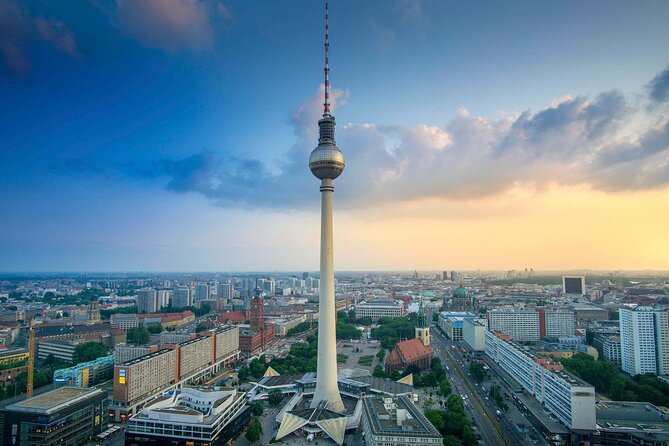
The Television Tower dominates the view. Built as a major East German symbol, it now functions as one of Berlin’s best-known landmarks and offers panoramic views from its observation area.
As with the cathedral and Reichstag, tower entry is not included. The audio guide can explain the building and its place in Berlin’s story, but you need a separate ticket if you want to go up.
Alexanderplatz also offers shops, cafes, and the Weltzeituhr clock. Since the tour ends back at the starting point according to the booking details, clarify the exact route in the app before setting out. The listed itinerary describes Alexanderplatz as the final major stop, while the activity information says the walk ends at the meeting point. That small inconsistency is worth checking on your phone.
How long does the walk really take?
The stated duration is about two hours, but you should not plan your day too tightly. A careful visit with photographs, pauses, and time to listen can take around four hours, especially if you stop for lunch.
That flexibility is the central advantage. You can pause the audio, explore a square, sit at a cafe, and restart without holding up a group. You can also replay sections, which is helpful when traffic, crowds, or your attention make it easy to miss a sentence.
The route involves substantial walking. One account of the experience reached more than 10,000 steps, so comfortable shoes are sensible. Public transportation is nearby, but transport is not included, and you will need to arrange your own way to and from the route.
App performance and navigation tips
The app is designed for iPhone and Android and includes an offline map, GPS route guidance, landmark illustrations, and one year of access. The map is generally easy to follow, and the offline function is useful if your mobile connection is weak.
There are a few practical cautions. The app has frozen for some users and needed to be closed and reopened. GPS has also been inaccurate at times, and some people would prefer a written walking direction option alongside the moving map.
The map may orient itself in the direction you are walking rather than keeping north fixed. That can feel confusing if you prefer a traditional map. Download and activate the tour before you reach Pariser Platz, bring headphones, and make sure your phone has enough battery for a long walk.
Support is available through [email protected]. A prompt reply has helped with activation problems, but you should not wait until the last minute to discover that your download link or setup is not working.
The narration is generally informative and easy to replay. One criticism is that the AI voice can sound theatrical, while some sections may feel longer than needed. The content itself covers questions you might have while walking, but anyone wanting detailed architectural analysis may find parts too light.
Is $6.61 good value?
At $6.61, this is an easy purchase to justify if you want a structured introduction to central Berlin. You receive route guidance, audio commentary, illustrations, and one year of access. There is no added cost for a human guide, and you can use the tour at your own pace.
The price does not cover museum, cathedral, Reichstag, or Television Tower admissions. It also does not include food, drinks, headphones, or transportation. Those exclusions are normal for a self-guided walk, but they matter when you plan the day.
I see the tour as a low-risk way to add context to sightseeing. It is not a substitute for a specialist history tour or a full museum visit. It is a practical companion for people who want the main sights connected by a story.
Free cancellation is available if you cancel at least 24 hours before the scheduled start time. Cancellations inside that window are not refunded.
Who should book this Berlin audio walk?
I would recommend it to independent visitors who dislike fixed group schedules and enjoy stopping for photos, food, or a quiet look around. It also suits couples or friends who want to listen together without a guide setting the pace.
Families and mixed-interest groups may appreciate the pause button, since not everyone walks or listens at the same speed. People who prefer detailed questions and live conversation should choose a human guide instead.
You should also be comfortable using a phone for navigation. If app problems would spoil your day, carry a paper map or use another map app as a backup. The route is central and well connected, but the technology is part of the experience, not just an extra feature.
Should you book it?
Book this tour if you want a very inexpensive, flexible route through Berlin’s major central sights, with enough commentary to help you notice places such as the Bebelplatz memorial and Ampelmännchen figures.
Skip it if you need guaranteed app reliability, expert discussion of every building, or included entry to the Reichstag, museums, cathedral, or Television Tower. For most independent visitors, the low price and one-year access make it a useful first walk, as long as you allow four hours rather than two and prepare your phone before starting.
FAQ
Where does the Berlin audio tour begin?
The tour begins at Pariser Platz, 10117 Berlin, Germany.
Where does the activity end?
The activity information says it ends back at the meeting point. Alexanderplatz is listed as the final major stop, so check the route in the app before beginning.
How long is the tour?
The estimated duration is about two hours. With regular sightseeing, photographs, and a meal or coffee break, it can take about four hours.
Is a human guide included?
No. This is a self-guided mobile tour with audio recordings. You follow the route using the app and map.
What devices support the audio guide?
The app is available for iPhone and Android devices.
Do I need headphones?
Yes. Headphones are not included, so you need to bring your own.
Are entrance tickets included?
No. Admission fees and tickets are not included. This applies to attractions such as museums, the cathedral, the Television Tower, and other paid sites along the route.
Can I pause the tour?
Yes. You can pause the audio for coffee, lunch, photographs, or other breaks and restart it later.
How long can I access the tour?
You receive access for one year in the language selected during checkout. The tour is offered in English.
Just added around Berlin
- Kreuzberg Private Walking Tour: Immigrants, Artists & Hipsters★ 5.0 · 3 reviews
- Private Photo Tour in Kreuzberg★ 5.0 · 3 reviews
- Individual city tour Berlin for max. 8 persons★ 5.0 · 3 reviews
- Berlin’s Jewish Heritage: Private Tour of the Vibrant Jewish District★ 5.0 · 3 reviews
- Berlin & The Third Reich Private Guided Tour★ 5.0 · 3 reviews
- Private Analogue Photography Experience in Berlin★ 5.0 · 3 reviews
- Spy Mission in Berlin: Self-Guided Espionage Puzzle Quest★ 5.0 · 3 reviews
- Berlin Christmas Markets Walking Tour with Local Guide★ 5.0 · 3 reviews
Walking Tours, compared.





Berlin’s Best: 2 Hour Walking Tour Third Reich and the Cold War
Read our review →


Third Reich Berlin: Hitler and WWII Walking Tour
Read our review →Browse the lists this tour appears in