
Reviewed · WALKING TOURS
Weimar Private Walking Tour With A Professional Guide
Weimar rewards curious walkers. This private tour connects Goethe and Schiller with Germany’s first attempt at democracy, moving between grand squares, churches, palaces, and literary homes in a compact historic center. I like the personal format and the way the route joins Weimar’s cultural fame to its political past. The main consideration is time: two hours gives you a strong introduction, but not enough for a slow visit inside every major building.
I also like that the guide can adjust the walk on the spot. Alexander has earned praise for explaining Weimar’s past with clarity, while another guide was described as able to handle questions well beyond the usual script. The tour is easy, requires no transport, and ends back near the Market Square, though the price is much better value for a group than for one or two people.
In This Review
- Key points at a glance
- Why Weimar works so well on foot
- Market Square and the city’s first layer of stories
- Theaterplatz, Goethe, Schiller, and a vanished empire
- St. Peter and Paul Church and the Herder connection
- Weimar Palace and the royal setting
- Democracy Square and Anna Amalia’s Library
- Park an der Ilm and Goethe’s first Weimar home
- Goethe’s House on Frauenplan
- Liszt Haus and Weimar’s musical chapter
- Friedrich Schiller’s House and the partnership behind the names
- Guide quality, group size, and the $244.41 price
- Who should book this Weimar walk?
- Should you book it?
- FAQ
- Where does the tour begin?
- Where does the tour end?
- How long does the tour last?
- Is this a private tour?
- How many people can join?
- Is the tour offered in English?
- Is transportation provided?
- Is the walk suitable for most people?
Key points at a glance
- Goethe and Schiller anchor the walk: See their famous memorial at Theaterplatz, then visit the homes connected with their creative partnership.
- Weimar’s political story gets equal billing: The House of the Weimar Republic explains the 1919 National Assembly and the birth of Germany’s first democracy.
- A private guide keeps the pace flexible: Your group alone takes part, with possible changes made during the walk.
- The route covers a lot without transport: Market Square, St. Peter and Paul Church, Weimar Palace, Democracy Square, Anna Amalia’s Library, Park an der Ilm, Goethe’s House, Liszt House, and Schiller’s House all fit into the central area.
- The walk is easy but information-heavy: The physical effort is modest, while the amount of literary, royal, religious, and political detail is substantial.
- The group price favors families and friends: At $244.41 for up to 15 people, the cost becomes reasonable when shared across a larger party.
Why Weimar works so well on foot
Weimar is unusually friendly to pedestrians. The main sights sit close together, so you spend your time looking at buildings and listening to stories instead of waiting for buses or finding parking. That makes this a useful first activity in town because you quickly learn how the historic center fits together.
The route also shows why Weimar can feel larger than its size. One block brings you into the world of Renaissance painting, the next into the court of Saxe-Weimar and Eisenach, then into Lutheran worship, German literature, music, or modern democracy. I appreciate that range. A tour focused only on Goethe would miss much of what gives the city its character.
The architecture reflects Weimar’s former feudal role. Royal buildings and former residences give the center a formal look, but the walk remains manageable. You should expect paved city streets and regular stops for explanation rather than a strenuous hike.
The advertised duration is about two hours. That is enough for orientation and outside views, with selected commentary at each place. One booking resulted in a three-hour walk, so the timing may sometimes stretch, but you should plan around the stated two-hour schedule rather than count on extra time.
More Walking Tours in Germany:
- Discover Berlin Half-Day Walking Tour
★ 5.0 · 9,624 reviews - Berlin: Third Reich and Cold War 2 Hour Walking Tour
★ 4.9 · 6,830 reviews - Munich: Third Reich & WWII Walking Tour
★ 4.6 · 6,181 reviews
Market Square and the city’s first layer of stories
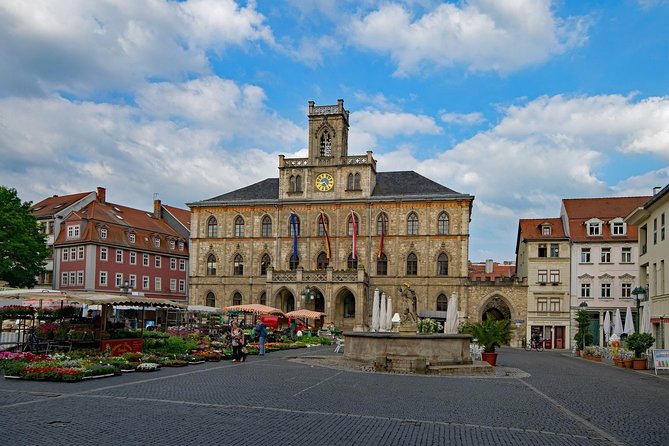
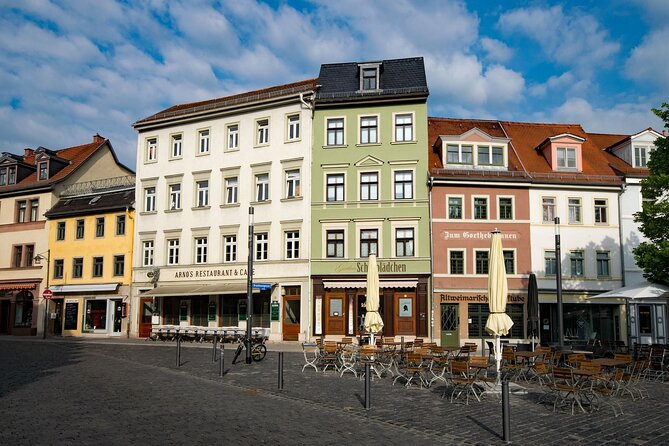
The tour begins at Markt 20, on the Market Square. This is a practical meeting point because it places you in the middle of Weimar’s pedestrian center from the first minute.
The square has long been a social meeting place, but its buildings also point to the city’s artistic past. Lucas Cranach, the Renaissance painter, lived in a building close to the square. That detail helps you see that Weimar’s cultural story did not begin with Goethe and Schiller. Their era simply became the city’s most famous chapter.
I would pay attention here to how close the major sights are. Your guide can give you a map in words, showing how the square connects to Theaterplatz, the palace district, and the literary homes. This early orientation is valuable if you plan to explore alone later.
Theaterplatz, Goethe, Schiller, and a vanished empire
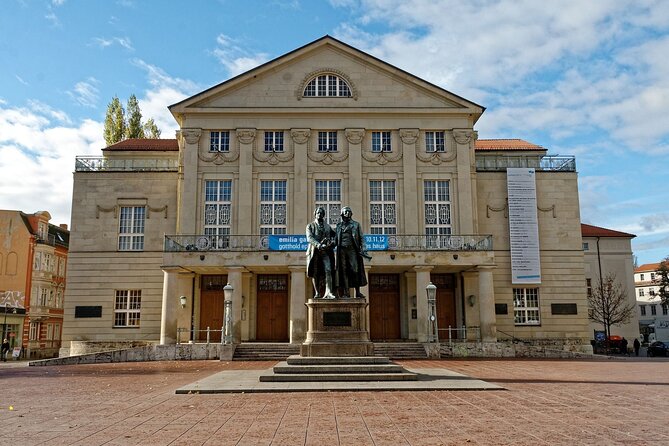
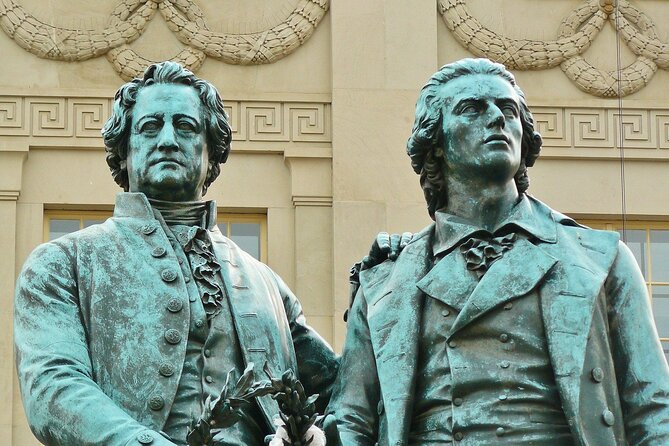
At Theaterplatz, the famous Goethe and Schiller memorial provides one of Weimar’s most recognizable views. The two writers are shown together in front of the National Theater, a fitting location for men whose work helped define German classicism.
The guide places them in the setting created by Duchess Anna Amalia, whose gatherings brought leading cultural figures together. Her support helped make Weimar a place where writers, artists, musicians, and thinkers could meet. The story is not simply about two statues. It is about the court culture that gave their work room to develop.
This is one of the tour’s strongest literary moments. You get a quick sense of why Goethe and Schiller are treated as partners in Weimar’s identity, even though each had a distinct career. The stop is also easy to appreciate if you know little about German literature.
Across the square, the House of the Weimar Republic changes the subject completely. In 1919, the National Assembly met here to debate Germany’s future after World War I and the fall of the German Empire. The Weimar Republic was born from that effort, becoming Germany’s first attempt at a democratic government before the Nazi Party destroyed it in 1933.
The renovated building now presents that story and serves as a Forum for Democracy. The walking tour may point out the building and explain its role, but admission details are not included in the tour information. If you want to explore the exhibition inside, ask your guide how the stop fits your schedule.
I value this part of the route because it prevents Weimar from becoming a museum of literary celebrities alone. The city also gave its name to a major period in German political history, and that history deserves attention.
St. Peter and Paul Church and the Herder connection
From Theaterplatz, the walk continues to St. Peter and Paul Church, regarded as Weimar’s most important church. The current building rests on the foundations of a 13th-century church and was first constructed in the 16th century in Gothic style.
The church became Lutheran during the Reformation, and Martin Luther preached there. Johann Gottfried Herder, the theologian who served as its superintendent, is buried inside. Duchess Anna Amalia is also buried there, linking the church back to the court and literary circles introduced earlier.
Outside, the Herder Memorial dates from 1850. This stop gives the tour a useful religious and intellectual layer. Herder was not only a church leader. His presence reflects the broad exchange of ideas that helped make Weimar a center of German culture.
You may want to ask whether the church is open during your tour time. The route includes the church as a place of interest, but specific interior access is not guaranteed. Even from outside, the guide can connect its architecture and people to Weimar’s larger story.
A few more tours and experiences worth a look
- Berlin: Private Reichstag and Glass Dome Tour
★ 4.8 · 2,226 reviews - Berlin Private Complete History All Day Walking Tour
★ 5.0 · 474 reviews - Munich Private Tour with a Local – Highlights & Hidden Gems
★ 5.0 · 469 reviews - Private Walking Tour Berlin Third Reich Hitler and World War II
★ 5.0 · 360 reviews
Weimar Palace and the royal setting
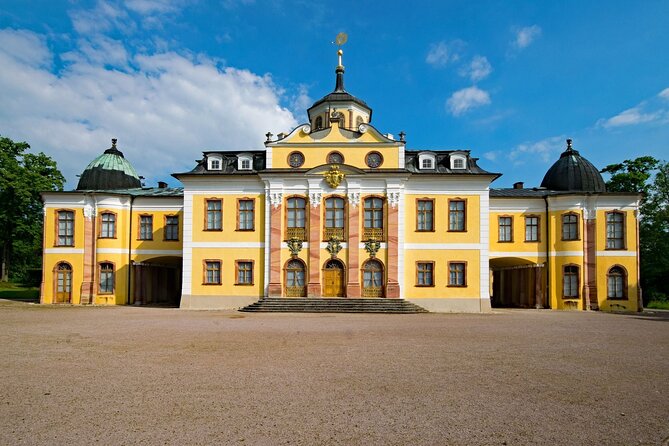
The route then passes Weimar Palace, once home to the dukes of Saxe-Weimar and Eisenach. The site began as a medieval castle, first mentioned in the 10th century, and changed many times after fires and rebuilding.
Its present form took about 500 years to develop. That long construction story is useful because it explains why the palace does not feel like a single-period building. It is a record of changing needs, fortunes, and tastes.
I like this stop as a bridge between the city’s courtly past and its artistic life. Weimar’s famous writers did not work in isolation. They lived and worked in a town shaped by dukes, duchesses, royal residences, and court-sponsored culture.
Again, the tour is primarily a walking experience. Do not assume the guide fee includes palace admission. If entering the palace matters to you, confirm that separately before booking or ask about it when you meet.
Democracy Square and Anna Amalia’s Library
Democracy Square was once called the Duke’s Square, a name that better reflected the buildings around it. The area includes the red and yellow palaces and the house associated with Duke Charles Augustus.
The newer name points to Weimar’s effort to keep its democratic story visible beside its royal architecture. That contrast is one of the most interesting themes of the walk. You move from dukes and court life to a national assembly, then back to the cultural institutions supported by the court.
Anna Amalia’s Library is next to the square. It occupies a small palace and has held a library for centuries. The duchess supported it strongly, and the collection includes treasures tied to Weimar’s literary world. One document provides an early indication of Wolfgang von Goethe’s presence in the city.
Goethe later ran the library for decades. That detail makes the institution feel less like a decorative stop and more like a working part of Weimar’s intellectual life. If you enjoy books, manuscripts, or the practical side of literary history, this may be one of your favorite places.
The available information does not promise entry to the library. I would treat the stop as an introduction unless your guide confirms that you can go inside. The building itself remains an important part of the route.
Park an der Ilm and Goethe’s first Weimar home
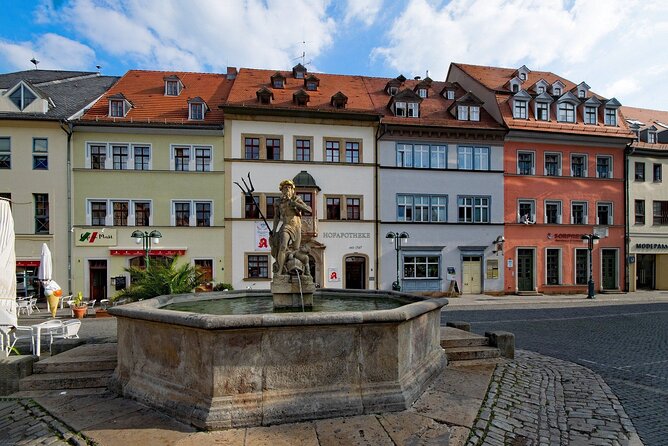
Near the library, Park an der Ilm offers a change of pace. Created in the 18th century, the park is known for valuable trees and architectural features, including the ruins of the Tempelherrenhaus.
Goethe helped design the park, and he spent his first years in Weimar in a house beside it. Charles Augustus gave him that house, a sign of the close relationship between the writer and the ruling duke.
This section adds breathing room after several formal squares and monumental buildings. You can see how Goethe’s connection to Weimar was not limited to offices, theaters, and grand residences. The park also reflects his interest in nature and design.
Because the walk is short, you should not expect a long park outing. Still, this stop helps explain why Weimar’s cultural sites feel connected to everyday streets and green spaces rather than isolated behind walls.
Goethe’s House on Frauenplan
Goethe’s House on Frauenplan became his larger residence after 1782. Many rooms remain arranged as they were during the last years of his life, including the study where he wrote works such as Faust.
Goethe stayed in Weimar until his death in 1832, so the house represents much of his adult life in the city. A guide can give the building personal meaning by linking the rooms to his work, his long association with the court, and his place in Weimar’s cultural circle.
This is another stop where you should separate seeing a building from entering a museum. The tour information does not state that admission is included. If you want time with the preserved rooms, ask whether the schedule allows a visit or plan to return independently.
I find the house especially useful for readers who know Goethe mainly as a name. Seeing where he worked can turn an abstract literary reputation into a more understandable part of Weimar’s daily life.
Liszt Haus and Weimar’s musical chapter
Franz Liszt’s house brings music into the walk. Liszt spent many summers in Weimar after receiving the house as a gift from the local duke. He taught young pianists from across Europe there without charging them.
That detail shows how Weimar’s cultural influence continued beyond the age of Goethe and Schiller. The town was not only preserving the past. It was also attracting active musicians and helping shape the next generation.
The Liszt stop may appeal most to music lovers, but it also helps you understand the role of patronage. Royal support could provide homes, workplaces, and audiences for artists. At the same time, the city’s cultural life depended heavily on those court connections.
As with the other homes, confirm what you can enter during the two-hour walk. The guide’s explanation may be the main experience, with a separate museum visit needed if you want to see the interior in detail.
Friedrich Schiller’s House and the partnership behind the names
The final major stop is Friedrich Schiller’s House. Schiller and Goethe were brought together through an assembly, and Goethe later invited Schiller to Weimar after being impressed by him.
Their relationship became an intense creative partnership. That story gives the earlier memorial at Theaterplatz more meaning. You first see the two men represented together, then learn how their association developed and how Schiller became part of Weimar’s cultural life.
The house also gives the tour a satisfying literary finish. Goethe’s home and Schiller’s home are not interchangeable attractions. Seeing both helps you understand that Weimar’s classic period grew from collaboration, friendship, and debate rather than from one writer working alone.
The walk returns to the Market Square, which is convenient if you want to continue exploring, find a café, or make your way to another part of town. You finish with a clearer sense of direction and a long list of places worth revisiting.
Guide quality, group size, and the $244.41 price
The private format is the main reason to choose this experience. Only your group participates, and the guide can adjust the walk on the spot. That matters in Weimar because some groups want more Goethe, while others care more about the Weimar Republic, church history, architecture, or music.
The price is $244.41 per group of up to 15 people. For a full group, that is strong value for two hours of private guiding. For two people, it is a much larger expense, so you should decide how much personal attention and schedule control matter to you.
The guide quality appears to be a major strength. Alexander received praise for his command of Weimar and its history, and one guide was described as able to answer questions far beyond the standard topics. Another German-language comment called the guide a firework of knowledge, which points to an energetic and well-informed presentation.
The tour is offered in English. Confirmation arrives when you book, and free cancellation is available if you cancel at least 24 hours before the start time. Changes or cancellations inside that window are not accepted for a refund.
Who should book this Weimar walk?
I would choose this tour if you are visiting Weimar for the first time and want the city’s major cultural and political themes explained in one compact outing. It suits families, couples, friends, and anyone who prefers asking questions instead of following a large group.
It is also a good match for mixed-interest groups. One person can focus on Goethe and Schiller, another on palaces and churches, and another on democracy and modern German history. A private guide can shift the emphasis as you go.
You may want something else if you prefer long museum visits or a very slow pace. Two hours is enough for an overview, not a full examination of every interior. The tour is easy for most people and needs no transportation, but the amount of information may feel brisk if you want time to read every plaque or linger at each site.
Should you book it?
Book this private Weimar walk if you want a smart introduction with strong guide interaction and a route that connects literature, royal life, religion, music, and democracy. The praise for guide expertise is consistent, and the compact city center makes the route efficient.
I would especially recommend it for a group of several people, since the $244.41 price covers up to 15. If you are alone or traveling as a couple, compare the cost with a shared tour or self-guided visit. Choose this experience for context and conversation, then return on your own to the museums and historic interiors that deserve more time.
FAQ
Where does the tour begin?
The tour begins at Markt 20, 99423 Weimar, Germany, on the Market Square.
Where does the tour end?
The walk returns to the Market Square area. The listed end point is 99 Weimar, Germany.
How long does the tour last?
The advertised duration is approximately two hours.
Is this a private tour?
Yes. Only your group participates, and the local guide is assigned to your group alone.
How many people can join?
The price covers one group of up to 15 people.
Is the tour offered in English?
Yes. English is the stated language for this experience.
Is transportation provided?
No transportation is needed. This is a walking tour through central Weimar.
Is the walk suitable for most people?
Yes. It is rated easy, suitable for any age, and most people can participate. It is also near public transportation.
Just added around Germany
- St George’s Culinary Food Tour★ 5.0 · 3 reviews
- Castle Braunfels Day Trip from Frankfurt★ 5.0 · 3 reviews
- Discover Hamburg: Private Walking Tour★ 5.0 · 3 reviews
- Whodunnit – Interactive city walk in Düsseldorf★ 4.5 · 3 reviews
- Discover Dusseldorf’s most Photogenic Spots with a Local★ 5.0 · 3 reviews
- Kreuzberg Private Walking Tour: Immigrants, Artists & Hipsters★ 5.0 · 3 reviews
- Private Photo Tour in Kreuzberg★ 5.0 · 3 reviews
- Dusseldorf Private Walking Tour With A Professional Guide★ 4.5 · 3 reviews
Walking Tours, compared.





Berlin’s Best: 2 Hour Walking Tour Third Reich and the Cold War
Read our review →

