
Reviewed · WALKING TOURS
Walking Tour of Historic Dresden with a Christmas Touch. Small group tour.
Dresden’s past is written in stone and ash. This small-group walk links the Zwinger, Semperoper, Royal Cathedral, Procession of Princes, Brühl’s Terrace, and a historic Christmas market while explaining how Dresden became the Florence on the Elbe, suffered wartime destruction, and was rebuilt. I especially like the strong historical focus and the chance to finish near Dresden’s Christmas stalls, where you can seek out Stollen and Glühwein.
I also like the small maximum of 17 people, which should make it easier to hear the guide and ask questions. The main drawback is clear: this is a history walk with a Christmas touch, not a full Christmas-market tour. Only about 20 minutes is set aside for the market portion, so you should allow extra time afterward if festive food, decorations, and shopping are your main goals.
In This Review
- Key points at a glance
- What this Dresden walk is really offering
- Starting at the Zwinger and its Baroque setting
- The Opera House, Royal Cathedral, and Old Masters Gallery
- Dresden’s destruction and patient rebuilding
- The Procession of Princes and Royal Palace courtyard
- Brühl’s Terrace, the Balcony of Europe
- The Christmas market and the story of Stollen
- Weather, walking, and group size
- How much value do you get for $25.35?
- Who should book this walk?
- Should you book the Dresden Christmas walking tour?
- FAQ
- How long does the walking tour last?
- Where does the tour begin?
- Where does the tour end?
- Is the Christmas market the main focus?
- Is food or Glühwein included?
- Does the tour enter Dresden’s museums?
- How large is the group?
- Can I cancel for a full refund?
Key points at a glance
- Dresden’s story comes first: The walk covers medieval, Renaissance, Baroque, World War II, and postwar reconstruction.
- The Zwinger opens the route: You spend about 10 minutes walking through this celebrated Baroque complex.
- Major landmarks are viewed from outside: The Opera House, Royal Cathedral, Old Masters Gallery, Palace, and Procession of Princes are part of the route.
- The Christmas stop is brief but useful: You learn about Striezelmarkt, Stollen, Glühwein, Nutcrackers, and Moravian Stars.
- The group is limited to 17 people: That is a sensible size for a city-center walk.
- The tour ends near Dresden’s markets: You can continue exploring on your own after the guided portion.
What this Dresden walk is really offering
At $25.35 per person, this is priced as an accessible introduction to central Dresden rather than a long specialist tour. You are paying for a guide who puts the city’s buildings into a clear story, not for museum admission, a meal, or a tasting package.
That distinction matters. The experience includes guiding and the guide’s local knowledge, good humor, and information. It does not include lunch, drinks, alcohol, or paid entry to attractions. If you sample Stollen or buy Glühwein, those costs are yours.
The tour lasts about two hours and uses a mobile ticket. It begins at Schlossplatz, a convenient historic square at Schloßplatz, 01067 Dresden, and ends around Altmarkt or another nearby Christmas market. Since the route stays in the historic center, you are well placed to continue sightseeing after the guide says goodbye.
I would choose this walk early in a Dresden visit. It gives you a map in your head and helps explain why the grand buildings look so carefully arranged. The guide can also point out museums, churches, and other places worth returning to, a useful service when your time in town is short.
More Historical Tours in Dresden
- Elbfloren: Historical city tour
★ 4.8 · 819 reviews - Görlitz: Ghosts and Spooky Historical Night Walking Tour
★ 4.8 · 197 reviews - Historic Dresden Small-Group Walking Tour in English
★ 5.0 · 160 reviews
Starting at the Zwinger and its Baroque setting
The first named stop is the Dresden Zwinger. You walk through the complex with the guide for about 10 minutes and hear how it fits into Dresden’s royal and architectural story.
The Zwinger is a good place to begin because it immediately shows the city at its most theatrical. The walk does not include a separate admission ticket, and the experience focuses on the exterior spaces rather than a long museum visit. That keeps the tour moving, but it also means you should not expect time to study every courtyard, sculpture, or gallery.
The guide uses the Zwinger to explain Dresden’s rise as a major court city. You get the background needed to understand the grand buildings that follow. The route is not simply a parade of façades. It connects royal ambition, architecture, war damage, and rebuilding.
One guide, Karen, was praised for enthusiasm, clear delivery, and the ability to make the city’s story understandable. Another guide, Lawrence, was described as a source of extensive information. A guide with architectural training has also led the walk, adding useful detail about the buildings and their design.
That range of feedback points to the tour’s main strength: the quality of the guide matters greatly here. A lively, clear guide can turn stone walls into a story. A less engaging guide may make two hours of standing outdoors feel long.
The Opera House, Royal Cathedral, and Old Masters Gallery
From the Zwinger, the walk takes in several of Dresden’s best-known buildings from the outside. You see the Opera House, Royal Cathedral, and Old Masters Gallery, with explanations of their architecture, destruction, and reconstruction.
This part is especially valuable for first-time visitors because Dresden’s center can look almost too polished. The restored façades give little hint of the scale of destruction caused by World War II firebombing. The guide provides the missing context, showing how the city’s present appearance is tied to both loss and careful rebuilding.
The architectural focus is another reason to choose this tour instead of relying only on a general city stroll. You learn not just what a building is called, but why it looks the way it does and how its story changed over time.
The buildings are viewed from outside, so plan a separate museum visit if you want to see collections or interiors. The Old Masters Gallery, for example, is not covered as an indoor art experience on this route. The same applies to other cultural sites along the way.
I like this format for a first orientation. You get a sense of what deserves more of your time later, without spending the full morning inside one museum.
Dresden’s destruction and patient rebuilding
The city’s wartime story is not a brief footnote. The route explains how Dresden was decimated by firebombing and later rebuilt and restored.
That subject needs careful handling, and the tour appears to give it a central place in the city’s wider story. Dresden was not only a Baroque showpiece. It was also a city reshaped by destruction, political change, and postwar decisions. The buildings you see today reflect that complicated path.
For you, the benefit is a better reading of the city center. Reconstructed architecture can feel less meaningful when seen without context. Once you understand what was lost and what was restored, the view from the square, terrace, or palace courtyard carries more weight.
The historical coverage extends from the medieval period through the Renaissance and Baroque eras, then into World War II and the postwar years. That is a lot of ground for roughly two hours. The guide must keep moving and simplify some subjects, so this is best treated as an introduction rather than a full study of Dresden’s past.
If you enjoy dates, dynasties, architectural details, and cause-and-effect stories, you will likely find the pace worthwhile. If you prefer a light walk with only a few facts, the amount of history may test your patience.
More Walking Tours in Dresden
- Dresden: City & Semperoper Guided Walking Tour
★ 4.8 · 2,293 reviews - Dresden: Guided City Walk with a Cup of Coffee
★ 4.7 · 1,568 reviews - Görlitz: Old Town Guided Walking Tour
★ 4.7 · 723 reviews - Dresden: Complete Walking Tour with Frauenkirche Visit
★ 4.8 · 700 reviews
The Procession of Princes and Royal Palace courtyard
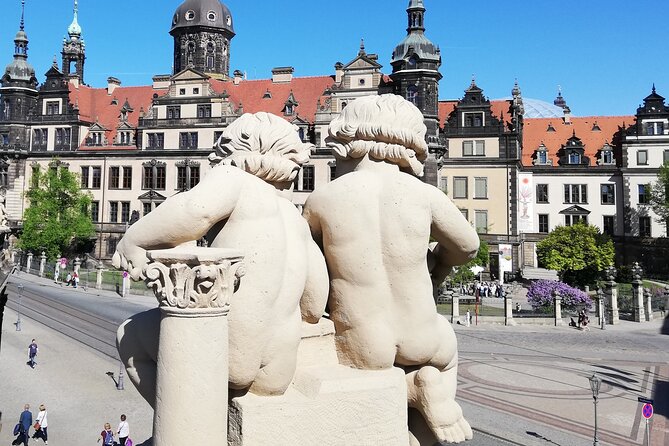
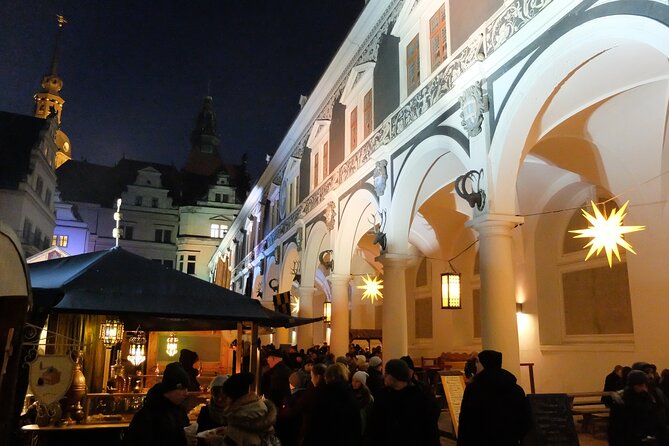
The route also passes the Procession of Princes, an ornate exterior landmark that helps show Dresden’s connection to Saxon rulers. You then admire the exterior of the Royal Cathedral and Palace before continuing toward Brühl’s Terrace.
If the Royal Palace courtyard is open, the guide may take the group through it. The courtyard includes Sgrafitto, a rare Renaissance decorative technique, along with frescoes. This is a useful extra because the courtyard gives you a closer look at details that can be easy to miss from the street.
The wording matters: the courtyard visit depends on whether it is open. The tour does not include entry into the Royal Palace museums. You should not book this experience expecting a museum tour or guaranteed interior access.
The Procession of Princes is also an exterior viewing stop. The value lies in the explanation and the route connection, not in a long stop with indoor shelter. On a cold Advent day, warm clothing and sensible shoes will make a real difference.
Brühl’s Terrace, the Balcony of Europe
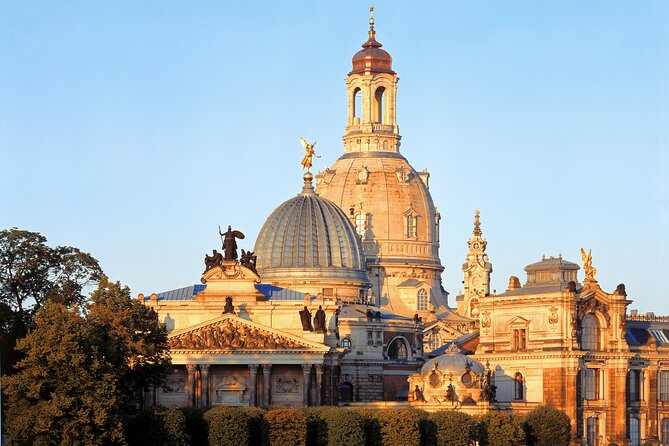
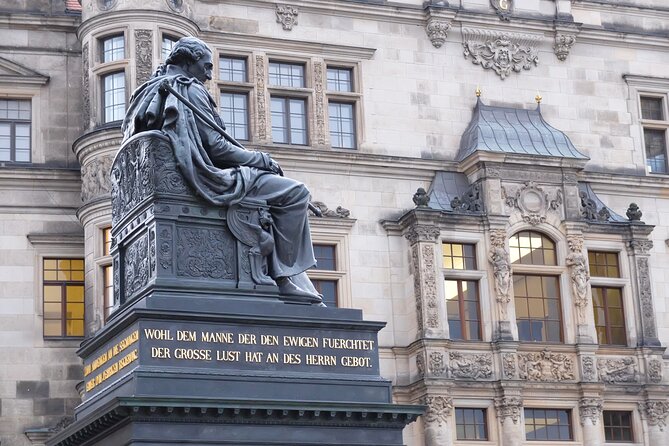
Brühl’s Terrace is presented as the Balcony of Europe, and the guide explains how it gained that name. This elevated promenade gives the tour a change of pace after the dense concentration of royal and religious buildings.
The terrace is a good place to hear how Dresden’s public spaces developed and why the city’s setting along the Elbe shaped its identity. The stop is also a reminder that Dresden is not only about reconstructed monuments. Its appeal comes from the way grand architecture, open promenades, and river views work together.
You should expect commentary rather than a long scenic break. The tour has several landmarks to cover, so the guide will continue the story instead of turning the terrace into a lingering photo stop.
Still, this is one of the places where a guide adds real value. A name such as Balcony of Europe is easy to repeat without understanding. Hearing why it was called that gives the place more character.
The Christmas market and the story of Stollen

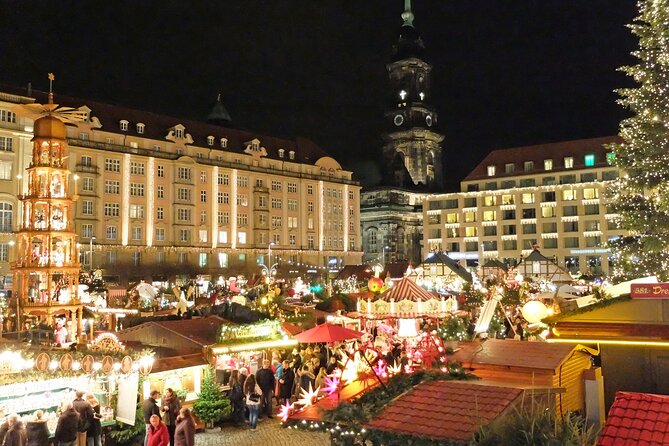
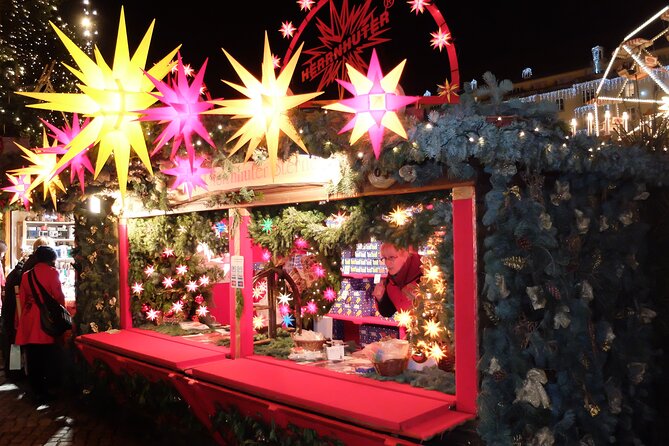
The Christmas portion centers on Dresden’s Striezelmarkt, described as Germany’s oldest Christmas market, dating to 1434. The guide explains how Dresden Stollen developed here and points you toward a baker who may offer a sample.
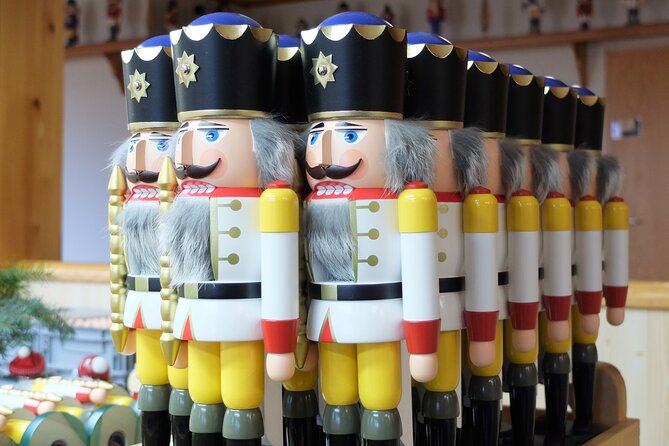
This is the festive heart of the experience, but it is intentionally short. About 20 minutes is allocated to the Christmas-market stop. The guide talks about Glühwein, local delicacies, and the stories behind familiar Saxon decorations, including Nutcrackers and Moravian Stars.
The Stollen detail is particularly useful. This is not just a chance to grab a generic Christmas cake. Dresden Stollen has a long local tradition, and the tour gives you a reason to look for it and understand what makes it part of the city’s identity.
Food and drink are not included. You may be able to sample Stollen, but you should not treat that as a guaranteed tasting or a meal. Alcoholic drinks, including Glühwein, are also purchased separately.
I would plan to stay after the tour. The guide can point you toward good Glühwein, but you will have time to browse the market at your own speed only after the formal walk ends. This arrangement suits you if you want a quick introduction followed by independent exploring.
It does not suit you if you are booking specifically for an evening of market-hopping. One disappointed participant found the Christmas-market section far too brief and expected a stronger festive focus. That criticism is fair if your main goal is shopping and seasonal food.
Weather, walking, and group size
The tour is outdoors and takes place in the colder Advent season. One guide led a group through cold, rainy weather, and the route still earned praise for giving a useful overview. That also tells you what to prepare for: rain or shine, the walk goes on unless the provider cancels it.
Wear warm layers, waterproof shoes, and a coat that makes standing comfortable. Two hours is not a marathon, but city walking combined with frequent stops can feel tiring in wet weather.
The maximum group size is 17 people. That is small enough for a guide to answer questions and keep the group together without the feel of a large coach excursion. It also makes clear speech important, especially beside busy squares or in open courtyards.
The tour is near public transportation, and service animals are allowed. Most people can take part. The meeting point is Schlossplatz, while the end is around Dresden Altmarkt or another nearby market, so you should allow a little time to orient yourself afterward.
How much value do you get for $25.35?
The price is reasonable if you want a guided introduction to Dresden’s central monuments. You receive about two hours of interpretation, a route through several major sights, architectural context, and a short Christmas-market visit.
The value rises if you are new to Dresden or want an English-language walk. Several comments praised the guides’ English, clear answers, and ability to explain the city in an understandable way. The tour can help you decide which museums, churches, and buildings deserve a return visit.
The value drops if you expect admission tickets, a full food tour, or a long market visit. None of those are included. Think of the fee as payment for orientation and storytelling, then budget separately for Stollen, Glühwein, lunch, museum entries, and market purchases.
The tour is also booked an average of 29 days ahead, which suggests you should not leave it until the last moment during the Advent season. Free cancellation is available up to 24 hours before the start time. If the minimum number of people is not reached and the provider cancels, you are offered another date or experience, or a full refund.
Who should book this walk?
I would recommend it to a first-time Dresden visitor who wants the city’s major historic sights explained in English. It is a strong match for anyone who enjoys architecture, wartime history, reconstruction, and the story behind famous buildings.
It also works well for a short city break. The route gives you a useful first look, and the end near Altmarkt lets you continue to the markets without arranging another transfer.
Families with older children may like the mix of royal stories, dramatic destruction, unusual architecture, and Christmas traditions. Younger children who need frequent activity may find the history-heavy format slow, especially in cold weather.
You should think twice if you want a dedicated Christmas-market tour. The seasonal material adds flavor, but the tour’s main subject is Dresden itself. The market stop is brief, and no food or drink is part of the price.
Should you book the Dresden Christmas walking tour?
Book it if you want history first, Christmas second. The strongest parts are the central route, the rebuilding story, the architectural explanations, and guides such as Karen and Lawrence, who have been praised for warmth, clarity, and strong command of the subject.
Skip it if you mainly want market time, tastings, or a relaxed festive stroll. In that case, you will get more from exploring Dresden’s markets independently after a shorter orientation elsewhere.
For the right audience, $25.35 is a fair price for a small-group introduction to one of Germany’s most layered city centers. Bring warm clothes, keep your expectations clear, and stay afterward for the Stollen and Glühwein.
FAQ
How long does the walking tour last?
The tour lasts approximately two hours.
Where does the tour begin?
The meeting point is Schlossplatz, Schloßplatz, 01067 Dresden, Germany.
Where does the tour end?
The tour ends at Dresden Altmarkt or at another nearby Christmas market.
Is the Christmas market the main focus?
No. The tour focuses mainly on Dresden’s history and historic city center, with a Christmas-market visit included as a seasonal addition.
Is food or Glühwein included?
No. Lunch, food, and drinks are not included. Alcoholic beverages are also excluded, but the guide explains local delicacies and can point you toward Glühwein and Stollen.
Does the tour enter Dresden’s museums?
No. The tour does not go inside the Royal Palace museums. If the Royal Palace courtyard is open, the guide may take the group through that courtyard.
How large is the group?
The tour has a maximum of 17 travelers.
Can I cancel for a full refund?
Yes. You can cancel at least 24 hours before the experience start time for a full refund. Changes or cancellations made less than 24 hours before the start time are not accepted for a refund.
More Christmas
- Dresden with a touch of Xmas: English small group tour
★ 4.7 · 41 reviews - Dresden: Festive Christmas Concert in the Zwinger
★ 5.0 · 26 reviews - Dresden: Christmas Sightseeing Tour with a ‘Pflaumentoffel’
★ 4.5 · 13 reviews - Original Munich Christmas Market Tour with Festive Wine and Food
★ 5.0 · 85 reviews
Just added around Dresden
- Dresden’s ‘Balcony of Europe’: A Self-Guided Audio Tour along the River Elbe★ 5.0 · 3 reviews
- A Walk Through Time in Dresden’s Historic Wonders★ 5.0 · 3 reviews
- Stadtrallye Dresden Altstadt★ 4.5 · 3 reviews
- From Dresden: Saxon Switzerland & Pillnitz Castle★ 5.0 · 4 reviews
- Private Dresden Classic Walking Tour★ 5.0 · 4 reviews
- Dresden: Bootstour mit dem Schlauchboot Loschwitz – Radebeul★ 5.0 · 4 reviews
- From Prague: Day trip to Dresden★ 4.3 · 4 reviews
- From Dresden: Bohemia and Saxon Switzerland Winter Tour★ 5.0 · 5 reviews
Walking Tours, compared.





Berlin’s Best: 2 Hour Walking Tour Third Reich and the Cold War
Read our review →


Third Reich Berlin: Hitler and WWII Walking Tour
Read our review →Browse the lists this tour appears in