
Reviewed · WALKING TOURS
A Walk Through Time in Dresden’s Historic Wonders
Dresden’s old center packs centuries into a few blocks. I like the way this two-hour private walk links major sights without wasting time on transport, and I especially like the focus on stories behind the stone, porcelain, and royal buildings. A guide such as Tom can add the small details that are easy to miss when you walk alone.
The main consideration is price: at $170.86 per person, this is a serious spend for a short tour, even with a private group. You pay for personal guiding and a quick, organized introduction to Dresden, not for museum admission or a long day of sightseeing.
In This Review
- Key points at a glance
- Why this short Dresden walk works
- Theaterplatz gives you the right opening view
- Kathedrale St. Trinitatis brings baroque drama
- The Procession of Princes rewards a slower look
- Frauenkirche connects beauty with survival
- Dresden Castle reveals royal power
- The Zwinger finishes the route with a flourish
- What the guide adds to the experience
- Is $170.86 per person fair?
- Who should book this Dresden experience?
- Practical details before you reserve
- Should you book this tour?
- FAQ
- How long does the Dresden historic walking tour last?
- Where does the tour begin?
- Where does the tour end?
- Is this a private tour?
- What sights are included?
- Is admission included for the stops?
- Can I cancel for a full refund?
Key points at a glance
- Theaterplatz begins the story: Dresden’s grand central square gives you a useful first look at the city’s major buildings.
- A remarkable porcelain mural: The Procession of Princes presents Saxony’s rulers in the world’s largest porcelain artwork.
- Frauenkirche carries powerful meaning: Its baroque design and postwar rebuilding make it more than a pretty church.
- Six central sights fit into two hours: The route covers Theaterplatz, the cathedral, the mural, Frauenkirche, Dresden Castle, and the Zwinger.
- Private guiding keeps the pace flexible: Only your group participates, which can make questions and conversation easier.
- Tom received especially warm praise: His entertaining way of explaining Dresden helped turn a basic city walk into a memorable introduction.
Why this short Dresden walk works

Dresden rewards a guide because its center can look like a grand collection of facades at first glance. The buildings are impressive, but the connections between them are what make the city easier to understand. Saxon rulers, Catholic and Protestant traditions, royal collections, wartime destruction, and postwar rebuilding all appear along this compact route.
I like the structure here. You begin at Theaterplatz, move past the cathedral and Procession of Princes, then reach Frauenkirche, Dresden Castle, and the Zwinger. The route gives you a clear sense of how Dresden’s political, religious, and artistic centers sit beside one another.
The tour lasts about two hours. That is enough time for an orientation walk, but not enough for a close visit inside every building. You should think of it as a guided introduction that helps you decide where to return later, rather than a full museum tour.
Because this is a private activity, only your own group takes part. That can be a major advantage if you want to ask questions, pause for photographs, or keep the guide focused on your interests. It also explains part of the higher cost. A solo visitor or couple may find the price harder to justify, while a larger group can get better value if the group discount applies.
More Historical Tours in Dresden
- Elbfloren: Historical city tour
★ 4.8 · 819 reviews - Görlitz: Ghosts and Spooky Historical Night Walking Tour
★ 4.8 · 197 reviews - Historic Dresden Small-Group Walking Tour in English
★ 5.0 · 160 reviews
Theaterplatz gives you the right opening view
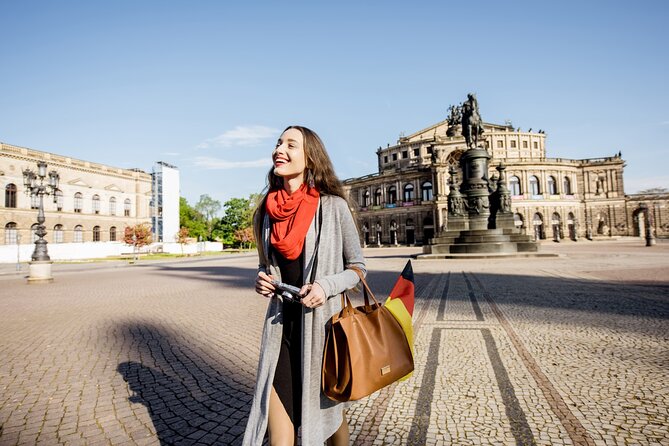
The walk starts at Theaterplatz, Dresden’s grand central square. You receive about 25 minutes here, with no admission charge, and that opening pause matters. The square gives you broad views of the architectural group you will explore during the rest of the tour.
This is a good place to get your bearings. Instead of approaching each sight as an isolated stop, you can see how Dresden’s monumental buildings face and frame one another. The setting also gives your guide room to explain the city before you move into tighter streets and courtyards.
I would pay close attention to the overall view rather than trying to photograph every facade immediately. The guide’s explanation should help you understand why Theaterplatz is such a useful starting point. A panoramic view can tell you a lot in a few minutes, especially when someone points out the buildings you will soon see up close.
The free admission is practical, but remember that the tour price covers guiding rather than entry into a paid attraction. Theaterplatz itself works best as an outdoor introduction.
Kathedrale St. Trinitatis brings baroque drama
The next stop is Kathedrale St. Trinitatis, also known as Dresden Cathedral. You have around 20 minutes here, again with no separate admission charge listed.
The cathedral represents Dresden’s baroque character and its Catholic tradition. That combination is useful context because the city’s historic center is not only a royal stage. Religious buildings helped shape its identity, and the cathedral’s scale and ornament give you a strong example of that side of Dresden.
A short exterior-focused visit will not replace time inside the cathedral, but it allows you to appreciate the building as part of the wider square. You might find the guide’s explanation especially helpful here, since architectural details can pass quickly when you are simply walking from one famous sight to the next.
I would not expect a long, quiet church visit during this tour. Twenty minutes is enough for an overview and photographs, but you may want to return later if the interior interests you.
The Procession of Princes rewards a slower look
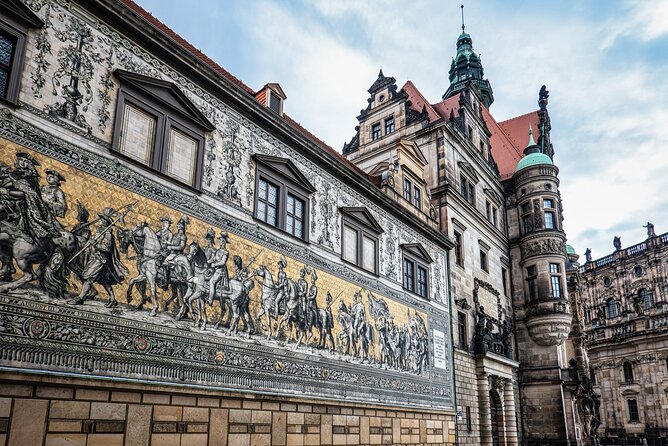
The Procession of Princes is one of the most unusual stops. This huge porcelain artwork celebrates the line of Saxon rulers and is described as the world’s largest porcelain artwork. You receive about 15 minutes here.
The material is part of the story. Dresden is closely associated with porcelain, and this mural gives you a chance to see that tradition on an enormous scale rather than in a small cabinet piece. The artwork also turns a royal family tree into something visual and public, with rulers presented across a long stretch of wall.
Fifteen minutes may sound brief, but this stop does not require the same movement as a palace or museum. You can stand opposite the mural, study the figures, and listen as the guide explains what you are seeing. This is exactly the kind of place where a local guide adds value. Without context, it can look like a long decorative panel. With context, the procession becomes a record of Saxon power and succession.
I suggest saving a little time for details instead of taking one quick photograph and moving on. The scale is easy to understand in person, while a single image may flatten the artwork into a crowded strip.
More Walking Tours in Dresden
- Dresden: City & Semperoper Guided Walking Tour
★ 4.8 · 2,293 reviews - Dresden: Guided City Walk with a Cup of Coffee
★ 4.7 · 1,568 reviews - Görlitz: Old Town Guided Walking Tour
★ 4.7 · 723 reviews - Dresden: Complete Walking Tour with Frauenkirche Visit
★ 4.8 · 700 reviews
Frauenkirche connects beauty with survival
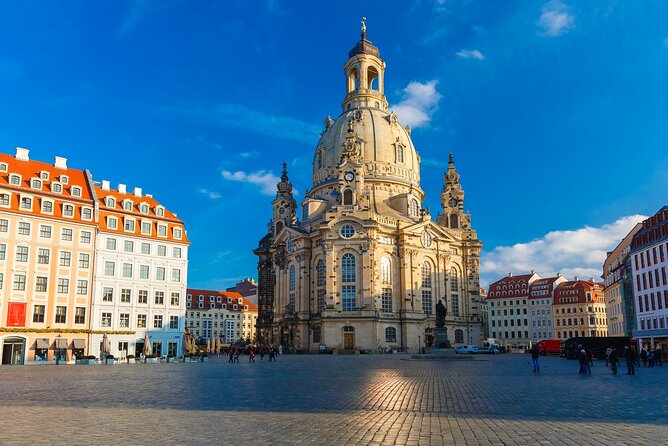
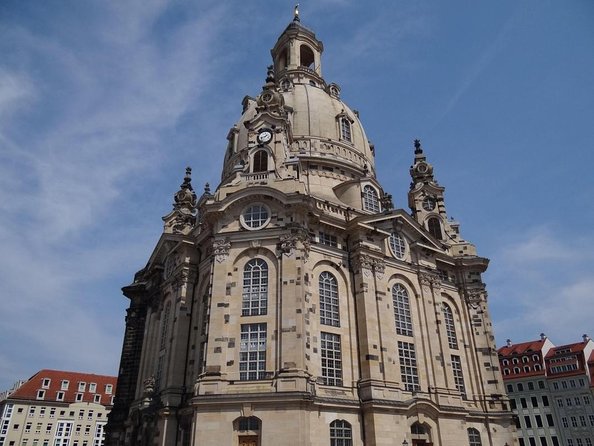
The 20-minute stop at Frauenkirche Dresden is likely to be one of the emotional centers of the walk. The church is a baroque masterpiece and a symbol of destruction and rebirth after World War II.
Its importance goes beyond style. The building’s story gives you a direct way to think about Dresden’s wartime past and the city’s decision to rebuild a major landmark. The church therefore works on two levels: it is an architectural sight, and it represents a city trying to recover a lost part of its identity.
I appreciate that this stop is not presented only as a photo opportunity. The postwar story gives the building weight. You can look at the elaborate design while also considering what it means for a structure to return after such devastation.
As with the cathedral, the stated schedule allows an overview rather than a long interior visit. If you want extended time inside Frauenkirche, you may need to come back separately. The walking tour gives you the setting and the story, then keeps moving.
Dresden Castle reveals royal power
Dresden Castle, or Residenzschloss, receives about 20 minutes. This Renaissance palace was once home to Saxony’s monarchs, making it an important stop for understanding the city’s royal past.
The castle helps connect the grand public spaces to the people who commissioned and used them. After seeing the Procession of Princes, you now reach the former royal residence associated with Saxon rulers. That sequence gives the tour a natural flow: the rulers appear in art, then their palace comes into view.
I like this part of the route because it places Dresden’s political story beside its artistic one. The castle is not merely another ornate building. It helps explain why so much money and effort went into the old center’s architecture and collections.
Twenty minutes will pass quickly here. You should expect the guide to point out the historic character of the palace rather than lead a full museum visit. If you have a special interest in the castle’s collections, ask the guide what deserves a return visit. The private format makes that sort of question easier.
The Zwinger finishes the route with a flourish

The tour ends at The Dresden Zwinger on Sophienstraße. You have about 20 minutes to take in this palace complex, which houses several museums and reflects Dresden’s cultural ambitions.
The Zwinger is a fitting final stop because it shifts the focus from royal residence to art and public display. Its ornate design gives you one last strong example of Dresden’s baroque style, while the museums point toward the city’s broader cultural offerings.
Ending here is convenient if you plan to continue sightseeing. You are not returned to the starting point, so you should account for that when planning the rest of your day. The end location also leaves you near one of Dresden’s key museum areas, though the tour itself does not include museum entry.
I would use the guide’s final minutes to ask what to see next. You may want practical advice on which museum suits your interests, especially if you have another afternoon in the city. Since the walk covers only the outside overview of several landmarks, the Zwinger is a natural place to continue independently.
What the guide adds to the experience
The most important part of this tour is not the number of buildings. You can walk past most of them on your own. The value comes from having someone connect the sights and point out details you might otherwise overlook.
Tom received particularly warm praise for being entertaining as well as well informed. That combination matters. A guide who only lists dates can make a beautiful city feel like a classroom. A guide who tells the story clearly and keeps the mood lively can help the buildings stay in your memory.
The walk also includes small details that may not appear in a standard self-guided stroll. That is useful in Dresden’s old center, where elaborate architecture can overwhelm you with visual information. A guide helps you decide what deserves your attention.
Since the group is private, you can ask for clarification without worrying about interrupting a large tour. You can also tell the guide if you prefer architecture, royal history, wartime recovery, or art. The supplied information does not promise a custom route, so you should not assume every request can change the itinerary, but the format should make conversation more natural.
Is $170.86 per person fair?
The price requires an honest look. At $170.86 per person, this is expensive for a two-hour walk, especially because the stops list free admission and the tour does not include museum entry.
The better question is what kind of value you want. If you are paying for a private group experience, personal attention, and a fast introduction to Dresden’s main historic center, the cost may make sense. A larger group may also benefit from the group discount, depending on the booking terms.
If you are a solo visitor on a tight budget, I would compare this with a self-guided walk or a less expensive group tour. You can see many of the buildings from the outside without paying admission. The private guide becomes more worthwhile when you value questions, a set pace, and a spoken explanation of the city’s past.
I would also consider how much time you have in Dresden. With only one day, this tour can quickly orient you to the central sights. With several days, you might prefer to explore slowly and spend the $170.86 on museum entries or another activity.
Who should book this Dresden experience?
I would recommend this walk to first-time visitors who want a strong introduction without spending half a day on a tour. The route is compact, the major sights are close together, and the private format can suit families or small groups with different interests.
It also fits anyone who likes architecture but wants more than a list of building names. Theaterplatz, the cathedral, Frauenkirche, Dresden Castle, and the Zwinger each reveal a different part of the city’s identity. The Procession of Princes adds a distinctive artistic stop that breaks up the sequence of palaces and churches.
The tour may be less suitable if you want extensive time inside museums or churches. The schedule is tight, and the stated stops are best understood as guided visits and explanations rather than long admissions.
You should also plan for city walking on cobbled streets. The information says most people can participate and that the meeting point is near public transportation. Still, wear comfortable shoes and allow yourself enough time to reach Theaterplatz.
Practical details before you reserve
You meet at Theaterplatz, 01067 Dresden, Germany, and finish at The Dresden Zwinger on Sophienstraße. The tour lasts about two hours and uses a mobile ticket.
Confirmation arrives at the time of booking. The meeting area is near public transportation, which makes the start fairly easy to reach, though you should still check the exact route from your hotel or station.
Free cancellation is available when you cancel at least 24 hours before the start time. Cancellations made inside that window are not refunded, and changes made less than 24 hours before departure are not accepted. The cut-off follows Dresden’s local time.
Should you book this tour?
Book it if you want a private, story-led introduction to Dresden’s central monuments and you are comfortable paying a premium for two hours of guiding. The strongest reasons are the efficient route, the unusual Procession of Princes, the meaning behind Frauenkirche, and the chance to ask questions in a private group.
Skip it if you mainly want museum time, low-cost sightseeing, or a leisurely visit inside each landmark. For the right group, this is a useful way to get oriented quickly. For a budget-conscious solo visitor, it is harder to justify. If you do book, arrive ready to listen at Theaterplatz, and save the Zwinger museums for a separate visit.
FAQ
How long does the Dresden historic walking tour last?
The tour lasts approximately two hours.
Where does the tour begin?
The meeting point is Theaterplatz, 01067 Dresden, Germany.
Where does the tour end?
The tour ends at The Dresden Zwinger on Sophienstraße, 01067 Dresden, Germany.
Is this a private tour?
Yes. Only your group participates in the activity.
What sights are included?
The route includes Theaterplatz, Kathedrale St. Trinitatis, the Procession of Princes, Frauenkirche Dresden, Dresden Castle, and The Dresden Zwinger.
Is admission included for the stops?
The listed stops have no admission ticket charge. The experience does not state that entry to the Zwinger museums or other paid interiors is included.
Can I cancel for a full refund?
Yes, if you cancel at least 24 hours before the experience start time. Cancellations made less than 24 hours before the start time are not refunded.
Just added around Dresden
- Dresden’s ‘Balcony of Europe’: A Self-Guided Audio Tour along the River Elbe★ 5.0 · 3 reviews
- Stadtrallye Dresden Altstadt★ 4.5 · 3 reviews
- From Dresden: Saxon Switzerland & Pillnitz Castle★ 5.0 · 4 reviews
- Private Dresden Classic Walking Tour★ 5.0 · 4 reviews
- Dresden: Bootstour mit dem Schlauchboot Loschwitz – Radebeul★ 5.0 · 4 reviews
- From Prague: Day trip to Dresden★ 4.3 · 4 reviews
- From Dresden: Bohemia and Saxon Switzerland Winter Tour★ 5.0 · 5 reviews
- Dresden: Private Sightseeing Treasure Hunt★ 5.0 · 5 reviews
Walking Tours, compared.





Berlin’s Best: 2 Hour Walking Tour Third Reich and the Cold War
Read our review →


Third Reich Berlin: Hitler and WWII Walking Tour
Read our review →Browse the lists this tour appears in