
Reviewed · THIRD REICH & WWII TOURS
Third Reich Tour Munich
Munich’s old center hides a dangerous past. This 2.5-hour walking tour connects beer halls, memorials, and grand Nazi-era buildings in a way that makes the story easier to follow. I like the route because it includes major sites such as Hofbräuhaus and Königsplatz, while also stopping at less familiar places like Sterneckerbräu. I also like the guides’ focus on context, especially how Jamie Buckley and Kaevan have helped turn a street walk into a clear historical story. The main consideration is that this is an outdoor tour, and one review specifically noted cold weather, so dress for the forecast.
At $34.73 per person, the tour offers solid value if you want a serious introduction to Munich’s role in the Nazi movement without paying separate admission fees. You should expect steady walking, pauses at public sites, and frank discussion of persecution, propaganda, and political violence. This is not a light sightseeing stroll, and that is precisely its strength.
In This Review
- Key points to know before you go
- Why this Munich history walk is worth your time
- Starting at Isartor and entering Munich’s old center
- Sterneckerbräu and the movement’s early meeting place
- Hofbräuhaus and the power of the speech
- Feldherrnhalle and the failed Beer Hall Putsch
- The memorial at Platz der Opfer des Nationalsozialismus
- The Führerbau and the Munich Agreement
- Königsplatz, propaganda, and the tour’s final scene
- Guide quality, pace, and group size
- Price, timing, and who should book
- Should you book the Third Reich Tour Munich?
- FAQ
- Where does the Third Reich Tour Munich begin?
- Where does the tour end?
- How long does the tour last?
- What sites are visited?
- What is the price?
- How large can the group be?
- Is the tour close to public transportation?
- Can I cancel for a full refund?
Key points to know before you go
- The route links seven important locations, beginning at Isartor and ending at Königsplatz.
- Sterneckerbräu and Hofbräuhaus reveal the movement’s beer-hall beginnings, where early meetings and speeches helped build support.
- Feldherrnhalle marks the failed Beer Hall Putsch of 1923, a turning point in Hitler’s political career.
- The memorial at Platz der Opfer des Nationalsozialismus adds essential balance, honoring people persecuted by the Nazi regime.
- The tour ends near excellent public transport, with Königsplatz U-Bahn station just a short walk away.
- The group can include up to 20 people, and the guides Jamie Buckley and Kaevan have received praise for clear storytelling and a thoughtful pace.
Why this Munich history walk is worth your time
Munich is often introduced through churches, palaces, food, and beer. Those pleasures are real, but they can hide the city’s darker political role. The Nazi movement did not appear fully formed in Berlin. It grew through Munich’s political clubs, beer halls, streets, and public squares.
This tour gives you a physical route through that story. You begin at Isartor, walk through the old center, visit the locations tied to early Nazi organizing, then move toward the grand spaces used for ceremony and propaganda. By the end, you have seen how ordinary urban places were used to build an extraordinary concentration of power.
I appreciate that the route does not focus only on Adolf Hitler. The stops also show how institutions, public spaces, crowds, and political symbols helped the movement grow. The memorial at Platz der Opfer des Nationalsozialismus is especially important because it shifts attention away from Nazi leaders and toward the people who suffered under the regime.
The tour is guided in English, according to the supplied experience details, and the guide commentary is the main attraction. You are not simply being pointed toward buildings. You are given the connections between them.
More Third Reich & WWII Tours in Munich
- Munich: Third Reich & WWII Walking Tour
★ 4.6 · 6,181 reviews - Third Reich Walking Tour Munich
★ 4.5 · 4,291 reviews - Munich: Birthplace of the Third Reich Guided Walking Tour
★ 4.6 · 771 reviews
Starting at Isartor and entering Munich’s old center
The meeting point is Isartor Gate at Tal 50. This is a useful starting place because it puts you at one of Munich’s historic entrances before the route moves into the central streets.
The initial meeting takes about five minutes, so arrive ready to begin. The tour ends at Königsplatz rather than returning you to Isartor, which is worth noting when planning your day. You will be walking across the city center, not taking a bus between separate attractions.
The walk is scheduled for about two and a half hours. That gives the guide enough time to explain each location without turning every stop into a long lecture. Still, you should wear comfortable shoes. The tour includes several standing pauses and a fair amount of movement through central Munich.
Sterneckerbräu and the movement’s early meeting place
Sterneckerbräu is one of the more unusual stops. The former beer hall was the place where the prototype Nazi Party was founded, and it served as an early meeting point for Adolf Hitler and his followers.
This stop helps explain how political organizing worked in Munich at the time. The setting matters. Beer halls could hold groups, encourage public speaking, and create an informal atmosphere where political ideas spread through conversation and speeches. You begin to see how a fringe movement could gain attention before it had government power or monumental buildings.
The scheduled visit lasts about 15 minutes. That is enough for a focused explanation, though you should not expect a museum-style interior visit. The admission is listed as free, and the value comes from the guide’s interpretation of the place and its role in the movement’s beginnings.
I find this stop useful because it corrects a common misunderstanding. The Nazi rise was not just a story of military force and official offices. It also involved recruiting, persuasion, repeated meetings, and the careful use of familiar public spaces.
Hofbräuhaus and the power of the speech
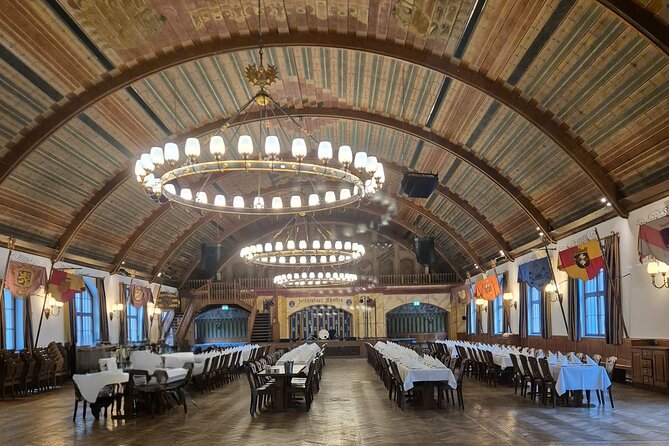
Hofbräuhaus is one of Munich’s best-known beer halls, and its connection to early Nazi politics makes it more than a food and drink stop on a sightseeing map.
The tour spends about 25 minutes here, explaining how Hitler held early party meetings and delivered speeches as the movement attracted larger crowds. The guide also covers the hall’s role in propaganda efforts. This is where you can consider how a famous social venue became a political stage.
The stop is valuable because it shows the relationship between spectacle and politics. A speech in a crowded hall could create a feeling of shared purpose. Repetition, slogans, and emotional appeals helped turn political gatherings into public performances.
Do not expect this part of the tour to include a meal, a beer tasting, or a reserved table. Hofbräuhaus is presented as a historical location, not as a dining experience. If you want to eat there, plan that separately and allow extra time after the walk.
The guide’s storytelling matters most here. Jamie Buckley was praised for making the streets feel like part of a connected story, while Kaevan was praised for answering questions and bringing the subject to life. That kind of explanation is particularly helpful at a busy, famous place where it would be easy to focus only on the atmosphere and miss the political history.
Something different for another day:
- From Munich: Neuschwanstein & Linderhof Castle Full-Day Trip
★ 4.5 · 12,494 reviews - Neuschwanstein & Linderhof Castle-Fairytale Day Tour from Munich
★ 4.5 · 7,275 reviews - Dachau Concentration Camp Memorial Site Tour from Munich by Train
★ 4.5 · 5,637 reviews - Neuschwanstein Castle Tour from Munich
★ 4.5 · 5,117 reviews
Feldherrnhalle and the failed Beer Hall Putsch
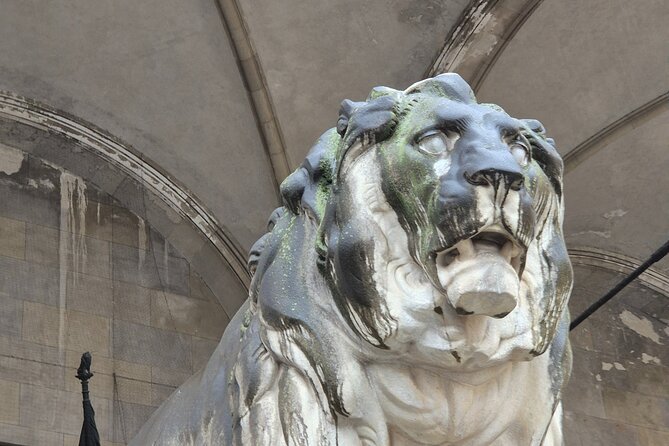
At Feldherrnhalle, the tour reaches one of the clearest turning points in the story. In 1923, Hitler and his followers attempted to seize power in the Beer Hall Putsch. The attempt failed after a clash with Bavarian police.
The stop lasts about 25 minutes, giving the guide time to explain both the event and its later use by Nazi propaganda. The monument became a symbol of Nazi martyrdom, even though the putsch itself did not succeed.
This is an important lesson in political memory. A failed action can still be turned into a powerful story if leaders present it as sacrifice and heroism. The Nazis used the deaths of their supporters to build a myth around the movement and strengthen loyalty.
You will also hear how the failed putsch shaped Hitler’s later path. Rather than ending his political career, the event helped create publicity and led to a change in strategy. The movement would continue pursuing power through political organization and legal institutions, while still using intimidation and violence.
Feldherrnhalle is an outdoor public site, so the explanation takes place on the street. If the weather is poor, the 25-minute pause may feel long. The practical fix is simple: wear a warm layer and bring weather protection, especially during colder months.
The memorial at Platz der Opfer des Nationalsozialismus
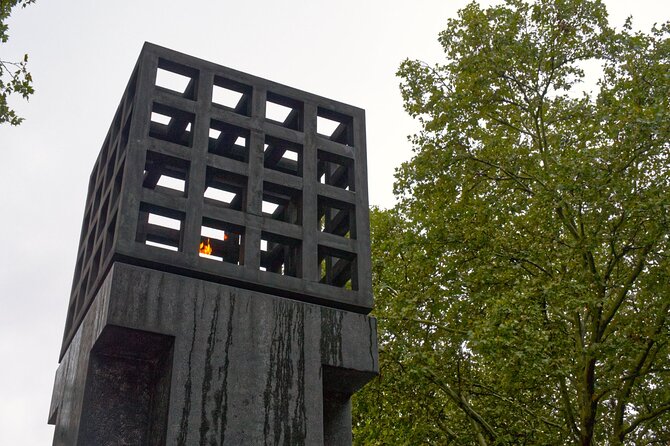
The visit to Platz der Opfer des Nationalsozialismus gives the walk a necessary moral center. The square is dedicated to people persecuted by the Nazi regime and includes an eternal flame.
This is a quieter stop than the beer halls and political monuments. The scheduled time is about 20 minutes, which allows the guide to explain the memorial and Munich’s efforts to confront its past.
I value this part of the route because it keeps the tour from becoming too focused on the men and symbols of Nazism. You are asked to remember the people targeted by the regime, including those who were persecuted, imprisoned, and killed.
The memorial also helps you understand how modern Munich presents this history. The city contains places once used for Nazi power, but it also has memorials that directly acknowledge the damage caused by that power. Those two realities exist side by side throughout the walk.
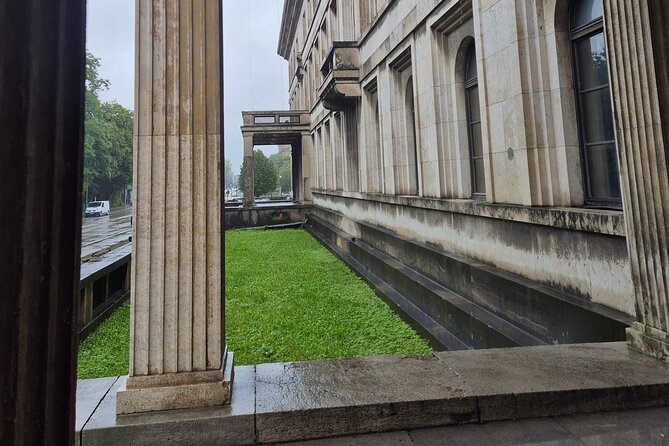
Take this stop seriously and give yourself a quiet moment. The tour covers a difficult subject, and this memorial provides space to absorb what you have heard before moving on to the larger Nazi-era buildings around Königsplatz.
The Führerbau and the Munich Agreement
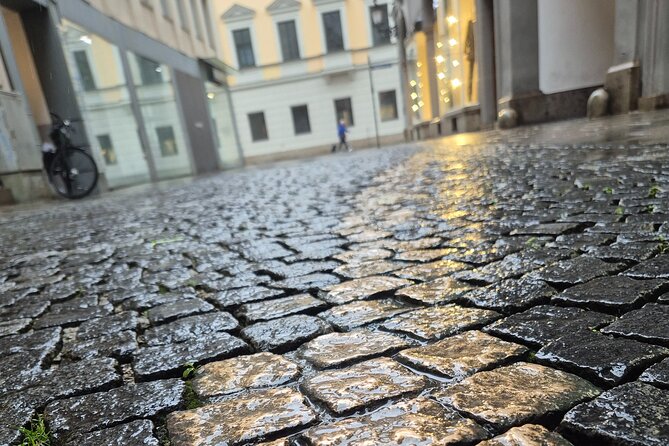
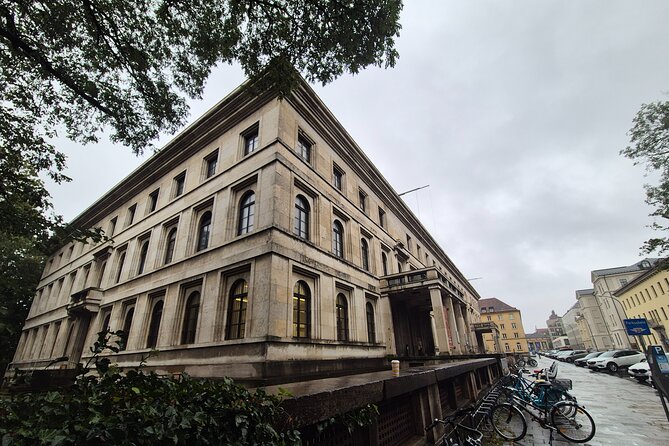
The Führerbau was Hitler’s official Munich office. The building was used for meetings with senior officials and for important decisions connected to the Third Reich.
The tour spends about 20 minutes here. One major event linked to the building is the signing of the Munich Agreement in 1938, making the site relevant not only to local Nazi history but also to the wider international story of the period.
The building’s plain presence today can make the history easy to miss. That is why a guide is useful. You may walk past it without realizing that officials once gathered there for decisions with consequences far beyond Munich.
This stop also helps shift the focus from street-level organizing to official administration. Earlier locations show how the movement built support. The Führerbau shows the machinery of government and diplomacy after the Nazis had gained power.
As with the other stops, the experience is based on exterior interpretation rather than a stated interior tour. You should not book this expecting access to private offices or a museum collection inside the building.
Königsplatz, propaganda, and the tour’s final scene
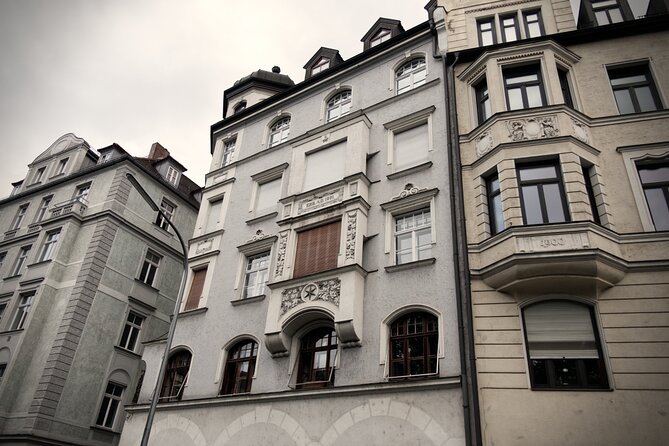
Königsplatz is the final stop and receives about 20 minutes. The Nazis transformed this grand square into a setting for rallies, military parades, public ceremonies, and book burnings.
The architecture and open space made it useful for displaying authority. Large gatherings could be staged here, giving the regime a visual language of order, power, and control. The guide explains how the square worked as a propaganda tool rather than merely a beautiful urban space.
Ending here makes sense. The route has moved from small political meetings to mass public ceremony. You can trace the change from a developing movement to a regime capable of reshaping the city for its own purposes.
Königsplatz also makes a practical ending point. The U2 U-Bahn station is nearby, and you can take the train one stop to Munich Central Station. Buses and trams serve the area as well, or you can walk back to Munich’s Old City in less than 15 minutes.
Guide quality, pace, and group size
The guide is the heart of this experience. Jamie Buckley has been praised for detailed historical context, a good pace, and adding useful information without losing sight of the planned route. Kaevan has also been praised for strong subject knowledge, answering questions, and helping a small group connect with the subject.
Those details matter because a Nazi-era tour can easily become either too shallow or too heavy with dates. The strongest moments here seem to come from turning the streets into a chronological story. One review described the experience as feeling like a story assembled as you walk, which is exactly what a good city history tour should do.
The maximum group size is 20. That is not a private tour, but it is still limited enough for the guide to manage questions more easily than on a large coach excursion. One group was described as small, and that allowed participants to get to know one another and discuss why the subject interested them.
The pace is designed to cover the route and allow extra information along the way. If you prefer to stop for long photographs or explore each site independently, you may find the schedule a little structured. If you want a clear narrative within a fixed two-and-a-half-hour window, the pacing should suit you.
Price, timing, and who should book
At $34.73 per person, I consider this a fair price for a guided city walk of this length. The public sites do not require admission fees, so you are paying mainly for the guide’s preparation, historical explanation, and ability to connect places that you could otherwise visit without context.
The tour is often booked about seven days ahead, but one person booked at the last minute and was happy with the result. I would still reserve in advance if your Munich schedule is tight, especially because the group is capped at 20 people.
This experience suits:
- History buffs who want more than general sightseeing
- First-time Munich visitors seeking political context
- People interested in how propaganda uses architecture and public space
- Curious visitors who enjoy walking and asking questions
- Anyone who wants to pair a city tour with later visits to Munich museums and memorials
It may not suit you if you want a relaxed beer-hall outing, an indoor museum tour, or a tour focused mainly on architecture. The subject is serious, and the route is outdoors for most of its duration.
Confirmation is provided at booking. Service animals are allowed, and the tour is near public transportation. Most people can participate, but the supplied details do not specify the exact walking distance or whether every stop is fully accessible, so contact the provider if you have mobility concerns.
You can cancel free of charge up to 24 hours before the start time for a full refund. Changes or cancellations made less than 24 hours before the start time are not accepted for a refund.
Should you book the Third Reich Tour Munich?
Book it if you want a clear, guided account of Munich’s Nazi-era role and are comfortable spending two and a half hours outdoors with a serious subject.
The strongest reasons are the route, the mix of famous and less familiar sites, and the guides’ praised storytelling. You will see where early meetings took place, where Hitler tried to seize power, how the regime used public space, and how Munich remembers those it persecuted.
Skip it if you are looking for entertainment, food, or a broad overview of all Munich history. For the right audience, though, this is a thoughtful and well-priced way to understand a part of the city that ordinary sightseeing can easily leave unexplained.
FAQ
Where does the Third Reich Tour Munich begin?
The tour begins at Isartor Gate, Tal 50, 80331 München, Germany.
Where does the tour end?
The tour ends at Königsplatz 1, 80333 München, Germany.
How long does the tour last?
The experience lasts approximately 2 hours and 30 minutes.
What sites are visited?
The route includes Isartor, Sterneckerbräu, Hofbräuhaus, Feldherrnhalle, Platz der Opfer des Nationalsozialismus, the Führerbau, and Königsplatz.
What is the price?
The listed price is $34.73 per person.
How large can the group be?
The maximum group size is 20 participants.
Is the tour close to public transportation?
Yes. It begins near public transportation and ends close to Königsplatz U-Bahn station. The U2 can take you from Königsplatz to Munich Central Station in one stop.
Can I cancel for a full refund?
Yes. You can cancel at least 24 hours before the scheduled start time for a full refund. Changes or cancellations made less than 24 hours before the start time are not accepted.
Just added around Munich
- Munich WWII and Dachau Concentration Camp Private Tour with Licensed Guide★ 5.0 · 3 reviews
- Munich Photoshoot: A Must-Have Holiday Experience!★ 5.0 · 3 reviews
- München: Braukurs mit Führung und Verkostung★ 4.2 · 4 reviews
- Mozart and German Composers Private Tour in Munich★ 4.8 · 4 reviews
- CITY QUEST Munich: reveal the secrets of this city!★ 4.0 · 4 reviews
- Private audio book city rally in Munich city centre★ 4.0 · 4 reviews
- Culinary Haidhausen – The Food Tour★ 4.3 · 4 reviews
- Private Munich History and Beer Culture Walking Tour★ 5.0 · 4 reviews
Third Reich & WWII Tours, compared.



Berlin’s Best: 2 Hour Walking Tour Third Reich and the Cold War
Read our review →

Third Reich Berlin: Hitler and WWII Walking Tour
Read our review →
Walking Tour of Former Nazi Party Rally Grounds
Read our review →
Browse the lists this tour appears in