
Reviewed · WALKING TOURS
Rostock: Private Guided Walking Tour
Rostock rewards a closer look. This private two-hour walk brings together Hanseatic history and Gothic landmarks, with the Town Hall, St. Mary’s astronomical clock, old walls, and the university all within a compact city route. I like the personal format and the chance to ask your own questions as you go. I also like that the guide can adjust the tour on the spot.
The main tradeoff is time. Two hours is enough for a strong first look, but not enough for a slow visit inside every church or a detailed exploration of Rostock’s museums. Entrance fees are not included, so this works best as a city orientation rather than a full indoor sightseeing program.
In This Review
- Key points at a glance
- Starting at New Market Square and the Seagulls’ Fountain
- Reading Rostock through its Hanseatic past
- St. Mary’s Church and its 15th-century clock
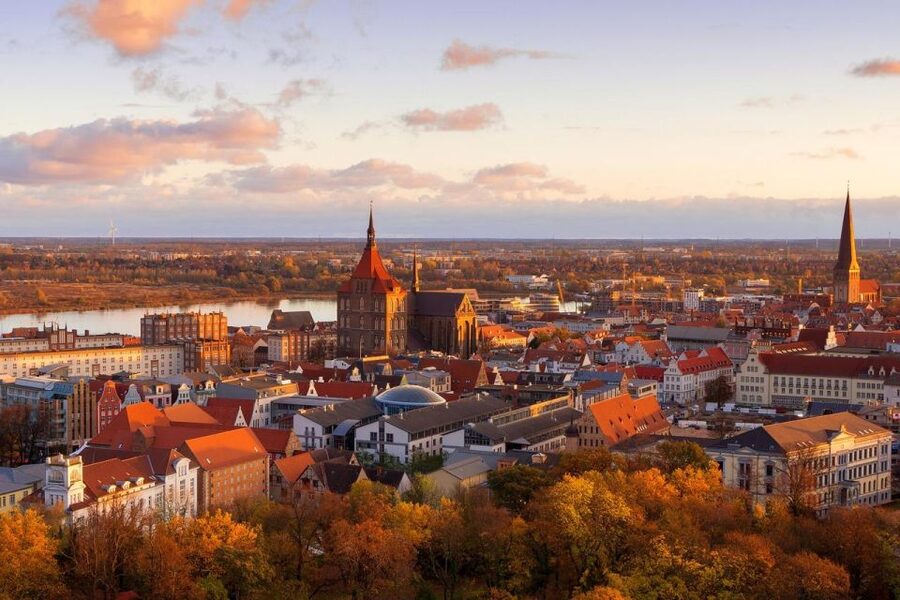
- St. Petri Church and the city skyline
- Walking the old walls and guard houses
- Stone Gate and its message of civic pride
- Rostock University and the Fountain of Happiness
- Rostock after WWII: destruction and rebuilding
- What the private format adds
- Is $280 a fair price for two hours?
- Timing, pace, and practical expectations
- Who should book this Rostock walk?
- Should you book the Rostock private walking tour?
- FAQ
- How long is the Rostock private walking tour?
- Where does the tour meet?
- Is the tour private?
- Which languages are available?
- Are entrance fees included?
- Can I cancel for a full refund?
Key points at a glance
- The Seagulls’ Fountain is the meeting point: Begin at New Market Square, where Neptune and his sons reflect Rostock’s close ties to the sea.
- St. Mary’s Church holds a rare survivor: Its 15th-century astronomical clock is a major highlight, and the church survived the WWII air raids that destroyed or damaged much of the city.
- Rostock’s Hanseatic past shapes the walk: The route explains how trade, shipping, and the Baltic connected the city with northern Europe.
- The fortifications make wartime history tangible: Ramparts, guard houses, and part of a wooden wall walk remain in the old city.
- The private format suits curious groups: Your local guide leads only your party, speaks English or German, and may tailor the walk while you are together.
- The price works best for a larger party: At $280 for up to 15 people, the per-person cost drops sharply as your group grows.
Starting at New Market Square and the Seagulls’ Fountain
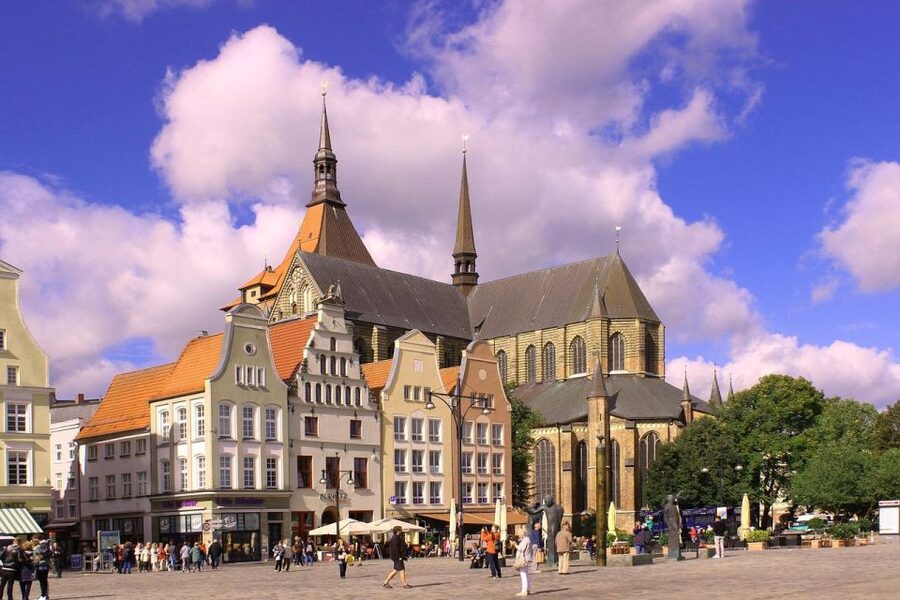
Your walk begins at the Seagulls’ Fountain in New Market Square, or Neuer Markt. This is a useful meeting point because it puts you right in the middle of Rostock’s old center instead of sending you to a modern transport hub or an outlying attraction.
The fountain is more than a landmark for finding your guide. Its figures represent Neptune, the Roman god of the sea, and his sons. That subject fits Rostock well. The city grew through shipping and trade, and its position on the Baltic helped it connect with Scandinavia, other German ports, and wider European markets.
I like beginning here because the square gives you an immediate sense of the city’s visual character. The Town Hall faces the space in a mix of Gothic and Baroque styles. Its seven towers make it one of the most recognizable sights in Rostock, and the guide uses the building to explain how the city developed political and economic power.
Look closely at the Town Hall rather than treating it as a quick photo stop. Its mixed design reflects layers of construction and changing taste. That contrast also introduces a theme that returns throughout the walk: Rostock is not a perfectly preserved medieval town. It is a city rebuilt, repaired, and adjusted over time.
More Walking Tours in Rostock:
- Rostock: City Walking Tour
★ 4.9 · 198 reviews - Warnemünde: Guided Walking Tour
★ 4.3 · 102 reviews - Surprise Walk of Rostock with a Local
★ 5.0 · 7 reviews
Reading Rostock through its Hanseatic past
The Hanseatic League is one of the most useful pieces of background for understanding Rostock. This network of trading cities shaped commerce around the North and Baltic seas, and Rostock became an important part of that system.
Your guide explains the city’s role in this northern trading world and why its port mattered. Rostock is described as Germany’s fourth-largest port city and the largest on the Baltic coast, with connections to Scandinavian destinations and international cruise routes. Those modern links make more sense once you understand the older trading networks that made the city prosperous.
The tour also covers the origin of the name Rostock and the city’s historical importance. This part can be easy to skip when exploring alone, but it gives the buildings a purpose. Instead of seeing a church, gate, or square as an isolated monument, you begin to understand how civic government, shipping, religion, and education worked together.
I especially value this kind of context on a short walk. You are not simply collecting landmarks. You are learning why this particular city grew where it did and why its old center looks the way it does.
St. Mary’s Church and its 15th-century clock
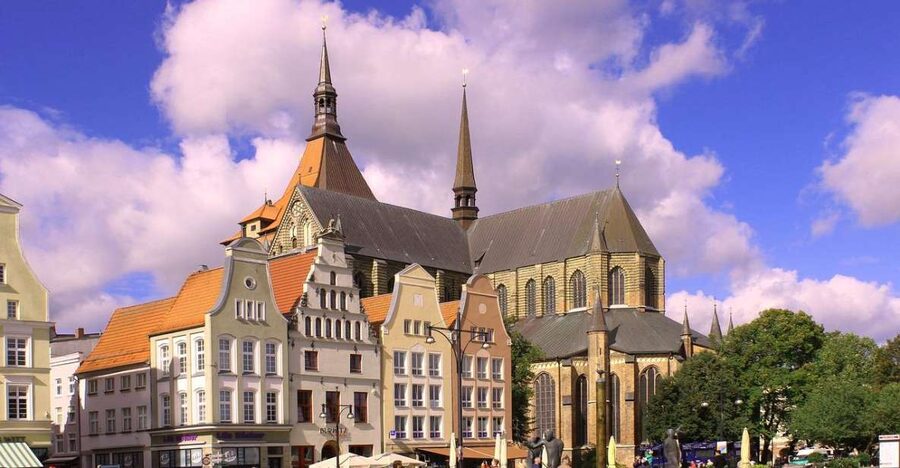
St. Mary’s Church is likely the most important stop for many people on the route. It is the only main Rostock church to survive the WWII air raids, and that fact gives the building unusual weight.
The church is also known for its astronomical clock, built in the 15th century. I would give this stop your full attention. The clock is not just a decorative detail. It reflects the technical skill, religious outlook, and civic pride of medieval Rostock.
The guide can explain what makes the clock significant and place it within the wider story of the church. Since entrance fees are not included, you should confirm on the day whether you will enter and what any fee may be. The tour promises the landmark and its story, but it does not promise admission to every interior.
That distinction matters. If you are mainly interested in architecture from the street, the two-hour route should serve you well. If you want a long look at the clock or time inside the church, you may need to plan a separate visit.
St. Petri Church and the city skyline
St. Petri Church provides another strong visual marker. Its Gothic tower guided fishermen in the area and remains an important part of Rostock’s profile.
The church was destroyed during WWII and rebuilt later. Its story pairs naturally with St. Mary’s Church. One survived the bombing while the other had to be reconstructed, giving you two different examples of how the war changed Rostock’s religious buildings and public spaces.
I like this contrast because it keeps the wartime section from becoming abstract. You can connect the story to actual structures. The tower carries both medieval purpose and modern repair, a combination that says a lot about Rostock’s endurance.
The information provided does not promise a tower climb or an interior visit, so think of St. Petri primarily as an architectural and historical stop. The tower itself is the main point, especially if you enjoy city views and Gothic church design.
A few more tours and experiences worth a look
- Warnemünde Shore Excursion: Private Tour of Berlin’s World War II and Cold War Sites
★ 5.0 · 17 reviews - Warnemuende Shore Excursion: Private Sachsenhausen Memorial and Berlin Tour
★ 5.0 · 8 reviews - Half-Day Rostock & Warnemünde Private Shore Excursion for Cruise Ship Passengers
★ 4.5 · 6 reviews - Warnemünde Shore Excursion: Private Highlights Tour of Berlin with Minivan
★ 5.0 · 5 reviews
Walking the old walls and guard houses
Parts of Rostock’s old fortifications still survive. The route includes sections of ramparts, built-in guard houses, and part of a wooden wall walk.
These remains help you picture the city as a defended medieval trading center. A wall was not merely a boundary. It protected merchants, homes, churches, and warehouses, while also marking the limits of civic authority.
The surviving pieces are especially valuable because Rostock’s center was heavily affected by WWII bombing. You are seeing fragments that connect the medieval city with its later destruction and reconstruction. That gives the walk a clear timeline, from fortified port to bomb-damaged city to rebuilt Baltic center.
I would not expect a long, continuous circuit of intact walls. The description points to partial remains, so the appeal is in the individual stretches and the explanation around them. A guide helps you notice what you might otherwise walk past as a stone wall or a low rampart.
Stone Gate and its message of civic pride
The Dutch Renaissance Stone Gate, or Steintor, is one of the route’s most memorable landmarks. Its design differs from the Gothic churches, and that change in style reflects another period in Rostock’s growth.
The motto on the walls translates as May harmony and prosperity reign within your walls. It is a compact statement of what a city wanted to project: order, peace, and commercial success.
I find inscriptions like this more useful than another general date. They show how Rostock wanted to describe itself. The gate was practical, but it was also public messaging, presenting the city as secure, prosperous, and united.
This is a good place to listen closely to the guide’s interpretation. You will get more from the motto if you understand the role of gates in a walled trading city and the pride that civic leaders placed in architecture.
Rostock University and the Fountain of Happiness
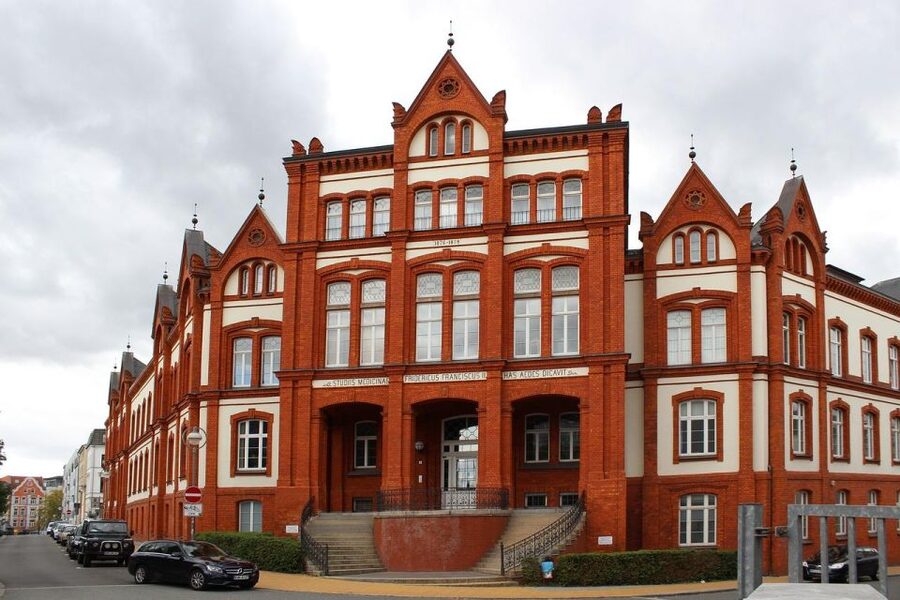
Rostock University dates from 1419 and is described as one of the oldest universities in the world, as well as the oldest in the Baltic region. Its presence adds a different layer to the city’s story.
Rostock was not only a port and a defended town. It was also a place of study and ideas. The university helped give the city a lasting cultural role, and its age connects Rostock with the wider intellectual life of northern Europe.
The Fountain of Happiness is included in this part of the walk. It is a lighter stop after the churches, walls, and wartime history, but it also reminds you that public art can express civic hopes just as clearly as a motto carved into a gate.
I appreciate the university stop because it broadens the tour. If the route focused only on shipping and medieval buildings, Rostock could seem like a museum of trade. The university shows that the city’s identity also includes education and public life.
Rostock after WWII: destruction and rebuilding
The WWII story is not a side note here. It runs through several stops, especially St. Mary’s Church, St. Petri Church, and the old fortifications.
Rostock suffered serious damage in the air raids. Some major buildings survived, while others were destroyed and rebuilt. The route presents the city as a place that came back from widespread destruction, rather than pretending that every old-looking building escaped the war intact.
That approach is important. Rebuilt architecture can still carry real historical meaning, but it tells a different story from an untouched medieval building. You will see how survival, loss, and reconstruction shaped the city you walk through today.
I also like that the wartime material is tied to streets and structures instead of being delivered as a detached lecture. The rebuilt tower and surviving church make the subject easier to understand. Rostock’s past is visible in what remains, what was repaired, and what exists only in the guide’s explanation.
What the private format adds
The tour is private for your group only, with a maximum of 15 people. That makes a real difference if you are traveling with family, friends, or a small organization.
A private guide can adjust the pace and answer questions without trying to satisfy a large mixed crowd. The experience also allows possible customization on the spot. If your group is more interested in churches, port history, university life, or wartime rebuilding, you can ask the guide to spend more time on those subjects when practical.
The guide speaks English or German. If you are visiting from a cruise or using Rostock as a Baltic base, an English-language walk provides a quick way to get oriented without committing to a full-day program.
One guide named Jana has been specifically praised for providing pleasant local insight and useful insider details. If Jana is assigned to your group, you may find that her personal knowledge adds extra color beyond the main landmarks. The available feedback also describes the tour as friendly and enjoyable, which fits the private setup well.
Still, guide quality can vary from person to person, and a two-hour walk cannot cover everything. I would arrive with two or three questions you care about. That makes the most of the private format.
Is $280 a fair price for two hours?
The price is $280 per group of up to 15 people. For one or two people, that is a substantial cost for a two-hour walk. For a full group, the value changes considerably.
At the maximum group size, the price works out to less than $19 per person. For six people, it is about $47 per person. For a couple, it is $140 per person. That makes this tour most attractive to families, friend groups, and larger parties who want a guide to themselves.
The price includes a local professional guide and possible customization. Entrance fees are not included, so budget separately if you decide to enter a church or another site that charges admission.
I would compare the tour with your plans for the day. If you want a compact introduction to Rostock before exploring on your own, the cost can be sensible for a group. If you are traveling alone and mainly want to see the exteriors, you may find the private rate harder to justify.
Timing, pace, and practical expectations
The walk lasts two hours. That is enough time to cover the main highlights at a steady pace, but it is not designed for lingering at every stop.
You should expect a city-center walking experience with frequent pauses for explanation and viewing. Wear comfortable shoes, since the route includes squares, streets, church areas, gates, ramparts, and sections of old fortification.
The meeting point is the Seagulls’ Fountain in New Market Square, Neuer Markt, 18055 Rostock. Check the available starting times when booking, since the precise departure time depends on availability.
The cancellation policy is flexible: you can cancel up to 24 hours before the start for a full refund. You can also reserve now and pay later, which is useful if your Baltic travel plans are still shifting.
Who should book this Rostock walk?
I would choose this experience if you want a clear introduction to Rostock without spending a full day on organized sightseeing. It suits first-time visitors, history fans, architecture lovers, and cruise passengers who want more than a quick look at the port.
It is also a good match for families or groups who value privacy. The chance to adjust the focus can help if some people care about church architecture while others prefer war history or the Hanseatic League.
I would think twice if you want extended interior visits, museum time, or a long climb for city views. The duration and entrance-fee policy point to a guided overview, not a full admission-based tour.
Should you book the Rostock private walking tour?
Book it if you are traveling with a group and want Rostock’s main stories explained in one well-focused walk. The strongest parts are the mix of Hanseatic trade, Gothic architecture, WWII destruction, surviving fortifications, and the old university. The private format also gives you room to ask questions and request adjustments.
For a solo visitor or couple, the $280 price is the main concern. In that case, book only if personal guiding and historical context matter more to you than keeping costs low. For larger groups, the price becomes much more reasonable, and the tour offers a useful first chapter before you continue exploring Rostock independently.
FAQ
How long is the Rostock private walking tour?
The tour lasts two hours.
Where does the tour meet?
The meeting point is by the Seagulls’ Fountain in New Market Square, Neuer Markt, 18055 Rostock.
Is the tour private?
Yes. It is a private group tour, with your group only, for up to 15 people.
Which languages are available?
The live guide is available in English or German.
Are entrance fees included?
No. Entrance fees are not included in the tour price.
Can I cancel for a full refund?
Yes. You can cancel up to 24 hours in advance for a full refund.
Just added around Rostock
- Private Warnemuende Shore Excursion: Third Reich Berlin★ 5.0 · 4 reviews
- Warnemünde Shore Excursion: Private Highlights Tour of Berlin with Minivan★ 5.0 · 5 reviews
- Half-Day Rostock & Warnemünde Private Shore Excursion for Cruise Ship Passengers★ 4.5 · 6 reviews
- Discover Rostock: A Guided City Tour for Cruise Guests★ 3.7 · 7 reviews
- Surprise Walk of Rostock with a Local★ 5.0 · 7 reviews
- Warnemuende Shore Excursion: Private Sachsenhausen Memorial and Berlin Tour★ 5.0 · 8 reviews
- Brewery tour with guide!★ 4.8 · 13 reviews
- Distillery tour with guide!★ 4.7 · 14 reviews
Walking Tours, compared.





Berlin’s Best: 2 Hour Walking Tour Third Reich and the Cold War
Read our review →


Third Reich Berlin: Hitler and WWII Walking Tour
Read our review →Browse the lists this tour appears in