
Reviewed · THIRD REICH & WWII TOURS
Warnemünde Shore Excursion: Private Tour of Berlin’s World War II and Cold War Sites
Berlin rewards the long haul. This private excursion turns a Warnemünde port call into a concentrated day of World War II and Cold War history, with a guide, private vehicle, and room to shape the route around your interests. You can visit Hitler’s bunker site, the Holocaust Memorial, Checkpoint Charlie, the Berlin Wall Memorial, and more without being tied to a large coach group.
I especially like the custom itinerary and the reliable port-to-port transport. Guides such as Glen, Ashleigh, Anne, Heiko, and Cian have been praised for strong historical knowledge and friendly presentation, while drivers including Peter, Herbert, Olaf, and Hoger have earned compliments for punctuality and comfortable vehicles. The main drawback is the distance: about 2.5 hours each way, leaving roughly six hours with the guide in Berlin and making this a very long day.
In This Review
- Key points to know before booking
- Why the Warnemünde to Berlin journey is worth considering
- Hitler’s bunker site and the final days of 1945
- The Holocaust Memorial asks for quiet time
- Brandenburg Gate and the Reichstag tell a story of change
- Checkpoint Charlie explains the Cold War in human terms
- Bernauer Strasse preserves the Wall’s hardest truths
- The German Resistance Memorial Center adds needed nuance
- The Soviet Memorial and Prenzlauer Berg show the divided city
- What the day feels like in practice
- Price, group size, and real value
- Who should book this Berlin shore excursion?
- FAQ
- Where does the tour begin?
- How long is the excursion?
- How long is the drive to Berlin?
- Is transportation included?
- Is the tour private?
- Can I choose between World War II and Cold War sites?
- Is food included?
- Can I request specific attractions?
- Does the tour enter Hitler’s bunker?
- What is the cancellation policy?
Key points to know before booking
- Five hours of the 12-hour day can be spent on the road, so Berlin’s importance to your cruise plans matters.
- Your group gets a private guide and vehicle, rather than joining a large ship excursion.
- The route can focus on Nazi Germany, the Cold War, or both, with specific requests welcomed at booking.
- The most moving stops are the Holocaust Memorial and Bernauer Strasse, where history is tied to personal stories and physical remains.
- Most sightseeing is outside, with short visits at many locations rather than long museum sessions.
- The price is easier to justify for a larger private group, especially if you value flexibility and a personal guide.
Why the Warnemünde to Berlin journey is worth considering
Warnemünde is a seaside port near Rostock, while Berlin lies far inland. The transfer takes about 2.5 hours south and another 2.5 hours north, so you should think of this as a Berlin expedition rather than a quick shore trip.
That road time is the central tradeoff. You lose several hours that could be spent exploring, but you gain access to Germany’s most important twentieth-century sites. If Berlin is a priority and your ship is scheduled for a long port day, this is one of the more practical ways to reach the capital without handling trains, taxis, and timing on your own.
Pickup and return at the cruise port are included. The private driver handles the long transfer and the city driving, while the local guide joins you in Berlin for about six hours. That division works well: you get a dedicated history specialist for the city and a separate driver focused on the road and vehicle.
The experience is private, so only your group participates. That makes it useful for families or friends with different interests. You can ask for more Nazi-era history, more Cold War material, or a blend of both. A pre-booking wish list is a good idea, since the day can fill quickly.
More Third Reich & WWII Tours:
- Berlin: Third Reich and Cold War 2 Hour Walking Tour
★ 4.9 · 6,830 reviews - Munich: Third Reich & WWII Walking Tour
★ 4.6 · 6,181 reviews - Berlin’s Best: 2 Hour Walking Tour Third Reich and the Cold War
★ 5.0 · 5,486 reviews
Hitler’s bunker site and the final days of 1945
The former Führerbunker is not an underground attraction. The bunker itself is inaccessible, and the visit lasts about 10 minutes, but the location carries enormous historical weight.
Your guide explains how the bunker formed part of a larger fortified complex and how Hitler spent his final days there as Soviet forces closed in on Berlin. You also hear about the decisions made inside the shelter, the collapse of the Nazi government, and the bunker’s later legacy.
The value here comes from explanation, not architecture. There is no dramatic interior to enter and no preserved room to photograph. You are visiting a place where the physical evidence has largely disappeared, so this stop works best if you want context and careful historical interpretation rather than a conventional monument.
The site is near Potsdamer Platz, making it easy to connect the bunker story with Berlin’s postwar rebuilding. The contrast between the modern city above ground and the catastrophe that unfolded below it is part of the point.
The Holocaust Memorial asks for quiet time
The Memorial to the Murdered Jews of Europe is one of the day’s most affecting stops. Its 2,711 concrete stelae fill a broad central site, creating corridors that rise and fall as you walk through them.
The planned visit lasts about 15 minutes, but I would want a little flexibility here. The memorial is not a place to rush through while checking off another sight. Its uneven paths and changing sightlines encourage you to pause and think about the six million Jewish people murdered during the Holocaust.
Your guide provides the historical setting and explains the memorial’s design. The underground information center is not listed as part of this tour, so you should not expect a full museum visit. Instead, this is an outdoor memorial paired with thoughtful commentary.
It is also close to several central Berlin sights, including the Brandenburg Gate and Reichstag, so the route can connect several major locations without wasting much city time.
Brandenburg Gate and the Reichstag tell a story of change
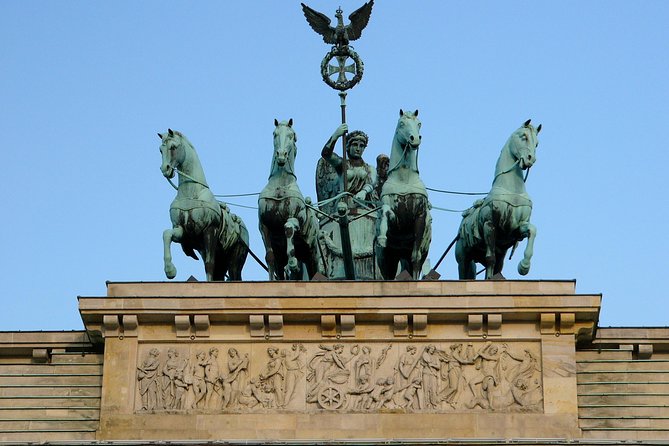
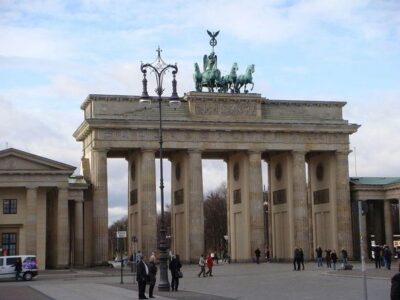
The Brandenburg Gate is among Berlin’s most recognizable monuments, but its meaning has changed repeatedly. It once represented a divided city and divided nation. Today, it is used as a national symbol of unity and peace.
You walk beneath the gate and hear how it fit into the story of Berlin during the Cold War. The stop is brief, but the guide can place the monument in the wider political story rather than treating it as a photo stop alone.
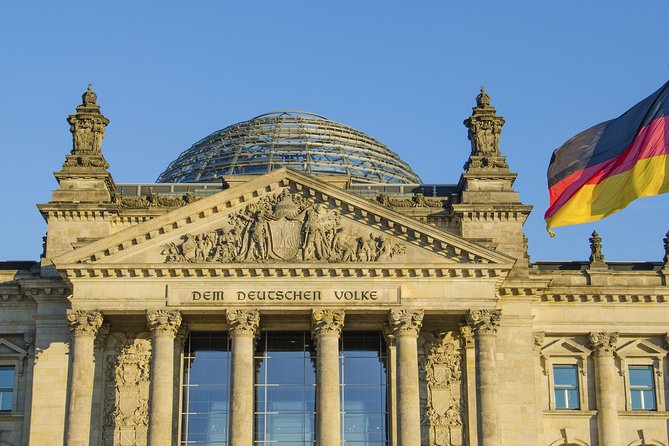
Nearby, the Reichstag building adds another layer. Built in 1894 as the home of the German parliament, it was damaged by fire in 1933, later affected by war and division, and restored after German reunification. Its modern glass dome, designed by Sir Norman Foster, reflects the building’s renewed role as the home of the German Parliament.
The stated visit is about 10 minutes, so this tour is mainly an exterior introduction. You should not assume that entry to the dome or an extended interior visit is included. If seeing the dome matters to you, ask about it before booking and make sure your schedule and access arrangements allow for it.
A few more tours and experiences worth a look
- Best Berlin Shore Excursion from Warnemunde or Rostock Port
★ 4.8 · 200 reviews - Lovely Rostock and Warnemünde Shore Excursion for Cruise Ships
★ 5.0 · 44 reviews - All-in-One Berlin Shore Excursion from Warnemunde
★ 4.5 · 293 reviews - All-in-One: Beautiful Lübeck: Shore Excursion from Kiel Port
★ 4.5 · 50 reviews
Checkpoint Charlie explains the Cold War in human terms
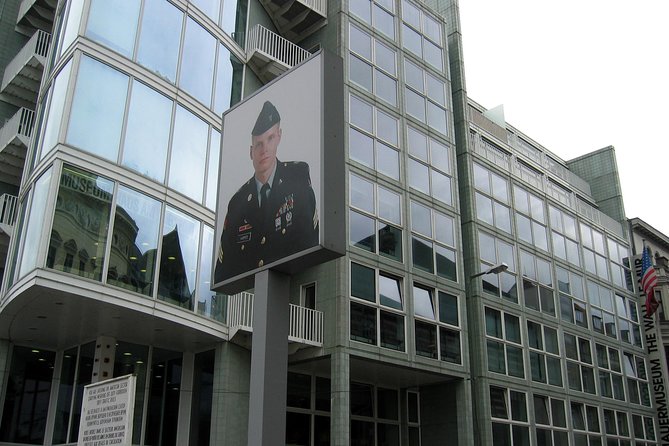
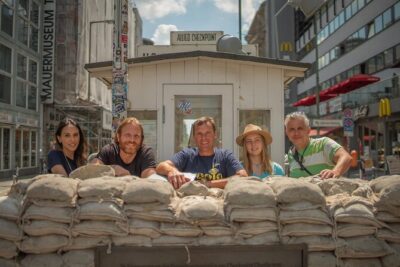
Checkpoint Charlie is one of the best-known former crossings between East and West Berlin. The site recalls the tense October 1961 standoff when American and Soviet tanks faced each other, a confrontation that brought the superpowers dangerously close to a wider crisis.
The stop lasts about 15 minutes. You see border markers and reconstructed checkpoint elements, then hear about escape attempts, espionage, and the political pressure surrounding the divided city.
The physical site is more reconstructed than preserved, so its importance lies in the stories your guide tells. A strong guide can explain how the checkpoint worked, who used it, and why it became such a powerful Cold War symbol.
This is where guide quality matters most. Cian, a local university student fluent in English and German, has been praised for adding detail to the stories. Glen was specifically requested for his World War II and Cold War expertise and was described as exceeding expectations. Guide assignments can vary, but you should state your interests clearly when booking.
Bernauer Strasse preserves the Wall’s hardest truths
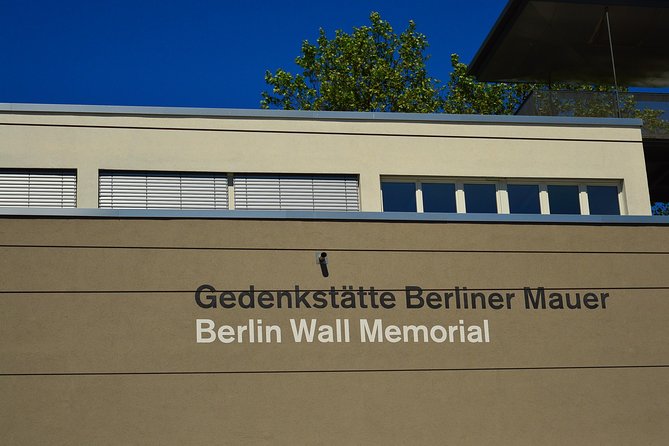
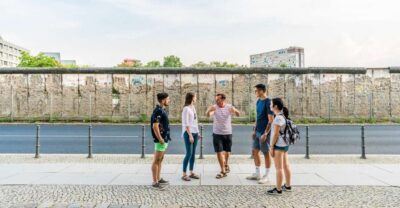
The Berlin Wall Memorial on Bernauer Strasse is more substantial than a quick photo stop. The street once divided neighbors and families, and the memorial preserves sections of the Wall, a watchtower, and part of the former death strip.
You have about 30 minutes here, the longest scheduled stop. That extra time matters because Bernauer Strasse connects the Wall to everyday life. You learn about people who tried to escape, including the daring Tunnel 29 and Tunnel 57 efforts, and about the risks faced by East Berliners seeking freedom.
The remaining structures help you understand the border system better than a small reconstructed booth can. This is a strong stop for anyone who wants more than the familiar Cold War symbols. It shows how the Wall affected homes, streets, churches, and ordinary routines.
The East Side Gallery offers a different mood. The open-air gallery runs along about 1.3 kilometers of surviving Wall and features more than 100 murals created after the Wall fell. The paintings focus on freedom, unity, and political change.
The scheduled visit is only 15 minutes, so you will see a section rather than walk the full length. I would treat it as a quick art and history stop, not a complete gallery visit. The contrast between Bernauer Strasse’s fear and separation and the East Side Gallery’s public expression is one of the day’s strongest pairings.
The German Resistance Memorial Center adds needed nuance
Berlin’s Nazi-era story should not suggest that every German accepted Hitler’s rule. The German Resistance Memorial Center, located in the Bendlerblock, examines the men and women who opposed the dictatorship.
The exhibits cover different forms of resistance, from underground groups to officials inside the military and government. The center also recalls the 1944 assassination attempt led by Claus von Stauffenberg and the severe consequences faced by those involved.
The visit is listed at about 15 minutes, which is short for a museum with this subject. You should expect an introduction rather than time to read every display. Still, it adds moral and political complexity to the day by showing the choices, risks, and failures faced by people who resisted Nazi power.
If this subject is especially important to you, tell the company in advance. The private format gives you a better chance of shaping the day around the exhibits and stories you most want to hear.
The Soviet Memorial and Prenzlauer Berg show the divided city
The Soviet War Memorial in Tiergarten honors Soviet soldiers killed during the Battle of Berlin. Built in 1945, it also reflects the Soviet presence in Berlin during the Cold War.
The memorial is a useful reminder that the end of Nazi rule did not lead directly to a peaceful, united Germany. Your guide can explain the Soviet role in the war, the memorial’s symbolism, and its place in a city controlled by competing powers.
The stop takes about 15 minutes. It is most valuable as part of the larger sequence, linking the defeat of Nazi Germany with the Soviet occupation and later division of Berlin.
In Prenzlauer Berg, the former NKVD and Stasi prison on Fröbelstrasse offers a more personal look at repression. The Soviet NKVD first used the prison in the late 1940s, and the East German Stasi later used it to detain and interrogate political prisoners.
This is not a cheerful sightseeing stop, but it helps explain how surveillance and intimidation shaped life behind the Iron Curtain. The scheduled visit is about 15 minutes, so the guide’s explanation is central. You see the site and learn what happened there, rather than spending hours inside a large museum.
What the day feels like in practice
The itinerary includes many stops, but most are short. You may be walking for 10 to 30 minutes, then returning to the private vehicle for the next section. That combination is helpful for a full day, especially for families with older relatives, but it also means you will not have unlimited time at any one place.
A typical day begins with a port meet and greet, followed by the drive to Berlin. Once in the city, you alternate between short walks and vehicle transfers. Lunch is not included, but your guide can suggest options such as a traditional German beer garden based on your preferences.
The strongest guide experiences have included photo-supported explanations, personal warmth, humor, and the ability to follow a wish list. Ashleigh, for example, was praised for using black-and-white photographs from the Nazi and Cold War periods and for arranging a bratwurst and beer stop. Nigel was described as both well informed and amusing, a useful quality during a long day of serious subjects.
Driver quality matters just as much. Peter, Herbert, Olaf, and Hoger were praised for prompt service, clean vehicles, safe timing, and comfortable transfers. One important caution came from a group whose driver spoke only German. The three-hour round-trip driving time offered no useful historical introduction because the group could not communicate with him.
Ask in advance about the driver’s language and the point where your English-speaking guide will meet you. The main guide is scheduled for six hours in Berlin, but the driver and guide are separate roles.
Price, group size, and real value
At about $919.02 per person, this is an expensive shore excursion. The price becomes easier to defend when several people share the private vehicle and guide, particularly if you would otherwise pay for separate transport, a private Berlin guide, and the risk of arranging your own return to the ship.
Group discounts are available, so check how the total changes with your party size. For a small group of two, the cost is harder to justify unless private service and the Berlin focus are especially important to you.
The value is not simply the number of sights. You are paying for port pickup, a private vehicle, a six-hour local guide, customization, and a worry-free return plan. The operator also promises to arrange transport to the next port if the ship departs unexpectedly, and to refund the activity if a ship delay prevents you from attending, subject to its terms.
That protection matters on a long independent shore day. Still, no excursion can erase the fact that Berlin is far from Warnemünde. You should book this because Berlin matters to you, not because it offers a relaxed day near the port.
The experience has a 4.8 rating from 17 reviews, with 94 percent recommending it. The praise centers on punctual transfers, excellent guides, personal attention, and the ability to cover a detailed wish list. The weaker points concern communication with the driver, limited time at some sites, and one wheelchair user whose restaurant bathroom was down a flight of stairs despite noting the wheelchair when booking.
For mobility needs, discuss vehicle access, walking distances, restaurant facilities, and bathroom arrangements directly before committing. Most people can participate, but the route includes sidewalks, memorial paths, and walking around outdoor sites.
Who should book this Berlin shore excursion?
I would choose it if you have one day in port, care deeply about twentieth-century German history, and prefer a private guide to a large ship bus. It suits families, history-focused couples, and groups who want to combine major sights with specific requests.
It is also a good match if you want to see both Nazi-era and Cold War sites. The itinerary gives you Hitler’s bunker site, the Holocaust Memorial, the Resistance Memorial, the Reichstag, Checkpoint Charlie, Bernauer Strasse, the East Side Gallery, the Soviet Memorial, and a former Stasi prison site in one demanding day.
I would hesitate if you dislike long road transfers, want extended museum visits, or prefer an unhurried city walk. You should also consider a shorter port-area excursion if Berlin is only a passing interest.
Book early if this is your priority. The experience is booked about 118 days ahead on average, and private vehicles with specialized guides are not as flexible as large group departures. Send a clear wish list, request a guide with strong World War II and Cold War expertise, confirm language arrangements for the driver, and mention any mobility needs more than once.
FAQ
Where does the tour begin?
The tour begins with pickup and a meet and greet at the Warnemünde cruise port.
How long is the excursion?
The full experience lasts about 12 hours, including the drive between Warnemünde and Berlin.
How long is the drive to Berlin?
The drive from Warnemünde to Berlin takes about 2.5 hours each way.
Is transportation included?
Yes. Port pickup and drop-off, transport by private vehicle, and the local guide for six hours are included.
Is the tour private?
Yes. Only your group participates in the private tour.
Can I choose between World War II and Cold War sites?
Yes. You can focus on World War II history, focus on the Cold War, or request a combination of both.
Is food included?
No. Food and drinks are not included. The guide can suggest lunch options, including a traditional German beer garden.
Can I request specific attractions?
Yes. You should provide requests for desired attractions when booking so the route can be planned around your interests.
Does the tour enter Hitler’s bunker?
No. The former bunker is not accessible. The visit explains the site and its historical setting.
What is the cancellation policy?
You can cancel up to 24 hours before the experience for a full refund. Cancellations or changes made less than 24 hours before the start time are not accepted for a refund.
Just added around Rostock
- Brewery tour with guide!★ 4.8 · 13 reviews
- Distillery tour with guide!★ 4.7 · 14 reviews
- Rostock: Hot Rod Harbor City Tour★ 4.9 · 16 reviews
- Rostock: Hot Rod Sightseeing Tour to Warnemünde★ 5.0 · 19 reviews
- Rostock: Tour with the Rostocker Executioner★ 4.7 · 28 reviews
- Berlin and Sachsenhausen: Shore Trip from Warnemünde Port★ 4.8 · 40 reviews
- Lovely Rostock and Warnemünde Shore Excursion for Cruise Ships★ 5.0 · 44 reviews
- Warnemünde: Guided Walking Tour★ 4.3 · 102 reviews
Third Reich & WWII Tours, compared.
Berlin’s Best: 2 Hour Walking Tour Third Reich and the Cold War
Read our review →
Third Reich Berlin: Hitler and WWII Walking Tour
Read our review →
Walking Tour of Former Nazi Party Rally Grounds
Read our review →
Browse the lists this tour appears in