
Reviewed · WALKING TOURS
Munich – the essential walking tour
Munich reveals itself one square at a time. This private walking tour links the city’s best-known old-town sights with stories about church legends, royal power, wartime history, food, and daily life. With a local guide and only your own group, you get a more personal introduction than a large city walk usually allows.
I like the small private format, which gives you room to ask questions and set the pace. I also like the strong mix of sights: grand churches, the New Town Hall clock, the Old Town Hall, Viktualienmarkt, and the Jewish center around Ohel Jakob Synagogue. The guides, especially Michael Schwennen, are praised for clear explanations, useful advice, and historical background.
The main consideration is timing. The tour is advertised as roughly two to three hours, but the listed stop times add up to about three hours and 35 minutes. The meeting information also mentions both Karlsplatz and Marienplatz, so confirm the exact starting point before you set out.
In This Review
- Key points to know before booking
- A useful first walk through Munich’s old town
- Frauenkirche and the devil’s footprint
- New Town Hall and the famous Glockenspiel
- Old Town Hall and difficult chapters
- Viktualienmarkt gives the walk a welcome break
- St. Peter’s Church and the old-city view
- Ohel Jakob Synagogue and Munich’s Jewish story
- What the private price really buys you
- Timing, weather, and practical planning
- Who will get the most from this Munich walk?
- Should you book Munich: The Essential Walking Tour?
- FAQ
- How much does the tour cost?
- How long does the tour last?
- Where does the tour start?
- What time does the tour begin?
- Is the tour private?
- Is admission included?
- Can I cancel for a full refund?
Key points to know before booking
- Private for up to 10 people: Your party gets the guide’s attention, with no unrelated group joining in.
- A history-heavy old-town route: The walk connects Munich’s churches, town halls, market, synagogue, and city stories.
- Viktualienmarkt gets a full hour: This is more than a quick photo stop, with time for food, coffee, beer, bread, soup, and local products.
- St. Peter’s Church includes admission: The church is the oldest in Munich, and its tower offers a view over the old city.
- Michael is a strong guide choice: His background as a historian comes through in the detailed explanations and printed supporting material.
- Plan for a possible schedule mismatch: The stated duration, stop times, and meeting-point descriptions do not line up perfectly.
A useful first walk through Munich’s old town
This is the kind of tour that works best near the start of your stay. You get a basic map of central Munich, learn which sights deserve more time, and pick up practical suggestions for the rest of your visit.
The route is compact. The listed stops sit close together, and one review specifically notes that the walk is not exhausting because the stations are near one another. You will still spend much of the time on your feet, so comfortable shoes matter. The tour asks for a moderate level of fitness, and the full version may last longer than the advertised two to three hours.
The private setup changes the feel of the outing. You can stop for a question without holding up a large crowd, and the guide can spend more time on subjects that interest your group. If you care about church art, Munich’s Nazi-era past, Jewish life, food, or city legends, say so early.
The meeting details need a little care. The highlights refer to Karlsplatz, while the practical information gives Marienplatz, 80331 München, as the starting point and says the tour ends back at the meeting point. Since these are different squares, check the confirmed meeting instructions rather than relying on a general map pin.
The scheduled start is noon. That makes this a good afternoon plan, particularly if you want breakfast or a quiet morning first. One guest received help finding breakfast on New Year’s Day when many shops were closed, which suggests the guide can offer useful local direction beyond the formal route.
More Walking Tours in Munich
- Munich: Third Reich & WWII Walking Tour
★ 4.6 · 6,181 reviews - Third Reich Walking Tour Munich
★ 4.5 · 4,291 reviews - Munich: Old Town & Viktualienmarkt City Walk in German
★ 4.7 · 2,304 reviews
Frauenkirche and the devil’s footprint
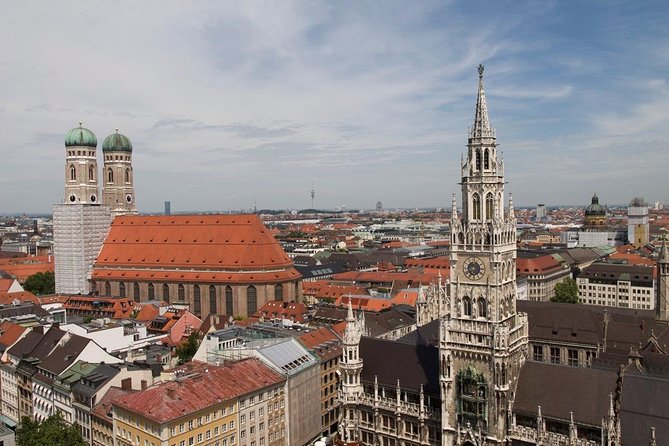
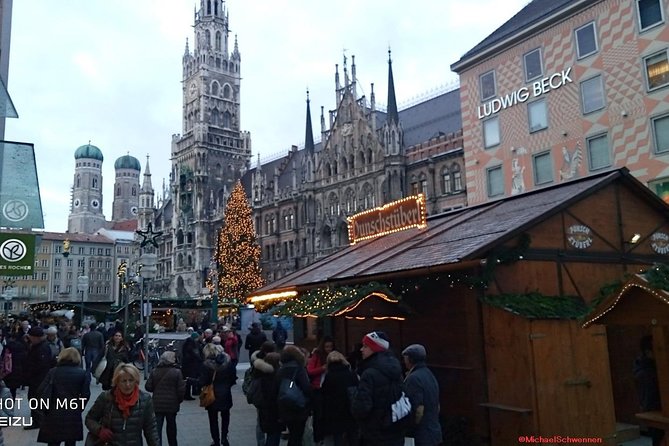
The first listed sight is Frauenkirche, Munich’s famous brick cathedral. You have about 45 minutes here, with no admission charge listed.
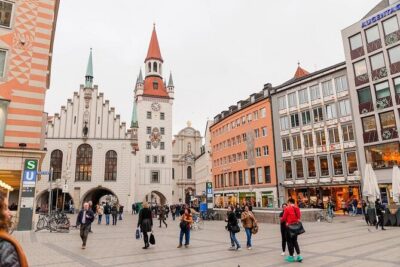
The church is presented through one of its best-known legends: even the devil was astonished by the building. That story gives the stop a human touch, but the real value is seeing how much character a vast brick church can have without relying on bright stone decoration.
A guide adds far more than a quick photograph from the square. You can ask about the cathedral’s place in Munich, its design, and the stories tied to it. The tour description does not promise a special interior visit beyond the stop, so your guide’s exact approach may depend on church access and the day’s conditions.
Forty-five minutes is generous for an orientation stop. It gives you time to hear the main explanation, look around, and take pictures without feeling pushed along. If church interiors are a top priority for you, ask at the start how much of this time will be inside and how much will be spent around the building.
New Town Hall and the famous Glockenspiel
From Frauenkirche, the walk continues to the New Town Hall, or Neues Rathaus. The stop is planned for around 30 minutes, and there is no admission charge listed.
The main attraction is the Glockenspiel. You will hear and see it while the guide explains the scenes it presents, including a royal marriage and the traditional Scheffler dance. This is a good example of what the tour does well: it turns a familiar city-center spectacle into a short lesson about Munich customs and public storytelling.
The clock can be crowded, especially around its performance times. The tour starts at noon, but the supplied information does not state exactly when you will reach the Glockenspiel or which performance you will see. Ask the guide about the timing if the display is a priority.
The New Town Hall is also a useful place to understand Munich’s civic identity. Its ornate facade can seem like pure decoration when seen alone. With context, it becomes part of the city’s story of power, ceremony, and local pride.
Old Town Hall and difficult chapters

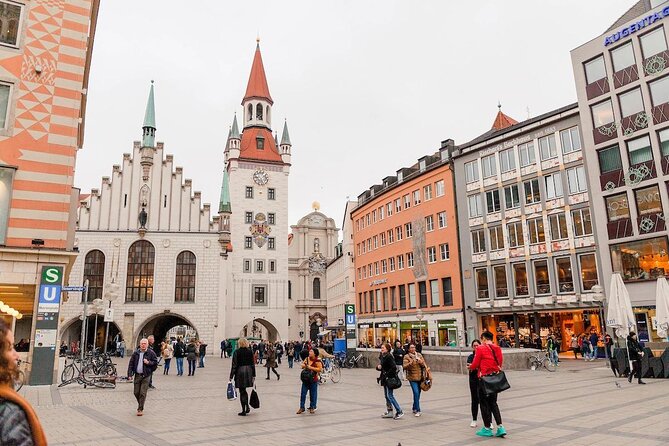
The Old Town Hall gets about 20 minutes. It is a shorter stop, but the subjects attached to it are unusually varied.
The guide covers the former use of the building for lotteries, the Moriskentänzer, or Moorish dancers, and the fact that these figures have danced since the late Middle Ages. You also hear about the Night of Broken Glass, the 1938 anti-Jewish pogrom that began in Munich. That sharp change from medieval civic traditions to modern persecution is important. Munich’s past cannot be reduced to pretty facades and beer halls.
This is where an informed guide matters most. Michael is described as a historian who uses printed pages to support the tour. That extra material can help you keep track of names, dates, and complicated events after the walk is over.
The stop is brief, so do not expect a full treatment of every subject. Still, 20 minutes can provide the context you need to return later, read more, or ask better questions. The tour’s strongest feature is not simply the number of buildings it covers. It is the effort to connect architecture with the people and events behind it.
Something different for another day:
- From Munich: Neuschwanstein & Linderhof Castle Full-Day Trip
★ 4.5 · 12,494 reviews - Neuschwanstein & Linderhof Castle-Fairytale Day Tour from Munich
★ 4.5 · 7,275 reviews - Dachau Concentration Camp Memorial Site Tour from Munich by Train
★ 4.5 · 5,637 reviews - Neuschwanstein Castle Tour from Munich
★ 4.5 · 5,117 reviews
Viktualienmarkt gives the walk a welcome break
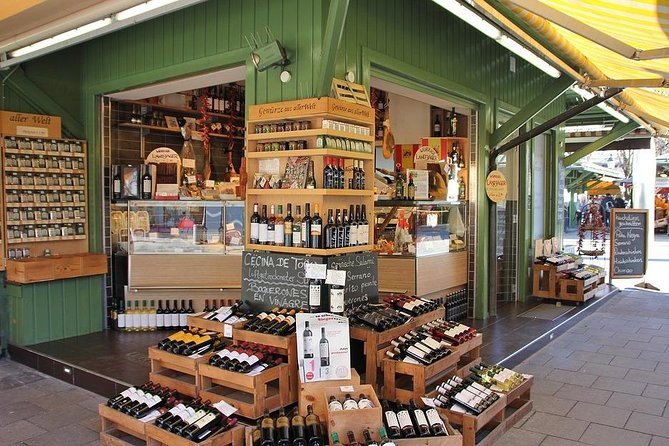
The planned hour at Viktualienmarkt is one of the tour’s best choices. This is not just a market photo stop. The description calls out tasting, smelling, and enjoying products from nature, local specialties, soup, bread, coffee, and beer.
You should see this as a flexible pause in the middle of a history walk. After churches and town halls, food gives you a direct way to experience Munich’s everyday culture. You can ask the guide what is local, what is seasonal, and what might make a good quick meal.
The price does not state that food and drinks are included. Admission is listed as free, so plan to pay for anything you choose to taste or buy. That is useful to know before you arrive, since an hour at a food market can easily become an extra expense.
The market also gives your group time to reset. You can take pictures, ask follow-up questions, and enjoy a less formal part of the route. If you have children or anyone in your group who needs a break from monuments, this stop helps keep the afternoon from becoming a steady march through buildings.
Do not assume the market hour means a full sit-down meal. The information promises the chance to enjoy market products, not a reserved tasting menu. Think of it as guided orientation with room for personal choices.
St. Peter’s Church and the old-city view
St. Peter’s Church receives another 45-minute stop, and admission is included. This is the first church built in Munich, according to the tour description, and its structure reflects several stages of the city’s development.
The church began in Romanesque style, later changed in the Gothic period, and was eventually given a Baroque interior with ceiling paintings and a large high altar. That sequence makes the building a practical lesson in how churches change over time. You are not looking at one single design moment. You are seeing layers of Munich’s religious and artistic past.
The tower is the major payoff. From the top, you get a view across Munich’s old city. The supplied information does not specify tower access arrangements, stairs, or whether the climb is always available, so ask the guide about current access and the physical effort required.
This is also the most important mobility consideration on the route. Even though the streets between stops are close, a tower visit can be more demanding than walking on level ground. If anyone in your group has trouble with stairs or steep climbs, discuss this before booking or ask whether the tower portion can be skipped.
A 45-minute allocation gives the guide time to explain the church and lets you enjoy the view if access is operating. It is a fitting high point for the tour, both literally and in terms of the route’s sightseeing value.
Ohel Jakob Synagogue and Munich’s Jewish story
The final listed stop is Ohel Jakob Synagogue on St. Jakobs Square. The visit lasts about 15 minutes, and no admission fee is listed.
The new synagogue is described as resembling the Temple in Jerusalem. Even a short stop here broadens the tour beyond the usual Munich postcard route. It places Jewish life and memory within the center of the city, alongside the churches, markets, and civic buildings.
Do not expect a long interior visit based on the information provided. The description only promises a stop at the synagogue, and access rules can vary. The guide can still explain the building’s design and its place in modern Munich.
Ending with Ohel Jakob gives the route a thoughtful final note. The tour has already touched on the Night of Broken Glass at the Old Town Hall, so this stop helps connect a painful chapter in Munich’s past with the city’s present Jewish community.
The activity ends back at the meeting point. That is convenient if you need to collect luggage, meet transport, or continue sightseeing from central Munich.
What the private price really buys you
The listed cost is $360.42 per group of up to 10 people. That is a high total for one or two people, but the calculation changes when you fill the group.
For 10 people, the cost works out to about $36 per person. For five people, it is roughly $72 each. For two people, it is about $180 each. The value is therefore strongest for families, friends, or a larger party that wants a private guide rather than separate tickets for a group walk.
The fee includes the guide and admission to St. Peter’s Church, while the other listed stops have no admission charge. Food and drinks at Viktualienmarkt are not stated as included. You are paying mainly for interpretation, personal attention, and an efficient route through central Munich.
That can be worthwhile if you want more than a building checklist. The strongest comments about Michael describe him as friendly, engaging, well informed, and good at answering questions. He also uses printed pages to support his explanations. Those details matter because a private tour should give you more than facts you could read from a sign.
The value is weaker if you prefer to wander alone, spend long periods inside each church, or make spontaneous food stops without a set route. The tour covers a lot, but it is still an overview rather than a series of lengthy guided visits.
Timing, weather, and practical planning
The advertised duration is approximately two to three hours, yet the individual stops total around 215 minutes before accounting for walking. That is already close to three hours and 35 minutes. Treat the schedule as flexible, and avoid booking a tight museum reservation immediately afterward.
The noon start gives the walk an afternoon rhythm. It also means Viktualienmarkt may be a natural place to eat during the tour, though you should budget separately for purchases.
The tour requires good weather. If poor weather causes cancellation, you will be offered another date or a full refund. Munich weather can change quickly, so dress for a long outdoor walk and wear shoes that can handle several hours on foot.
You receive booking confirmation at once unless you book within one day of departure. Last-minute bookings are confirmed as soon as possible, subject to availability. Service animals are allowed, and the meeting area is near public transport.
The activity is private, but it is not presented as a fully tailored custom tour. You get a personal guide for your group, not necessarily a route built from scratch around your interests. Tell the guide what matters most, then listen for opportunities to shape the conversation.
Who will get the most from this Munich walk?
I would recommend this tour to first-time visitors who want a firm grounding in central Munich. It also suits families, couples, and small groups who value questions, a relaxed pace, and a guide who can adjust explanations to the people in front of him.
History-minded visitors should find plenty to hold their attention. The route includes medieval dance figures, civic traditions, church styles, the Glockenspiel, the city’s Jewish past, and the Night of Broken Glass. It does not hide the difficult material behind cheerful sightseeing.
Food-minded visitors will appreciate the hour at Viktualienmarkt. People who want a broad introduction before exploring alone will like the compact route and central ending.
I would hesitate to recommend it to anyone seeking a short, strictly timed two-hour walk. I would also think twice if climbing St. Peter’s tower is essential but stairs are difficult, since the access details are not provided. Finally, if you have only one afternoon and must reach another appointment, allow extra time.
Should you book Munich: The Essential Walking Tour?
Book it if you want a private introduction to Munich that balances famous sights with real context. The strongest reasons are the small-group format, the carefully connected old-town route, the generous market stop, and Michael Schwennen’s clear, history-focused approach.
Before paying, confirm whether you will meet at Karlsplatz or Marienplatz, ask how long the actual tour is expected to run, and check the current plan for St. Peter’s tower. If your group has several people, the fixed price can be fair. If you are alone or traveling as a pair, compare the per-person cost with a group walk.
Cancel at least 24 hours before the local start time for a full refund. Changes or cancellations within 24 hours are not accepted for a refund, except when poor weather cancels the experience.
FAQ
How much does the tour cost?
The price is $360.42 per group of up to 10 people. The total is not priced per person.
How long does the tour last?
The advertised duration is approximately two to three hours. The listed stop times add up to about three hours and 35 minutes, so you should allow extra time.
Where does the tour start?
The practical meeting information lists Marienplatz, 80331 München, Germany. The tour highlights also mention Karlsplatz, so confirm the exact meeting location before departure.
What time does the tour begin?
The scheduled start time is 12:00 pm.
Is the tour private?
Yes. Only your group participates, with a maximum group size of 10 people.
Is admission included?
Admission to St. Peter’s Church is included. Frauenkirche, the New Town Hall, the Old Town Hall, Viktualienmarkt, and Ohel Jakob Synagogue are listed with no admission ticket required. Food and drinks at Viktualienmarkt are not stated as included.
Can I cancel for a full refund?
Yes, if you cancel at least 24 hours before the experience’s local start time. Cancellations or changes made less than 24 hours in advance are not refunded or accepted. If poor weather causes the tour to be canceled, you will be offered a different date or a full refund.
Just added around Munich
- Munich: Private or Group Third Reich and WWII Walking Tour★ 4.9 · 13 reviews
- From Munich: Neuschwanstein Castle and Linderhof Private Tour★ 5.0 · 13 reviews
- Private Transfer from Munich to Salzburg with 2 hours for sightseeing★ 4.5 · 13 reviews
- Munich: Historical Walking Tour on the Rise of Hitler★ 5.0 · 13 reviews
- Private Scenic Transfer from Munich to Prague with 4h of Sightseeing★ 5.0 · 13 reviews
- From Munich: VIP day trip to Salzburg★ 5.0 · 14 reviews
- National Socialism WWII with licensed guide – private tour★ 5.0 · 14 reviews
- Private Tour to Neuschwanstein & Linderhof, Skip The Line & Lunch★ 5.0 · 14 reviews
Walking Tours, compared.
Berlin’s Best: 2 Hour Walking Tour Third Reich and the Cold War
Read our review →
Third Reich Berlin: Hitler and WWII Walking Tour
Read our review →Browse the lists this tour appears in