
Reviewed · WALKING TOURS
Walking Tour on Resistance to Nazism in Munich
Small acts of courage changed Munich. This 2.5-hour walking tour follows the people and groups who resisted Nazi rule, moving from royal gardens to government buildings, churches, art institutions, and memorials. I like the way it focuses on individual choices rather than treating the period as one large, distant political story. I also like that the route includes both famous names, such as the White Rose, and less familiar subjects, including resistance within the military, church opposition, and Georg Elser’s attempt to kill Hitler.
The main drawback is its walking-and-talking format. Each of the eight stops receives about 20 minutes, so the tour offers context and storytelling rather than long visits inside museums or buildings. At $19.49 per person, it is a strong value if you want a focused history walk, but you should not expect admission to paid attractions or a full museum tour.
In This Review
- Key points to know before you book
- Why this Munich history walk matters
- Hofgarten: royal life under dictatorship
- Bayerische Staatskanzlei and political opposition
- Prinzregentenstraße and resistance within the military
- Bavarian National Museum and Operation Valkyrie
- Haus der Kunst and the fight over art
- Ludwigskirche and religious resistance
- DenkStätte Weiße Rose and Munich’s best-known resisters
- Türkenstraße and Georg Elser’s attempt
- What the guide can add to the experience
- Price, group size, and timing
- Who should book this tour?
- Should you book the Munich resistance tour?
- FAQ
- How long does the Munich resistance walking tour last?
- What time does the tour start?
- Where does the tour begin?
- Where does the tour end?
- How many stops are included?
- Is admission included at the stops?
- How large can the group be?
- Is the tour accessible by public transportation?
- What is the cancellation policy?
Key points to know before you book
- Eight stops connect Munich’s resistance stories: The route runs from Odeonsplatz to Georg-Elser-Platz, covering political, military, religious, artistic, and student opposition.
- The White Rose is only one part of the story: You also learn about the Valkyrie Operation, Sopade, Georg Elser, Law T4, and resistance inside the Luftwaffe command structure.
- The tour begins at 3:00 pm: Plan for about two and a half hours on foot, ending in Maxvorstadt.
- The guides receive especially warm praise: Laura is repeatedly described as friendly, clear, attentive, and well prepared. Maca, Javier, Jaime, and Julieta are also named positively.
- The group can reach 25 people: That is small enough for a guided walk, though the experience may feel less personal at the maximum size.
- Free cancellation is available until 24 hours before departure: Changes or cancellations inside that window are not accepted for a refund.
Why this Munich history walk matters
Munich is closely tied to the rise of Nazism, but a city tour about the period can easily become a parade of dates, party buildings, and grim facts. This route takes a more useful approach. It asks what people did when the regime demanded obedience, and where resistance appeared.
You move through several forms of opposition. Some people resisted through political work. Some acted inside the military. Some challenged propaganda and censorship. Religious figures spoke against state crimes. Students distributed leaflets. Georg Elser made a direct attempt on Hitler’s life.
That range gives the tour its value. You are not left with the idea that resistance belonged to one political camp or one kind of hero. Instead, you see how different people faced the regime in different ways, with different levels of risk.
The walk is also practical for a first visit to Munich. It starts at Odeonsplatz, a central location near public transportation, and ends at Georg-Elser-Platz in Maxvorstadt. You see a section of central Munich while following a clear theme, rather than spending half the tour simply finding the next sight.
More Walking Tours in Munich
- Munich: Third Reich & WWII Walking Tour
★ 4.6 · 6,181 reviews - Third Reich Walking Tour Munich
★ 4.5 · 4,291 reviews - Munich: Old Town & Viktualienmarkt City Walk in German
★ 4.7 · 2,304 reviews
Hofgarten: royal life under dictatorship
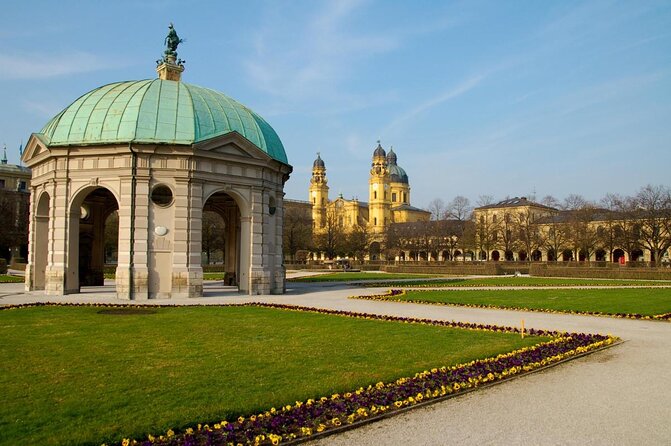
The first stop is Hofgarten, where the guide sets the political scene and explains how the royal family lived during the Nazi period. The setting helps establish a contrast between Munich’s older royal identity and the dictatorship that reshaped public life.
I like beginning here because it gives you a wider frame before the tour moves into specific acts of resistance. The story is not only about officials and famous activists. It is also about how daily life changed when Nazi policies reached into public institutions, politics, culture, and personal freedom.
Expect about 20 minutes at this stop. Admission is free, and the main value comes from the guide’s explanation rather than from entering a particular attraction. If you already know the basic political timeline, pay close attention to how the guide connects the city’s royal past with its role during the Nazi period.
Bayerische Staatskanzlei and political opposition
At the Bayerische Staatskanzlei, the focus shifts to political parties that resisted the Nazi regime and to Sopade. This stop adds an important layer to the story because resistance was not limited to dramatic underground plots.
The subject can be less familiar than the White Rose, so a good guide matters here. The tour’s strongest praise goes to guides who make complicated history easy to follow. Laura is repeatedly singled out for clear explanations, kindness, and careful answers to questions. Maca is also praised for presenting the material with feeling and detail, while Javier is described as especially enthusiastic about history.
You spend roughly 20 minutes here. The building itself is part of the setting, but the stop is primarily interpretive. I would treat it as a chance to listen closely and ask questions, especially if political resistance groups are new to you.
Prinzregentenstraße and resistance within the military
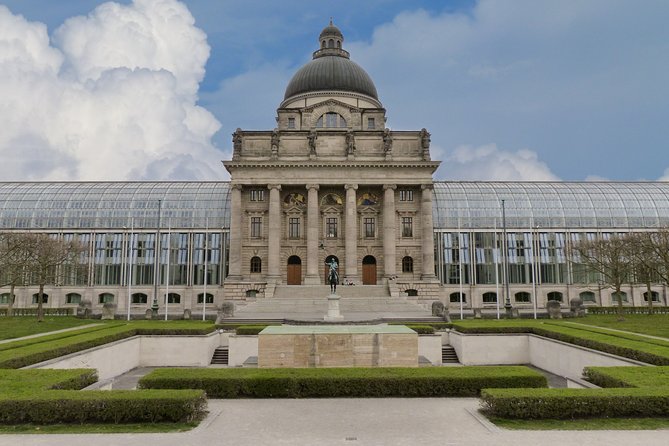
The third stop on Prinzregentenstraße introduces the former Luftwaffe Command Center and resistance within the military itself. This is a useful correction to the simple picture of a completely united German military.
The subject is sensitive and complex. Military resistance did not all look the same, and the tour presents it as one part of a wider challenge to the regime. You learn how opposition could exist inside institutions that were also involved in Nazi Germany’s war machine.
The stop lasts about 20 minutes and takes place outdoors. You should expect explanation of the site and its role, not a visit through the former command center. That distinction matters if you prefer museum interiors or preserved rooms. For a short city walk, though, the location gives the story a strong physical anchor.
Something different for another day:
- From Munich: Neuschwanstein & Linderhof Castle Full-Day Trip
★ 4.5 · 12,494 reviews - Neuschwanstein & Linderhof Castle-Fairytale Day Tour from Munich
★ 4.5 · 7,275 reviews - Dachau Concentration Camp Memorial Site Tour from Munich by Train
★ 4.5 · 5,637 reviews - Neuschwanstein Castle Tour from Munich
★ 4.5 · 5,117 reviews
Bavarian National Museum and Operation Valkyrie
At the Bavarian National Museum, the guide explains the Valkyrie Operation. The name is widely associated with the attempt to overthrow the Nazi leadership, and this stop gives the tour another opportunity to explore opposition from within the state and military system.
The location makes the route feel varied. You are not standing outside one government building after another. Instead, the walk passes through places connected with royal history, administration, military command, culture, religion, student activism, and individual action.
Again, the planned time is about 20 minutes. Since admission is listed as free for the tour, do not count on a museum ticket or a long indoor visit. The stop works best as a concise explanation of the operation and the people connected with it.
Haus der Kunst and the fight over art
The Haus der Kunst stop looks at Nazi censorship of art, the Degenerate Art exhibition, and the use of propaganda to control the press. This is one of the most visually and culturally distinct parts of the walk.
Art became a political tool under the regime. The tour shows how the government tried to decide what could be displayed, what counted as acceptable culture, and how the press could be managed. That broadens your understanding of dictatorship. Control did not stop at elections, police power, or military force. It also reached paintings, exhibitions, newspapers, and public taste.
The guide’s role is especially important here because the stop covers several connected subjects in only 20 minutes. If you like museums, architecture, or cultural history, this may be one of the most rewarding sections. If you want a detailed discussion of individual artworks, the time limit may feel short.
Ludwigskirche and religious resistance
At Ludwigskirche, the tour examines the relationship between the Church and Nazism, Law T4, and religious resistance. The subject adds moral and institutional questions to the political story.
This stop is valuable because it avoids presenting resistance as simple or universal. The relationship between religious institutions and the Nazi regime involved conflict, compromise, and individual acts of opposition. The tour specifically addresses how religious figures resisted, while also placing that resistance within the wider relationship between Church and state.
You receive about 20 minutes here. The church provides a powerful setting for the discussion, but the listed format does not promise an extended interior visit or a religious service. If you want to ask about Law T4 or the role of religious resistance, this is another point where an attentive guide can make a major difference.
DenkStätte Weiße Rose and Munich’s best-known resisters
The White Rose memorial is likely to be the emotional center of the tour. Munich’s best-known resistance group was made up largely of students who opposed Nazi rule and distributed leaflets calling for resistance.
The guide introduces the group and places its actions within the wider story you have been following all afternoon. By this point, you have heard about political opposition, military plots, cultural control, and religious resistance. The White Rose shows young people making their own choice to act, despite the danger.
The stop is planned for 20 minutes. That is enough for a meaningful introduction, but not enough for every detail of the group’s members, writings, arrest, trial, and execution. If the White Rose is your main reason for booking, you may want to set aside extra time on another day for more study. The walking tour still gives you a useful starting point and puts the memorial into a larger Munich context.
Türkenstraße and Georg Elser’s attempt
The final stop is on Türkenstraße, at the Georg Elser Memorial. Here you learn about Elser’s attempt to kill Hitler, an especially striking example of individual resistance.
His story gives the tour a different ending from the collective action of the White Rose. The route closes with one person deciding to act directly against the Führer. That helps reinforce the central theme: resistance could take many forms, and it often came from people who did not fit one neat category.
The walk ends at Georg-Elser-Platz in Maxvorstadt. That makes the finish practical if you plan to continue exploring the neighborhood, though no onward plans are included with the tour. Since the end point differs from the starting point, you should note the route before booking and allow time to orient yourself afterward.
What the guide can add to the experience
The strongest thread in the available feedback is guide quality. Laura is mentioned several times and receives praise for being friendly, well informed, patient with questions, and easy to understand. One person chose this tour after enjoying a city walk with her the previous day, which suggests that a good guide can turn a difficult subject into an engaging afternoon.
Maca is described as warm and detailed, with a way of communicating the subject from the heart. Javier is praised for making the history interesting and lively. Jaime is described as someone who clearly enjoys his work and helps you feel connected to the city. Julieta is also recommended for her explanations.
Guide assignments can change, so you should not assume one specific person will lead your departure. Still, the repeated praise tells you what to value: a guide who explains clearly, welcomes questions, and keeps the material human rather than turning it into a dry lecture.
The subject is serious, but the feedback points to an experience that is engaging rather than stiff. That balance matters. You want enough detail to understand the events, but also enough clarity to keep the two and a half hours moving.
Price, group size, and timing
At $19.49 per person, this is a modestly priced guided experience. All eight stops list free admission, so you are paying mainly for the guide, the route, and the organized interpretation. I consider that good value if you want a focused introduction to Munich’s resistance history.
The price is less attractive if you expect indoor admissions, extensive time at each site, or a small private group. The maximum group size is 25 people. That is manageable for a city walk, but you may find it harder to ask personal questions when the group is full.
The tour begins at 3:00 pm and lasts about 2 hours and 30 minutes. The afternoon start leaves your morning open for Munich’s central sights, but you should avoid scheduling another fixed activity too soon after the stated end time. Walking pace, questions, and city conditions can affect the finish.
The experience is booked an average of 141 days in advance, which suggests that planning ahead is sensible. Confirmation is normally sent at booking. If you book within 16 hours of departure, confirmation arrives as soon as possible and depends on availability.
Who should book this tour?
I would choose this tour if you want history connected to real places and prefer a guide’s explanation to reading plaques on your own. It suits first-time Munich visitors who want a serious subject presented in a clear two-and-a-half-hour format.
It is also a good fit for anyone interested in the White Rose, Georg Elser, military opposition, political groups, religious resistance, or Nazi censorship of art. The broad subject range means you get more than one famous story.
You might look elsewhere if you want a museum-heavy experience, a private guide, or a highly specialized study of the White Rose alone. The route covers a lot of ground, and each stop receives about 20 minutes, so some subjects will be introductions rather than full lectures.
Most people can take part, the route is near public transportation, and service animals are allowed. The tour requires a minimum number of participants. If that minimum is not reached and the experience is canceled, you are offered another date or experience, or a full refund.
Should you book the Munich resistance tour?
Yes, if you want a well-priced, focused walk that links Munich’s streets to the people who opposed Nazi rule. I especially like the range of stories. The White Rose receives proper attention, but it does not crowd out political, military, religious, artistic, and individual resistance.
Book it for the quality of the storytelling, not for museum entry. If possible, reserve ahead, arrive ready to walk for two and a half hours, and keep the afternoon free after 3:00 pm. Laura, Maca, Javier, Jaime, and Julieta have all been praised for making the material clear and personal, though the guide for your date may be different.
You can cancel for a full refund up to 24 hours before the start time. Inside that window, cancellations and changes are not accepted for a refund.
FAQ
How long does the Munich resistance walking tour last?
The tour lasts approximately 2 hours and 30 minutes.
What time does the tour start?
The scheduled start time is 3:00 pm.
Where does the tour begin?
It begins at Odeonsplatz, Odeonsplatz, 80333 Munich, Germany.
Where does the tour end?
The tour ends at Georg-Elser-Platz in Munich’s Maxvorstadt district.
How many stops are included?
The route includes eight stops: Hofgarten, Bayerische Staatskanzlei, Prinzregentenstraße, Bavarian National Museum, Haus der Kunst, Ludwigskirche, DenkStätte Weiße Rose, and Türkenstraße.
Is admission included at the stops?
Each stop is listed with free admission. The experience is a walking tour, so the information provided does not promise paid museum admission or extended indoor visits.
How large can the group be?
The tour has a maximum of 25 participants.
Is the tour accessible by public transportation?
Yes. The tour is near public transportation.
What is the cancellation policy?
You can cancel up to 24 hours before the start time for a full refund. Cancellations or changes made less than 24 hours before departure are not accepted for a refund.
Just added around Munich
- Munich WWII and Dachau Concentration Camp Private Tour with Licensed Guide★ 5.0 · 3 reviews
- Munich Photoshoot: A Must-Have Holiday Experience!★ 5.0 · 3 reviews
- München: Braukurs mit Führung und Verkostung★ 4.2 · 4 reviews
- Mozart and German Composers Private Tour in Munich★ 4.8 · 4 reviews
- CITY QUEST Munich: reveal the secrets of this city!★ 4.0 · 4 reviews
- Private audio book city rally in Munich city centre★ 4.0 · 4 reviews
- Culinary Haidhausen – The Food Tour★ 4.3 · 4 reviews
- Private Munich History and Beer Culture Walking Tour★ 5.0 · 4 reviews
Walking Tours, compared.





Berlin’s Best: 2 Hour Walking Tour Third Reich and the Cold War
Read our review →


Third Reich Berlin: Hitler and WWII Walking Tour
Read our review →Browse the lists this tour appears in