
Reviewed · WALKING TOURS
Private Walking Sightseeing Local Berlin Tour Guides up 15 Person
Berlin reveals itself quickly from the back of an e-rickshaw. This private city tour links Alexanderplatz, Museum Island, the Berlin Wall, the Holocaust Memorial, Brandenburg Gate, and the Reichstag in about four hours. I like the way the ride covers ground without trapping you inside a car, and I also like the freedom to shape the route around your interests. The main consideration is pace: with ten listed stops, several visits are brief photo and orientation stops rather than full museum visits.
The e-rickshaw includes bottled water and blankets, a small but welcome touch in cool Berlin weather. I also like that guides can collect you and return you to a central Berlin hotel, saving you from figuring out public transport at the start or end. For travelers with mobility difficulties, the ride can be especially useful, though you should confirm the exact pickup and vehicle arrangements before booking.
In This Review
- Key points to know before booking
- What this Berlin e-rickshaw tour is really like
- Alexanderplatz and Museum Island: Berlin’s imperial core
- Bebelplatz and Gendarmenmarkt: Berlin’s polished center
- Checkpoint Charlie and the Topography of Terror
- Potsdamer Platz: From wasteland to modern Berlin
- The Holocaust Memorial and Brandenburg Gate
- The Reichstag and the government district
- Four hours, several shorter options, and the question of value
- Guides, comfort, and mobility
- Who should book this Berlin tour?
- Should you book the Berlin e-rickshaw tour?
- FAQ
- How long does the Berlin e-rickshaw tour last?
- How much does the tour cost?
- Is hotel pickup available?
- Is this a private tour?
- What language is offered?
- Are entrance tickets included?
- What is included in the price?
- Can I cancel for a full refund?
Key points to know before booking
- A private route through central Berlin: Only your group participates, with space for groups of up to 15 people.
- A fast first look at Berlin: The route connects Alexanderplatz, Museum Island, Bebelplatz, Gendarmenmarkt, Checkpoint Charlie, Potsdamer Platz, the Holocaust Memorial, Brandenburg Gate, and the Reichstag.
- Comfort beyond a standard walking tour: You ride in an e-rickshaw, with blankets and bottled water supplied.
- Flexible tour lengths: Options range from two hours to a full day, with the advertised experience lasting about four hours.
- A strong choice for limited mobility: You can see a large part of central Berlin without long stretches on foot.
- Personal guiding matters here: Guides named Levent and Levi received praise for friendly, entertaining, and well-informed commentary in English.
What this Berlin e-rickshaw tour is really like
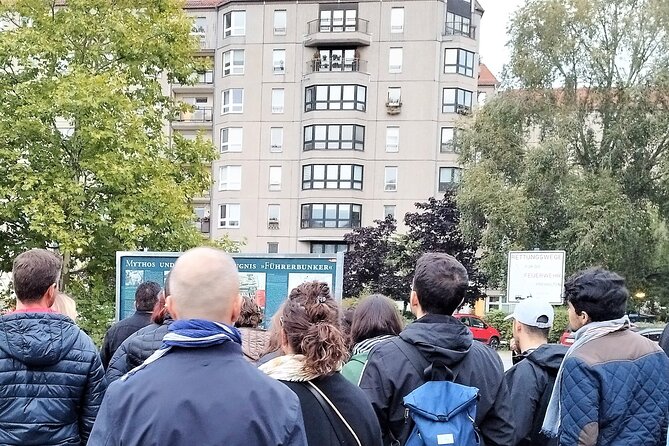
The title describes a walking sightseeing tour, but the experience details describe an e-rickshaw or tuk-tuk ride. That distinction matters. You are not expected to walk from Alexanderplatz to the Reichstag. Instead, the vehicle carries you between sights, while you get out for short stops and photographs.
That format suits Berlin well. The central sights are spread across a large area, and a traditional walking tour covering all of them would require a lot of time and energy. The e-rickshaw can also use routes and park areas that a larger vehicle cannot reach, according to direct feedback from the experience.
This is not a museum tour. The listed stop times range from five to ten minutes, and admission tickets are not included. Think of the outing as a guided introduction to Berlin’s main sights, with historical explanation, photographs, and the chance to request more time at places that interest you.
The private setup is the biggest advantage. You do not have to match the pace of strangers or listen to a fixed script that ignores your interests. A group of two can ask for a history-heavy outing, while a family might prefer a broader route with easier sightseeing and fewer long walks.
More Walking Tours in Berlin
- Discover Berlin Half-Day Walking Tour
★ 5.0 · 9,624 reviews - Berlin: Third Reich and Cold War 2 Hour Walking Tour
★ 4.9 · 6,830 reviews - Berlin: Discover Berlin Walking Tour
★ 4.9 · 5,998 reviews
Alexanderplatz and Museum Island: Berlin’s imperial core
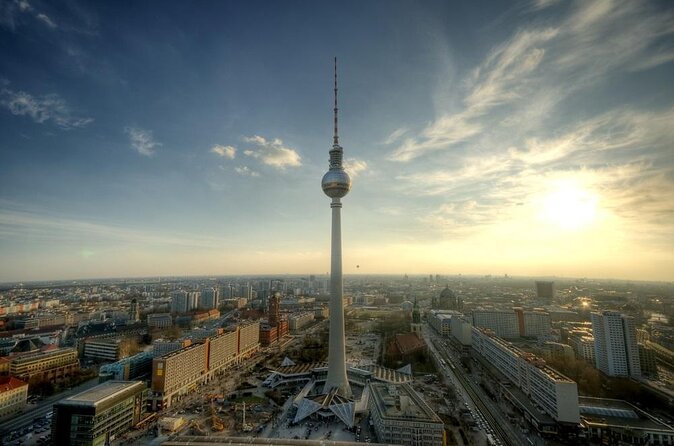
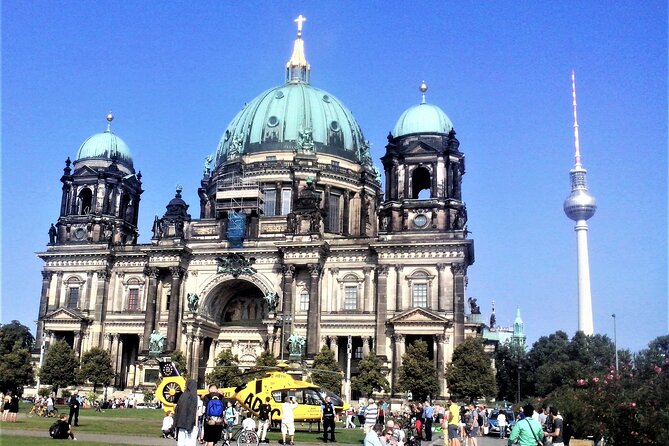
The tour begins at the Fernsehturm, Berlin’s famous television tower in Alexanderplatz. At 368 meters, it is Germany’s tallest structure and one of the easiest landmarks to spot from across the city. The square around it helps you get your bearings in the former East Berlin.
From here, the e-rickshaw passes the Red Town Hall, Marien Church, and Neptune Fountain before reaching Museum Island. These short first stops give you a quick look at Berlin’s changing architectural story, from medieval traces to grand nineteenth-century civic buildings and the unmistakable television tower.
Museum Island deserves more than ten minutes if you want to enter a museum. The complex is a UNESCO World Heritage Site and includes the Berlin Cathedral, Old Museum, Old National Gallery, Pergamon Museum, and Bode Museum. The route also takes in the reconstructed City Palace, now known as the Humboldt Forum.
I like this part of the tour because it places several major sights close together without asking you to navigate the area yourself. You will see the length of Unter den Linden, Berlin’s grand historic boulevard, and get a useful introduction to the city’s former royal center.
The drawback is simple: you will not have time to explore the collections. Museum Island works best here as an outdoor orientation stop. If the Pergamon Museum or another museum is a priority, plan a separate visit and use this tour to understand how the area fits together.
Bebelplatz and Gendarmenmarkt: Berlin’s polished center
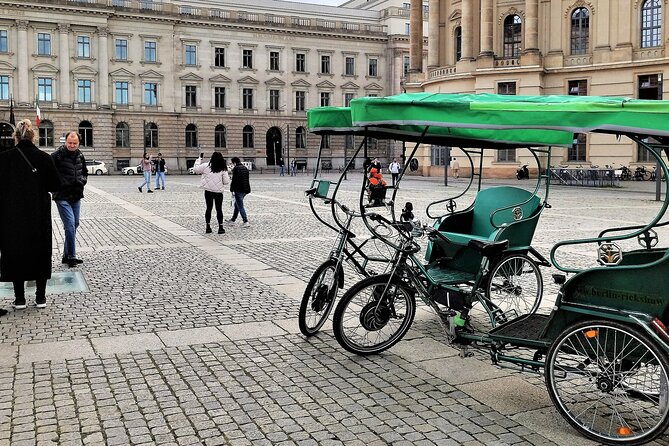
Bebelplatz is a small square with a heavy past. It forms part of the Forum Fridericianum, alongside the State Opera, Humboldt University, the State Library, and St. Hedwig’s Cathedral, Berlin’s first Catholic church.
The square is best known for the Nazi book burning of 1933. A memorial beneath the pavement recalls the event, with empty bookshelves visible through a glass panel. The five-minute stop is short, but a good guide can explain why this modest square carries such weight.
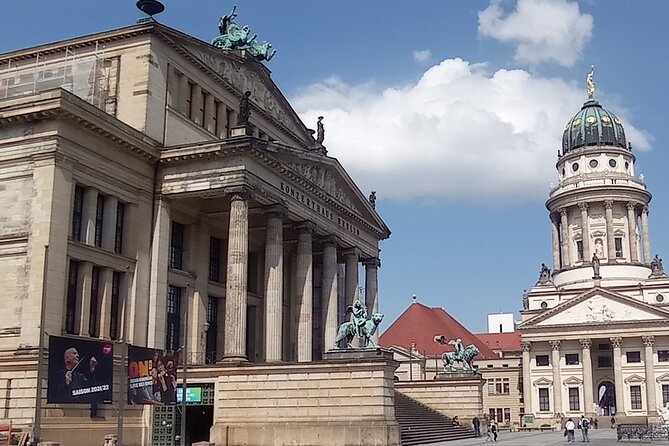
From Bebelplatz, the route continues to Gendarmenmarkt. This is one of central Berlin’s grandest squares, framed by the former Royal Concert Hall and the German and French cathedrals. The German Dome sits to the south, while the French Dome sits to the north.
Gendarmenmarkt is a fine place for photographs, though restoration work or public events can affect what you see. The short stop gives you the shape of the square and its main buildings, but it does not allow much time inside the cathedrals or concert hall.
This section shows why a private guide is useful. The buildings can look like a parade of impressive facades if you do not know what you are seeing. A guide can connect the square to Prussian Berlin, royal planning, religion, and the city’s later damage and rebuilding.
Checkpoint Charlie and the Topography of Terror
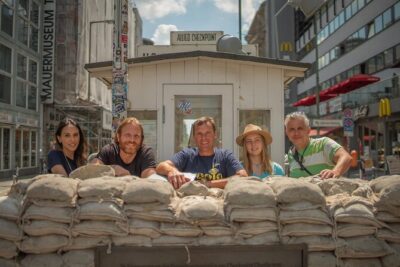
Checkpoint Charlie was one of the best-known border crossings in divided Berlin. During the Cold War, it marked a passage between the American sector of West Berlin and East Berlin. The crossing became famous during a tense 1961 confrontation involving American and Soviet tanks, an episode that raised fears of a wider war.
Today, Checkpoint Charlie is heavily visited and commercialized. The famous sign makes a quick photograph, but the modern setting can feel more like a tourist stop than an untouched piece of the Wall. That is why the guide’s explanation matters more than the checkpoint itself.
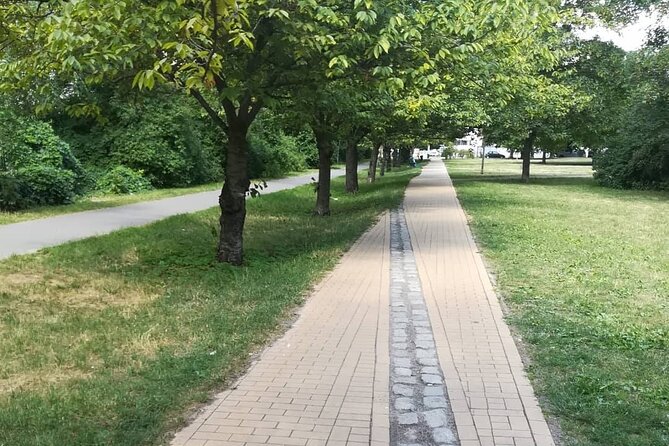
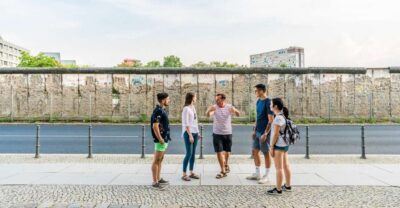
The route then follows part of the former border strip to the Topography of Terror. This documentation center occupies the former headquarters of the SS and Gestapo. Original sections of the Berlin Wall remain nearby, adding physical context to the displays.
The stop also brings you past Martin-Gropius-Bau, known for major art exhibitions, and the Prussian Parliament. The listed five minutes is enough to identify the buildings and understand the location. It is not enough to visit the documentation center properly.
I recommend returning to the Topography of Terror on your own if you want a serious look at Nazi Germany and the machinery of persecution. The center is free to enter, and it deserves more attention than a quick roadside explanation can provide.
Something different for another day:
- Berlin: Reichstag, Dome and Government District Guided Tour
★ 4.7 · 18,288 reviews - Berlin: 1-Hour City Tour by Boat with Guaranteed Seating
★ 4.3 · 16,993 reviews - Berlin: Boat Tour Along the River Spree
★ 4.4 · 11,252 reviews - Berlin: Hop-on Hop-off Bus Tour with Live Commentary
★ 4.3 · 8,579 reviews
Potsdamer Platz: From wasteland to modern Berlin
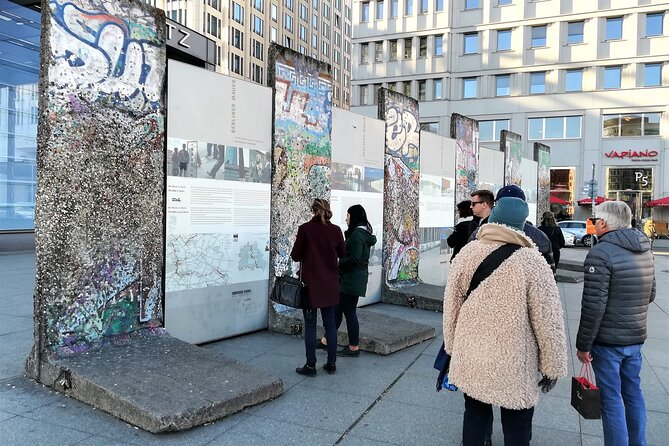
Potsdamer Platz offers one of Berlin’s sharpest changes in mood. Once cut apart by the Wall and left as an empty border zone, it later became one of Europe’s largest construction sites. Today, skyscrapers and futuristic buildings surround the Sony Center and major commercial spaces.
The ten-minute stop gives you a useful visual lesson in modern Berlin. You can see how the city rebuilt a former dead zone with bold architecture rather than trying to recreate the old streets exactly.
Some visitors love the sleek towers; others find the area less personal than Berlin’s older quarters. I see it as a worthwhile contrast to Museum Island and Gendarmenmarkt. It shows that Berlin is not only about royal buildings, wartime ruins, and Cold War memory.
A private e-rickshaw also makes this transition easier. You can move from the Wall’s former border strip to Potsdamer Platz without spending time changing trains or walking long blocks.
The Holocaust Memorial and Brandenburg Gate
The Memorial to the Murdered Jews of Europe is made up of 2,711 concrete slabs arranged across a large open site. It commemorates the murder of more than six million Jews under National Socialism.
The memorial is intentionally difficult to sum up in a single message. As you move among the slabs, the ground changes and the views shift. The five-minute listed stop lets you see the memorial from outside and hear its purpose, but it is too short for a quiet visit.
Treat the memorial with care. It is not simply a photo backdrop. If you want to walk through it slowly, tell the guide and use the flexible format to request more time, or return separately.
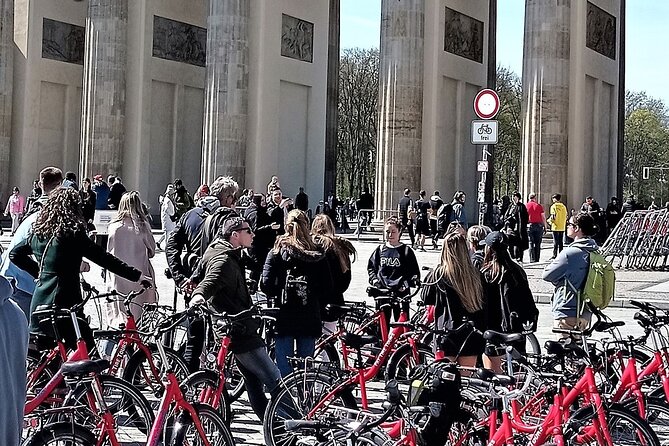
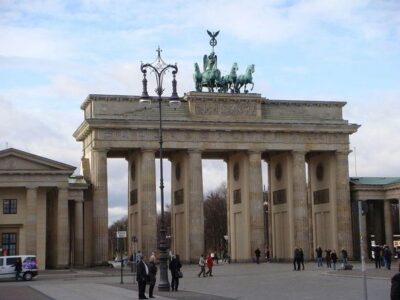
A short ride then brings you to the Brandenburg Gate, Berlin’s most recognizable landmark. Built as a neoclassical city gate, it later became a Cold War symbol because it stood near the Wall. After German reunification, it became a powerful image of a shared Berlin.
The gate is often crowded, and traffic or events can affect the view. Still, it is one of the few places where Berlin’s royal past, division, and reunification come together in one photograph.
The Reichstag and the government district
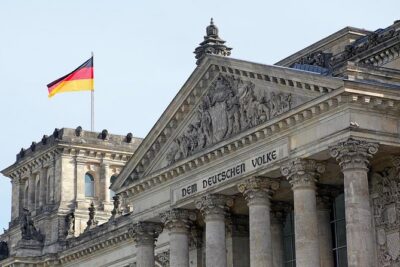
The final listed stop brings you into the government district. You pass the Memorial to the Murdered Sinti and Roma and see the Reichstag, home of the Bundestag, along with the Federal Chancellery.
The Reichstag’s glass dome is one of Berlin’s major modern attractions, but this tour does not include admission. A visit to the dome requires separate arrangements, so do not assume that the five-minute stop includes entry.
Ending near the Reichstag makes sense. It leaves you with present-day Germany’s political center after a route that has covered monarchy, dictatorship, war, division, and reunification.
The itinerary description mentions leaving the former eastern part of Berlin before reaching this area. In practice, the route crosses several layers of the city rather than presenting a simple east-to-west story. That is one of its strengths, especially if you are new to Berlin and want the broad picture first.
Four hours, several shorter options, and the question of value
The advertised price is $174.22 per person. That is a serious price for a city tour, but the value depends heavily on group size and the length you choose.
For a private group of four or more, the cost can make sense because you are paying for a dedicated guide, a private vehicle, hotel pickup and drop-off, and a route that covers a wide area. For one or two people, the per-person cost is harder to justify if you only want a quick introduction.
The experience offers routes from two hours to a full day, while the main tour is described as approximately four hours. Check the exact option before payment. A two-hour ride can cover a surprising amount, but it will leave little room for lingering at the Holocaust Memorial, Museum Island, or the Topography of Terror.
One useful point comes from direct experience with the shorter route: a two-hour outing can cover much of Berlin, but adding a return to the western part of the city can extend the time considerably. If your hotel is around Kurfürstendamm and the route ends in Mitte, confirm how pickup and drop-off affect the schedule.
The booking pattern also suggests planning ahead, with the experience booked an average of 116 days in advance. I would not leave it until the last moment if your dates are fixed, especially if you want a certain guide or a particular tour length.
Guides, comfort, and mobility
The guide is central to the value of this experience. The included guide is described as sympathetic and certified under DIN EN15565, while direct feedback gives specific praise to Levent and Levi for friendly, funny, personal, and well-informed guiding in English.
That combination matters. Berlin’s monuments do not explain themselves, and the city’s twentieth-century history can become confusing when you move quickly. You need a guide who can keep the story clear without turning the ride into a lecture.
The e-rickshaw is also a practical choice for anyone who finds long walking tours tiring. Direct feedback specifically praised the tour for people with mobility difficulties. You still need to confirm your own access needs, since the supplied information does not describe boarding arrangements or wheelchair storage.
Blankets and bottled water make the ride more comfortable, particularly when the weather is cool. The vehicle is open enough to give you a direct view of the city, but that also means you should dress for outdoor conditions.
Who should book this Berlin tour?
I would choose this experience for a first day in Berlin, especially if you want to understand the city’s basic layout before exploring individual museums and memorials.
It also suits families, older adults, couples, and small private groups who want a personal pace. The ability to cover park routes and central sights without a long walk is a real advantage.
You should also consider it if your visit is short. In four hours, you can see the city’s major symbols and make a list of places to revisit. That is far more useful than trying to explore every museum in a rush.
I would be more cautious if your main goal is extended time inside museums or memorials. The tour is built around movement and explanation, not long admissions. You may also find the price high for a solo booking unless the private format and hotel service are especially important to you.
Free cancellation is available if you cancel at least 24 hours before the start time. Cancellations or changes made inside that window are not refunded or accepted.
Should you book the Berlin e-rickshaw tour?
Book it if you want a comfortable, private overview of central Berlin with a guide who can adjust the route and explain the city’s difficult past in a human way.
The strongest reasons are the efficient coverage, the private format, and the help it offers if walking is difficult. The most praised qualities are the guides’ warmth, humor, and personal attention, with Levent and Levi singled out by name in the feedback.
Skip it if you want a slow museum day, a very cheap introduction, or a long walking experience focused on one neighborhood. Before booking, decide whether two hours, four hours, or a full-day option fits your plans, and confirm what hotel pickup and drop-off mean for your selected route.
For many first-time visitors, this is a smart way to get your bearings fast. Use it as your Berlin overview, then return on foot to the places that deserve more time.
FAQ
How long does the Berlin e-rickshaw tour last?
The main experience lasts approximately four hours. Other options are available, ranging from two hours to a full day.
How much does the tour cost?
The listed price is $174.22 per person. Group discounts are offered, so the final value may be better for a larger private group.
Is hotel pickup available?
Yes. Pickup and drop-off are offered at central Berlin hotels.
Is this a private tour?
Yes. Only your group participates, with groups of up to 15 people.
What language is offered?
The tour is offered in English.
Are entrance tickets included?
No. Admission tickets are not included. The listed stops are primarily outdoor sightseeing and orientation stops.
What is included in the price?
The tour includes a certified guide, travel by e-rickshaw, bottled water, and blankets. Tips are not included.
Can I cancel for a full refund?
Yes, if you cancel at least 24 hours before the experience start time. Cancellations made less than 24 hours before the start time are not refunded.
Just added around Berlin
- Berlin: Private Guided Tour of the Main Sights★ 5.0 · 13 reviews
- Private Highlights of Berlin Bike Tour★ 5.0 · 13 reviews
- Modern Berlin Private Walking Tour: Diverse, Vibrant and Exciting German Capital★ 5.0 · 13 reviews
- Tour in Berlin from Warnemünde and Rostock Cruise Port★ 4.1 · 13 reviews
- Berlin: Stasi Museum Private Guided Tour with Entry Ticket★ 4.8 · 13 reviews
- Private Food Tour Experience with a born and bred Berliner★ 5.0 · 14 reviews
- Berlin: Rheinsberg Palace Entrance Ticket★ 4.8 · 14 reviews
- Berlin in one day – day tour with an expert guide★ 5.0 · 14 reviews
Walking Tours, compared.
Berlin’s Best: 2 Hour Walking Tour Third Reich and the Cold War
Read our review →
Third Reich Berlin: Hitler and WWII Walking Tour
Read our review →Browse the lists this tour appears in