
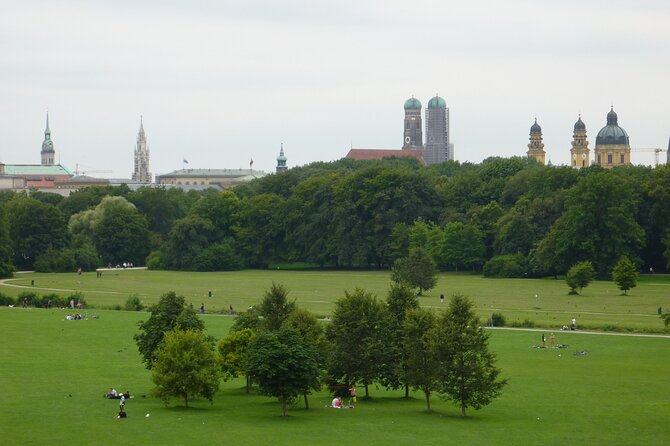
Reviewed · WALKING TOURS
Munich Private Walking Tour With A Professional Guide
Munich rewards a good first walk. This private two-hour tour links the city’s grand squares, royal buildings, churches, beer halls, and difficult twentieth-century past with one guide focused on your group. I like the private format, which gives you room to ask questions and adjust the walk, and I like the broad route, from Marienplatz to Viktualienmarkt. The main caution is pace: there is a lot to cover in two hours, and entrance fees are not included.
You pay $305.11 for up to 15 people, so a full group pays about $20 per person. That is fair for a private introduction, but expensive for one or two people. Most of the value comes from the guide’s stories and local advice, not from entering attractions.
In This Review
- Key points at a glance
- Starting at Marienplatz and the Glockenspiel
- St. Peter’s and the devil’s footprint
- Odeonsplatz and the Beer Hall Putsch
- Theatine Church and Ludwigstrasse
- Max-Joseph-Platz and the Bavarian monarchs
- Hofbräuhaus and Viktualienmarkt
- What two hours really gives you
- Guide style and the importance of a clear voice
- Price, group size, and practical value
- Who should book this Munich walk?
- Should you book it?
- FAQ
- How long does the Munich private walking tour last?
- How much does the tour cost?
- Is the tour private?
- What language is offered?
- Where does the tour start?
- Where does the tour end?
- Are entrance fees included?
- Does the tour require transportation?
- Can I cancel for a full refund?
Key points at a glance
- The route covers Munich’s essential center: Marienplatz, St. Peter’s, Frauenkirche, Odeonsplatz, Ludwigstrasse, the Residence, Hofbräuhaus, and Viktualienmarkt.
- A private group keeps the walk personal: You can ask questions freely and request changes during the tour.
- Munich’s darker past is included: The guide explains the Beer Hall Putsch and Hitler’s attempted seizure of power.
- The walk is easy and needs no transport: It suits most ages and stays near central public transportation.
- The two-hour limit requires brisk sightseeing: You will see many landmarks, but entry visits are not part of the standard experience.
- Guide quality matters: Tom Lipton earned praise for his stories and warmth, while Peter was described as accommodating and highly capable.
Starting at Marienplatz and the Glockenspiel
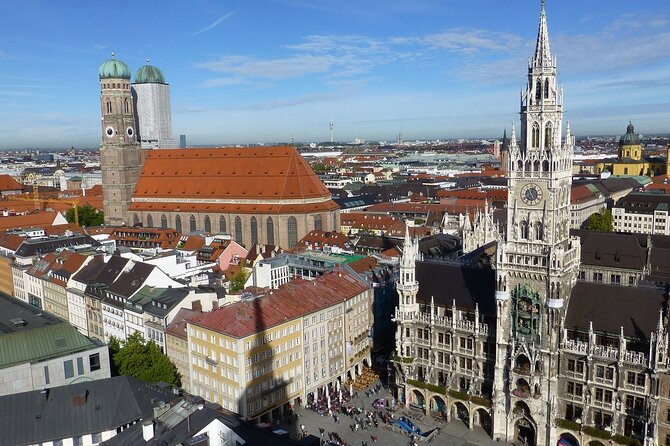
Your meeting point is Fischbrunnen at Marienplatz, right in the heart of Munich. This is a sensible place to begin because the square puts several major sights within a few steps of one another.
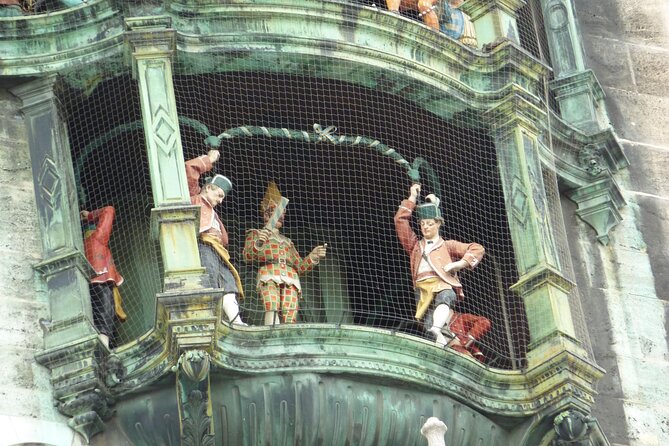
The first focus is the Neues Rathaus, or New Town Hall, with its famous Rathaus-Glockenspiel. The clock tower contains 43 bells and 32 figures. At set times, the wooden figures perform two scenes from Munich’s past. Your guide explains what you are watching, which matters because the display is easy to admire without understanding its story.
The square also takes its name from the Mariensäule, or Mary’s Column. A private guide can connect the column, the town halls, and the square’s role in city life instead of treating each item as a disconnected photo stop.
You should confirm the exact timing of the Glockenspiel performance when you book or meet your guide. The tour information says the figures perform at fixed hours, but it does not promise that your two-hour route will coincide with one. If seeing the moving figures is a priority, ask about it at the start.
The New Town Hall is primarily an exterior stop on this walk. That is useful for orientation, but you should not expect an included visit inside the building. The tour includes guiding, not admission tickets.
More Walking Tours in Munich
- Munich: Third Reich & WWII Walking Tour
★ 4.6 · 6,181 reviews - Third Reich Walking Tour Munich
★ 4.5 · 4,291 reviews - Munich: Old Town & Viktualienmarkt City Walk in German
★ 4.7 · 2,304 reviews
St. Peter’s and the devil’s footprint
From Marienplatz, you reach St. Peter’s, Munich’s oldest Catholic church. Even if you do not go inside, this stop helps place the city’s religious past beside its civic center.
The church is also tied to one of Munich’s best-known legends. At Frauenkirche, you hear the tale of the devil’s footprint, a dark story connected with the cathedral. The guide can give the legend context and point out the mark, turning a quick look at the building into a memorable piece of local folklore.
Frauenkirche is Munich’s largest church, recognized by its twin towers. The route gives you a good view of those towers, but entrance is not included. That distinction matters. If you want time for the interior, prayer, or a closer look at the footprint, ask whether the guide can adjust the route, and expect to handle any admission costs yourself.
I like this early part of the walk because it gives you three useful layers of Munich: the city government at the New Town Hall, religious tradition at St. Peter’s and Frauenkirche, and popular legend through the devil’s footprint. You get a quick sense of how the old center fits together.
Odeonsplatz and the Beer Hall Putsch
The walk then moves toward Odeonsplatz, where the subject changes sharply. Here the guide discusses the Beer Hall Putsch, the failed 1923 attempt led by Adolf Hitler and roughly 2,000 men to seize power in Munich.
This is an important inclusion. Munich is often introduced through palaces, pretzels, and beer halls, but the city also played a major role in the rise of National Socialism. A good explanation at the actual setting helps you understand the sequence of events and why Odeonsplatz matters.
The tour description refers to the tumultuous night when the march reached the city center. Since the walk is only two hours, the depth of this discussion will depend on your guide and your questions. If this period is especially important to you, say so early. The private setup gives you a better chance of spending extra time on it than a large fixed group would.
This part may feel heavier than the opening sights, but that contrast is useful. Munich’s past is not a tidy parade of royal buildings and cheerful beer halls. I appreciate that the route makes room for a difficult chapter rather than skipping it.
Theatine Church and Ludwigstrasse
At Odeonsplatz, you also see the Theatine Church, a baroque church commissioned by Elector Ferdinand Maria and his wife. It was built as a thank-you for the birth of their long-awaited heir, Prince Max Emanuel.
That detail brings the Bavarian monarchy into focus. The church is not just an ornate facade. Its origin reflects dynastic hopes, royal gratitude, and the importance placed on succession.
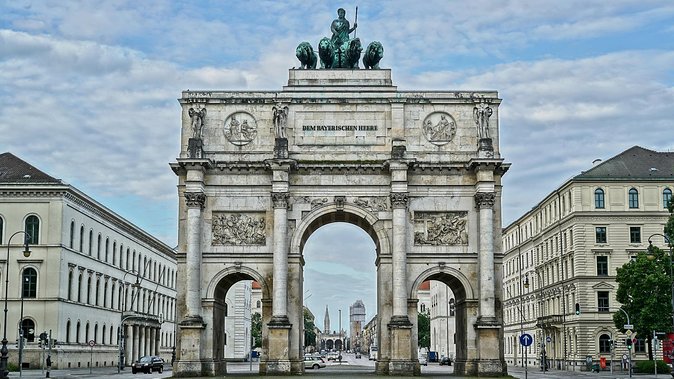
Next comes Ludwigstrasse, a broad neo-classical street lined with major institutions. You see the State Library, Munich’s oldest university, and the Gate of Victory. The street provides a different visual mood from the narrow lanes around Marienplatz, with formal architecture and a grand urban plan.
You will likely appreciate this section most if you enjoy architecture and political history. It can be less immediately entertaining than the Glockenspiel or Hofbräuhaus, but it shows how rulers used buildings and avenues to project order, learning, and power.
Something different for another day:
- From Munich: Neuschwanstein & Linderhof Castle Full-Day Trip
★ 4.5 · 12,494 reviews - Neuschwanstein & Linderhof Castle-Fairytale Day Tour from Munich
★ 4.5 · 7,275 reviews - Dachau Concentration Camp Memorial Site Tour from Munich by Train
★ 4.5 · 5,637 reviews - Neuschwanstein Castle Tour from Munich
★ 4.5 · 5,117 reviews
Max-Joseph-Platz and the Bavarian monarchs
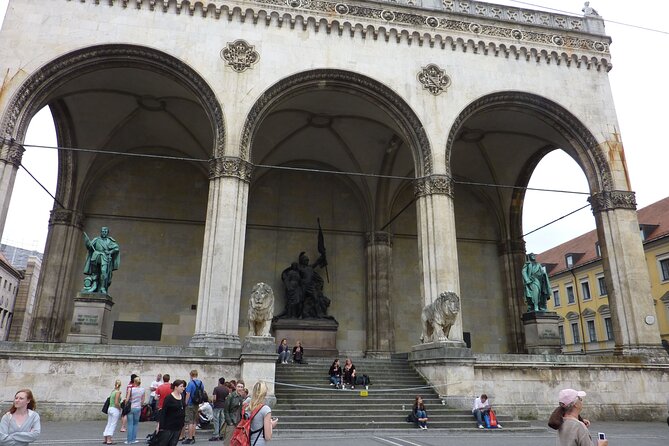
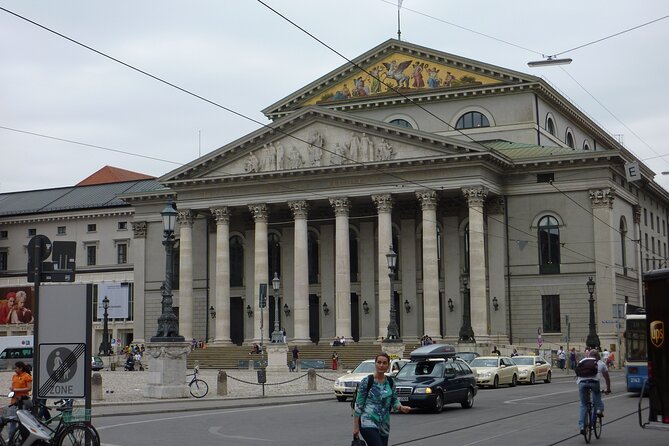
The route turns back toward the center and reaches Max-Joseph-Platz. From here, you can view the Opera, the National Theater, and the Residence.
The Residence was the former palace of Bavaria’s monarchs and is described as the largest palace in Germany. That is a major sight, but the standard walk does not include an admission ticket or a dedicated interior visit. Think of this stop as an introduction and orientation. You can return later if you want to explore the palace rooms and collections at your own speed.
This is where the private format can help. You can ask your guide which royal buildings deserve an interior visit, how much time to allow, and how to fit the Residence into the rest of your Munich plans. The guide may also be able to adjust the walk on the spot, though no particular change is guaranteed.
I like the way this route connects the monarchy to the city streets. You move from a royal church to a formal boulevard and then to the palace district. The story becomes easier to follow because the buildings are close enough to see in sequence.
Hofbräuhaus and Viktualienmarkt
Near the end, you reach Hofbräuhaus, the royal brewery founded in 1589. It is widely considered the mother ship of Munich beer halls, and its long history makes it an obvious stop on a first visit.
Your guide can explain why Hofbräuhaus matters, but the tour does not promise a meal, a drink, or a reserved table. If you want to sit down for beer and food, plan separate time after the walk. Two hours is not enough for a relaxed meal and a full central Munich route.
The final stop is Viktualienmarkt, the city’s public food market. It offers fresh local products and is a practical place to continue after the tour. You can ask your guide for advice about what to try or where to eat nearby.
One especially useful detail from the experience is the lunch guidance offered at the end of one tour. The advice led to a very good meal, so do not rush away when the walk finishes. Ask for restaurant suggestions while you still have your guide’s attention.
The end point is listed simply as Munich rather than a precise attraction. Confirm where the walk will finish if you need to reach a train station, hotel, or timed reservation afterward.
What two hours really gives you
Two hours is enough for a strong first orientation, not a full museum visit. You will see a long chain of central landmarks and hear stories about Bavaria’s rulers, religious traditions, Munich’s architecture, the Nazi era, beer culture, and the food market.
The route is ambitious. Marienplatz, St. Peter’s, Frauenkirche, Odeonsplatz, Theatine Church, Ludwigstrasse, Max-Joseph-Platz, Hofbräuhaus, and Viktualienmarkt make for a busy schedule. I would expect exterior viewing and short explanations rather than long stops inside each building.
That is not a flaw if you use the tour as a map for the rest of your stay. It helps you decide where to return. If you want a slow visit to the Residence, a church interior, or a meal at Hofbräuhaus, save those for later.
Ask questions as you walk. The private arrangement is wasted if you simply follow silently from one stop to the next. You can ask about Bavarian monarchs, the Beer Hall Putsch, local food, or which sights deserve more of your time.
Guide style and the importance of a clear voice
The strongest praise centers on the guides’ storytelling, humor, and willingness to adapt. Tom Lipton was thanked for bringing Munich’s character and past to life, while another guide, Peter, was described as accommodating and excellent. One visitor also praised a guide’s witty and jovial manner.
Those details tell you what this experience can offer at its best: not just dates and building names, but stories that make the streets easier to remember. Tom’s warm approach was especially appreciated by a small group that included Anna and Talia, and the personal connection clearly added to the experience.
There is one useful warning. A separate walk suffered because the guide spoke too softly, and the presentation felt dull to some of the group. This is a reminder to tell your guide if you cannot hear. In a private tour, you can stop, move closer, or ask for a clearer explanation. Still, guide style can affect the experience greatly.
The assigned guide is not guaranteed in the information provided, so book this for the private format and route rather than for one named person alone. If you are able to request Tom Lipton or Peter, it is reasonable to ask, but do not treat that as promised.
Price, group size, and practical value
The price is $305.11 per group of up to 15 people. At the maximum size, that works out to roughly $20.34 per person, which is solid value for a private city introduction. A group of six pays about $50.85 each, while two people pay about $152.56 each.
That makes this tour most attractive for families, friends, or a larger group who want their own guide. For one or two people, a shared walking tour may offer better value if a private guide is not important to you.
The tour is offered in English and uses a mobile ticket. It lasts about two hours, requires no transportation, and has an easy activity level. Most people can take part, and service animals are allowed. The meeting point is Fischbrunnen at Marienplatz, near public transportation.
Entrance fees are not included. You should budget separately if you later choose to enter the Residence, Frauenkirche, St. Peter’s, or another paid attraction. The information does not specify which interiors, if any, the guide enters during the walk, so ask before you begin.
Free cancellation is available until 24 hours before the start time. Cancellations or changes made within 24 hours are not accepted for a refund, and the cut-off follows Munich local time.
Who should book this Munich walk?
I would choose this tour for a first visit when you want a quick but meaningful introduction to central Munich. It works especially well for a family or friend group that wants to stay together, ask questions, and avoid the rigid pace of a large public tour.
It also suits you if Munich’s political history matters as much as its royal buildings and beer halls. The inclusion of the Beer Hall Putsch gives the route more weight than a simple highlights walk.
You may want something else if your priority is entering several attractions. This is mainly an outdoor orientation, and two hours will not allow lengthy visits inside the churches, Residence, or other buildings. It may also feel rushed if you prefer slow photography or long explanations at every stop.
Should you book it?
Book this private walk if you are traveling with a group and want one guide to connect Munich’s central sights into a clear story. The route is well chosen, the pace should be manageable for most ages, and the chance to customize the discussion adds real value.
For a couple or solo visitor, compare the per-person cost with a shared tour. If you do book, ask at the start about the Glockenspiel timing, tell the guide which subjects matter most, and request a lunch recommendation at Viktualienmarkt. That small bit of planning can turn a fast city walk into a useful first day in Munich.
FAQ
How long does the Munich private walking tour last?
The tour lasts approximately two hours.
How much does the tour cost?
The listed price is $305.11 per group, with up to 15 people included.
Is the tour private?
Yes. Only your group participates, and a local guide accompanies your group alone.
What language is offered?
The tour is offered in English.
Where does the tour start?
It starts at Fischbrunnen, Marienplatz 8, 80331 München, Germany.
Where does the tour end?
The end point is listed as Munich, Germany. The exact finishing place should be confirmed with the guide.
Are entrance fees included?
No. Entrance fees are not included in the tour price.
Does the tour require transportation?
No. This is a walking tour, and no transportation is needed.
Can I cancel for a full refund?
Yes, if you cancel at least 24 hours before the experience start time. Cancellations or changes made less than 24 hours in advance are not accepted for a refund.
Just added around Munich
- Munich WWII and Dachau Concentration Camp Private Tour with Licensed Guide★ 5.0 · 3 reviews
- Munich Photoshoot: A Must-Have Holiday Experience!★ 5.0 · 3 reviews
- München: Braukurs mit Führung und Verkostung★ 4.2 · 4 reviews
- Mozart and German Composers Private Tour in Munich★ 4.8 · 4 reviews
- CITY QUEST Munich: reveal the secrets of this city!★ 4.0 · 4 reviews
- Private audio book city rally in Munich city centre★ 4.0 · 4 reviews
- Culinary Haidhausen – The Food Tour★ 4.3 · 4 reviews
- Private Munich History and Beer Culture Walking Tour★ 5.0 · 4 reviews
Walking Tours, compared.





Berlin’s Best: 2 Hour Walking Tour Third Reich and the Cold War
Read our review →


Third Reich Berlin: Hitler and WWII Walking Tour
Read our review →Browse the lists this tour appears in