
Reviewed · WALKING TOURS
Jewish Life in Berlin – Private Walking Tour
Berlin’s Jewish story is written in fragments. This private three-hour walk connects those fragments, from 17th-century Jewish immigration and the old Scheunenviertel to the Holocaust and today’s Jewish community. I like the personal guide-led format and the focus on ordinary streets, schools, cemeteries, and workshops rather than only famous memorials. I also like that the route ends at the New Synagogue, one of Berlin’s most important Jewish landmarks.
The main drawback is that this is a serious amount of walking with short stops, and the exact interior access can be unclear. One review expected the Holocaust Memorial and more time inside the old synagogue, but this tour takes a different path. It is strongest for people who want context and conversation, not a quick parade of major sights.
In This Review
- Key points to know before booking
- Why this Jewish Berlin walk feels different
- Meeting at Hackescher Markt
- Hackesche Höfe and the memory of resistance
- Otto Weidt’s workshop and quiet courage
- Scheunenviertel and the texture of everyday life
- Sophienstraße and Sophia Church
- Grosse Hamburger Strasse: cemetery, school, and deportation
- Auguststraße and the changing Jewish quarter
- The New Synagogue and Centrum Judaicum
- What the $355.25 group price really means
- Who will get the most from this walk
- A practical way to plan your day
- Should you book Jewish Life in Berlin?
- FAQ
- Where does the tour begin?
- Where does the tour end?
- How long does the walking tour last?
- Is this a private tour?
- How much does the tour cost?
- What is included in the price?
- Does the tour visit the Holocaust Memorial?
- Is the tour suitable in bad weather?
- Is the route flat?
- Can I cancel for a full refund?
Key points to know before booking
- The route begins at Hackescher Markt and ends at the New Synagogue, making it easy to connect with central Berlin sightseeing.
- Otto Weidt’s workshop tells a personal story of resistance, focusing on how one owner protected blind and deaf Jewish workers.
- The Scheunenviertel reveals daily Jewish life, not just wartime destruction and memorials.
- Private means your group has the guide to itself, with room for questions and adjustments in pace.
- The walk is flat but substantial, and poor weather can affect the final stops.
- The price is $355.25 per group of up to 15, which becomes better value as your party gets larger.
Why this Jewish Berlin walk feels different

Berlin has no shortage of sites connected with Nazi persecution. Yet a visit built only around memorials can leave you with a narrow picture of Jewish life, as if the story began with the Holocaust and ended with stone and silence.
This route begins earlier. You hear about the first Jewish immigrants who settled in Berlin in the 17th century, then follow the growth of Jewish institutions, businesses, schools, religious buildings, and neighborhoods. The story later turns to Nazi propaganda, deportation, resistance, and the destruction of the city’s Jewish population.
I like that wider frame. You learn about people such as Albert Einstein and Moses Mendelssohn, the philosopher who founded the first modern public school for Jewish boys. These details help you see Berlin’s Jewish community as a living part of the city, not a footnote to the 20th century.
The private setup matters here. The subject is complex, and the best part of the walk may be the chance to stop and ask how a building, street, or memorial fits into the larger story. Several guides have been praised for handling difficult questions with patience and tact. Carlos, Caroline, Marriette, and Finn are among the guides singled out in the feedback, with Carlos noted for combining facts, perspective, appropriate humor, and candid answers.
More Walking Tours in Berlin
- Discover Berlin Half-Day Walking Tour
★ 5.0 · 9,624 reviews - Berlin: Third Reich and Cold War 2 Hour Walking Tour
★ 4.9 · 6,830 reviews - Berlin: Discover Berlin Walking Tour
★ 4.9 · 5,998 reviews
Meeting at Hackescher Markt
The guide meets you outside the Hackescher Markt S-Bahn station, at Neue Promenade 3, in front of Starbucks. This is a busy central meeting point, so allow a few minutes to find the correct side of the station and the meeting area.
The first ten minutes provide an introduction to the tour and the Jewish history of the district. Do not expect a long formal orientation. It is more likely to be a quick setting of the scene before you start moving through Berlin Mitte.
Hackescher Markt is a useful starting place because it puts you close to the former Jewish quarter. It also offers easy public transport connections, which helps if you are fitting this tour between other central Berlin stops.
Hackesche Höfe and the memory of resistance
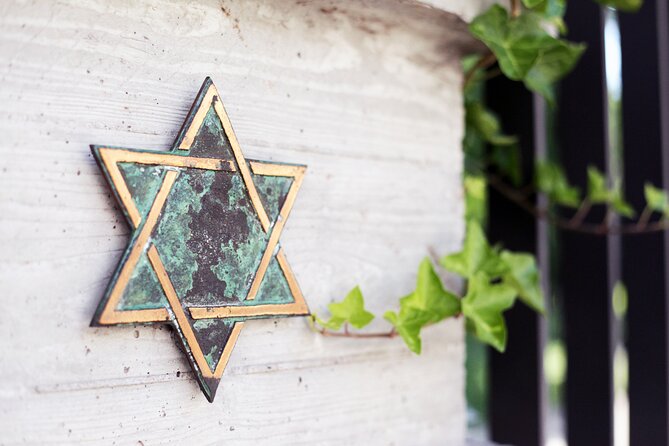
The walk continues to the Hackesche Höfe, a series of courtyards known today for shops, cafes, and striking architecture. Here, the guide explains the site’s earlier history and discusses the memorial connected with the women’s protest.
This stop is valuable because it shows how Jewish memory appears within an active modern neighborhood. You are not walking through a preserved historical set. Contemporary Berlin carries on around the courtyards, while plaques and memorials point to lives and events that are easy to miss.
The stop is listed at about ten minutes. That is enough for an explanation and questions, but not enough for a long architectural or social history of the courtyards. If you want extended time for photographs or shopping, plan to return another day.
Otto Weidt’s workshop and quiet courage
The Museum Blindenwerkstatt Otto Weidt is one of the most affecting parts of the route. Otto Weidt ran a workshop in the 1940s and employed blind and deaf Jewish workers. He used his position to protect them from Nazi persecution.
This story brings the Holocaust down from the level of government policy to the scale of a workplace. You are asked to think about the risks taken by an individual, the vulnerability of workers, and the practical ways people tried to survive under Nazi rule.
The stop is scheduled for roughly ten minutes, so the guide’s explanation carries much of the experience. The tour information describes a visit to the museum, while the included services list only a professional guide and free admission at the itinerary stops. If seeing the full interior is important to you, confirm exactly what access is provided when booking.
This is also one of the places where a private guide has real value. A good explanation can keep the story focused and respectful, without turning the site into a rushed photo stop.
Something different for another day:
- Berlin: Reichstag, Dome and Government District Guided Tour
★ 4.7 · 18,288 reviews - Berlin: 1-Hour City Tour by Boat with Guaranteed Seating
★ 4.3 · 16,993 reviews - Berlin: Boat Tour Along the River Spree
★ 4.4 · 11,252 reviews - Berlin: Hop-on Hop-off Bus Tour with Live Commentary
★ 4.3 · 8,579 reviews
Scheunenviertel and the texture of everyday life
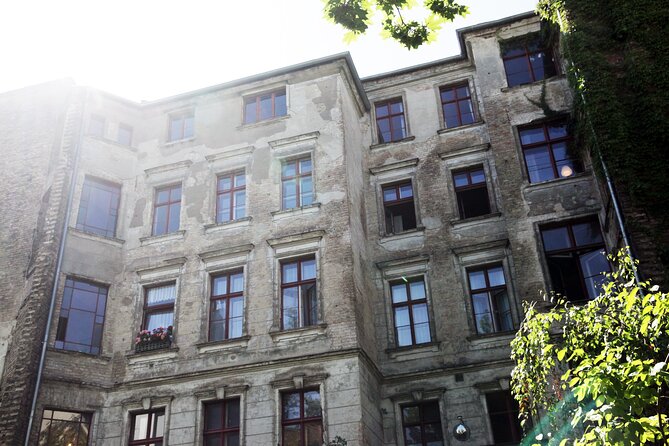
In the Scheunenviertel, the guide explains the former Jewish quarter and the history of Berlin’s Jewish community. This is where the tour shifts from individual courage to the shape of daily life.
You hear about a community that built homes, businesses, religious institutions, and schools. The surviving evidence is incomplete, which is part of the lesson. Much of the Jewish quarter has changed, and the past often appears through fragments rather than grand intact monuments.
One of the most useful features of this section is its attention to ordinary life before World War II. The route is not only about persecution. It helps you picture the people who lived here, worked here, studied here, and helped shape Berlin.
The short stop at the Scheunenviertel also explains why you should not expect a single enclosed Jewish quarter with clear gates and boundaries. The experience depends on the guide pointing out connections that may not be obvious from the street.
Sophienstraße and Sophia Church
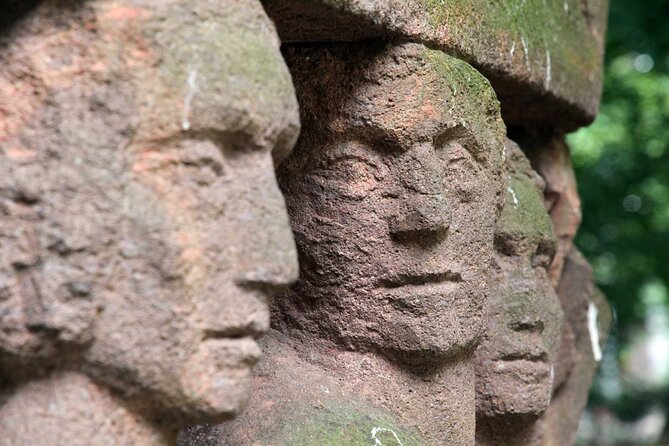
Sophienstraße provides a change of pace. This picturesque street is named after Queen Sophie, and the guide explains its place in Berlin’s history. The architecture and quiet atmosphere offer a pause from the more painful subjects covered earlier.
Next comes Sophia Church. Its history includes a connection with Martin Luther King, a detail that broadens the walk beyond Jewish history alone. The point is not to shift the tour away from its main subject, but to show how Berlin’s religious and civic stories overlap.
These two ten-minute stops are likely to appeal to anyone who enjoys seeing how history survives in street plans and buildings. They are less dramatic than the Holocaust-related sites, but they help give the neighborhood a physical setting.
The route is flat, according to the practical information and direct feedback, but you will still be on your feet for much of the three hours. Wear comfortable shoes. In hot weather, the lack of shade may make the walk harder, and in rain, the final stops can be affected.
Grosse Hamburger Strasse: cemetery, school, and deportation
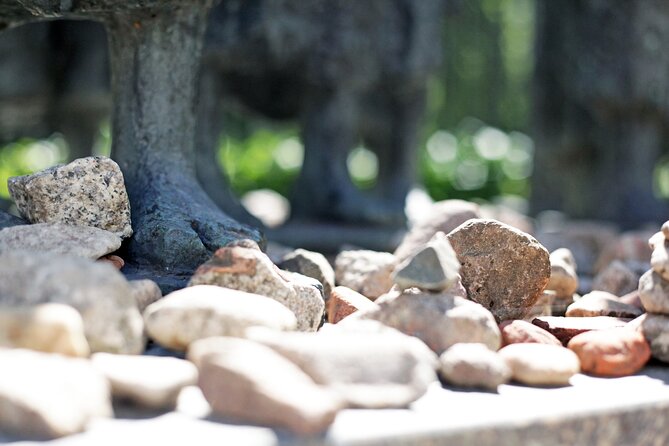
Grosse Hamburger Strasse brings several strands of Jewish Berlin together. The guide discusses the Jewish cemetery, the Jewish school, and the deportation of Jews during the Nazi era.
This is an important part of the walk because it links education, faith, family life, and persecution in one area. The cemetery and school represent community institutions. The deportations show how those same streets were pulled into the machinery of Nazi oppression.
Expect a spoken explanation rather than a long museum visit. The itinerary gives each stop about ten minutes, so the guide must make careful choices. A private group can use that time well if you ask focused questions about what remains, what was destroyed, and how the sites are remembered today.
The tour’s strength here is its connection between buildings and people. You are not simply told that an institution existed. You learn how Jewish life took form in Berlin and how quickly that life was attacked and dismantled.
Auguststraße and the changing Jewish quarter
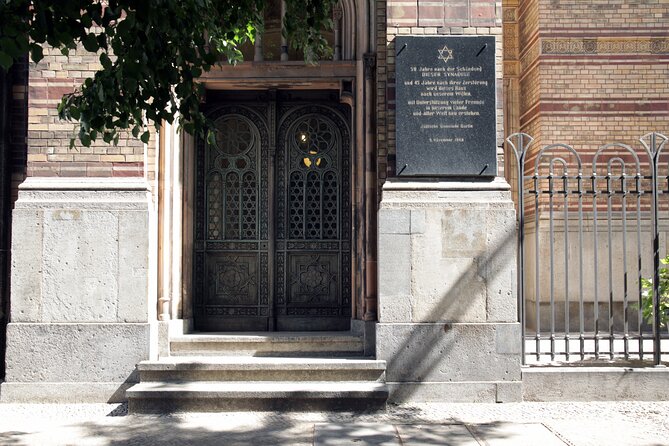
Auguststraße is known for art galleries and important buildings linked to the old Jewish community. This section shows another side of Berlin Mitte: the same streets can now feel creative and contemporary while carrying memories of a very different past.
I find this kind of contrast useful, though it may not satisfy someone looking for large monuments at every stop. One direct comment about the tour noted that the sights were less familiar and more connected to daily life before World War II. That is exactly the appeal, but it is also something to understand before booking.
The route is about interpretation. You may pass a building that looks ordinary, then learn why it mattered. Without a guide, those connections would be easy to miss.
The New Synagogue and Centrum Judaicum
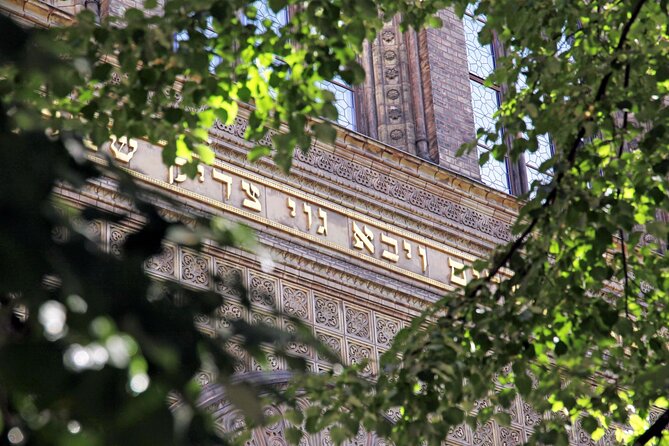
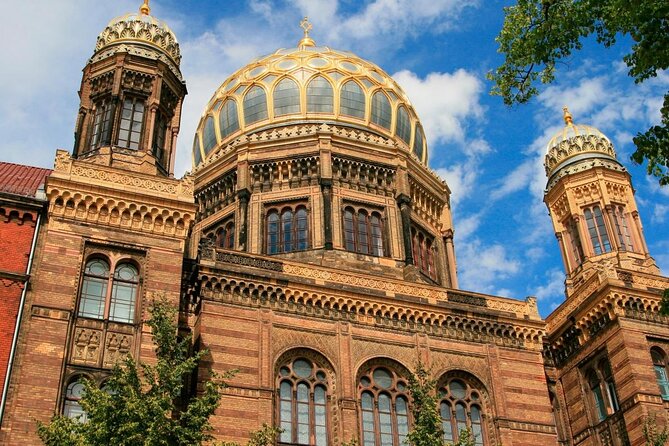
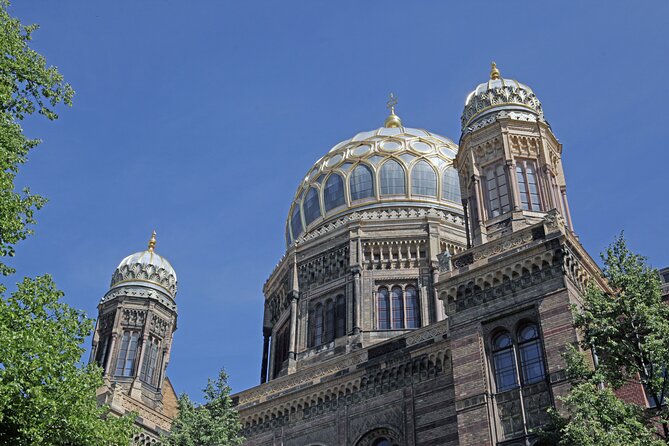
The walk ends at the New Synagogue Berlin, Centrum Judaicum, at Oranienburger Strasse 28 to 30. The 19th-century synagogue was once the main synagogue of Berlin’s Jewish community and remains one of the city’s key Jewish landmarks.
Its architecture reflects the confidence and importance of Berlin’s Jewish community before the Nazi period. The guide also explains what happened during Kristallnacht in 1938, often called the Night of Broken Glass, and discusses people who helped Jews during the Nazi era.
The synagogue is home to the Centrum Judaicum, which traces the building’s history and the life associated with it. Be aware of the distinction between ending at this landmark and receiving a full museum visit. At least one person expected more time inside the old synagogue, so you should confirm whether admission or an extended interior visit is part of your departure plan.
The listed opening hours are 9 a.m. to 3 p.m., Monday through Sunday, for the period shown in the tour details. Since schedules can change, check current access if visiting the Centrum Judaicum after the walk matters to you.
What the $355.25 group price really means
The cost is $355.25 for a private group of up to 15 people. That works out to about $23.68 per person for a full group of 15, but the per-person cost rises sharply for a small party of two or three.
For a family, reunion group, school group, or gathering of friends, this can be a sensible buy. You get three hours with a professional guide, and the private format lets you ask questions without competing with strangers.
For a couple, the value depends on your interest in the subject. If Jewish Berlin is a major reason for your visit, the focused attention may justify the price. If you mainly want a general overview of central Berlin, a less specialized walking tour may fit better.
The listed inclusions are limited to a professional guide. The itinerary marks the stops as free admission, but because the included section does not list museum tickets separately, check what entrance access is covered before you pay.
Who will get the most from this walk
I would choose this tour if you want Jewish history presented across several centuries. It suits visitors who prefer local streets and specific human stories to a checklist of headline sights.
It is also a good choice for mixed-age groups. A guide can explain the material at the right level and handle questions from children, teenagers, and adults. Carlos was praised for keeping a group with a wide range of ages engaged, while other guides were described as friendly, thoughtful, and easy to question.
You should think twice if you dislike walking, need frequent indoor breaks, or want a tour centered on the Holocaust Memorial. That memorial is not part of the stated route. The focus here is Berlin’s Jewish quarter, community institutions, resistance, deportation, and the New Synagogue.
The tour operates in all weather. Rain did not prevent some people from enjoying it, but heavy downpours and very hot weather clearly made the walk more demanding. Dress for the forecast and bring water in warm conditions.
A practical way to plan your day
Because the tour begins at Hackescher Markt and ends near Oranienburger Strasse, it fits naturally into a day in Berlin Mitte. You can reach the starting point by public transport, and the final stop places you near other central attractions and transport connections.
Keep the rest of your schedule flexible. The advertised length is approximately three hours, and the walking time between the nine listed stops is part of the experience. The ten-minute figures describe explanation time at each location, not the entire time spent moving through the district.
I would not schedule a tight museum reservation immediately afterward. The route is outdoors, the weather can slow things down, and a thoughtful question or discussion may extend a stop.
The tour is offered with a mobile ticket, and confirmation is normally sent at booking. If you book within three days of travel, confirmation may arrive within 48 hours, subject to availability. Free cancellation is available up to 24 hours before the start time. Within 24 hours, refunds are not provided and changes are not accepted.
Should you book Jewish Life in Berlin?
Book it if you want a focused, human-scale history of Berlin’s Jewish community, especially the years before World War II and the ways Jewish people lived, worked, studied, and worshipped in the city. The guides are repeatedly praised for being well informed, friendly, patient, and sensitive with difficult material.
Choose it with realistic expectations. This is not a memorial-only route, it does not include the Holocaust Memorial, and interior museum access may need confirmation. The walk is flat but long, and the value is strongest when you have a private group large enough to share the cost.
For a group of friends or family, I think the private format is the key advantage. For a pair on a tight budget, it is worth booking only if this specific subject is high on your Berlin list.
FAQ
Where does the tour begin?
The guide meets you at Neue Promenade 3, 10178 Berlin, outside the Hackescher Markt S-Bahn station and in front of Starbucks.
Where does the tour end?
The tour ends at the New Synagogue Berlin, Centrum Judaicum, at Oranienburger Strasse 28 to 30, 10117 Berlin.
How long does the walking tour last?
The tour lasts approximately three hours.
Is this a private tour?
Yes. Only your group participates in the activity, with a maximum group size of 15 people.
How much does the tour cost?
The listed price is $355.25 per group of up to 15 people.
What is included in the price?
A professional guide is included. The listed stop information shows free admission, but confirm any specific interior or museum access before booking because separate entrance tickets are not listed among the inclusions.
Does the tour visit the Holocaust Memorial?
No. The stated route includes Hackescher Markt, Hackesche Höfe, the Otto Weidt workshop, Scheunenviertel, Sophienstraße, Grosse Hamburger Strasse, Sophia Church, Auguststraße, and the New Synagogue. The Holocaust Memorial is not listed.
Is the tour suitable in bad weather?
Yes. The tour operates in all weather conditions. You should dress appropriately, since much of the experience takes place outdoors.
Is the route flat?
Yes. The walking route is described as flat, though it involves quite a lot of walking.
Can I cancel for a full refund?
Yes, if you cancel at least 24 hours before the experience starts. Cancellations made less than 24 hours before the start time are not refunded, and changes within that period are not accepted.
Just added around Berlin
- Berlin: Private Guided Tour of the Main Sights★ 5.0 · 13 reviews
- Private Highlights of Berlin Bike Tour★ 5.0 · 13 reviews
- Modern Berlin Private Walking Tour: Diverse, Vibrant and Exciting German Capital★ 5.0 · 13 reviews
- Tour in Berlin from Warnemünde and Rostock Cruise Port★ 4.1 · 13 reviews
- Berlin: Stasi Museum Private Guided Tour with Entry Ticket★ 4.8 · 13 reviews
- Private Food Tour Experience with a born and bred Berliner★ 5.0 · 14 reviews
- Berlin: Rheinsberg Palace Entrance Ticket★ 4.8 · 14 reviews
- Berlin in one day – day tour with an expert guide★ 5.0 · 14 reviews
Walking Tours, compared.
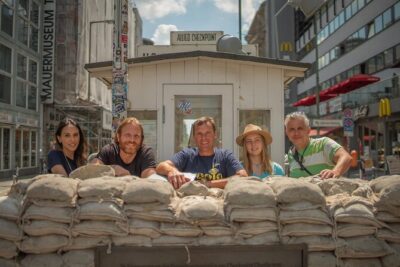
Berlin’s Best: 2 Hour Walking Tour Third Reich and the Cold War
Read our review →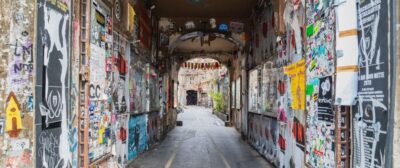
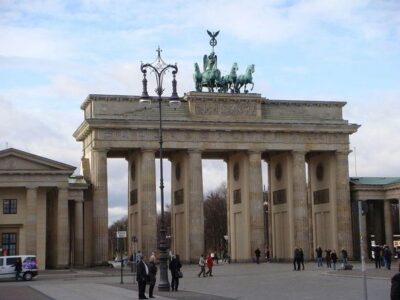
Third Reich Berlin: Hitler and WWII Walking Tour
Read our review →Browse the lists this tour appears in