
Reviewed · WALKING TOURS
Frankfurt Highlights English Walking Tour
Frankfurt rewards a closer look. This English walking tour ties the city’s medieval core to its modern skyline, with stops at the cathedral, Römerberg, the Jewish quarter, and the Main River. I especially like the small-group limit of 20 and the way the route mixes famous sights with places many visitors might miss. The main drawback is time: at up to three hours, the walk can feel long if your back, knees, or energy are not at their best.
The tour also has two practical strengths. It moves at a generally manageable pace, with frequent stops, and guides such as Hannes, Jennifer, Anne, Anna, Philip, and Annika have been praised for making Frankfurt’s complex past easy to follow. On the other hand, some parts are closed or viewed only from outside on Sundays and German holidays, so your touring day affects what you can see.
In This Review
- Key points to know before you go
- Why this Frankfurt walk works so well
- Starting at Frankfurt Cathedral
- Römerberg, the city hall, and a difficult memory
- Old Nicholas Church and the New Old Town
- Karmeliterkloster and Frankfurt’s art
- Kleinmarkthalle, a useful food stop
- Frankfurt’s Jewish past at the old cemetery
- City planning and the model of modern Frankfurt
- Crossing the Eiserner Steg
- Staufenmauer and the medieval Jewish wall
- Pace, walking effort, and group size
- Is $36.28 a good value?
- Who should book this tour?
- Should you book the Frankfurt Highlights walk?
- FAQ
- How much does the Frankfurt Highlights English Walking Tour cost?
- How long does the walking tour last?
- What time does the tour start?
- Where does the tour begin?
- Where does the tour end?
- Is the tour offered in English?
- Is the route suitable for people using a stroller?
- What happens if I need to cancel?
Key points to know before you go
- The route covers ten central sights: You see Frankfurt Cathedral, Römerberg, the New Old Town, the Jewish cemetery area, the Staufenmauer, and the Eiserner Steg.
- The city’s past connects to its present: The tour moves from Holy Roman Empire coronations to modern urban planning and Frankfurt’s current city model.
- The English commentary is the main attraction: Guides explain history, architecture, daily life, food, wine, art, and local customs rather than simply naming buildings.
- Sunday changes the route: The cathedral and Old Nicholas Church are exterior-only on Sundays, while Kleinmarkthalle and Stadtplanungsamt are closed on Sundays and German holidays.
- Expect a long but not frantic walk: The full route takes about two to three hours, with frequent pauses and some intermittent steps.
- The price is fair for a city introduction: At $36.28 per person, you are paying mainly for interpretation, orientation, and local advice rather than entrance tickets.
Why this Frankfurt walk works so well
Frankfurt is easy to underestimate. Many people arrive for the airport, trade fairs, or business towers and expect a modern financial center with little old Europe left. The historic center tells a more interesting story. It has been rebuilt, reshaped, and debated, and this tour gives you a clear way to read those layers.
I like the route because it does not stop with the postcard view of Römerberg. You hear about imperial elections and coronations, the medieval Jewish quarter, wartime destruction, reconstruction, present-day city planning, and the modern skyline along the Main. That range gives you a better sense of Frankfurt as a living city, not a preserved stage set.
The guides are a major part of the experience. Hannes, in particular, has been praised for answering questions beyond a memorized script and for linking old streets, museums, buildings, and modern life into one understandable story. Jennifer is noted for keeping a group attentive for three hours with humor and clear explanations. Anne, Anna, Philip, and Annika have also been praised for strong historical commentary, useful food suggestions, and an easygoing manner.
The style varies by guide, as it should on a walking tour. Some guides may give you a very full history lesson, while others may lean more toward stories and practical tips. If you enjoy asking questions, this format should suit you well. If you prefer a fast checklist of sights with little talking, three hours may feel heavy.
More Walking Tours in Frankfurt
- Frankfurt on Foot Daily Walking Tour in English
★ 4.9 · 323 reviews - Frankfurt: Private or Shared Walking Tour
★ 4.8 · 156 reviews - Frankfurt Self-Guided Historical Walking Tour
★ 4.0 · 58 reviews
Starting at Frankfurt Cathedral
The walk begins at Braubachstraße 41 at 10:00 a.m., close to Frankfurt Cathedral. Check the written address carefully before setting out. One person missed the tour after following an incorrect map pin that placed the meeting point about a block away, a problem made worse by rain and snow.
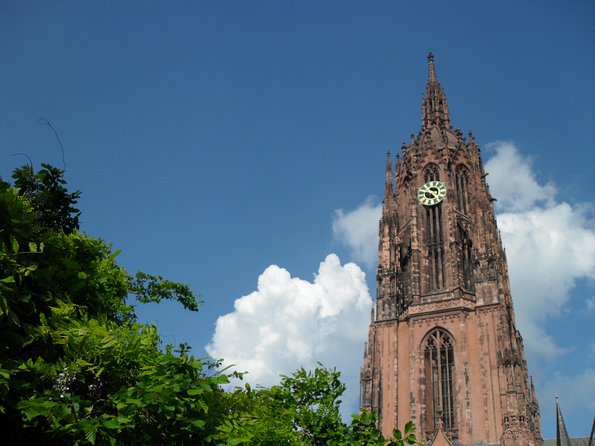
Frankfurt Cathedral, officially the Kaiserdom St. Bartholomäus, is the right place to begin because it introduces the city’s imperial role. The church was the site of elections and coronations for Holy Roman Emperors. Your guide explains why Frankfurt mattered politically, not just commercially.
The visit is exterior-only on Sundays. That does not erase the value of the stop, since the building and its setting still anchor the story, but you should adjust your expectations. If seeing the interior matters to you, avoid Sunday if possible or confirm what the day’s route includes.
The scheduled stop lasts about 20 minutes. That is enough time for an explanation and a look at the exterior without turning the opening into a long lecture.
Römerberg, the city hall, and a difficult memory
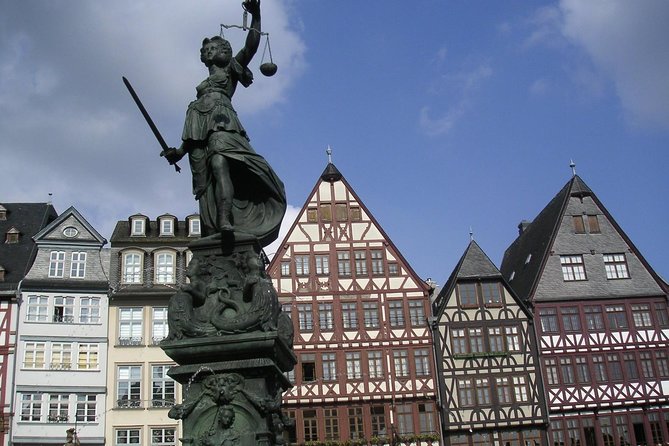
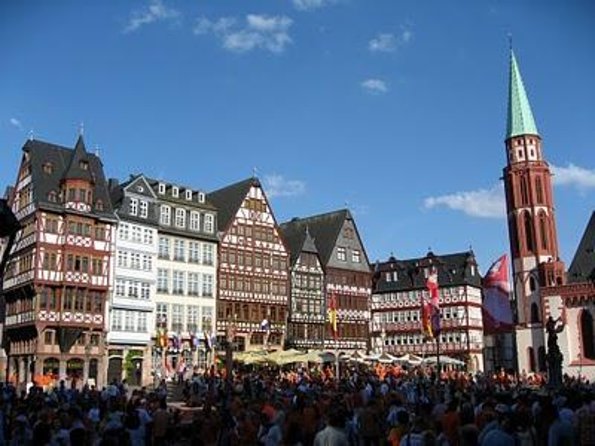
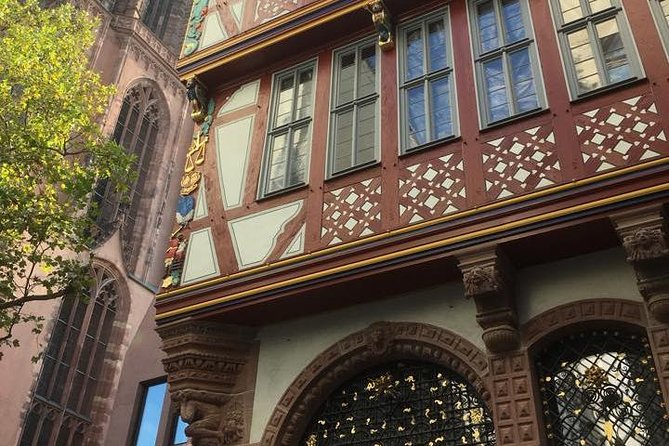
Römerberg is Frankfurt’s best-known historic square and one of the clearest places to see the city’s rebuilt old center. Here you learn about the Römer, Frankfurt’s city hall, along with the Justicia statue and the Book Burning Memorial.
The Römer is tied to the city’s civic and political life. The nearby Justicia figure points to law and public authority, while the Book Burning Memorial adds a sober reminder of the destruction of free thought under the Nazi regime. The value of this stop is the contrast: attractive historic façades and lively public space sit beside reminders of political failure and persecution.
The stop is planned for around 15 minutes. That may sound brief, but the tour returns to several themes later, especially the way Frankfurt rebuilt and reinterpreted its center. Use this time to ask how much of the old square is original and how much reflects later reconstruction.
Old Nicholas Church and the New Old Town
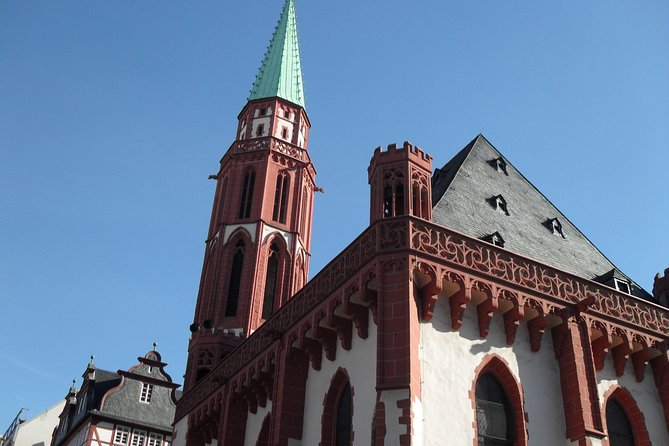
The Old Nicholas Church, or Alte Nikolaikirche, is one of Frankfurt’s oldest churches. The guide explains its place in the medieval center, and on Sundays you view it from outside.
From here, the walk continues into the New Old Town. This is one of the most useful parts of the tour for understanding modern Frankfurt. The area recreates or reconstructs historic-looking streets and buildings, while also serving as a contemporary neighborhood and public space.
You also follow part of the former coronation route used by Holy Roman Emperors. That detail gives the streets added meaning. You are not simply looking at attractive façades. You are walking through a route connected to the ceremonies that once made Frankfurt central to imperial politics.
Some people may find the New Old Town too polished or reconstructed compared with older European districts. That is precisely why a guide helps. You get context about what you are seeing instead of assuming every stone belongs to the medieval city.
Something different for another day:
- Frankfurt: River Main Sightseeing Cruise with Commentary
★ 4.3 · 5,127 reviews - Frankfurt: Hop-On, Hop-Off Grand or Express Bus Ticket
★ 3.9 · 2,088 reviews - Frankfurt: 1-Hour Panorama Boat Cruise on the river Main
★ 4.4 · 1,822 reviews - Rhine Valley Castles: 1.5-Hour Boat Tour from Rüdesheim
★ 4.2 · 1,390 reviews
Karmeliterkloster and Frankfurt’s art
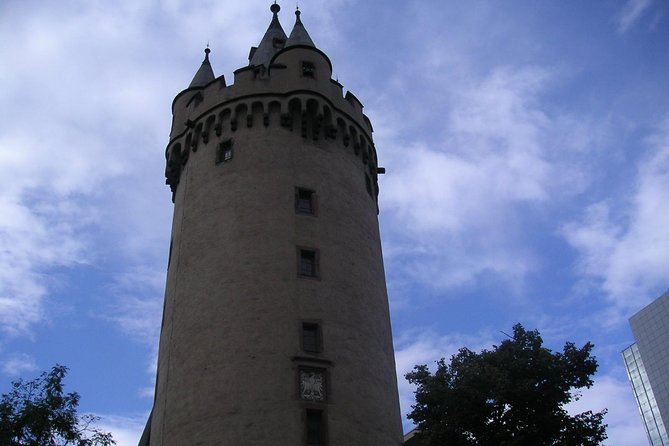
The Karmeliterkloster offers a quieter change of mood. Its wall paintings, created between 1513 and 1521, bring art into the walk and show that Frankfurt’s story is not only about emperors, merchants, and finance.
The planned stop is about 15 minutes. You may find this section especially rewarding if you like architecture and religious art, since the paintings provide something tangible to look at while the guide fills in the setting.
This is also where a strong guide can make a real difference. A building like the Karmeliterkloster can be easy to pass without understanding its importance. The tour’s general approach is to point out such details and explain why they matter.
Kleinmarkthalle, a useful food stop
Kleinmarkthalle is an indoor market filled with produce, chocolate, cheeses, meats, pastries, and other food. It is a good stop for practical reasons as well as sightseeing. A market shows how residents shop and eat, and it gives you a chance to note foods you may want to try later.
The stop lasts about 15 minutes. Do not expect a full meal break built into the tour, but guides may offer snack and bathroom suggestions along the way. Annika and other guides have been praised for giving useful recommendations about food and drinks, which can make this short visit more valuable.
Kleinmarkthalle is closed on Sundays and German holidays. When it is unavailable, the route has to pivot. That flexibility has worked well in poor weather and on closure days, but you will not get the market experience itself.
Frankfurt’s Jewish past at the old cemetery
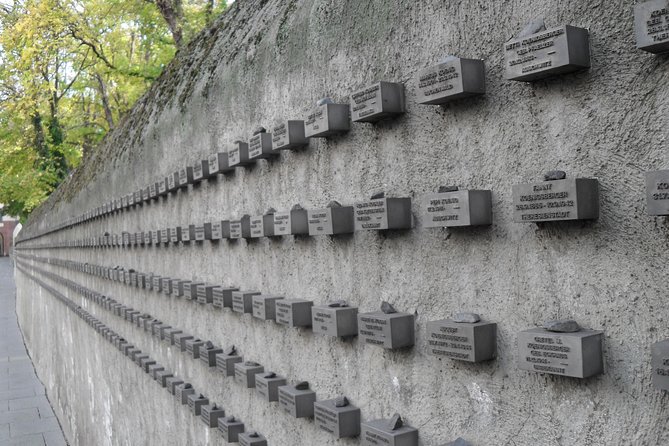
The Old Jewish Cemetery is one of the most serious and moving stops. Your guide discusses Frankfurt’s Jewish community, which has been present since the 1100s, and explains the medieval Jewish ghetto.
The medieval cemetery is viewed through the gate. A Holocaust Remembrance Wall surrounds it, creating a powerful setting for learning about both the long presence of Jewish life in Frankfurt and the persecution that followed. The stop is scheduled for about 30 minutes, longer than most others, and rightly so.
This section requires attention and respect. It is not a quick photo stop. The guide’s explanation helps connect the physical remains to the city’s wider story, including the loss and disruption experienced by Frankfurt’s Jewish community.
One useful feature of the route is its balance. The tour does not treat the Jewish quarter as a detached subject. It places the cemetery and wall within the broader development of Frankfurt, alongside trade, religion, government, war, and rebuilding.
City planning and the model of modern Frankfurt
The Stadtplanungsamt, or City Planning Department, contains a large-scale model of present-day Frankfurt. This is a surprising stop on a sightseeing walk, and I like it because it helps you understand the city beyond the old center.
A scale model makes the relationship between the medieval core, modern towers, neighborhoods, and riverfront easier to grasp. Your guide can point out how the city has changed and how planners think about its future. This is where the tour links historic preservation with current urban life.
The Stadtplanungsamt is closed on weekends and German holidays. If your tour runs on one of those days, this stop will not be available. That is an important reason to check the schedule before booking if modern Frankfurt interests you as much as the old town.
Crossing the Eiserner Steg
The Eiserner Steg is Frankfurt’s famous footbridge, often called the Love-lock Bridge. The walk across offers views from both sides of the Main River, including the European Central Bank, the museum riverbank, and Sachsenhausen.
This is the tour’s most open, scenic moment. After several close historic streets and buildings, you get a wider view of the city. The bridge helps you see how Frankfurt combines old districts, cultural institutions, finance, and residential neighborhoods along the river.
The stop itself lasts about 10 minutes, but the views can help orient you for the rest of your visit. You may want to return later for a slower look, especially if the weather is clear.
Locks can make the bridge feel crowded at times, and the river crossing may be exposed in cold or wet weather. Still, it is a worthwhile part of the route because it shows Frankfurt as a city with several identities at once.
Staufenmauer and the medieval Jewish wall
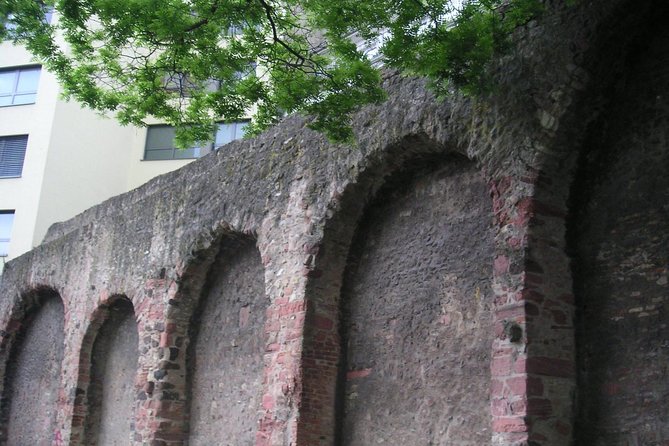
The final stop is the Staufenmauer, a city wall from the 1100s that also formed part of the medieval Jewish wall. It is a modest-looking remnant, but it carries a lot of meaning.
The wall helps explain the limits and boundaries of medieval Frankfurt. It also returns the tour to the Jewish history introduced at the cemetery, giving the walk a sense of continuity rather than ending with a random final landmark.
The scheduled stop is about 15 minutes, and the activity ends back at the meeting point. That makes the walk convenient if you have a train, another tour, or a planned meal afterward, though you should leave extra time if the group spends longer answering questions.
Pace, walking effort, and group size
The advertised duration is about two to three hours. Most of the route consists of walking between nearby central sights, with frequent stops for explanation. Several people found the pace manageable, and one small group of nine described the walk as easy to follow and uncrowded.
Still, three hours on city streets is not effortless for everyone. There are intermittent steps, and one account specifically noted that the pace was not ideal for an older participant. Another person left before the full three hours because of back pain.
The route is described as stroller-friendly, and most people can take part. Service animals are allowed, and the tour is near public transportation. If you have mobility concerns, tell the guide at the start. One guide was praised for checking on a participant and her son several times, suggesting that considerate pacing is possible, though the route still includes some steps.
The maximum group size is 20. That is large enough to keep the tour affordable but small enough for a guide to answer questions and keep the group together. Actual groups may be smaller.
Is $36.28 a good value?
At $36.28 per person, this is not the cheapest way to see Frankfurt’s center. Most stops have no separate admission charge, so you are paying for the guide’s time, organization, storytelling, and local advice.
That can be good value if Frankfurt is new to you. A well-run walking tour can prevent a day of wandering without context, help you understand the rebuilt old town, and point you toward food, museums, and neighborhoods to visit afterward. The broad subject range, from wine and art to imperial politics and city planning, gives the price more weight than a simple photo walk.
The value is lower if you only want to see the main square and cathedral exterior. You can reach those places on your own. The reason to book is the connected explanation, especially at the Jewish cemetery, Karmeliterkloster, and Stadtplanungsamt.
Who should book this tour?
I would choose this walk if you want a strong first orientation to Frankfurt and enjoy history told through places. It suits curious first-time visitors, couples, families with older children, and anyone who likes a guide who can answer questions rather than recite a short script.
It is also a good fit if you want practical suggestions for food and drinks. The Kleinmarkthalle stop and guide recommendations can help shape the rest of your day.
Think twice if you dislike long explanations, have serious walking limitations, or want a tour focused mainly on modern skyscrapers. The route spends most of its time in and around the old town, though the river bridge and city planning model broaden the picture.
Book with the calendar in mind. Sunday removes interior access at the cathedral and Old Nicholas Church, while Kleinmarkthalle and Stadtplanungsamt are unavailable on Sundays and German holidays. Free cancellation is available until 24 hours before the 10:00 a.m. start, which gives you some flexibility if plans change.
Should you book the Frankfurt Highlights walk?
Yes, if you want to understand Frankfurt rather than simply photograph it. The strongest features are the guides, the thoughtful connection between medieval and modern Frankfurt, and the inclusion of the Jewish cemetery, city model, and Staufenmauer alongside the familiar Römerberg.
I would book it early if your schedule is fixed, since it is commonly reserved well ahead of the date. Choose a weekday if the market and planning department matter to you, wear comfortable shoes, and arrive at the exact Braubachstraße address rather than relying only on a map marker.
FAQ
How much does the Frankfurt Highlights English Walking Tour cost?
The price is $36.28 per person.
How long does the walking tour last?
The tour lasts approximately two to three hours.
What time does the tour start?
The start time is 10:00 a.m.
Where does the tour begin?
The meeting point is Braubachstraße 41, 60311 Frankfurt am Main, Germany.
Where does the tour end?
The activity ends back at the meeting point.
Is the tour offered in English?
Yes. The tour is offered in English and includes a mobile ticket.
Is the route suitable for people using a stroller?
The route is described as stroller-friendly. There are also some intermittent steps, so mention any mobility concerns to the guide before setting out.
What happens if I need to cancel?
You can receive a full refund if you cancel at least 24 hours before the experience start time. Cancellations or changes made less than 24 hours before the start are not accepted for a refund.
Just added around Frankfurt
- Wiesbaden Biebrich: Outdoor Escape Game★ 4.7 · 13 reviews
- from Frankfurt – romantic Black Forest & brewery, private tour★ 5.0 · 13 reviews
- Frankfurt : Highlights & hidden Gems Private Walking Tour★ 4.6 · 13 reviews
- Discover the Heart of Frankfurt – City Tour in German★ 5.0 · 13 reviews
- From Frankfurt: Heidelberg and Rothenburg Guided Day Trip★ 5.0 · 14 reviews
- Private German Beer Tasting Experience in Frankfurt Old Town★ 5.0 · 14 reviews
- Frankfurt: Old Town Crime Mystery Game★ 4.3 · 14 reviews
- Mainz Highlights, private walking tour★ 4.9 · 15 reviews
Walking Tours, compared.


Berlin’s Best: 2 Hour Walking Tour Third Reich and the Cold War
Read our review →
Third Reich Berlin: Hitler and WWII Walking Tour
Read our review →Browse the lists this tour appears in