
Reviewed · CITY TOURS
Discover the Heart of Frankfurt – City Tour in German
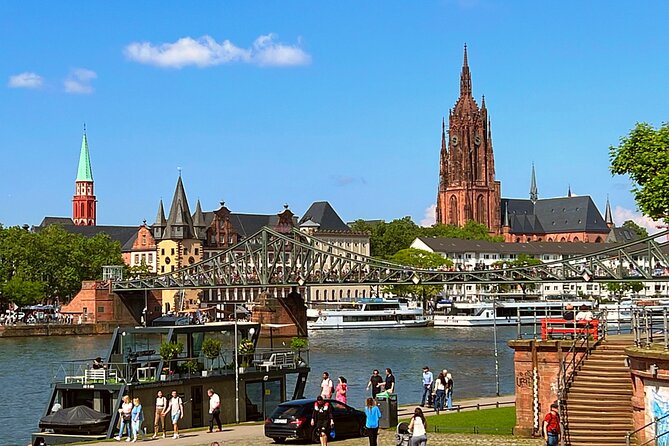
Frankfurt’s old center tells a surprising story. This two-hour German walking tour links St. Paul’s Church, the Römer, the Main River, the cathedral, and the New Old Town, while Dimitri adds the local details that help the rebuilt streets make sense. I especially like the tour’s mix of major sights and less obvious corners, plus the guide’s use of old photographs to show how Frankfurt looked before wartime destruction and reconstruction.
I also like the sensible route, which begins at St. Paul’s Church and ends at Römerberg, right in the center of the action. At $21.97 per person, it offers good value if you want context before exploring museums or historic interiors on your own. The main consideration is language: this is a German-language tour, and most sights are viewed from outside, so it is not a substitute for a museum visit or cathedral tour.
In This Review
- Key points to know before booking
- Why this Frankfurt walking tour works
- Starting at St. Paul’s Church and the birth of German democracy
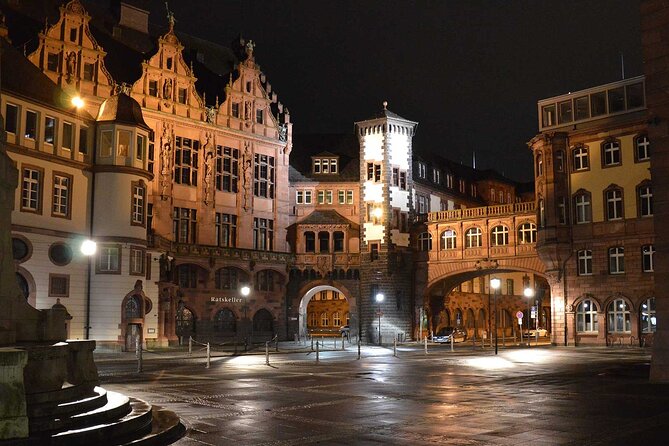
- The Römer courtyard and Frankfurt’s town hall
- Following the Mainkai to the Iron Footbridge
- Haus Wertheym and Frankfurt’s sweet side
- Archaeology beside the Historical Museum
- Römerberg, the city’s great public square
- Alte Nikolaikirche, Schirn, and Saalgasse
- The cathedral and the New Old Town
- Guide style and group experience
- Price, timing, and practical value
- Who should book this tour?
- Should you book it?
- FAQ
- How long does the Frankfurt city tour last?
- In which language is the tour conducted?
- Where does the tour start?
- Where does the tour end?
- Which major sights are included?
- Are admission tickets included?
- How large can the group be?
- Can I cancel for a full refund?
Key points to know before booking
- Dimitri leads with humor and local pride: He has lived in Frankfurt for 35 years and is praised for his energy, clear explanations, and ability to answer questions.
- The route covers Frankfurt’s historic core: You see St. Paul’s Church, the Römer, Römerberg, the Iron Footbridge, the cathedral, and the Dom-Römer quarter.
- Old and reconstructed Frankfurt appear side by side: Haus Wertheym, Saalgasse, archaeological remains, and the New Old Town show how the city has changed.
- Most visits are exterior stops: The tour focuses on streets, squares, façades, river views, and stories rather than long indoor visits.
- The pace is active but manageable: Expect about two hours of walking, with a maximum group size of 25 people.
- The price includes a German-speaking guide: Food, drinks, and transportation to the meeting point are not included.
Why this Frankfurt walking tour works
Frankfurt can be hard to read at first. The city has a famous skyline, a busy financial district, and an old center that was heavily damaged during the Second World War. Much of what you see around the Römer is reconstructed, but that does not make it unimportant. The key is understanding what is old, what was rebuilt, and what was newly designed in an old style.
This tour gives you that framework. You move through the city’s central historic district rather than spending the full two hours at one attraction. The route is compact, with stops generally lasting from a few minutes to 25 minutes, so you get a broad introduction without committing half a day.
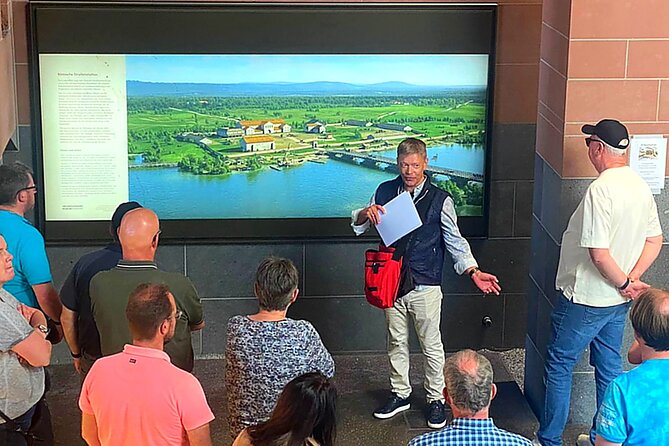
Dimitri’s role appears to be central to the experience. He has lived in Frankfurt for 35 years and presents the city with obvious affection. His style combines jokes, personal enthusiasm, printed images, historical background, and answers to questions. That matters here because Frankfurt’s story can otherwise feel like a list of dates and rebuilt façades.
The tour is also designed for a mixed group. The available feedback describes it working well for children, adults, long-time Frankfurt residents, and people with little interest in history. That points to a useful balance: enough information for serious curiosity, but not a lecture that leaves you staring at your watch.
More City Tours in Frankfurt
- From Frankfurt: Heidelberg, Castle and Old City Guided Tour
★ 4.5 · 677 reviews - Heidelberg Castle and City Day Tour from Frankfurt
★ 4.5 · 292 reviews - Frankfurt: Discover the heart of Frankfurt – a city tour in German
★ 5.0 · 196 reviews
Starting at St. Paul’s Church and the birth of German democracy
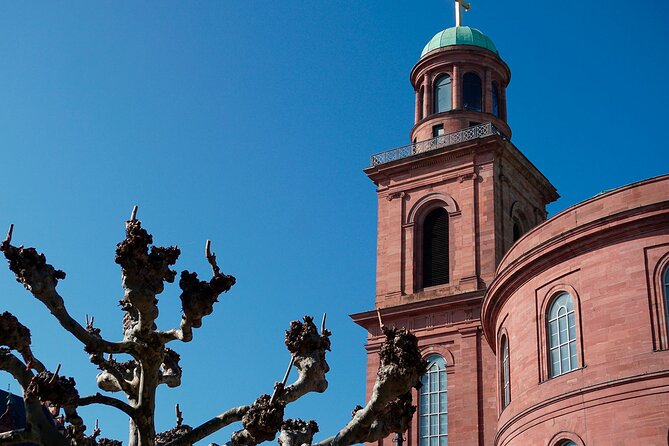
The meeting point is St. Paul’s Church, at Paulsplatz 11. It is a good place to begin because the building represents one of the most important political moments in modern German history.
St. Paul’s Church was built between 1789 and 1833 as an Evangelical Lutheran church. In 1848, it became the meeting place of the Frankfurt National Assembly, the first freely elected parliament in Germany. The building was destroyed during the war and rebuilt in 1948 as Frankfurt’s first historic reconstruction.
You will normally see the church from outside during the tour. I consider that a limitation if you are hoping to inspect the interior, but it is also a sensible choice for a short walking route. You can return afterward for an independent visit, giving yourself time to look at the exhibitions and memorial displays without holding up the group.
The church is still used for exhibitions, commemorations, and meetings. It is also known for the annual Peace Prize of the German Book Trade. Dimitri’s explanation helps turn a handsome façade into a place connected with the development of German democracy.
The Römer courtyard and Frankfurt’s town hall
From St. Paul’s Church, the tour moves toward the Römer. This historic town hall complex has served Frankfurt since 1405 and is made up of several connected buildings added over many centuries.
The familiar stepped-gable façade faces Römerberg, but the tour also includes a look at the inner courtyard between the Bürgersaal building and the south building. That courtyard gives you a closer sense of the complex than a quick photograph from the square.
The Römer’s story is tied to Frankfurt’s role in the Holy Roman Empire. The Kaisersaal, or Imperial Hall, was used for coronation celebrations of Roman-German emperors. It remains the ceremonial hall for official receptions, medal ceremonies, and social events.
The experience includes a short tour of the Imperial Hall and the Kaiserpfalz Franconofurd only if they are open. That qualification matters. You should treat the indoor access as a possible bonus, not the main reason to book. If the rooms are closed, the outdoor history and architecture still form the backbone of the tour.
There is also a lighter local thread here: stories about Frankfurt cider. That is a welcome change from nonstop royal names and political dates. The city’s drink traditions help connect the grand town hall with everyday Frankfurt life.
Following the Mainkai to the Iron Footbridge
The route then reaches the Mainkai, the promenade along the right bank of the Main between the Old Bridge and the Untermainbrücke. This section gives the tour some breathing room after the tight lanes and squares of the old center.
The Mainkai began as a medieval mooring and landing area. It was widened and converted into a modern street from 1826. Today, you can see the river promenade, passenger boats, historic buildings such as the Saalhof and Rententurm, and the city’s connection to river travel.
The tour continues to the Iron Footbridge, known in German as the Eiserner Steg. Opened in 1869, it was funded through a citizens’ initiative because the Old Bridge could no longer handle growing traffic. It was destroyed during the war, rebuilt in 1946, and raised slightly during a 1993 renovation.
This is one of the route’s strongest photo stops. From the bridge, you can look back toward Frankfurt’s old center and across the Main toward Museumsufer. The bridge also reinforces a useful theme in Frankfurt: citizens have repeatedly shaped the city, from financing a new crossing to rebuilding historic streets.
You should wear shoes that can handle roughly two hours of walking. The tour is not described as strenuous, and most people can participate, but the route includes streets, squares, and a bridge rather than a seated museum visit.
More City Tours:
- Frankfurt Old Town & Emperors: City Game & Walking Tour
★ 4.5 · 39 reviews - Darmstadt: City Highlights and History Guided Walking Tour
★ 4.0 · 23 reviews - Frankfurt: Private Transfer to/from Airport and City
★ 4.0 · 21 reviews - Berlin: 1-Hour City Tour by Boat with Guaranteed Seating
★ 4.3 · 16,993 reviews
Haus Wertheym and Frankfurt’s sweet side

Haus Wertheym offers a change of mood. This half-timbered house, built around 1600, is the only half-timbered house in Frankfurt’s Old Town to survive the wartime air raids almost unscathed.
You view the exterior and hear about the building’s former roles as a customs house and lodging for the city guard. After renovation in 1926, it became home to a café and restaurant. Today, it is a protected historic building and one of the clearest reminders of the old town’s prewar appearance.
Dimitri also introduces typical Frankfurt sweets, including Frankfurter Kranz and Bethmännchen. This is exactly the sort of detail I value on a city walk. You do not just look at a building; you get a food clue to seek out later.
There is no food tasting included, so plan to buy these treats separately if they catch your interest. The stop is more about stories and recognition than eating.
Archaeology beside the Historical Museum
Near the Historical Museum, the tour pauses for a brief look at the Staufer wharf, also called the Stauferhafen. It is an archaeological discovery displayed in the museum foyer.
You do not take an interior museum tour here. That keeps the route moving, but it also means you should not expect a full presentation of the museum’s collections. The value of this stop is its reminder that Frankfurt’s past is not only found in rebuilt façades. Archaeological remains can reveal earlier layers of the city that are easy to miss while walking through the modern center.
If you are interested in the Historical Museum, save it for a separate visit. The walking tour gives you a starting point, not a replacement for the museum.
Römerberg, the city’s great public square

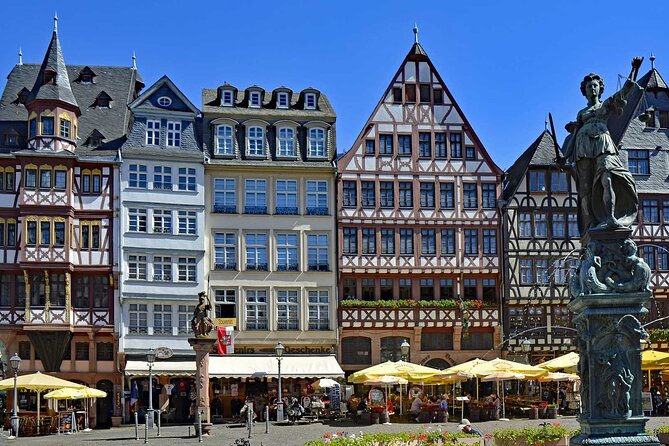
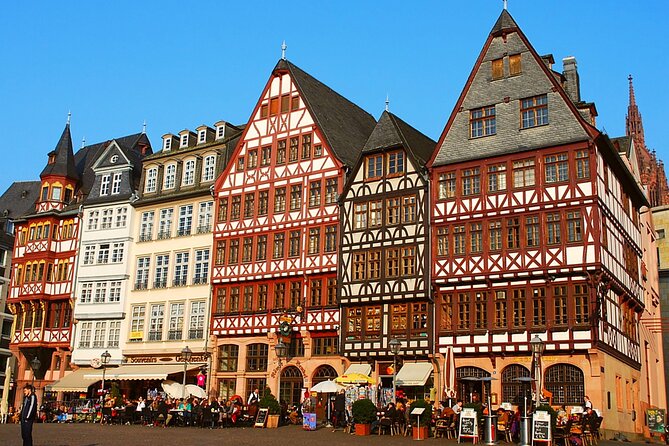
Römerberg is the historic heart of Frankfurt. In the Middle Ages, it served as a market square and a setting for major public events, including imperial coronations. By the 16th century, it was regarded as one of the most beautiful squares in the Holy Roman Empire.
The square was badly damaged during the Second World War and rebuilt afterward. Today, its historic façades make it one of the city’s most recognizable scenes, especially during the annual Frankfurt Christmas market.
Here Dimitri tells stories from outside the Römer, including the famous Römerbalkon. The balcony has hosted public speeches, celebrations, and receptions for successful football teams. That mix of emperors and football gives the town hall a more human scale. It is not just a relic of old power; it remains part of Frankfurt’s public life.
The route spends only a few minutes at some of these places, so listen closely and take photographs quickly. The benefit is variety. The drawback is that anyone wanting a slow architectural study may feel rushed.
Alte Nikolaikirche, Schirn, and Saalgasse
The Alte Nikolaikirche is viewed from outside. Originally built in the 12th century as a court chapel, it served the Hohenstaufen emperors and later became the city council chapel in the 15th century.
The church survived the war with relatively little damage while much of the surrounding old town was destroyed. Its late Gothic form and 51-bell carillon make it worth noticing, even during a short stop.
The walk then passes the Schirn Kunsthalle, one of Europe’s major exhibition halls for contemporary art. Since opening in 1986, it has presented changing exhibitions devoted to important artists. Again, the tour does not include an indoor visit, but the location helps you see how Frankfurt places modern art right beside medieval and reconstructed architecture.
Saalgasse adds another useful contrast. Its colorful postmodern houses were designed during the postwar rebuilding of the old town. Their bold façades do not pretend to be medieval, and that makes them a good counterpoint to the carefully reconstructed buildings nearby.
I like this part of the route because it refuses to present Frankfurt as a frozen historic town. You see old religious buildings, contemporary art, postwar architecture, and new reconstructions within a short walk.
The cathedral and the New Old Town
The Cathedral of St. Bartholomew, or Kaiserdom, is viewed from outside. It is one of Frankfurt’s defining landmarks and an important stop for understanding the city’s imperial past. The tour may also include a short look at the Kaiserpfalz Franconofurd when it is open.
The final major section is the Neue Altstadt, or New Old Town, also known as the Dom-Römer quarter. This project was completed between 2012 and 2018 on about 7,000 square meters between the Römer and the cathedral.
The quarter contains 35 buildings: 15 faithful reconstructions of historic houses and 20 modern buildings. Haus zur Goldenen Waage is a noted showpiece, while the Rote Haus and Goldene Lämmchen add other recognizable façades.
This area is worth careful explanation because it can be confusing. Some buildings recreate earlier forms, while others are modern designs that fit the scale and character of the old center. The result includes apartments, shops, cafés, and museums, rather than a stage set used only for sightseeing.
The tour spends about 25 minutes here, the longest single stop. That gives you time to compare façades, hear why the rebuilding was undertaken, and understand the arguments around reconstructing a lost old town. I would return after the tour for a slower look and perhaps a café stop.
Guide style and group experience
The guide can make or break a city walk, and Dimitri receives unusually warm praise for his energy, humor, planning, and passion for Frankfurt. He is described as answering questions fully, adjusting to the group, and using printed pictures to show the old town before reconstruction.
That last detail is especially useful. Modern Frankfurt does not always reveal what stood here before the war. A photograph or drawing can bridge the gap between the present street and the vanished medieval or early modern city.
The maximum group size is 25 people. That is not a private walk, but it is still small enough to feel more personal than a large coach excursion. The guide’s ability to respond to children, adults, locals, and first-time visitors is a strong reason to choose this tour.
The tour is in German, so you should be comfortable following spoken German for two hours. The information is presented as entertainment as well as instruction, with anecdotes and humor rather than a dry academic format.
Price, timing, and practical value
At $21.97 per person, the tour is fairly priced for a two-hour guided walk with a certified German-speaking guide. You are paying for organization and interpretation, not admission tickets. Since nearly every stop is free to view from outside, the real value lies in the stories, route planning, historic comparisons, and local recommendations.
The tour is often booked about 27 days ahead, so booking early may be sensible if your Frankfurt dates are fixed. Confirmation arrives when you book, and the mobile ticket is convenient for a city break.
The starting point at St. Paul’s Church is near public transportation. The tour ends at Römerberg, a useful location for continuing on foot to nearby sights, cafés, or additional historic sites. Transportation to the start, food, and drinks are not included.
Free cancellation is available up to 24 hours before the start time for a full refund. Inside that window, no refund is offered, and changes are not accepted. Bring weather-appropriate clothing and comfortable shoes. Pets are not allowed, except for assistance dogs, and anyone who needs a walking stick or other aid must bring it.
Who should book this tour?
I would choose this walk if you want a first orientation to Frankfurt’s old center, especially if you enjoy history told through stories rather than display panels. It suits German-speaking visitors, families, curious locals, and anyone who wants to understand the city’s reconstruction before exploring alone.
It is also a good choice for a short stay. In two hours, you see the main central sights and finish in a place where you can continue sightseeing without backtracking.
I would look elsewhere if you need an English tour, extensive indoor access, or a slow visit to the cathedral, Römer, or Historical Museum. Those attractions deserve separate time, and this experience is built around movement and explanation.
Should you book it?
Yes, if your German is strong enough for a lively two-hour talk and you want the old center explained by someone who knows Frankfurt well. Dimitri’s local experience, use of historic images, humor, and ability to surprise even long-time residents give this walk more personality than a basic landmark checklist.
Book it as your introduction, not your entire Frankfurt program. Use the route to get oriented, note the buildings and food suggestions that interest you, then return independently for the interiors and museums that receive only a brief exterior glance.
FAQ
How long does the Frankfurt city tour last?
The tour lasts approximately two hours.
In which language is the tour conducted?
It is a guided walking tour in German with a certified German-speaking guide.
Where does the tour start?
The meeting point is St. Paul’s Church, Paulsplatz 11, 60311 Frankfurt am Main, Germany.
Where does the tour end?
The tour ends at Römerberg in Frankfurt’s central old town.
Which major sights are included?
The route includes St. Paul’s Church, the Römer, Römerberg, the Mainkai, the Iron Footbridge, Haus Wertheym, the Historical Museum area, Alte Nikolaikirche, Schirn Kunsthalle, Frankfurt Cathedral, and the New Old Town.
Are admission tickets included?
The tour includes free guided visits or views at the listed stops. Short tours of the Imperial Hall and Kaiserpfalz Franconofurd are offered only if those areas are open. Food, drinks, and transportation are not included.
How large can the group be?
The maximum group size is 25 people.
Can I cancel for a full refund?
Yes. You can cancel at least 24 hours before the experience start time for a full refund. Cancellations or changes made within 24 hours are not accepted for a refund.
Just added around Frankfurt
- Wiesbaden Biebrich: Outdoor Escape Game★ 4.7 · 13 reviews
- from Frankfurt – romantic Black Forest & brewery, private tour★ 5.0 · 13 reviews
- Frankfurt : Highlights & hidden Gems Private Walking Tour★ 4.6 · 13 reviews
- From Frankfurt: Heidelberg and Rothenburg Guided Day Trip★ 5.0 · 14 reviews
- Private German Beer Tasting Experience in Frankfurt Old Town★ 5.0 · 14 reviews
- Frankfurt: Old Town Crime Mystery Game★ 4.3 · 14 reviews
- Mainz Highlights, private walking tour★ 4.9 · 15 reviews
- magnificent historic Heidelberg, private Tour, from Frankfurt★ 4.5 · 15 reviews
City Tours, compared.
1-Hour City Tour by Boat with Guaranteed Seating
Read our review →
City History Canal Sightseeing Tour on a Motorboat
Read our review →
Browse the lists this tour appears in