
Reviewed · WALKING TOURS
Bremen: City Center Guided Walking Tour
Bremen rewards a closer look. This two-hour walking tour links the city’s grand market square with Böttcherstraße and the old Schnoor quarter, while local guides add the stories, jokes, and small details you could easily miss alone. I like the compact 2-kilometer route, and I like the way it connects Bremen’s architecture with the city’s trading past and everyday culture.
At $14 per person, it is an easy-value introduction to Bremen, especially if you have only one day. The main consideration is the walking surface: cobblestones, uneven ground, and tram tracks can slow you down, and two hours may feel brief if you want long visits inside the cathedral or museums.
In This Review
- Key points at a glance
- Why this short walk works so well in Bremen
- Meeting at Böttcherstraße 4
- The market square and Bremen’s civic symbols
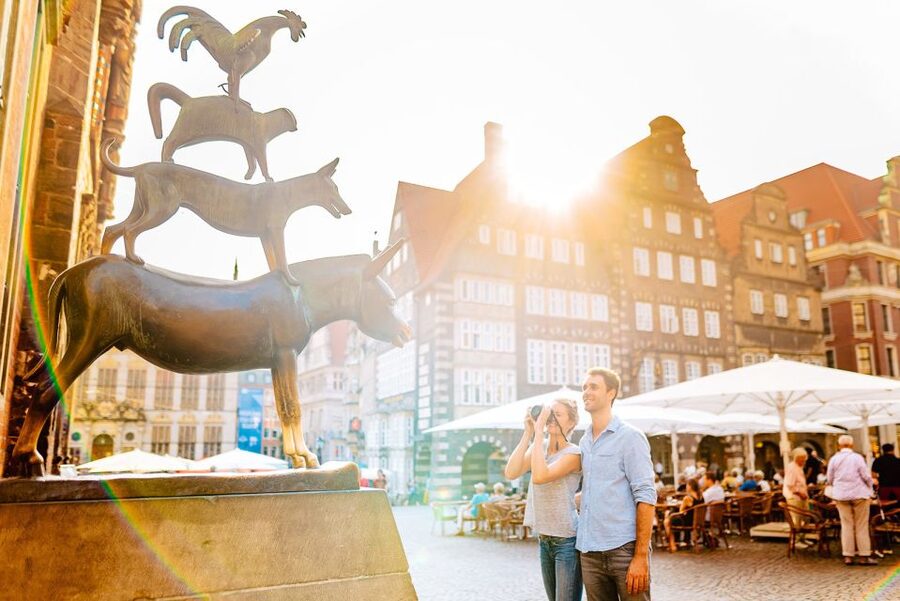
- The Bremen Town Musicians
- Böttcherstraße’s red brick and Expressionist edge
- Schnoor, Bremen’s oldest quarter
- The guides make the difference
- Pace, terrain, and weather
- Is $14 a good price?
- Who should book this Bremen walk?
- Should you book it?
- FAQ
- How long is the Bremen city center walking tour?
- What sights are included?
- Where does the tour meet?
- Is the tour offered in English?
- Is the route wheelchair accessible?
- Can the route change?
- Can I cancel for a full refund?
Key points at a glance
- Bremen’s market square sets the stage: See the UNESCO-listed town hall, Roland statue, St. Petri Cathedral, and the famous Town Musicians sculpture in one compact area.
- Böttcherstraße mixes old and new: Traditional red-brick buildings share a narrow pedestrian street with striking Expressionist designs.
- Schnoor gives the tour its most intimate stop: Wander lanes from Bremen’s oldest quarter, once home to fishermen, sailors, and craftspeople.
- Guides add local color: Pierre, Rima, Guido, Hans, and others have been praised for clear English, humor, strong pacing, and enthusiasm for Bremen.
- The route is short but not flat in feel: It covers about 2 kilometers, yet cobbles and tram tracks call for sensible shoes.
- The price is hard to fault: At $14, you get two hours of live guiding and a useful orientation before exploring further on your own.
Why this short walk works so well in Bremen
Bremen’s central sights are close together, but closeness does not always make a city easy to understand. You can walk through the market square, admire the red-brick buildings, and take a photo of the Town Musicians without knowing how the pieces fit together.
This tour supplies that missing connection. You move from civic power in the market square to the merchant-built character of Böttcherstraße, then into Schnoor’s smaller lanes. The result is not just a checklist of sights. You get a simple picture of how Bremen grew as a North German trading city and how its older buildings still shape daily life.
I especially like the scale. Two hours is long enough to hear stories and ask questions, but short enough to fit before lunch, after arriving by train, or between other plans. Several guides have been praised for keeping the group moving without making the walk feel rushed.
The tone also seems to be a major strength. Guides such as Pierre have been described as amusing and engaging, while Rima has earned praise for excellent English, patience, and her ability to answer questions. Guido has even provided bilingual tours in German and English, with jokes and anecdotes that worked for people familiar with Bremen as well as first-time visitors.
More Walking Tours in Bremen
- Bremen: Walking Tour in German with Night Guard
★ 4.7 · 2,922 reviews - Bremen: Walking Tour of Historic Schnoor District
★ 4.8 · 429 reviews - Bremerhaven: Sailor’s yarn, legends and sea walking tour
★ 4.7 · 33 reviews
Meeting at Böttcherstraße 4
The official meeting point is on the right side in front of the Tourist Information at the Glockenspiel House, Böttcherstraße 4. That location puts you near one of Bremen’s most distinctive streets from the first minute, rather than beginning in a bland transport area.
Look for the Tourist Information and the Glockenspiel House. If you arrive early, you are already positioned to notice the unusual character of Böttcherstraße, though save a close look for the guide’s explanation.
The start can vary slightly in practice. One account describes meeting near the Radisson Blu and moving toward Schnoor before returning to the center. Short-term route changes are possible during events, so do not worry if the guide takes the group in a different order from the one you expected.
The market square and Bremen’s civic symbols
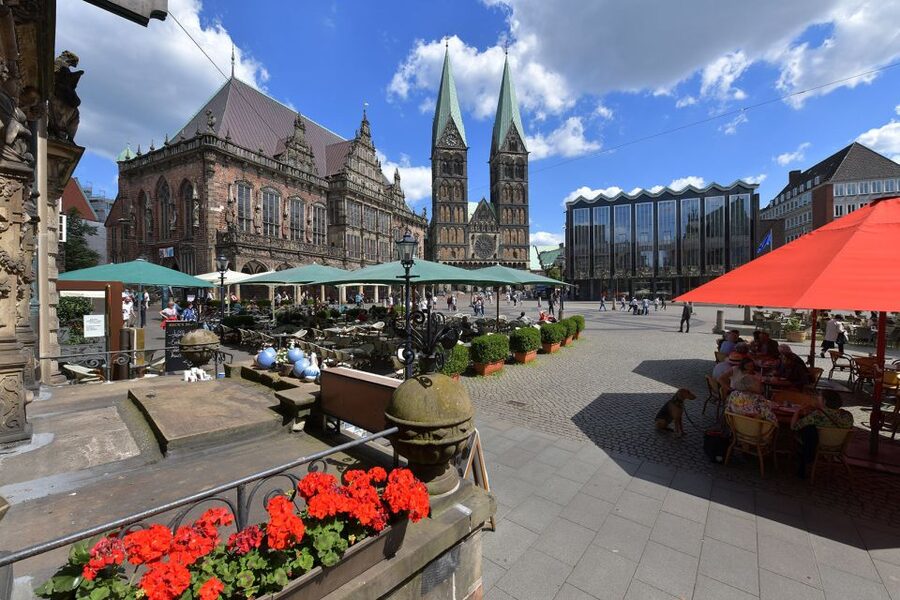
The market square is the visual centerpiece of the walk. It is widely regarded as one of Germany’s prettiest squares, and it earns that reputation through variety rather than size alone.
Here you see the town hall, a UNESCO World Heritage site, alongside the stone statue of Roland. The pairing says a great deal about medieval civic life: one building represents local government and public authority, while Roland symbolizes rights and independence.
Your guide can turn what looks like a grand postcard scene into a readable place. Take time to look at the details of the town hall rather than only photographing the front. The building’s design, its place beside the cathedral, and its relationship to the square help explain why Bremen’s center feels both ceremonial and practical.
St. Petri Cathedral adds a different mood. Its tall presence gives the square a strong vertical marker, and the tour allows you to see it as part of the city’s wider story rather than as an isolated church stop.
You may get a chance to enter the cathedral, depending on opening conditions and the route that day. One winter tour group was able to get inside the cathedral and part of the parliament building while rain continued outside, but interior access should not be treated as guaranteed. The dependable part is the exterior visit and the guide’s explanation.
The Bremen Town Musicians
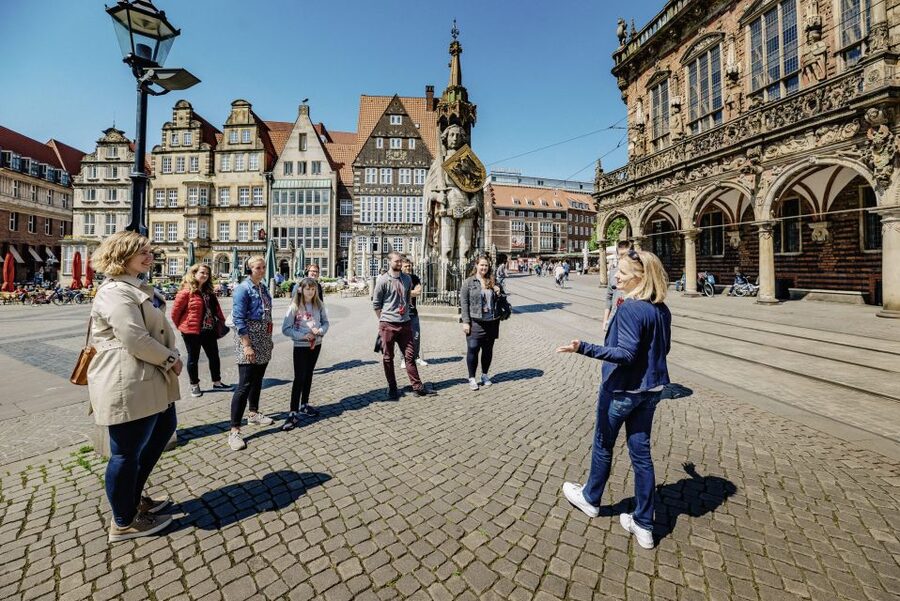
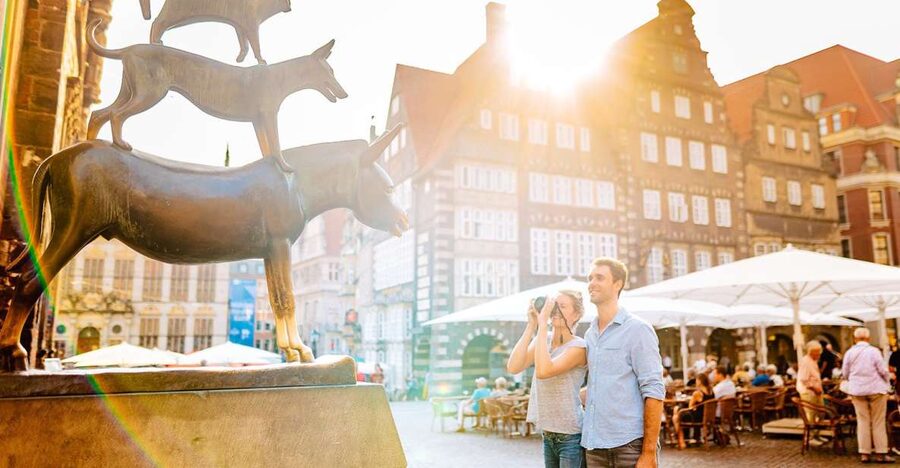
Near the town hall, the sculpture of the Bremen Town Musicians is an essential stop. It depicts the donkey, dog, cat, and rooster from the Brothers Grimm fairytale, in which four aging animals set off for Bremen.
The sculpture is more than a children’s story photo stop. It is one of Bremen’s best-known symbols, and the guide can explain how a literary tale became part of the city’s public identity. You will probably see people touching the animals’ front legs, a local custom linked with good luck.
This is the kind of place where a guide earns the $14 price. Alone, you might take the standard picture and move on. With a good explanation, the sculpture becomes a small lesson in how folklore, tourism, and civic pride overlap.
It can be crowded around the statue, especially on busy days. One guide was praised for waiting until the full group had gathered before speaking and for handling crowded streets well. That matters here, since the best listening spot may not be the closest spot to the sculpture.
More Walking Tours:
- Bremen: Private Walking Tour with a Professional Guide
★ 4.2 · 22 reviews - Discover Berlin Half-Day Walking Tour
★ 5.0 · 9,624 reviews - Berlin: Third Reich and Cold War 2 Hour Walking Tour
★ 4.9 · 6,830 reviews - Munich: Third Reich & WWII Walking Tour
★ 4.6 · 6,181 reviews
Böttcherstraße’s red brick and Expressionist edge
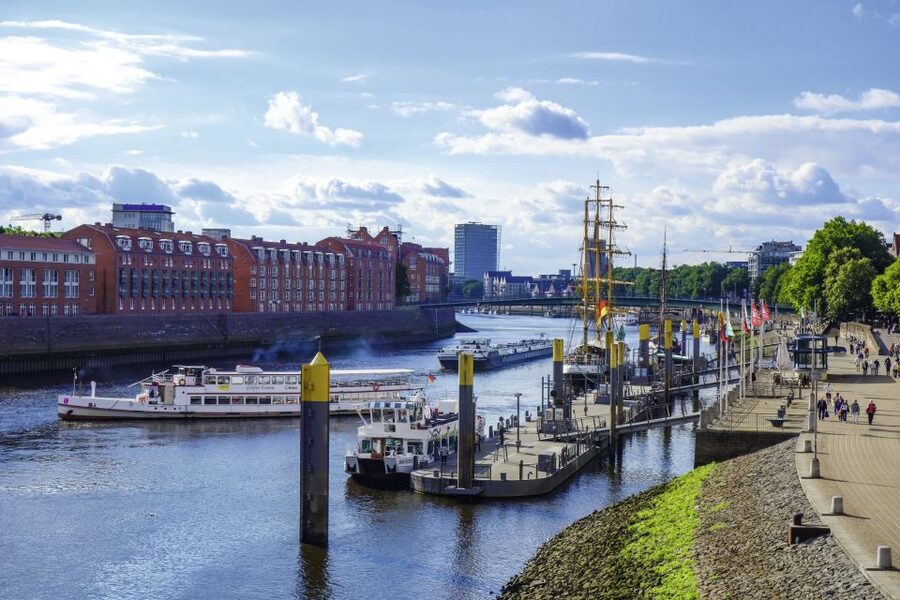
Böttcherstraße runs from the market square toward the Weser and is one of Bremen’s most memorable urban spaces. Its older identity comes from the böttcher, or coopers, who once made barrels here.
Today, the street is a pedestrian passage lined with traditional red-brick buildings, craft shops, cafés, and bold Expressionist architecture. The contrast is the point. Bremen does not present its past as a perfectly preserved museum scene. Instead, older forms and modern artistic ideas sit tightly together in one short street.
Your guide can help you read the design. The brickwork gives the lane a northern, practical feel, while the more modern buildings bring sharp angles and unusual shapes. Without context, the street can seem simply attractive. With context, you begin to see the choices behind it and the way local tradition was reworked rather than discarded.
The street is also a useful pause in the walking route. It is pedestrian-friendly, visually busy, and compact. You can look up at the façades while the guide explains the area, then return later for a slower look at the shops and architecture.
Some tours have included small tastings from local shops, and another guide included beer during the walk. These extras are not presented as a fixed part of the tour, so think of them as possible surprises rather than something to count on. The reliable offering is the guided visit and interpretation.
Schnoor, Bremen’s oldest quarter
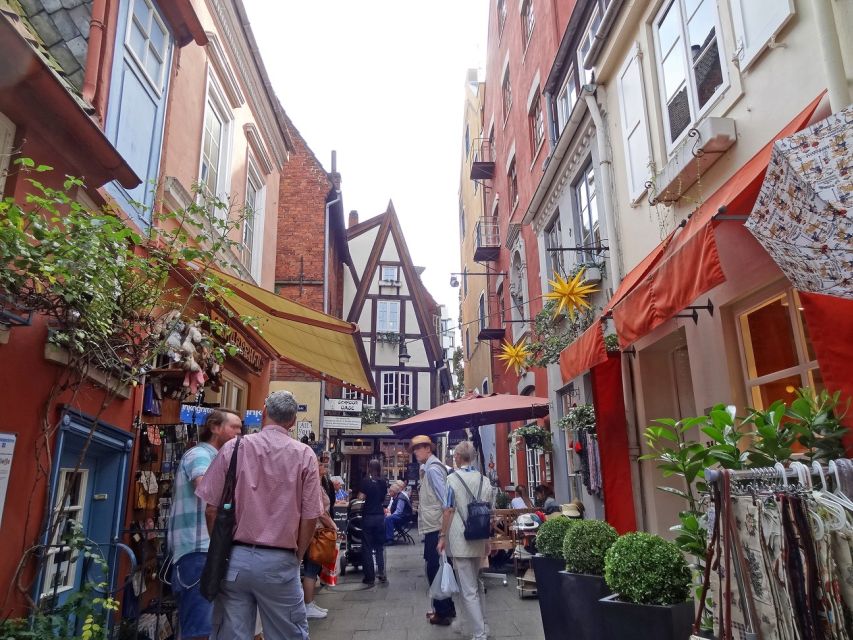
Schnoor is likely to be the most charming part of the route. Its narrow, winding lanes once housed fishermen, artisans, and sailors. The scale changes quickly here, from the broad market square to small passages where buildings press close together.
This is the place to slow your eyes down. Look at the irregular lanes, small façades, and close-set buildings. Schnoor feels less formal than the market square and less designed than Böttcherstraße. Its appeal comes from the sense of an older residential quarter that has been adapted for modern use.
Today, cafés, restaurants, and handicraft stores fill the streets. That makes Schnoor pleasant to explore, but it also means the lanes can be crowded. You will have more time to browse after the tour than during it. The guide’s job here is to explain who lived in the quarter and how its working life differed from the grand civic center.
Several guides have made Schnoor a highlight by saving it for the end. One guide was praised for saving the best for last, while another used the quarter to show a side of Bremen that would have been hard to understand without local context.
I would not expect a long shopping stop. The tour is designed to keep moving, with short pauses for stories and photos. If a particular café, restaurant, or craft store catches your eye, note its location and return later.
The guides make the difference
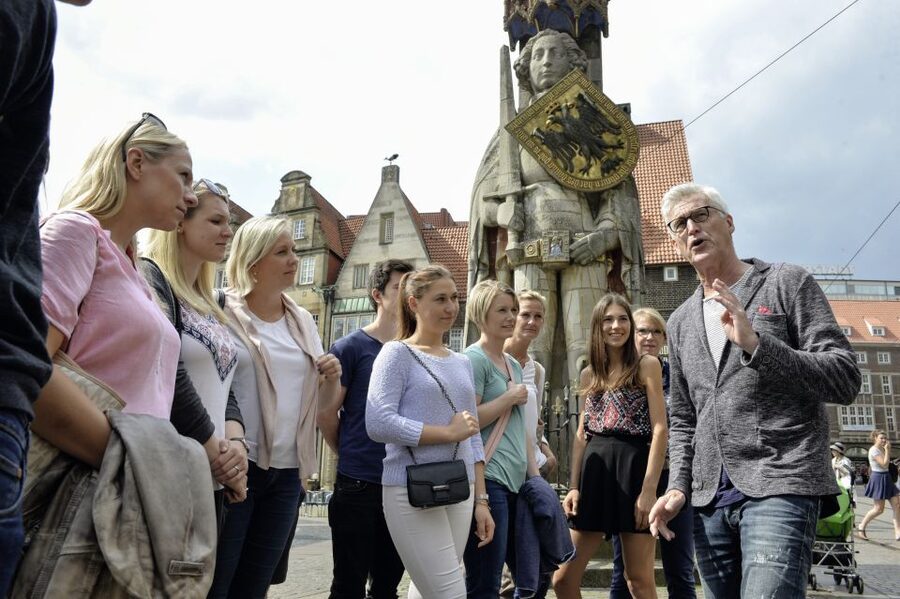
The strongest pattern in the feedback is the quality of the guiding. People repeatedly praised clear English, good humor, strong local knowledge, and enthusiasm for Bremen.
That does not mean every guide will have the same style. Some are energetic entertainers. Pierre, for example, has been singled out for combining information with comic timing. Others focus more on history and architecture. Rima has been praised for a steady pace and excellent English, while Hans has been described as friendly, engaging, and generous with time for questions.
Guido is particularly useful if you appreciate language flexibility. He has led bilingual tours in German and English, with anecdotes and humor that worked for a mixed group. The activity information lists English guiding, and language availability depends on the option selected, so check the choice at booking.
A good guide also manages the practical side of a city walk. On crowded days, you need someone who waits for the group, chooses sensible places to stop, and keeps the back of the group from being left behind. One guide was specifically praised for making sure everyone arrived before beginning an explanation.
Expect plenty of stories and facts, but not a formal lecture. The best accounts describe a relaxed walk with jokes, questions, and links between Bremen’s past and present. A few guides also used old photographs or other visual aids to explain how places looked before.
Pace, terrain, and weather
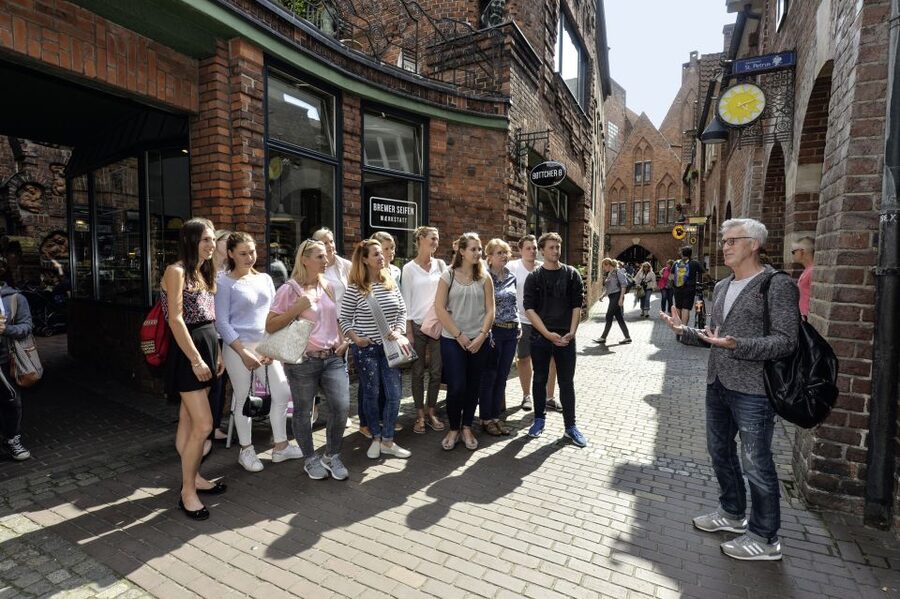
The walk covers about 2 kilometers over two hours. That is a gentle distance for many people, but the surface can make it feel more demanding than the numbers suggest.
You may cross uneven ground, cobblestones, and tram tracks. Wear shoes with a secure sole, and avoid treating this as a polished indoor sightseeing experience. The tour is wheelchair accessible, but the uneven sections are still worth considering if you use a wheelchair or have trouble with balance.
Bremen weather can add another layer. Rain, wind, and drizzle are possible, especially outside summer. A winter group still enjoyed the tour in cold, wet conditions because the guide used indoor spaces when possible, but waterproof clothing will make the experience far more comfortable.
The pace appears to be steady rather than punishing. One account describes a route lasting about one hour and forty-five minutes, while the advertised duration is two hours. That difference is minor, but it reminds you that walking tours do not always run to the exact minute.
If you need frequent rests, tell the guide early. The route has several natural points for pauses, but the tour is still built around continuous movement through the center.
Is $14 a good price?
Yes, for most first-time visitors. At $14 per person, the tour costs little more than a casual city-center purchase, yet it gives you two hours of live explanation at Bremen’s key sights.
The value comes from the connections. You can see the market square and Town Musicians for free, and Böttcherstraße and Schnoor are open public areas. What you are paying for is the local voice that explains why these places matter, helps you notice details, and gives you a useful route through the center.
The price is also low enough that you do not need to build your entire day around the tour. Take it early, then return to the places that caught your interest. If you already know Bremen well, the tour may be less essential, though Guido’s bilingual storytelling and the strong local focus could still add something.
The tour has a 4.5 rating from 2,709 reviews, which supports the idea that it delivers consistent value. Still, ratings cannot promise a particular guide or group size. Your experience will depend on the guide assigned and the weather that day.
Who should book this Bremen walk?
I would choose it for a first visit, a short city break, or a stop when you want the basics explained without committing to a full-day program. It suits solo visitors, couples, families with older children, and anyone who likes history delivered in short stories rather than long museum panels.
It is also useful for people who have already wandered through the center. One participant had seen the main places before the tour but found that the guide gave those familiar sights a new meaning.
You may want another plan if you prefer extensive interior visits, shopping time, or a slow photographic walk. The route focuses on outdoor sights, and two hours leaves limited time for lingering. It is an introduction, not a substitute for Bremen’s museums, cathedral interiors, or a longer exploration of the Weser area.
Book early in your stay if possible. That way, you can use the guide’s suggestions to shape the rest of your time. Free cancellation up to 24 hours before the start and a reserve-now, pay-later option also make it easier to keep plans flexible.
Should you book it?
Book this tour if you want a fast, friendly introduction to Bremen with real context behind the postcard sights. The market square, Böttcherstraße, and Schnoor are all worth seeing, but the guide’s stories are what turn the route into a coherent visit.
I would skip it only if you already know the city well, dislike walking on cobblestones, or want long stops inside buildings. For nearly everyone else, $14 is a sensible price for two hours of orientation, local anecdotes, and a better understanding of Bremen’s character.
FAQ
How long is the Bremen city center walking tour?
The advertised duration is two hours. The route covers approximately 2 kilometers.
What sights are included?
The walk includes Bremen’s market square, the UNESCO-listed town hall, the Roland statue, St. Petri Cathedral, the Bremen Town Musicians sculpture, Böttcherstraße, and the Schnoor quarter.
Where does the tour meet?
Meet on the right side in front of the Tourist Information at the Glockenspiel House, Böttcherstraße 4.
Is the tour offered in English?
Yes. English guiding is available, and the activity also provides language options depending on the selection made when booking.
Is the route wheelchair accessible?
The activity is listed as wheelchair accessible. Parts of the approximately 2-kilometer route have uneven ground, including cobblestones and tram tracks.
Can the route change?
Yes. Short-term route changes are possible because of events or other conditions in the city center.
Can I cancel for a full refund?
You can cancel up to 24 hours before the tour for a full refund. A reserve-now, pay-later option is also available.
More City Tours
- e-Scavenger hunt Bremen: Explore the city at your own pace
★ 4.0 · 24 reviews - Berlin: 1-Hour City Tour by Boat with Guaranteed Seating
★ 4.3 · 16,993 reviews - Leipzig: City History Canal Sightseeing Tour on a Motorboat
★ 4.7 · 6,232 reviews - Cologne: Panoramic City Cruise
★ 4.3 · 5,698 reviews
Just added around Bremen
- Bremen: Full-Day Kayak Rental on the Wümme River★ 4.8 · 14 reviews
- Above the rooftops of Bremen★ 4.1 · 19 reviews
- Truth or lie? – A special tour through Bremen’s Old town★ 4.3 · 20 reviews
- Bremen: Private pub crawl with insider-guide & free shots★ 4.5 · 22 reviews
- Bremen: Private Walking Tour with a Professional Guide★ 4.2 · 22 reviews
- e-Scavenger hunt Bremen: Explore the city at your own pace★ 4.0 · 24 reviews
- Bremen: Outdoor Escape Game in the Old Town★ 4.4 · 41 reviews
- Bremen: Übersee Museum Entrance Ticket★ 4.3 · 59 reviews
Walking Tours, compared.



Berlin’s Best: 2 Hour Walking Tour Third Reich and the Cold War
Read our review →
Third Reich Berlin: Hitler and WWII Walking Tour
Read our review →Browse the lists this tour appears in