
Reviewed · WALKING TOURS
Explore Berlin History and Highlights Sightseeing Walking Tour
Berlin makes you walk through its past. This 3.5-hour tour links the city’s major landmarks, from the Brandenburg Gate and Reichstag to Checkpoint Charlie and Museum Island, while a guide explains how Prussia, Nazism, the Cold War, and reunification shaped the streets around you. I especially like the small group limit of 15 and the strong focus on historical context rather than quick photo stops.
The price is $32.58 per person, which is fair for an English-language tour covering so much central Berlin. I also like that the route includes difficult sites such as the Führerbunker location and the former Gestapo headquarters, where a guide can explain what you are seeing. The main caution is simple: this is a serious walking tour, and anyone with limited stamina should think carefully before booking.
In This Review
- Key points at a glance
- Why this route works for a first Berlin visit
- Starting at the Brandenburg Gate and Reichstag
- Facing Berlin’s Nazi past at the Holocaust Memorial and Führerbunker
- Topography of Terror and the difficult story of power
- Checkpoint Charlie and the divided city
- Prussian grandeur at Gendarmenmarkt and Bebelplatz
- Unter den Linden and the final approach to Museum Island
- What the guides add to the experience
- Price, pace, and who should book
- Should you book this Berlin history walk?
- FAQ
- How long does the Explore Berlin History and Highlights Sightseeing Walking Tour last?
- What time does the tour begin?
- Where does the tour start?
- Where does the tour end?
- How many people can join the tour?
- Is the tour conducted in English?
- Are entrance tickets included?
- Can I cancel for a full refund?
Key points at a glance
- A full central Berlin route: Visit 11 major stops in about three and a half hours.
- History comes first: The route moves from Prussian Berlin through Nazi Germany, the Cold War, and reunification.
- Small groups help: The maximum of 15 people allows room for questions and more personal discussion.
- No attraction tickets are needed: The tour explains each site from outside, so admission costs are not part of the experience.
- Guides add personality: Guides named Cairan, Aurel, Rhys, Eugen, Steve, Paul, Aaron, Al, and Ciaran have been praised for clear explanations and lively storytelling.
- Plan for distance: Wear comfortable shoes, bring water, and expect a steady outdoor walk beginning at 10:00 a.m.
Why this route works for a first Berlin visit
Berlin can feel scattered at first. Its major sights are spread across an area shaped by war, division, demolition, and rebuilding. This route gives you a useful first map of the city on foot, connecting places that can otherwise seem unrelated.
You begin at the Brandenburg Gate and finish on Museum Island, passing through the government quarter, former Nazi power centers, Cold War checkpoints, Prussian squares, and the grand avenue Unter den Linden. That chronological and geographic structure is one of the tour’s best qualities.
I would book it near the start of a Berlin stay. You will learn where the major districts sit, hear the background behind famous monuments, and collect ideas for places to revisit on your own. One person described the experience as a way to get familiar with Berlin before setting off independently, which is exactly how I would use it.
The guide is the key ingredient. The stops themselves are free and easy to reach, but the meaning of each place is not always obvious. At the Führerbunker site, for example, you see an ordinary car park. Without explanation, it is just an unremarkable patch of city. With context, it becomes one of the most unsettling places on the route.
More Historical Tours in Berlin
- Berlin: Natural History Museum Entrance Ticket
★ 4.6 · 3,382 reviews - Berlin: World Heritage Cruise to Potsdam
★ 4.5 · 1,435 reviews - Berlin Historical Highlights Walking Tour
★ 4.9 · 657 reviews
Starting at the Brandenburg Gate and Reichstag
The meeting point is Wurst 🙂 am Brandenburger Tor, at Ebertstraße and Scheidemannstraße. The tour begins at 10:00 a.m., so allow enough time to reach the area by public transportation and locate the meeting point.
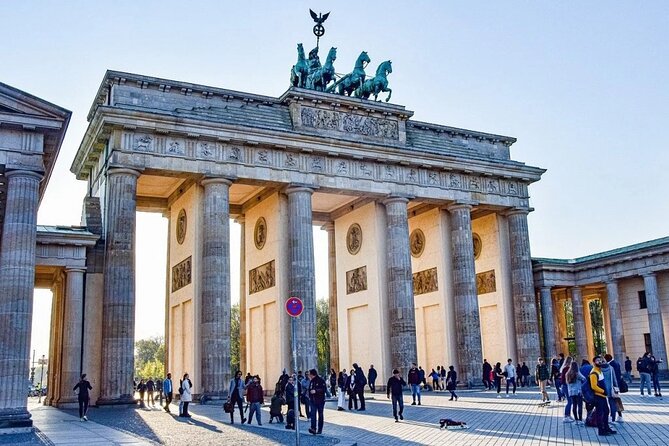
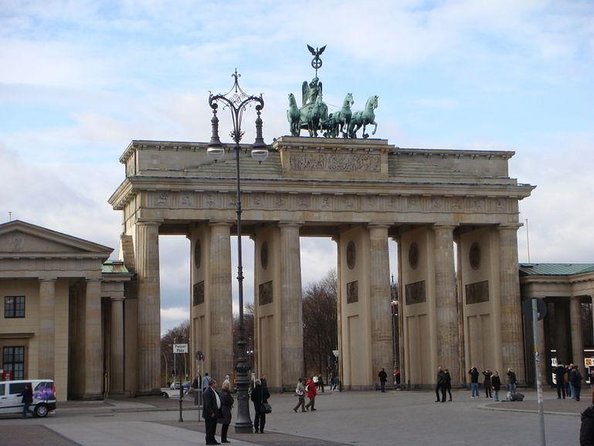
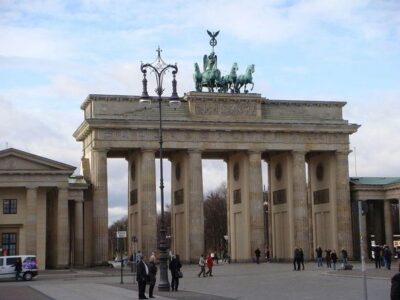
The Brandenburg Gate is a strong opening. This neoclassical gate has witnessed major turning points in Berlin, and the guide uses it to explain how the city changed from Prussian capital to divided Cold War symbol and then to a sign of reunified Germany. You have about 20 minutes here, enough for photos and a proper introduction.
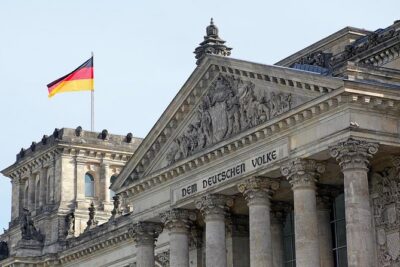
The Reichstag follows, also with about 20 minutes. You do not enter the building on this tour, but its exterior provides plenty to discuss. It served as Germany’s parliament during the imperial period, was associated with the famous fire shortly after Hitler became chancellor, and became a major Soviet target during the final battle for Berlin in the Second World War.
I appreciate the way these first two stops set up the tour’s method. You are not just collecting famous buildings. You are learning how one place can carry several layers of political meaning.
Facing Berlin’s Nazi past at the Holocaust Memorial and Führerbunker
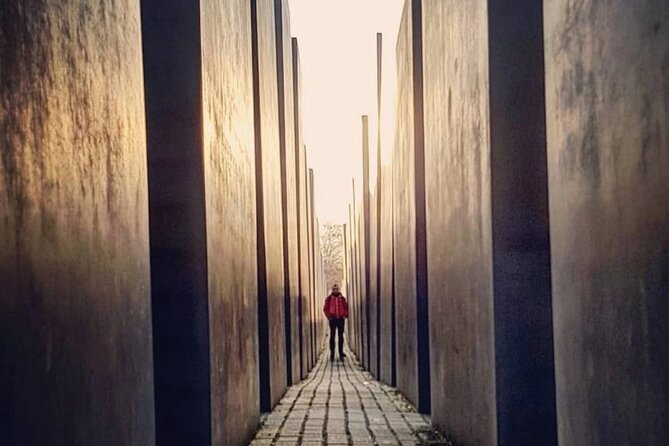
The Memorial to the Murdered Jews of Europe is given about 15 minutes. The field of concrete blocks is deliberately open to interpretation, but a guide can explain the history behind its construction and the crimes it commemorates. This is a place for quiet attention rather than a rushed photograph.
The tour then moves to the former Führerbunker site, another 15-minute stop. Today, the location is associated with a car park, which can feel jarring. The bunker was beneath what had been the garden of the New Reich Chancellery, and it was where Hitler ended his life as Soviet forces closed in on Berlin.
This portion requires a good guide. The subject is grim, and a thoughtful explanation matters. The route treats the site as a place for historical understanding, not theatrical fascination. That distinction makes the stop worthwhile.
The tour’s treatment of Nazi history continues at the Bundesministerium der Finanzen, the Federal Ministry of Finance. The building was formerly the headquarters of the Luftwaffe, Germany’s air force under the Nazi regime. You hear about its construction, its wartime use, and its later Cold War importance.
These stops are close enough to form a clear story, but you should not expect museum-style exhibits or indoor displays. The value comes from the guide’s spoken account and the buildings themselves.
Topography of Terror and the difficult story of power
At the Topography of Terror, you spend about 20 minutes at the former headquarters of the SS, Gestapo, and SD. The site explains the machinery of Nazi repression and also raises questions about how postwar Germany should remember such crimes.
This is one of the most valuable stops for anyone who wants more than postcard Berlin. The buildings and streets around you do not always announce what happened there. The guide helps connect the physical setting to the institutions that operated from it.
Because this is an outdoor walking experience, the amount of time at each site is limited. If you want to read every panel or spend a long time inside the Topography of Terror documentation center, you will need to return separately. The tour gives you orientation and context, not a full museum visit.
That is a useful distinction when deciding on value. For $32.58, you are paying for a guide who ties many locations together. You are not paying for entry to museums or special access to the buildings.
More Walking Tours in Berlin
- Discover Berlin Half-Day Walking Tour
★ 5.0 · 9,624 reviews - Berlin: Third Reich and Cold War 2 Hour Walking Tour
★ 4.9 · 6,830 reviews - Berlin: Discover Berlin Walking Tour
★ 4.9 · 5,998 reviews - Berlin’s Best: 2 Hour Walking Tour Third Reich and the Cold War
★ 5.0 · 5,486 reviews
Checkpoint Charlie and the divided city
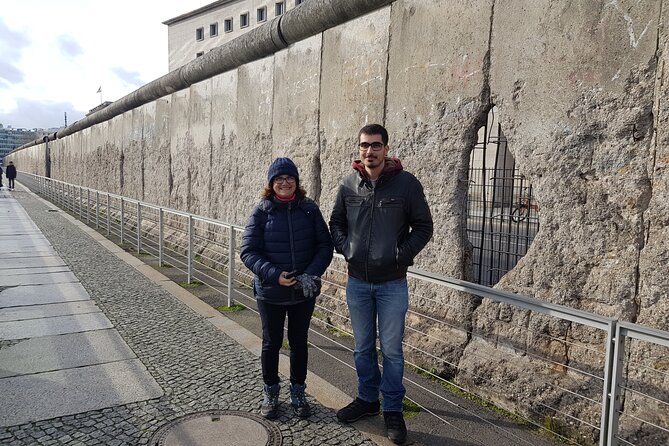
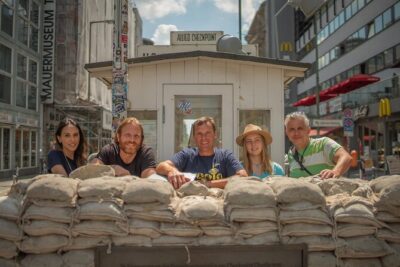
Checkpoint Charlie receives about 20 minutes. It is one of Berlin’s most famous Cold War locations, and the guide explains why this crossing became such a powerful symbol of the city’s division.
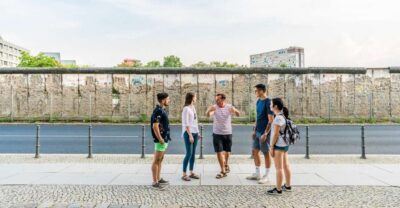
The modern setting can surprise you. Famous Cold War sites in Berlin are often surrounded by ordinary businesses, traffic, and commercial activity. That contrast is part of the lesson. The Berlin Wall period is not ancient history, and much of the city has changed rapidly since reunification.
Checkpoint Charlie works best when paired with the other stops. On its own, you might see a replica guardhouse and take a photo. After hearing about the political tension between East and West, the risks faced by people trying to cross, and the role of the checkpoint in the divided city, you have a better sense of what the location represents.
The route has already covered a lot by this point. Keep your water handy and expect to remain outdoors. The tour does not include a dedicated meal break, and one guide described the schedule as a lot to take in, so a snack before the start is sensible.
Prussian grandeur at Gendarmenmarkt and Bebelplatz
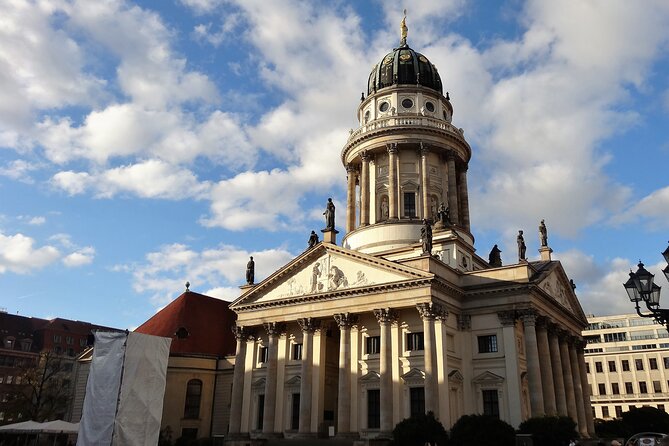
Gendarmenmarkt shifts the story away from dictatorship and division to the grand planning of Prussian Berlin. You spend about 15 minutes hearing about the square’s creation and development while taking in its 18th- and 19th-century architecture.
This change of mood is important. Berlin is not only a city of wartime ruins and political memorials. Its earlier identity as a royal and intellectual capital remains visible in its formal squares, churches, and institutional buildings.
Bebelplatz follows for another 15 minutes. The square is surrounded by buildings linked to Frederick the Great’s Prussian capital, and the guide explains why they were built and how the area developed.
Bebelplatz also holds a memorial to the Nazi book burning of 1933. The memorial is easy to miss if you do not know where to look, and this is exactly the sort of detail a walking guide can point out. You get both the architectural setting and the darker event that transformed the square’s meaning.
The tour does not flatten Berlin into a single story. It shows the city as a place shaped by monarchy, learning, propaganda, destruction, division, and remembrance.
Unter den Linden and the final approach to Museum Island
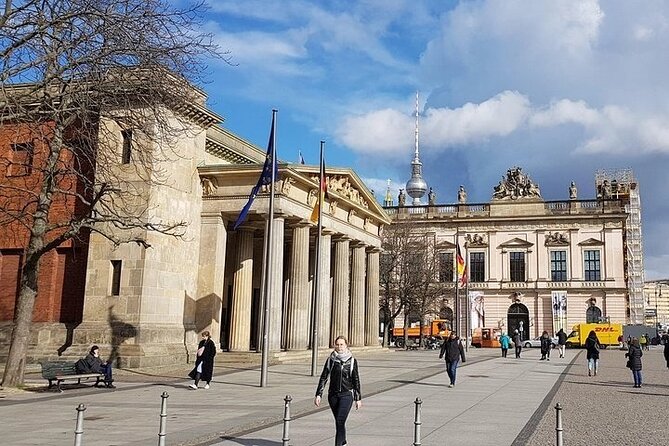
The walk along the eastern end of Unter den Linden takes about 20 minutes. This grand avenue brings together several important sites, including Humboldt University, the Memorial to Victims of War and Tyranny, and the German History Museum.
This stretch is useful for understanding how Berlin presented itself as a capital. The architecture and institutions speak to education, state power, military memory, and national identity. The guide’s job here is to show how those themes overlap.
The Memorial to Victims of War and Tyranny also deserves a thoughtful explanation. The name itself points toward the broad questions Berlin has faced in remembering both war and political violence. You are not simply passing a statue or ceremonial building. You are seeing how modern Germany publicly addresses its past.
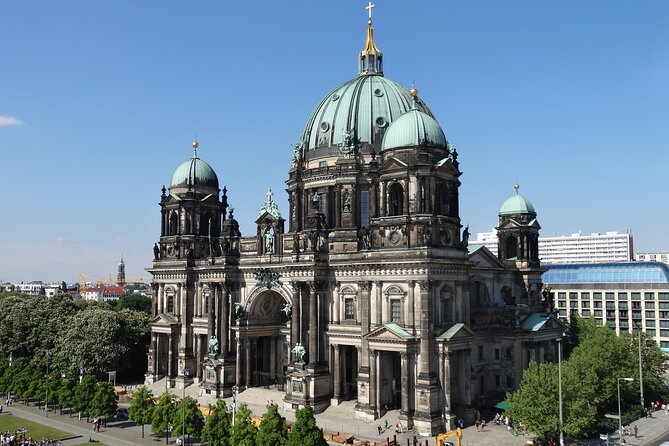
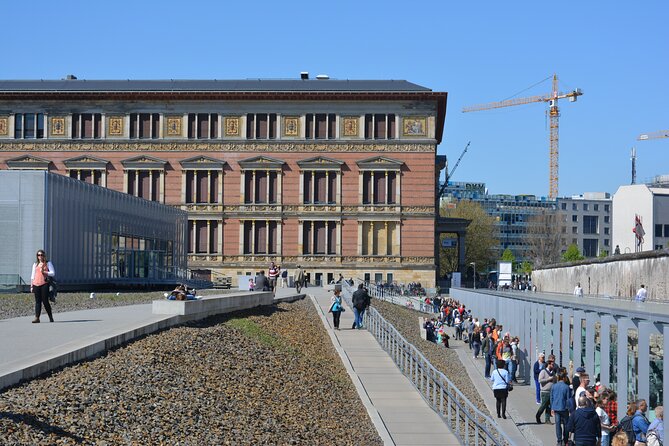
The final stop is Museum Island, reached after crossing into what was medieval Berlin. This area was once home to the City Palace from the 15th century and now contains the Berlin Cathedral and five world-class museums.
From the eastern side of Museum Island, the guide looks toward Alexanderplatz and explains its place as the center of postwar East Berlin. It is a fitting ending because the view brings together old Berlin, reconstructed Berlin, and the former East German capital.
The tour ends at Museum Island, 10 Berlin. That location is practical. You can continue with a museum visit, walk toward the cathedral, or use public transportation to reach another part of the city.
What the guides add to the experience
The strongest praise has gone to the guides’ ability to explain complicated subjects clearly and keep the group involved. Cairan, Aurel, Rhys, Eugen, Steve, Paul, Aaron, Al, and Ciaran are among the guides singled out for friendly, engaging presentations.
Aurel was praised for explaining buildings through their design, original purpose, wartime damage, and later rebuilding. He also used personal photographs connected with East Berlin, which gave the Cold War story a more human scale.
Cairan was praised for linking individual landmarks to larger themes, answering questions patiently, and using simple exercises to help people connect with the past. Rhys was described as funny and easy to follow, including for someone with only basic English. Steve was praised for arranging the history in a clear chronological order.
Guide quality can vary on any scheduled tour, but the repeated pattern here is encouraging. The experience works best when your guide is willing to pause, answer questions, and explain why a site matters. The small group limit helps. A group of seven, or even three, allows more interaction than a large crowd gathered around a flag.
The tour is offered in English. If English is not your first language, the comments about clear speech and easy-to-follow explanations are worth noting, though the historical content remains dense.
Price, pace, and who should book
At $32.58 per person, I consider this good value if you want a guided introduction to central Berlin. You see 11 major places, receive nearly four hours of commentary, and avoid spending time figuring out how the sites fit together.
The tour does not include entrance tickets, meals, or transportation. That keeps the price down, but it also means the experience is entirely outdoors and on foot. Every listed stop has free admission because you are viewing and discussing the locations from public areas.
The schedule allows roughly 15 to 20 minutes at each stop, with walking time between them. That is enough for an explanation and photographs, but not enough for extended independent exploration. If you want to visit the Reichstag interior, museums on Museum Island, or the Topography of Terror exhibits in detail, plan separate visits.
I would recommend the tour most strongly to:
- First-time visitors who want a clear introduction to Berlin
- History-focused visitors interested in Prussia, Nazi Germany, and the Cold War
- Families with older children who can manage a long walk
- English-speaking visitors who prefer conversation over an audio guide
- People with only a short stay who want to cover many central sights efficiently
I would think twice if you have difficulty walking for several hours, need frequent indoor rests, or prefer a slow visit to one or two attractions. One unhappy booking resulted from a misunderstanding about the walking format. The description does identify it as a walking tour, so take that seriously before paying.
Wear comfortable shoes and check the weather. The start time is fixed at 10:00 a.m., and the tour stays outside for most of its duration. Service animals are allowed, the route is near public transportation, and most people can participate, but the distance remains the main practical issue.
Free cancellation is available up to 24 hours before the start time for a full refund. Changes or cancellations made less than 24 hours in advance are not accepted for a refund.
Should you book this Berlin history walk?
Book it if you want the city’s major sights explained as parts of one connected story. The route is broad, the price is reasonable, and the best guides bring real warmth, humor, and personal perspective to difficult material.
I would not book it as a substitute for Berlin’s museums or a relaxed sightseeing day. Think of it as a well-organized first pass that helps you understand what you are looking at. If you can comfortably walk for 3.5 hours and want Berlin to make more sense by the end of your first day, this is a strong choice.
FAQ
How long does the Explore Berlin History and Highlights Sightseeing Walking Tour last?
The tour lasts approximately 3 hours and 30 minutes.
What time does the tour begin?
The tour begins at 10:00 a.m. local time.
Where does the tour start?
It starts at Wurst 🙂 am Brandenburger Tor, at Ebertstraße and Scheidemannstraße, 10117 Berlin, Germany.
Where does the tour end?
The tour ends on Museum Island at 10 Berlin, Germany.
How many people can join the tour?
The maximum group size is 15 travelers.
Is the tour conducted in English?
Yes. The experience is offered in English.
Are entrance tickets included?
No entrance tickets are included. This is a walking tour, and the listed stops are visited from public areas.
Can I cancel for a full refund?
Yes. You can cancel at least 24 hours before the experience start time for a full refund. Cancellations or changes made less than 24 hours before the start time are not accepted for a refund.
Just added around Berlin
- Berlin: Private Guided Tour of the Main Sights★ 5.0 · 13 reviews
- Private Highlights of Berlin Bike Tour★ 5.0 · 13 reviews
- Modern Berlin Private Walking Tour: Diverse, Vibrant and Exciting German Capital★ 5.0 · 13 reviews
- Tour in Berlin from Warnemünde and Rostock Cruise Port★ 4.1 · 13 reviews
- Berlin: Stasi Museum Private Guided Tour with Entry Ticket★ 4.8 · 13 reviews
- Private Food Tour Experience with a born and bred Berliner★ 5.0 · 14 reviews
- Berlin: Rheinsberg Palace Entrance Ticket★ 4.8 · 14 reviews
- Berlin in one day – day tour with an expert guide★ 5.0 · 14 reviews
Walking Tours, compared.

Berlin’s Best: 2 Hour Walking Tour Third Reich and the Cold War
Read our review →
Third Reich Berlin: Hitler and WWII Walking Tour
Read our review →Browse the lists this tour appears in