
Reviewed · THIRD REICH & WWII TOURS
Cologne EL-DE Haus and WWII Jewish Holocaust History Tour
Cologne’s past is written on its walls. I like the private format, which lets your guide adjust the pace and spend more time on the parts that matter most to you. I also like that entry to EL-DE Haus is included, saving you a separate wait and placing the former Gestapo prison at the center of the experience.
The main consideration is the subject itself. This is a serious tour about Nazi persecution, prison cells, torture, forced labor, and the Holocaust, not a light stroll through Cologne. At $289.95 per person, it makes the most sense for visitors who want close guidance and a focused three-hour history lesson rather than a general city walk.
In This Review
- Key points to know before booking
- Why this Cologne history tour matters
- Meeting at Alter Markt
- Old Town streets and the road to 1933
- Alter Markt, the city hall, and Cologne’s older layers
- Entering EL-DE Haus, Cologne’s former Gestapo headquarters
- Why a private guide changes the experience
- Is $289.95 per person a fair price?
- Practical timing and pace
- Who should book this experience?
- My take on the strongest features
- Should you book the EL-DE Haus tour?
- FAQ
- Where does the tour begin?
- Where does the tour end?
- How long does the tour last?
- Is admission to EL-DE Haus included?
- Is the tour private?
- Is the tour offered in English?
- Does the tour focus on Jewish history?
- What can I see inside EL-DE Haus?
- Can I cancel for a full refund?
Key points to know before booking
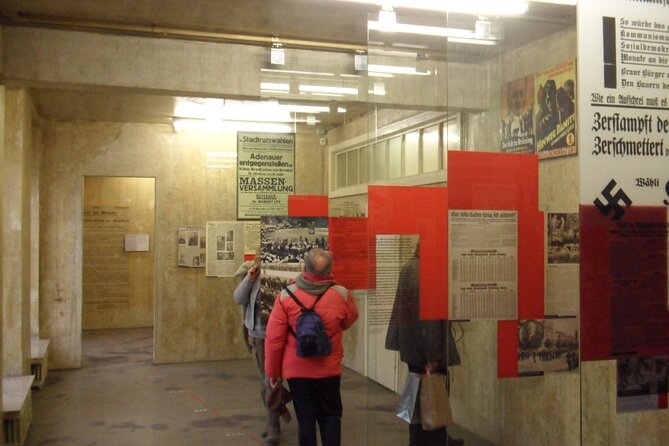
- EL-DE Haus is the main stop: You spend about two hours at the former Gestapo headquarters, including its prison cells and preserved wall inscriptions.
- The tour begins at Alter Markt: Meet your guide in front of Cafe Extrablatt Köln at Alter Markt 28-32.
- Jewish history receives special attention: The commentary covers Nazi persecution of Jewish people, political opponents, forced laborers, and resistance.
- Cologne’s wartime destruction provides wider context: The walk explains the Allied bombing campaign and the destruction of about 90 percent of the city.
- Your group has the guide to itself: This private setup allows you to ask questions and set the pace.
- Guide style matters here: Ralph is described as entertaining and informative, while Michael is praised for shaping the discussion around your interests.
Why this Cologne history tour matters
Cologne is easy to associate with its cathedral, Roman past, beer halls, and Old Town squares. Those sights matter, but they tell only part of the city’s story. This tour shifts your attention to the people and institutions that shaped Cologne during Hitler’s Third Reich.
I like that the experience does not treat World War II as an isolated museum topic. You begin outdoors, among familiar city landmarks, then move toward EL-DE Haus with a guide explaining how political power, racial persecution, and daily life changed under the Nazi regime.
That approach gives the museum more meaning. You are not simply walking into a building filled with objects and text panels. You arrive with a sense of place, aware that Cologne’s public spaces, government offices, Jewish community, and residents were all caught up in the period’s events.
The tour also gives special attention to Jewish history. It addresses Nazi oppression of Jewish people while placing that persecution alongside the treatment of political enemies and forced laborers. The subject is painful, but the guide’s role is valuable: you can ask questions, clarify dates, and understand how individual suffering connected to the larger system.
More Third Reich & WWII Tours:
- Cologne: WWII Sites with Optional EL-DE Haus Private Tour
★ 4.9 · 22 reviews - Berlin: Third Reich and Cold War 2 Hour Walking Tour
★ 4.9 · 6,830 reviews - Munich: Third Reich & WWII Walking Tour
★ 4.6 · 6,181 reviews
Meeting at Alter Markt
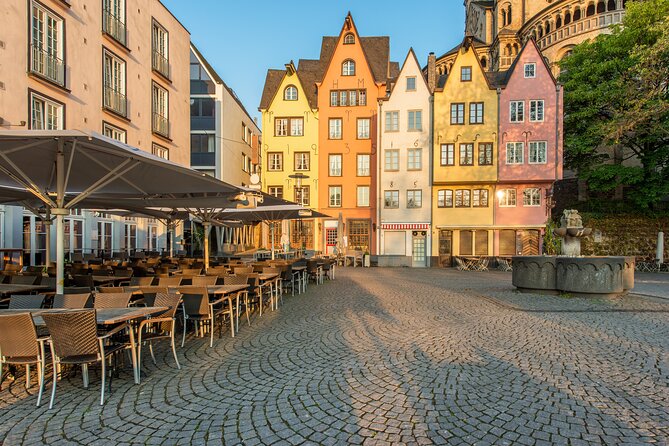
The tour begins in front of Cafe Extrablatt Köln at Alter Markt 28-32. The meeting point is in Cologne’s Old Town, near major sights and public transportation, so it is a practical place to start.
Allow yourself enough time to find the cafe and identify your guide. The meeting point is specific, but busy city squares can still cause confusion, especially if you are arriving by public transport or walking from the cathedral.
The first meeting stop is listed as about 10 minutes, with no admission charge. That short period is mainly useful for introductions and getting the group organized. Since this is a private activity, only your party participates, which creates a more personal beginning than a large group gathering.
Check your email the day before departure for important tour information. That small step matters, particularly if meeting instructions or timing details have changed.
Old Town streets and the road to 1933
The first substantial part of the walk lasts about 30 minutes. Your guide leads you through Cologne’s Old Town while explaining the rise of Adolf Hitler and the political conditions that allowed the Nazi movement to take power.
I like this outdoor section because it keeps the history tied to real streets. You are not hearing about the Third Reich in an abstract classroom. You are walking through the center of Cologne, seeing the city that was later damaged so severely by Allied bombing.
The guide also explains the Nazi oppression of Jewish people and the experiences of political opponents. The focus is not only on major leaders. The tour description promises attention to the people and events that shaped the period, which should help you connect government policy with the lives affected by it.
This part is short, so do not expect a full political history of Germany between the world wars. Instead, think of it as a clear introduction before the longer museum visit. If you want the guide to spend more time on Jewish history, resistance, wartime destruction, or another subject, the private format gives you a good chance to ask.
Alter Markt, the city hall, and Cologne’s older layers
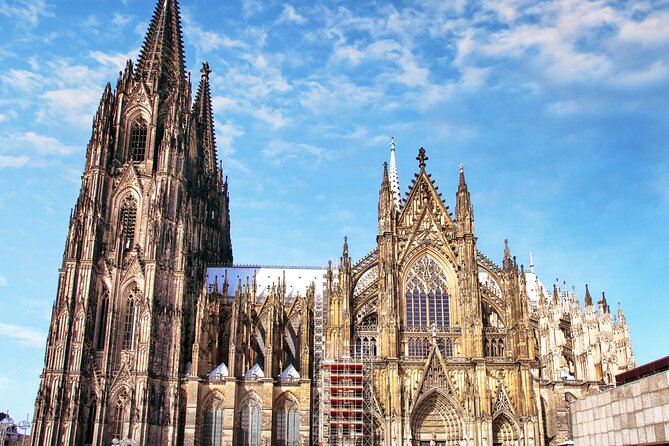
The next stop returns attention to Alter Markt and nearby landmarks. You see the reconstructed square, the Old City Hall, carved images of the Good Heroes, Cologne Cathedral, and the 10th-century Dominican Church of St. Andrew.
You also pass Stumbling Stones, small memorial markers placed in the pavement for people persecuted and murdered under the Nazi regime. Their location within ordinary sidewalks is part of their power. They do not sit apart from daily life. You encounter them while moving through the city.
This 20-minute segment adds a useful contrast. Cologne’s medieval buildings and religious landmarks show a city with centuries of tradition, while the Stumbling Stones point to a much more recent crime. The tour asks you to hold both parts of Cologne in view at once.
The word reconstructed is important for Alter Markt. Much of Cologne was destroyed during World War II, and the rebuilt square reflects the city’s effort to restore its historic center. Your guide connects that visible rebuilding with the wartime claim that about 90 percent of Cologne was destroyed.
Do not expect a long sightseeing stop at every landmark. The cathedral, city hall, and St. Andrew’s Church serve as reference points within the history walk. If your main goal is architectural detail, a separate cathedral or Old Town tour may suit you better.
More Historical Tours:
- Cologne: Old Town Beer History Tour
★ 4.7 · 659 reviews - Cologne: Old Town Historical Walking Tour with GEO Epoche
★ 4.7 · 31 reviews - Leipzig: City History Canal Sightseeing Tour on a Motorboat
★ 4.7 · 6,232 reviews - Berlin: Natural History Museum Entrance Ticket
★ 4.6 · 3,382 reviews
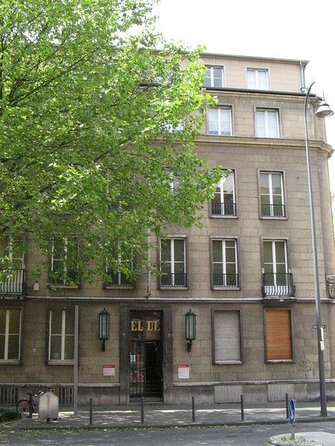
Entering EL-DE Haus, Cologne’s former Gestapo headquarters
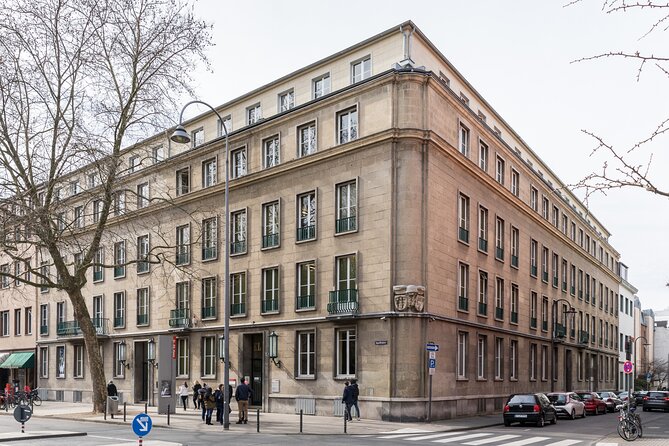
The heart of the experience is EL-DE Haus, now the NS Documentation Center. About two hours are reserved here, and admission is included in the tour price.
EL-DE Haus was the former headquarters of the Gestapo, the Nazi secret police. Its basement was used for prison cells and torture rooms. Forced laborers and political enemies were held there, and more than 1,800 inscriptions made by prisoners remain visible on the walls.
Those inscriptions are likely to be the most affecting part of the visit. A written account can describe imprisonment, but marks left inside the cells bring the experience much closer. The walls preserve the presence of people who were confined there, even when the rest of their lives was stripped away.
The museum also presents the upper floors, where Gestapo offices show how administrative work supported persecution. That is an important part of the story. Terror did not operate only through violence in a basement. It also relied on paperwork, offices, orders, records, and people carrying out an organized system.
Your guide explains who suffered, why they were targeted, and how the Nazi regime worked in Germany. The visit covers Jewish victims, but also political opponents, forced laborers, and others caught in the system. This broader view helps you understand that Nazi persecution was not one single act. It was a network of laws, police power, imprisonment, forced work, and murder.
I would plan your emotional energy carefully. Two hours in a former Gestapo prison can feel heavy, and the material deserves your attention. This is not the place to rush through for a few photographs before moving to the next attraction.
Why a private guide changes the experience
A private tour is especially useful for a subject like this. In a large group, the guide must keep to one pace and give the same explanation to everyone. Here, you can stop to ask about a name, a political event, a memorial marker, or the meaning of a particular inscription.
The experience is offered in English. Guide quality will always shape a history tour, and the available feedback gives two names to look for: Ralph and Michael. Ralph is praised for combining entertainment with information, while Michael is praised for his detailed command of the subject and his willingness to tailor the tour to your interests.
Those descriptions suggest two slightly different strengths. Ralph may suit you if you value a lively presentation while still wanting serious content. Michael may appeal if you want a more focused discussion and hope to guide the conversation toward a specific area of World War II history.
The private setup also helps if members of your party have different levels of background knowledge. You can ask for a basic explanation of Hitler’s rise to power, or move toward more detailed questions about Nazi administration and resistance. The guide is not forced to choose one level for a crowd.
Is $289.95 per person a fair price?

At $289.95 per person, this is not a budget walk. The price needs to be judged against what you receive: approximately three hours, a private English-speaking guide, and included admission to EL-DE Haus.
The strongest value comes from the private attention. If you are traveling with family or friends who want to discuss the subject in detail, the cost may feel more reasonable because the guide works only with your group. Group discounts are also available, though the exact reduction is not provided, so you should check the final booking terms.
If you are comfortable reading museum information on your own, a self-guided visit may cost less. You would, however, lose the connected story that begins in Alter Markt, moves through Cologne’s wartime destruction, and ends in the former Gestapo headquarters.
I would choose this tour for the guide rather than simply for admission. Entry to EL-DE Haus is useful, but the real benefit is having someone explain how the Old Town, Jewish persecution, political repression, forced labor, resistance, and wartime bombing fit together.
The price is harder to justify if you want a broad introduction to Cologne or a casual sightseeing walk. This experience is narrow in subject and serious in tone. It earns its cost when that focus matches your reason for visiting.
Practical timing and pace
The total duration is about three hours. Roughly 10 minutes are set aside at the meeting point, 30 minutes for the Old Town history walk, 20 minutes around Alter Markt and its sights, and two hours inside EL-DE Haus.
Because the tour ends back at the meeting point, you can plan your next activity from central Cologne. The route is near public transportation, which makes it easier to connect with the cathedral area or other parts of the city.
Most people can participate, according to the provided information. No special restriction is stated, but remember that this is a walking tour followed by an extended museum visit. You should be ready to spend time moving through the Old Town and concentrating inside the documentation center.
The pace can be adjusted because the activity is private. Still, the overall schedule is limited to about three hours, so ask early if you want extra time on one part. A guide can adapt the discussion, but the tour cannot cover every detail of Cologne’s wartime past.
Who should book this experience?
I would recommend it to you if you want:
- A focused introduction to Cologne’s Jewish history and Nazi-era persecution
- A guided visit to the former Gestapo headquarters
- Direct access to a guide for questions and discussion
- A serious museum experience with preserved prisoner inscriptions
- A history walk that connects the Old Town to World War II
- A private activity for your own group
I would hesitate to recommend it if you want a cheerful first-day orientation, a food walk, or a general overview of Cologne’s art and architecture. The cathedral and Old Town sights appear along the route, but they are supporting players, not the main attraction.
Families should also consider the age and comfort level of everyone in the group. The material includes torture, imprisonment, forced labor, and the Holocaust. The tour’s purpose is education and remembrance, but the details can be upsetting.
My take on the strongest features
The best part is the combination of place and explanation. You see Stumbling Stones in the streets, learn about Cologne’s destruction, and then enter a building where prisoners left more than 1,800 inscriptions on the walls.
I also value the attention to resistance. The tour does not present Nazi Germany only through the actions of Hitler and the Gestapo. It also encourages remembrance of those who opposed the regime and suffered under it.
The guides’ reported styles are another positive. Ralph’s entertaining presentation could help keep a difficult subject approachable, while Michael’s ability to tailor the tour may suit visitors with particular questions. Since the guide can adjust the pace, you have more control than you would on a standard group walk.
The main weakness is cost. You are paying a premium for a private experience, and the price may be too high if you only want to see the museum. The other limitation is the narrow theme. That focus is a strength for the right audience, but it leaves little room for lighter Cologne sightseeing.
Should you book the EL-DE Haus tour?
Book it if you want to understand Cologne through its Nazi and Jewish history, and if you value a private guide who can explain difficult material in context. The included entrance, two-hour museum visit, preserved prison inscriptions, and Old Town route create a focused experience rather than a quick memorial stop.
I would especially consider it for a small family group, history-focused friends, or anyone who wants to ask detailed questions without competing with a large crowd. Look for Ralph if you prefer an informative tour with an entertaining touch, or Michael if you want the discussion shaped around your interests.
Skip it if your visit is short and your priority is Cologne’s cathedral, food, or medieval sights. For everyone else, this is a serious and worthwhile way to remember the people persecuted by the Nazi regime and to see how that history remains part of the city today.
Free cancellation is available if you cancel at least 24 hours before the start time. Changes or cancellations made later are not accepted for a refund.
FAQ
Where does the tour begin?
It begins in front of Cafe Extrablatt Köln at Alter Markt, Alter Markt 28-32, 50667 Cologne, Germany.
Where does the tour end?
The activity ends back at the meeting point.
How long does the tour last?
The tour lasts approximately three hours.
Is admission to EL-DE Haus included?
Yes. Admission to EL-DE Haus, the NS Documentation Center, is included.
Is the tour private?
Yes. Only your group participates in the activity.
Is the tour offered in English?
Yes. The tour is offered in English.
Does the tour focus on Jewish history?
Yes. It has a special focus on Cologne’s Jewish history and explains the Nazi oppression of Jewish people.
What can I see inside EL-DE Haus?
You can see former prison cells and torture rooms in the basement, more than 1,800 prisoner inscriptions on the walls, and former Gestapo office areas on the upper floors.
Can I cancel for a full refund?
Yes. You can cancel for a full refund at least 24 hours before the experience start time. Later cancellations are not refunded.
Just added around Cologne
- XXL tour (11km)★ 5.0 · 3 reviews
- Compact tour (7km)★ 5.0 · 3 reviews
- Köln Night PubCrawl: 4 Venues, Welcome Shots + Club Entry★ 3.5 · 4 reviews
- Aachen – Old town Guided tour★ 3.5 · 4 reviews
- Cologne Private Walking Tour With A Professional Guide★ 5.0 · 4 reviews
- From Eigelstein to Nippes: city tour and wine hike★ 3.9 · 4 reviews
- Explore Cologne’s best Street Art Quarter★ 4.5 · 4 reviews
- From Amsterdam: Cologne Private Sightseeing Tour★ 5.0 · 4 reviews
Third Reich & WWII Tours, compared.



Berlin’s Best: 2 Hour Walking Tour Third Reich and the Cold War
Read our review →

Third Reich Berlin: Hitler and WWII Walking Tour
Read our review →
Walking Tour of Former Nazi Party Rally Grounds
Read our review →
Browse the lists this tour appears in