
Reviewed · OLD TOWN WALKS
Aachen – Old town Guided tour
Aachen rewards a closer look. This private 90-minute walk gathers the city’s main sights into one tidy route, with a guide explaining how Charlemagne, medieval trade, religion, and local industry shaped the old center. I like the easy meeting point beside Aachen Cathedral, and I like that a private group of up to 15 can move at its own pace. The main drawback is the price: $406.51 per group is a serious outlay for a short walk, especially since entrance fees are not included.
The route covers plenty in little time. You’ll see the cathedral, Puppenbrunnen, Elisenbrunnen, Grashaus, Haus Löwenstein, City Hall, and Ponttor without spending your first hour squinting at a map. Just note one practical wrinkle: Ponttor is listed as the final sightseeing stop, while the end point is given as the original meeting point, so confirm the exact finish with the guide.
In This Review
- Key points to know before booking
- Why this short Aachen walk works
- Starting beside Aachen Cathedral
- Puppenbrunnen and Aachen’s moving social history
- Elisenbrunnen and Aachen’s thermal springs
- Grashaus and Haus Löwenstein: two medieval survivors
- Aachen City Hall and the Granus Tower
- Ponttor finishes the old-town route
- Timing, group size, and practical value
- Who should book this Aachen experience?
- Should you book the Aachen Old Town Guided Tour?
- FAQ
- Where does the Aachen Old Town tour begin?
- Where does the activity end?
- How long does the tour last?
- How many people can join the private tour?
- Is the tour private?
- Is a guide included?
- Are entrance fees included?
- Is Aachen Cathedral included in the route?
- Does the tour visit Elisenbrunnen?
- Is the tour refundable or changeable?
Key points to know before booking
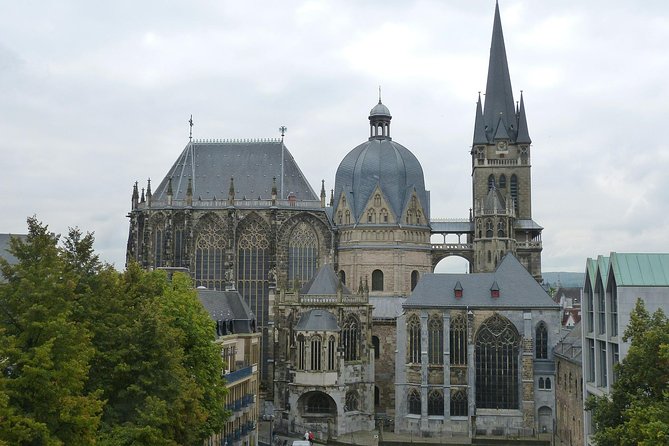
- Aachen Cathedral begins the story: You start beside one of Europe’s oldest cathedrals and the seat of the Diocese of Aachen.
- Private touring keeps the route focused: Your group alone takes part, with space for up to 15 people.
- Puppenbrunnen adds a playful local touch: Bronze marionettes and paired figures explain Aachen society in a way children can enjoy.
- The walk packs in seven important sights: You’ll cover the central old town, historic houses, the town hall, and a surviving medieval gate.
- The guide provides the real value: The walk is short, but the historical context helps turn buildings into a connected story.
- Budget for possible extras: The official guide is included, while entrance fees are not.
Why this short Aachen walk works
Aachen is compact enough to explore on foot, yet its story is not simple. Roman Catholic power, Charlemagne’s court, Holy Roman Empire ceremonies, trade, thermal springs, and local crafts all appear within a small area. A guide helps you connect those pieces instead of seeing a cathedral here and a fountain there.
I see this as a good choice if you have only a short window in the city. Ninety minutes is long enough to cover the central sights but short enough to fit around a wider Germany trip. You will not get a full museum day or a slow architectural study, but you will get a useful orientation and a clear sense of why Aachen matters.
The private format is important. A group of up to 15 is not tiny, but it is still more personal than a large public walk. You can ask questions about the places in front of you, and the guide does not need to serve strangers with different schedules. It also removes the mild stress of keeping up with an unfamiliar route.
The price needs a careful look. At $406.51 per group, the cost works out to about $27 per person if all 15 spaces are filled. For two people, it is roughly $203 each, which is hard to justify for 90 minutes unless private guiding is a top priority. Families or larger groups can get better value from the flat group rate.
More Old Town Walks in Cologne
- Cologne: The Night Watchman Old Town Walking Tour in German
★ 4.6 · 1,395 reviews - Cologne: Old Town Highlights Walking Tour
★ 4.6 · 1,093 reviews - Cologne Cathedral and Old Town Tour with 1 Kölsch
★ 4.8 · 674 reviews
Starting beside Aachen Cathedral
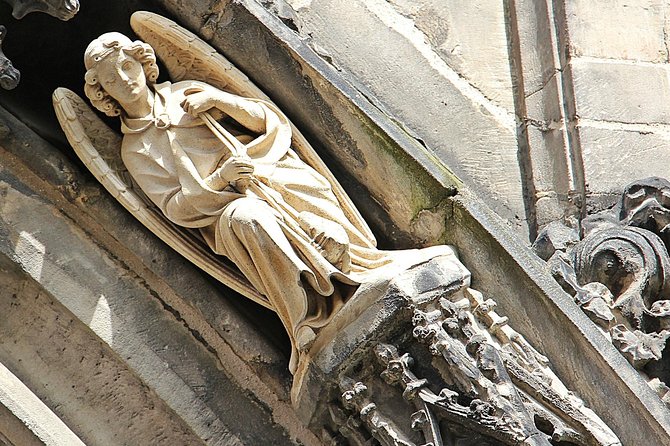
The walk begins at Dominformation on Johannes-Paul-II.-Straße 1, 52062 Aachen. That puts you right by the cathedral, a sensible starting point because the building supplies the key to much of Aachen’s story.
Aachen Cathedral is a Roman Catholic church also known as the Cathedral of Aix-la-Chapelle. It is one of Europe’s oldest cathedrals and serves as the seat of the Roman Catholic Diocese of Aachen. Even a brief visit gives the tour a strong opening: this is not simply an attractive church, but a major religious and political landmark.
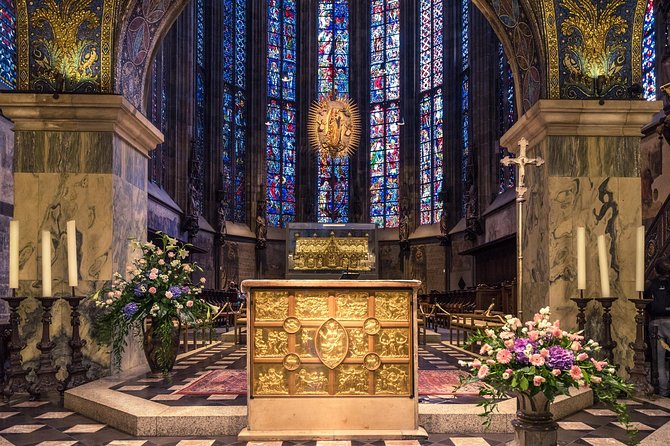
The stated stop lasts about 10 minutes, and admission to the stop is listed as free. You also have the chance to visit the Cathedral Treasury, which contains important medieval church works, including the Cross of Lothair, the Persephone sarcophagus, and a bust of Charlemagne.
That last point matters. The Treasury can add real depth, but the tour is not designed as a long indoor visit. If you want time with those objects, ask the guide how the visit fits into the schedule and confirm any fee before you arrive, since entrance fees are not included in the tour price.
The strongest praise connected with this experience focuses on Charlemagne and the way the sights are placed in context. That is exactly where a guide can help most. Without explanation, a medieval object or grand church can feel distant. With a clear link to Aachen’s imperial past, the first stop becomes much more meaningful.
Puppenbrunnen and Aachen’s moving social history
A short walk from the cathedral brings you to Puppenbrunnen, the Dolls Fountain, created by Bonifatius Stirnberg in 1975. This is one of the most memorable stops because it presents Aachen through figures rather than dates alone.
The bronze fountain is made of paired figures and symbols. You will see references to the textile industry and the doll, a horse and rider, a bishop and church, a market woman, a professor and harlequin, and doctrine and culture. A clock at the top represents the French occupation.
The fountain’s moving marionettes give the stop a light, almost comic quality. Children have something to watch, while adults can listen for the social clues in the figures. It is a useful change of pace after the solemn cathedral.
The listed time is about 10 minutes, enough to look closely and hear the explanation without turning the fountain into a long lecture. I would pay attention to how the guide explains the different pairs. The fountain is most interesting when you understand it as a portrait of the city’s people and occupations, not just as a decorative object.
Elisenbrunnen and Aachen’s thermal springs
The next stop is Elisenbrunnen, a fountain linked to Aachen’s healing thermal water. Two drinking fountains provide the water, which is said to have a high sulphur content and medicinal properties.
This is a small stop, listed at about 10 minutes, but it gives you a different way to understand the city. Aachen is not important only because of churches and emperors. Its springs also helped shape its identity and draw people to the city.
The sulphur content may make the water memorable for reasons beyond its history. I would treat this as a brief look and listen rather than expect a major bathing experience. The tour provides context for the fountain, not a spa visit.
Elisenbrunnen also helps break up the route. The walk moves from religion to civic symbolism to local natural resources, giving the old town more range than a standard parade of grand buildings.
Something different for another day:
- Cologne: Panoramic City Cruise
★ 4.3 · 5,698 reviews - Cologne: Brewery Tour with 3 Kölsch Beer Tastings
★ 4.7 · 3,108 reviews - Cologne: Top Sights Rhine River Cruise – Skyline Tour
★ 4.4 · 3,030 reviews - Cologne: Chocolate Museum Entrance Ticket
★ 4.4 · 2,790 reviews
Grashaus and Haus Löwenstein: two medieval survivors
The route then passes the Grashaus at the fish market. This is one of Aachen’s oldest houses and an important civic building. It served as the city’s first town hall, with construction completed in 1267, although the site reaches back even further.
The Grashaus also connects to a darker chapter. It was once associated with a medieval village and included a prison. That combination of government, daily life, and confinement gives the building more human weight than a simple date on a plaque.
The stop is not given a separate duration, so you should expect a guided exterior look as the group continues through the old town. That is both a benefit and a limit. You get several historic buildings in one compact route, but you will not have much time for detailed interior exploration.
Nearby Haus Löwenstein offers another useful architectural pause. Built around 1344, it is one of the few Gothic buildings to survive the great fire of 1656. Its original purpose remains unknown, which gives the building an appealing question mark.
I like this part of the walk because it shifts attention from famous monuments to less obvious pieces of the city. The Grashaus tells you about early civic administration. Haus Löwenstein shows how much old Aachen was lost and how unusual it is to find a surviving Gothic structure.
Aachen City Hall and the Granus Tower
City Hall is the route’s major civic landmark. Its Gothic building was constructed in the 14th century under Gerhard Chorus to host the traditional coronation feast of the Holy Roman Empire. Construction finished in 1349, after which the building served as an administrative center.
That former role explains why the town hall feels grander than a routine municipal building. It was designed for ceremony as well as government. The connection to imperial coronation feasts gives the façade a place in the broader story of medieval Europe.
You will also see the Granus Tower, a 20-meter-high structure that was used to store weapons. The tower adds a practical military note to the ceremonial setting. Aachen’s government buildings were not isolated from defense, power, or the threat of conflict.
The stop lasts about 10 minutes. Admission is not included, so check what you want to see before booking. If your goal is an exterior overview, the short stop should work well. If you want to enter City Hall or spend serious time with its interiors, this walk may feel too compressed.
Ponttor finishes the old-town route
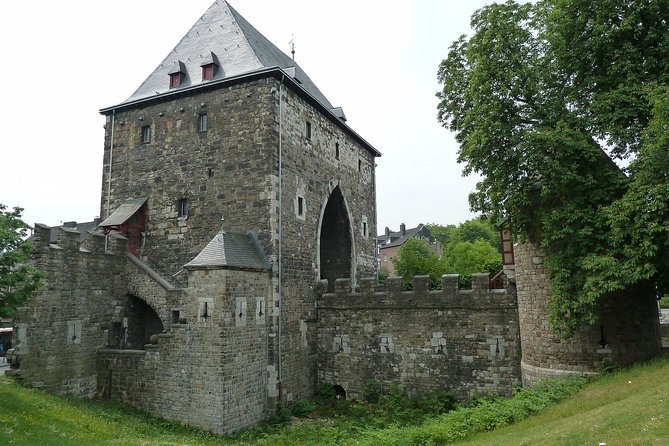
Ponttor provides a fitting final sight. It was one of the city gates, along with Marschiertor, and was once known as the Brückenpforte. Both gates belonged to the city wall built in the 14th century.
Only a small number of such defenses remain, so Ponttor gives you a physical sense of medieval Aachen’s boundaries. After seeing churches, civic buildings, fountains, and old houses, you finish with the structure that controlled movement into the city.
The gate is now used by the German Scout Club and German Scout Association Saint George. That modern use keeps the building connected to present-day city life rather than leaving it as a frozen monument.
The listed visit lasts about 10 minutes and has no admission fee. The route information says the activity ends back at the meeting point, while Ponttor is described as the final sightseeing stop. This may mean the guide walks you back after viewing the gate, but the details are not fully clear. Confirm the end point if you have a train, hotel transfer, or another booking waiting.
Timing, group size, and practical value
The total duration is about 1 hour and 30 minutes. The named stops at the cathedral, Puppenbrunnen, Elisenbrunnen, City Hall, and Ponttor each receive about 10 minutes, with the remaining time used for walking and explanations at the Grashaus and Haus Löwenstein.
That pace is brisk but sensible for an orientation walk. You will see a lot, but you should not expect long pauses at every façade. Comfortable walking is important because the experience is built around moving through the old town on foot.
The meeting point is near public transportation, which makes the start convenient. Confirmation is provided when you book, and most people can participate according to the supplied details. No special access restrictions are stated, but the tour is still a walking experience, so plan for the normal demands of a city-center stroll.
The private setup is the clearest practical advantage. You do not need to worry about joining a large mixed group, and your party alone participates. That can make the tour especially useful for families, friends, or a larger group that wants one shared introduction to Aachen.
The provider is BlackBuck Travels. The experience has a 3.5 rating based on four reviews, so I would treat it as a promising but not fully proven choice. The strongest written praise points to the guide’s ability to explain Charlemagne and place the sights in context. That is the service’s main selling point, not an extensive interior visit.
Who should book this Aachen experience?
I would consider it for a first visit with limited time, especially if Aachen is one stop in a larger itinerary. The route gives you a quick framework for the city, and you can return later to the cathedral, Treasury, City Hall, or other sights that deserve more time.
It also suits anyone who prefers history with a human guide rather than a map and phone screen. The Puppenbrunnen, Grashaus, Haus Löwenstein, and Elisenbrunnen are easier to appreciate when someone explains the local meaning behind them.
Families may like the fountain’s moving bronze figures, while larger private groups may find the flat price more reasonable. Solo visitors and couples should compare the cost with a public walking tour or a self-guided visit, since $406.51 is a high per-person price for a small party.
This is less suitable if you want a slow architectural study, guaranteed interior access, or a long museum visit. It is also not a good match for a fixed onward schedule until you confirm where the tour actually ends.
Should you book the Aachen Old Town Guided Tour?
Book it if you value a private guide, have only 90 minutes, and want Aachen’s central sights explained in one connected walk. The Charlemagne context, the compact route, and the unusual details at Puppenbrunnen, Grashaus, and Haus Löwenstein make this more useful than simply ticking off monuments.
Think twice if you are traveling as a pair or on a tight budget. The price makes much better sense for a full group of 15 than for one or two people, and entrance fees are extra. Before paying, confirm the Cathedral Treasury and City Hall arrangements, ask about the Ponttor return route, and make sure the private format is worth the premium for your group.
FAQ
Where does the Aachen Old Town tour begin?
It begins at Dominformation, Johannes-Paul-II.-Straße 1, 52062 Aachen, Germany.
Where does the activity end?
The stated end point is back at the meeting point. Ponttor is listed as the final sightseeing stop, so confirm whether the guide walks the group back afterward.
How long does the tour last?
The tour lasts approximately 1 hour and 30 minutes.
How many people can join the private tour?
The private tour is available for one group of up to 15 people.
Is the tour private?
Yes. Only your group participates in the activity.
Is a guide included?
Yes. An official tour guide is included.
Are entrance fees included?
No. Entrance fees are not included in the tour price.
Is Aachen Cathedral included in the route?
Yes. Aachen Cathedral is the first listed stop, with about 10 minutes scheduled there.
Does the tour visit Elisenbrunnen?
Yes. The route includes Elisenbrunnen, the fountain associated with Aachen’s sulphur-rich thermal water.
Is the tour refundable or changeable?
No. The experience is non-refundable and cannot be changed for any reason.
Just added around Cologne
- XXL tour (11km)★ 5.0 · 3 reviews
- Compact tour (7km)★ 5.0 · 3 reviews
- Köln Night PubCrawl: 4 Venues, Welcome Shots + Club Entry★ 3.5 · 4 reviews
- Cologne Private Walking Tour With A Professional Guide★ 5.0 · 4 reviews
- From Eigelstein to Nippes: city tour and wine hike★ 3.9 · 4 reviews
- Explore Cologne’s best Street Art Quarter★ 4.5 · 4 reviews
- Cologne EL-DE Haus and WWII Jewish Holocaust History Tour★ 5.0 · 4 reviews
- From Amsterdam: Cologne Private Sightseeing Tour★ 5.0 · 4 reviews
Old Town Walks, compared.

Old Town & Viktualienmarkt City Walk in German
Read our review →
The Night Watchman Old Town Walking Tour in German
Read our review →
Browse the lists this tour appears in