
Reviewed · WALKING TOURS
Duisburg: Guided Walking Tour through the inner harbour
Industrial change meets waterfront charm. This 1.5-hour walk shows how Duisburg’s former grain port became a lively district of marinas, museums, restaurants, offices, and striking modern buildings. You’ll hear how Sir Norman Foster’s plan helped reshape the area from the mid-1990s onward.
I like the clear story behind the route and the mix of historic warehouses and modern architecture. I also like the low price, at $16 per person, which makes this an easy addition to a day in Duisburg. The main limitation is language: the live tour is offered in German, so you’ll get the most from it if you understand German or are comfortable following a visual walking tour with some spoken explanation.
In This Review
- Five things to know before you go
- Why Duisburg’s Inner Harbour changed so completely
- Starting at the Mercator fountain by Town Hall
- Following the Foster plan through the waterfront district
- The Five Boats and the modern face of Duisburg
- From grain handling to yachts and restaurants
- Warehouses, museums, and a district still finding its balance
- What the walking pace and weather mean
- Is $16 a fair price?
- Who will enjoy this Duisburg walk?
- How I would plan the rest of the visit
- Should you book the Duisburg Inner Harbour tour?
- FAQ
- How long does the Duisburg Inner Harbour walking tour last?
- What language is the tour offered in?
- Where does the tour meet?
- What does the tour include?
- Is the tour wheelchair accessible?
- Does the tour operate in rainy weather?
Five things to know before you go
- The tour explains a dramatic change: Learn how the former bread basket of the Ruhr area became a modern waterfront district.
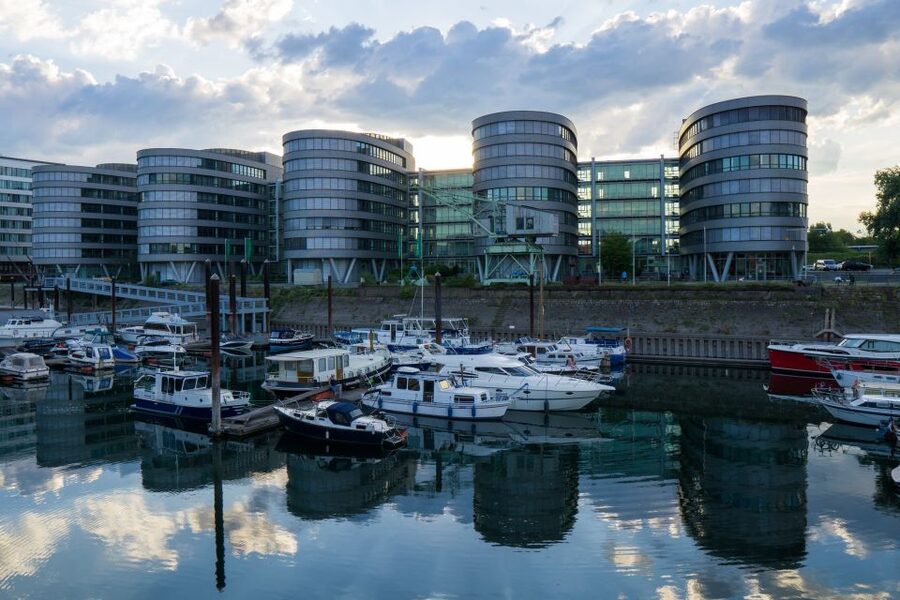
- The Five Boats provide a modern architectural highlight: These prominent buildings are part of the Inner Harbour’s new identity.
- The route mixes work and leisure: Former loading areas now sit beside yachts, restaurants, museums, and office complexes.
- The meeting point is central: Find your guide in front of the Mercator fountain by Duisburg Town Hall.
- Rain does not cancel the experience: Bring suitable clothing, since the walking tour goes ahead in wet weather.
- German is the tour language: The walk is wheelchair accessible, but the guided commentary is not advertised in other languages.
Why Duisburg’s Inner Harbour changed so completely
Duisburg’s Inner Harbour was once a serious working port. Grain arrived here in large quantities, and the area earned the nickname bread basket of the Ruhr area because of its huge grain-handling operation.
That role faded when the grain mills declined at the end of the 1960s. Once the mills disappeared, the old port no longer had the same purpose. Empty industrial sites and outdated waterfront buildings needed a new plan, not just a fresh coat of paint.
This is the main reason I find the tour worthwhile. You are not simply looking at attractive buildings beside the water. You are seeing one answer to a difficult urban question: what should a former industrial district become when its original trade has gone?
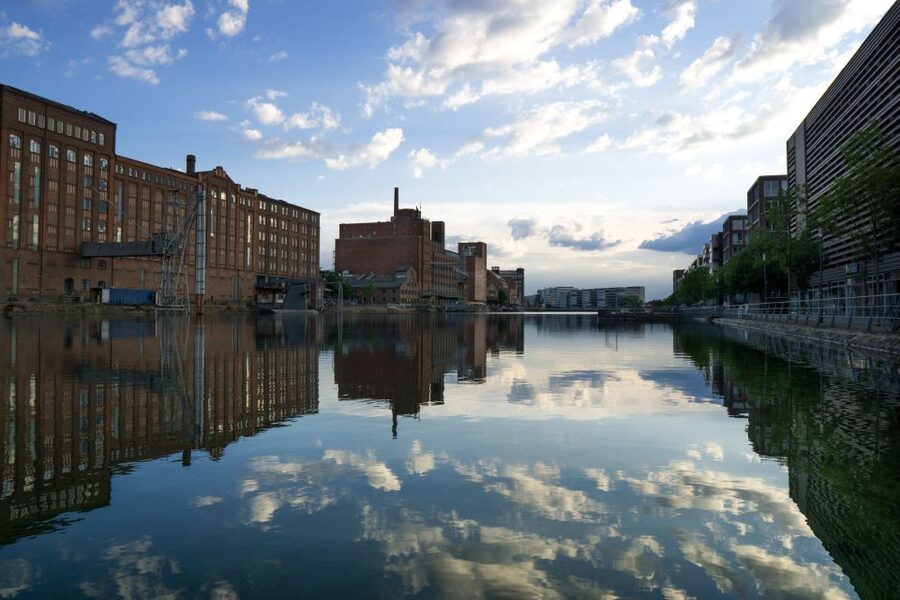
From the mid-1990s, a plan by British architect Sir Norman Foster helped guide the transformation. The goal was not to erase the area’s working past. Instead, the Inner Harbour gained new offices, cultural spaces, restaurants, public areas, and a marina while retaining reminders of the old port.
That contrast gives the walk its character. You may see a nostalgic warehouse row beside a glass office complex, or yachts resting where freighters were once loaded and unloaded. The result is a waterfront with a distinctly modern purpose and a visible industrial memory.
More Walking Tours in Dusseldorf
- Düsseldorf: Altbier-Safari Beer Walking Tour
★ 4.4 · 1,150 reviews - Düsseldorf: Sweet Treats Guided Walking Tour of Old Town
★ 4.7 · 66 reviews - Düsseldorf: Guided City Architecture Walking Tour
★ 4.6 · 61 reviews
Starting at the Mercator fountain by Town Hall
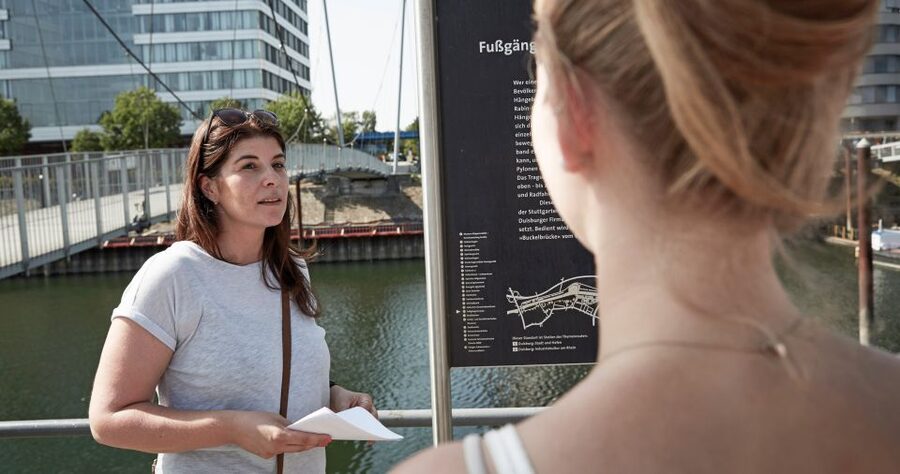
The tour begins in front of the Mercator fountain, outside Duisburg Town Hall. This is a useful meeting point because it places you near the city center before the walk turns toward the Inner Harbour.
Arrive with enough time to find the fountain and settle in. The provided meeting information does not include a hotel pickup or transport from other parts of the city, so you should plan to reach the Town Hall area independently.
The walk lasts 1.5 hours. That is long enough for a proper explanation of the district without taking over your entire day. I would place it early in your Duisburg visit if you want the story of the Inner Harbour to shape the way you look at the area afterward.
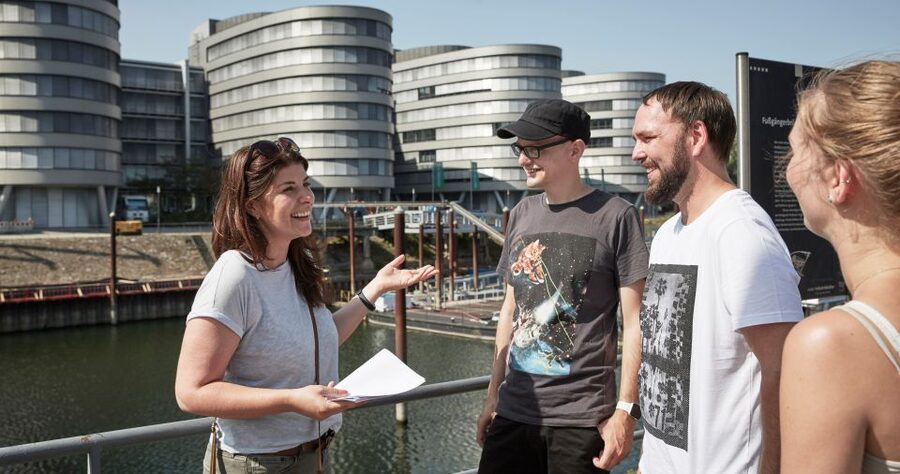
The guide speaks German and leads the route live. Recent feedback gives particular credit to the guides’ humor and the informative nature of the presentation. One participant specifically found the tour enjoyable despite poor weather, while another praised its strong value for the price.
Following the Foster plan through the waterfront district
The central part of the tour focuses on the changes introduced from the mid-1990s. Sir Norman Foster’s plan is important because it gives the district a larger urban logic. The new buildings, public spaces, and restored industrial structures are not random additions. They form part of a deliberate attempt to give the Inner Harbour a new role.
You will learn about that plan while walking through the district rather than hearing a detached lecture in a room. That matters. As the guide points out the buildings and waterfront spaces, you can connect the planning decisions with what you see in front of you.
The tour’s strongest feature is this link between explanation and place. A former port can look polished and attractive today, but without context you may miss the reason for its layout. The guide helps you read the area as a working harbor that has been adapted for offices, culture, leisure, and city life.
I would not expect a detailed architectural lecture on every building. The tour is short, and its focus is the broad transformation of the Inner Harbour. If you want technical information about individual architects, construction dates, or interiors, you may need to explore the museums separately.
The Five Boats and the modern face of Duisburg
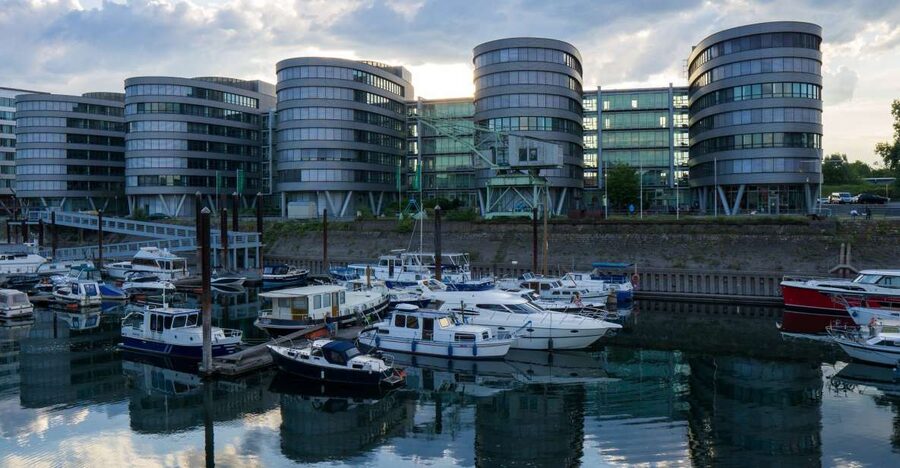
The Five Boats are among the modern architectural features included along the route. They help show how far the Inner Harbour has moved from its former industrial role.
Their name and visual presence make them an easy point of reference during the walk. They are part of the district’s new image, set among water, public spaces, offices, and leisure venues. For anyone interested in urban design, this is one of the most useful parts of the tour because it shows how architecture can help signal a city’s change in direction.
The Five Boats also provide a counterpoint to the old warehouse rows. Rather than presenting Duisburg as either an industrial city or a modern one, the waterfront holds both identities at once. That balance is more interesting than a full demolition and replacement scheme would have been.
The drawback is that the tour description does not promise entry into the buildings. You should expect to view the architecture from the walking route and hear its place in the redevelopment story, not take an interior architecture tour.
Something different for another day:
- Düsseldorf: City Sightseeing Cruise on the Rhine
★ 4.1 · 2,954 reviews - Düsseldorf: 24-Hour Hop-On Hop-Off Ticket
★ 4.2 · 1,685 reviews - Düsseldorf: Brewery Tour with Alt Beer Tastings
★ 4.7 · 1,523 reviews - Düsseldorf: Guided Tour with a Night Watchman
★ 4.7 · 986 reviews
From grain handling to yachts and restaurants
The marina gives the Inner Harbour a very different mood from the one created by its former freight traffic. Yachts now lie at anchor where commercial vessels once served the mills and warehouses.
That change creates the maritime flair highlighted by the tour. The water remains central, but its purpose has shifted. It is no longer mainly a place for cargo handling. It now supports recreation, dining, and a more relaxed waterfront atmosphere.
Restaurants beside the water add to that feeling. You can plan to eat or have a drink before or after the walk, although the tour itself includes only the guided walk. This makes the experience easy to pair with a meal without committing to a full-day activity.
I like this part of the route because it shows structural change in a way that is easy to understand. You do not need a background in planning or industrial economics. The difference between freighters and yachts, loading areas and outdoor dining, is right in front of you.
Still, the Mediterranean atmosphere has limits. This is not a historic coastal town, and you should not expect a traditional fishing harbor. The charm comes from the contrast between the old port infrastructure and its newer leisure use.
Warehouses, museums, and a district still finding its balance
The Inner Harbour’s old warehouse rows are an important part of the experience. They preserve a visual link to the area’s commercial past and stop the redevelopment from feeling like a completely new quarter.
Beside them, modern office complexes show the district’s new economic role. This mix gives you a practical look at urban reuse. The old structures provide memory and texture, while the newer buildings bring offices and activity.
Museums add another layer. The tour passes museums, and two are especially worth considering after the walk. The Küppersmühle Museum of Modern Art is recommended for its modern art collection and its strong connection to the waterfront setting. The Cultural and Urban History Museum offers a different angle, helping you place Duisburg and its changing city life in a broader context.
I would not try to rush through both museums around the tour. The walking experience is only 1.5 hours, but museums require a different pace. Choose the one that fits your interests, or allow a separate block of time if you want both.
The Inner Harbour also hosts events for different age groups. The available details do not specify an event calendar, so check current local information if a particular event is part of your plan. The important point is that the district is not only a preserved industrial quarter. It has been given an active public role.
What the walking pace and weather mean
At 1.5 hours, this is a manageable walk for most people who prefer a short, focused city experience. You get enough time to hear the redevelopment story and see the major types of spaces without signing up for a long trek.
The tour is wheelchair accessible, which is useful for visitors who need a more considerate route. The information does not provide details about every surface or slope, so you may still want to confirm any specific mobility needs before booking.
The walk operates in the rain. That can be a benefit if your schedule is tight, since wet weather does not automatically remove the tour from your day. It also means you should dress for the conditions rather than count on a cancellation.
In bad weather, the waterfront may lose some of its relaxed appeal. You will spend time outdoors beside the harbor, so a waterproof jacket and shoes with good grip are sensible. The positive side is that the tour’s humor and explanation can still carry the experience when the sky does not cooperate.
Is $16 a fair price?
At $16 per person, the tour is priced as an accessible introduction rather than a premium specialist experience. You receive 1.5 hours with a live guide, a clear route through one of Duisburg’s most changed districts, and context that would be difficult to gather from a casual walk alone.
The value is strongest if you are curious about cities, architecture, or the Ruhr area’s industrial past. The guide connects the grain trade, the decline of the mills, the Foster plan, and the present-day marina district. That is a useful framework for understanding what you see.
The value is weaker if you want extensive historical detail, a tour in English, or access to museum interiors. Those are not included. You will need to visit the museums separately and make sure German-language guiding suits you.
For a short city activity, though, the price is easy to justify. You can add it to a museum visit and a meal beside the water, creating a full half-day around the Inner Harbour without paying for a long excursion.
Who will enjoy this Duisburg walk?
I would recommend this experience most strongly to:
- Architecture fans who want to compare Foster’s modern planning with older warehouse buildings.
- Urban-history enthusiasts interested in how former industrial sites gain a new purpose.
- First-time visitors to Duisburg who want an organized introduction to the Inner Harbour.
- Museum visitors planning to see the Küppersmühle or Cultural and Urban History Museum.
- Budget-conscious visitors looking for a short guided activity at $16.
- German speakers who want a local-language explanation with a friendly, humorous tone.
I would be more cautious if you need English guiding or want a tour centered on interiors and museum collections. The waterfront is the subject, and the main experience comes from walking, looking, and listening.
How I would plan the rest of the visit
I would begin at the Mercator fountain, take the guided walk, and then choose one museum for a slower visit. The Küppersmühle Museum of Modern Art makes sense if modern art and architecture are your priorities.
If you prefer city development and local history, the Cultural and Urban History Museum may be the better follow-up. Afterward, sit at one of the waterfront restaurants and look back across the marina. That pause helps you appreciate the scale of the change the guide has explained.
You can also reverse the order, visiting a museum before the walk. The best choice depends on opening times and your energy, since those details are not provided here. Keep some flexibility for a meal or event beside the water rather than packing the schedule too tightly.
Should you book the Duisburg Inner Harbour tour?
Book it if you want a short, inexpensive way to understand Duisburg’s shift from grain port to modern waterfront district. The combination of industrial history, Norman Foster’s planning, yachts, museums, and restaurants gives the walk more substance than a simple sightseeing stroll.
Skip it if you require an English-language guide or expect a long, highly technical architecture tour. For German speakers, families, museum visitors, and anyone interested in the Ruhr area’s changing cities, it is a sensible buy. The positive feedback on the informative and humorous guiding is especially encouraging, and the rainy-weather policy makes it a dependable option in an uncertain forecast.
FAQ
How long does the Duisburg Inner Harbour walking tour last?
The guided tour lasts 1.5 hours.
What language is the tour offered in?
The live tour guide speaks German.
Where does the tour meet?
The guide waits in front of the Mercator fountain, in front of Duisburg Town Hall.
What does the tour include?
It includes the 1.5-hour guided walking tour through Duisburg’s Inner Harbour.
Is the tour wheelchair accessible?
Yes, the tour is listed as wheelchair accessible.
Does the tour operate in rainy weather?
Yes. The tour also takes place when it is raining.
Just added around Dusseldorf
- Whodunnit – Interactive city walk in Düsseldorf★ 4.5 · 3 reviews
- Discover Dusseldorf’s most Photogenic Spots with a Local★ 5.0 · 3 reviews
- Dusseldorf Private Walking Tour With A Professional Guide★ 4.5 · 3 reviews
- Düsseldorf: Media Harbor and Rhinetower★ 5.0 · 4 reviews
- Düsseldorf Old town – guided tour★ 3.5 · 4 reviews
- Filmtour Düsseldorf: From Hollywood to Netflix★ 4.9 · 4 reviews
- Düsseldorf: Girls-only-tour with shots, party, fun & games★ 4.5 · 4 reviews
- Explore Dusseldorf’s Art and Culture with a Local★ 5.0 · 4 reviews
Walking Tours, compared.





Berlin’s Best: 2 Hour Walking Tour Third Reich and the Cold War
Read our review →


Third Reich Berlin: Hitler and WWII Walking Tour
Read our review →Browse the lists this tour appears in