
Reviewed · DUSSELDORF TOURS
Explore Dusseldorf’s Art and Culture with a Local
Art gives Düsseldorf its best introduction. This 90-minute walk links the Tonhalle, Hofgarten, Kunsthalle, Old Town, Rhine, and major art spaces with a local guide, giving you a useful first look at the city’s cultural center. I like the small-group format and the way the route mixes outdoor sights with serious art stops. I also like that the tour finishes at Kunstsammlung, where you can continue exploring independently.
The main consideration is time. Ninety minutes is enough for orientation, not full museum visits, and the $117.16 price is high if you want only a quick stroll through the Old Town. Still, the route covers a lot of ground, and guides such as Anne and Beatriz have shown a warm, flexible approach, including extra care for an older guest who needed a gentler pace.
In This Review
- Key points at a glance
- Why this Düsseldorf art walk works
- Starting at Tonhalle and Wilhelm Kreis
- Hofgarten and the view toward Kö-Bogen
- Kunsthalle and its modern art focus
- Kunstsammlung and Düsseldorf’s art scene
- The Old Town and the heart of Düsseldorf
- Burgplatz and the work called Rivertime
- The Rhine promenade and the city’s cheerful side
- The former North Rhine-Westphalia Parliament
- Guide style and the small-group advantage
- Is $117.16 a fair price?
- Who should book this walk?
- Final booking advice
- FAQ
- Where does the Düsseldorf art and culture tour start?
- Where does the tour end?
- How long does the experience last?
- What language is the tour offered in?
- How much does the tour cost?
- What is included in the price?
- Are food and drinks included?
- How many people can join the tour?
- Is the tour accessible by public transportation?
- Can I cancel for a full refund?
Key points at a glance
- Start at Wilhelm Kreis’s Tonhalle: Begin beside one of Düsseldorf’s notable concert halls and set an arts-focused tone from the first step.
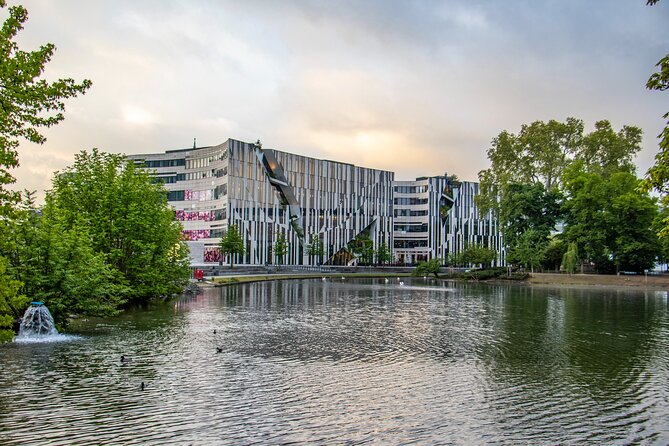
- See modern design from Hofgarten: The historic central park gives you a view toward Daniel Libeskind’s modern Kö-Bogen.
- Connect art and city life: The walk joins galleries, public art, the Old Town, Burgplatz, and the Rhine rather than treating them as separate sights.
- Expect a small group: The experience is designed for about six people, with a maximum of eight.
- Finish beside Kunstsammlung: The walk ends at Ständehausstraße, leaving you free to visit the museum on your own.
- Best for first-time visitors: A local guide can help you decide where to spend more time after the tour.
Why this Düsseldorf art walk works
Düsseldorf can feel split between several identities. It is a city of grand civic buildings, a compact Old Town, a broad Rhine waterfront, and a strong modern art scene. This route puts those pieces together in one short walk.
I like that the experience is not limited to a gallery interior. You see how art fits into the city itself: a concert hall designed by Wilhelm Kreis, a park dating from the 1600s, a modern building by Daniel Libeskind, public art at Burgplatz, and exhibition spaces connected to the city’s present-day cultural life.
The guide is the main reason to book. You are not simply given a list of buildings to photograph. A local can explain what deserves your attention, point out the relationship between older and newer architecture, and help you understand why Düsseldorf has such a strong art reputation.
The format also makes a difference. With a maximum of eight people, you can ask questions without trying to speak over a large crowd. The experience is advertised around a group of six, so the exact number may vary, but this remains a more personal setup than a standard coach or large walking tour.
Other Dusseldorf trips people book alongside this one:
- Düsseldorf: City Sightseeing Cruise on the Rhine
★ 4.1 · 2,954 reviews - Düsseldorf: 24-Hour Hop-On Hop-Off Ticket
★ 4.2 · 1,685 reviews - Düsseldorf: Brewery Tour with Alt Beer Tastings
★ 4.7 · 1,523 reviews
Starting at Tonhalle and Wilhelm Kreis
The meeting point is Tonhalle Düsseldorf, at Ehrenhof 1. This concert hall was built by architect Wilhelm Kreis, giving the walk an immediate architectural focus.
That is a smart starting point. Instead of beginning with a generic city-square introduction, the route opens beside a building tied to music and design. You can expect the guide to use the hall as the first marker in a larger story about Düsseldorf’s arts scene.
The tour is offered in English, which helps if you want explanations rather than a quick photo stop. The supplied details do not specify the interior access to Tonhalle, so plan on seeing it as part of the outdoor walking route unless your guide says otherwise.
If you use public transportation, the meeting point is near public transportation. That makes the start easier to reach, especially if you are staying outside the central area. Give yourself enough time to find Ehrenhof before the scheduled start, since a short tour loses value if you arrive late.
Hofgarten and the view toward Kö-Bogen
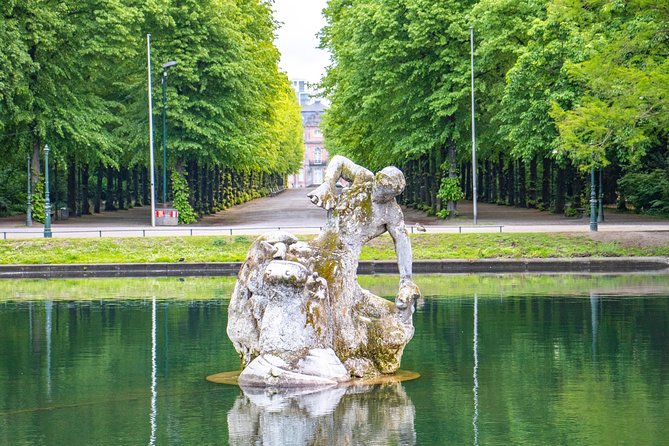
From Tonhalle, the walk continues through Hofgarten, a central park dating from the 1600s. This stop gives the tour a welcome change of pace. You move from a formal arts venue into greenery, then look toward the modern Kö-Bogen by Daniel Libeskind.
I like this contrast. Düsseldorf’s story is not only about preserved buildings and museum rooms. The route shows you an older public park alongside a bold modern creation, making the city’s changing design easier to grasp.
The stop also adds breathing room to the walk. A full art route can become a parade of facades, but Hofgarten gives you space to pause and see how the city organizes public areas. The information provided does not promise a long park visit, so expect a guided pass through the garden rather than free time for a full circuit.
If photography matters to you, the view toward Kö-Bogen should be one of the more useful moments early in the tour. The guide can help you frame the older park and the newer architecture as one scene.
Kunsthalle and its modern art focus
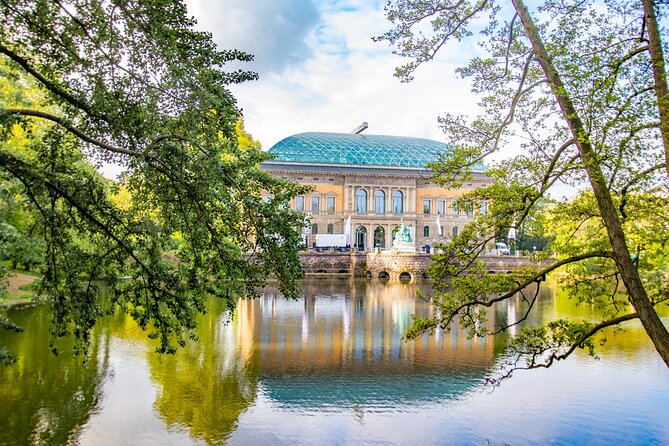
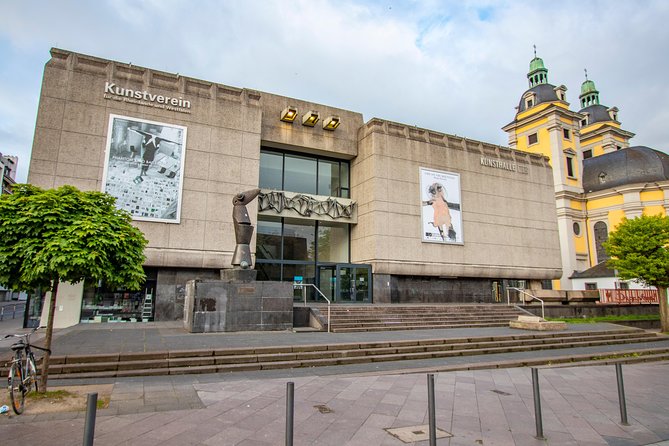
One of the next stops is Kunsthalle, described as a remarkable collection of artistic movements from the last century. It is also known for a famous mural on the wall.
This is an important stop for anyone who wants more than postcard views. The building and its art connect Düsseldorf to the major changes in twentieth-century art. You may not have time to study the collection inside during this walk, but the guide can give you a reason to return.
The mural adds a public, visible element. You do not need a long museum visit to appreciate a work on an exterior wall, and it gives the group something specific to look for rather than a vague discussion of art.
Keep your expectations realistic. This is a sightseeing walk, not an admission-based museum tour. The included feature is a local guide, while food, drinks, snacks, and personal expenses are not included. If you want to enter every museum along the route, you will need extra time and may need to arrange admission separately.
Something different for another day:
- Düsseldorf: Altbier-Safari Beer Walking Tour
★ 4.4 · 1,150 reviews - Düsseldorf: Guided Tour with a Night Watchman
★ 4.7 · 986 reviews - Düsseldorf: Rhine Tower Adult Entry
★ 4.5 · 638 reviews - Dusseldorf: Old Town & Altbier Tour
★ 4.7 · 585 reviews
Kunstsammlung and Düsseldorf’s art scene
The route also includes an excellent museum with an ever-changing collection by some of Germany’s most innovative artists. The final meeting point is Kunstsammlung at Ständehausstraße 1, where the walk ends and you can explore the museum independently.
This ending is useful because it gives you a clear next step. You do not finish in an anonymous street and have to guess what to do next. If the guide’s introduction raises your interest in Düsseldorf’s art scene, you can continue at the museum after saying goodbye.
The word ever-changing matters here. A temporary collection means the precise works on view can change, so the tour is better understood as an orientation to the institution and its role than as a promise to see particular artists.
I would ask the guide at the start how much time remains for questions at the final stop. Since the experience finishes outside the museum, you should also check opening arrangements separately if you plan to go in immediately. The provided details confirm that you can explore on your own, but they do not include museum admission or opening times.
The Old Town and the heart of Düsseldorf
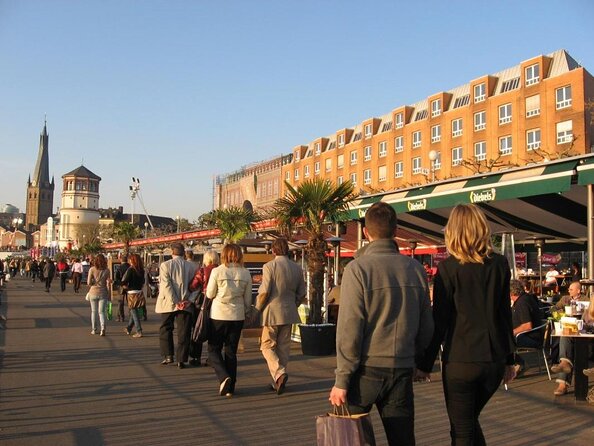
The walk reaches the heart of Düsseldorf, an area described as covering about half a square kilometre. This is the compact center where the city’s historic identity becomes easiest to feel.
For a first visit, this section may be just as useful as the formal art stops. You get a sense of the city’s scale, the relationship between its public spaces, and where you may want to return for more time later.
The tour does not include food or drinks, so do not expect a scheduled café break or tasting. That keeps the 90-minute route moving, but it also means you should handle refreshments before or after the walk.
I see the Old Town section as practical orientation. If you are deciding where to spend your evening, the guide can help you understand which central areas are close together. The available information does not name individual restaurants, bars, or historic buildings, so the value here comes from the local conversation and the route itself, not a promised food stop.
Burgplatz and the work called Rivertime
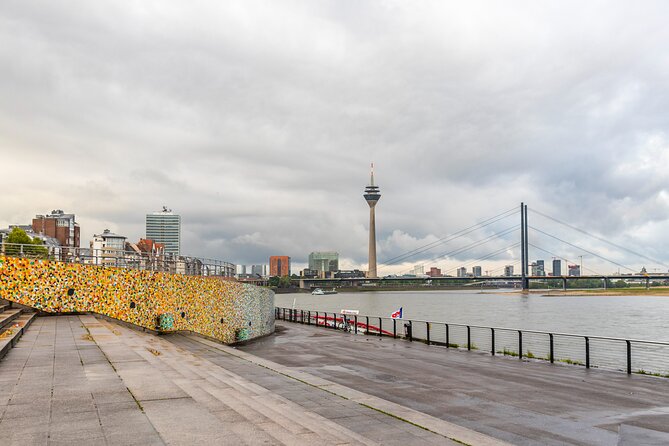
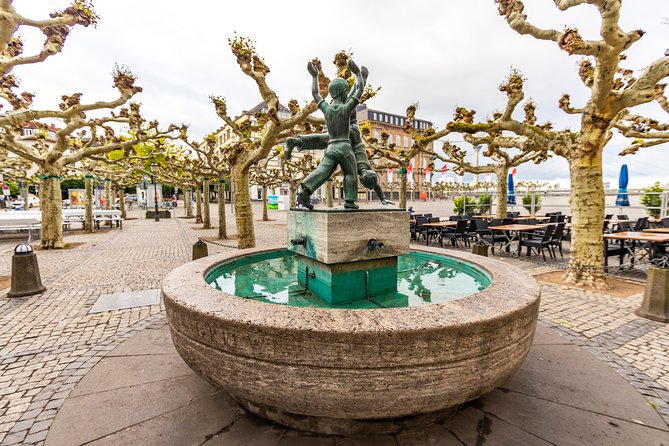
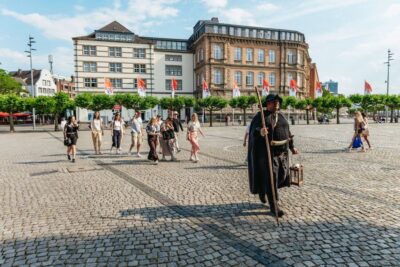
Burgplatz is one of the more distinctive public spaces on the route. It received recognition as one of Germany’s most beautiful post-World War II places, and the tour points out Rivertime on the side walls of the staircase.
That detail makes this more than a quick square crossing. Public art can be easy to miss when you are walking alone, especially when it is placed along a staircase rather than on a museum wall. A guide gives you a better chance of noticing the work and understanding why the location matters.
Burgplatz should appeal to you if you like art that shares space with ordinary city life. You are not being led only from one admission desk to another. The route treats a staircase, a square, and a riverfront as part of Düsseldorf’s cultural offering.
The stop may feel brief because the whole experience is tightly timed. Take note of the work and the setting, then return later if you want a slower look. The tour’s job is to show you what is here and help you remember it.
The Rhine promenade and the city’s cheerful side
The Rhine is described as Düsseldorf’s lifeline, connecting the city to the river and reflecting its cheerful spirit. The promenade gives the walk an open finish to the central-city portion.
I like the change in mood. After concert architecture, museums, public art, and compact Old Town streets, the riverfront gives you room to look outward. It also shows why Düsseldorf is more than an arts destination. The river is part of daily city life and a key piece of its identity.
The supplied information does not promise a cruise, river commentary of a fixed length, or a scheduled stop for drinks. You should think of this as a walking viewpoint and city-orientation section.
If you have limited time in Düsseldorf, a route that includes the Rhine is useful because it helps you locate the waterfront early in your visit. You can then decide if you want to return for a longer walk after the tour.
The former North Rhine-Westphalia Parliament
Another notable stop is a grand neo-Renaissance building that once served as the seat of the Parliament of North Rhine-Westphalia. It is now known for cutting-edge art exhibitions.
This building neatly sums up the tour’s central idea: Düsseldorf’s cultural life does not fit into one period or one style. A formal government building now associated with new art gives you a clear example of old architecture being used in a contemporary setting.
The stop is especially useful if you enjoy architecture with a change of purpose. You can see how civic buildings may gain a second life as cultural spaces. As with the other museums and exhibition venues, the experience does not state that admission is included, so treat it as a guided exterior or orientation stop unless told otherwise.
The route’s value comes from these connections. You see how music, public parks, modern design, government, museums, and the river fit within a relatively compact part of Düsseldorf.
Guide style and the small-group advantage
The strongest praise attached to this experience concerns the guides’ energy and personal attention. Anne was described as enthusiastic and considerate with a senior guest, adapting the walk to her mother’s needs. That suggests a useful level of human flexibility, especially for anyone who prefers not to be rushed.
Beatriz was praised for giving a newcomer a better feel for Düsseldorf and helping identify where to explore next. That is exactly what a short introductory tour should do. You may not leave knowing every gallery or street, but you should have a clearer plan for the rest of your stay.
The tour has a maximum of eight people and is presented as a group of six. That is small enough for conversation and questions, though the exact group size is not guaranteed to be six.
Most people can participate, and service animals are allowed. No special fitness requirement is listed, but this is a walking tour with several stops, so you should tell the guide about mobility concerns at the beginning. The positive experience with an older guest suggests that an adjusted pace may be possible, but it is best to ask directly rather than assume.
Is $117.16 a fair price?
At $117.16 per person, this is not a budget walking tour. The price makes more sense if you place a high value on a local guide, a small group, and a carefully linked art-and-city route.
You are paying for access to a person who can shape the walk around your questions, not for food, drinks, museum admission, or a long list of included extras. If you mainly want to see the Old Town and Rhine, you can likely find a cheaper way to walk those areas on your own.
I think the price is easier to justify for a first visit, a short stay, or an art-focused trip. The route covers enough distinct places to help you plan the rest of your time, and the small group should make the discussion more personal than a large public tour.
Group discounts are available, though the amount is not specified. If you are booking for several people, check the final price before paying. Free cancellation is allowed up to 24 hours before the start time for a full refund. Changes or cancellations within 24 hours are not accepted for a refund.
Who should book this walk?
I would recommend it to a first-time visitor who wants a quick, guided introduction to Düsseldorf’s art and central sights. It also suits anyone who likes architecture, public art, modern museums, and riverfront views in one outing.
It is a good match for a small family group or friends who want to ask questions without joining a large crowd. The positive experience with Anne and the senior guest also makes it worth considering if someone in your party needs a thoughtful, adjustable pace.
I would hesitate if you want extended museum time, a food experience, or a low-cost orientation walk. The 90-minute schedule moves quickly, and the price is harder to defend if you will not use the guide’s local perspective.
Final booking advice
Book this experience if you want Düsseldorf explained through its art, architecture, parks, Old Town, and Rhine rather than through a simple list of historical dates. The best reason to go is the combination of a small group and a local guide who can help you decide what deserves more time later.
Skip it if you prefer to wander alone and enter museums at your own pace. For everyone else, this looks like a polished first look at Düsseldorf, with enough specific stops to make the city easier to navigate after the guide says goodbye.
FAQ
Where does the Düsseldorf art and culture tour start?
It starts at Tonhalle Düsseldorf, Ehrenhof 1, 40479 Düsseldorf, Germany.
Where does the tour end?
It ends at Kunstsammlung, Ständehausstraße 1, 40217 Düsseldorf, Germany.
How long does the experience last?
The walking tour lasts approximately 1 hour and 30 minutes.
What language is the tour offered in?
The experience is offered in English.
How much does the tour cost?
The listed price is $117.16 per person.
What is included in the price?
A local guide who wants to show you Düsseldorf is included.
Are food and drinks included?
No. Food, drinks, snacks, and personal expenses are not included.
How many people can join the tour?
The experience is designed for a small group of about six people and has a maximum of eight participants.
Is the tour accessible by public transportation?
Yes. The meeting point is near public transportation.
Can I cancel for a full refund?
Yes. You can cancel at least 24 hours before the experience start time for a full refund. Cancellations or changes made less than 24 hours before the start time are not accepted for a refund.
Just added around Dusseldorf
- Discover Dusseldorf’s most Photogenic Spots with a Local★ 5.0 · 3 reviews
- Whodunnit – Interactive city walk in Düsseldorf★ 4.5 · 3 reviews
- Dusseldorf Private Walking Tour With A Professional Guide★ 4.5 · 3 reviews
- Düsseldorf: Media Harbor and Rhinetower★ 5.0 · 4 reviews
- Düsseldorf Old town – guided tour★ 3.5 · 4 reviews
- Filmtour Düsseldorf: From Hollywood to Netflix★ 4.9 · 4 reviews
- Düsseldorf: Girls-only-tour with shots, party, fun & games★ 4.5 · 4 reviews
- Duisburg: Scavenger Hunt Self-Guided Tour★ 3.7 · 5 reviews
Dusseldorf Tours, compared.



Browse the lists this tour appears in