
Reviewed · WALKING TOURS
Berlin: Sightseeing Walking Tour of the Top 20 Attractions
Berlin rewards a good pair of walking shoes. This fast-moving tour links the Reichstag, Brandenburg Gate, Checkpoint Charlie, and Museum Island into one clear route, while local guides add personal stories, Berlin humor, and useful advice for the rest of your stay. I especially like the mix of famous landmarks and difficult history, plus the chance to ask questions as you walk.
I also like the flexible format. Private and small-group options are available, and the guide can adjust the conversation to your interests. The main drawback is the pace: about 6 kilometers in three hours is a lot of ground, and you will usually see major sites from outside rather than enter museums or buildings.
In This Review
- Key points to know before booking
- A practical way to meet Berlin in three hours
- Starting beside the Paul-Löbe-Haus and Federal Chancellery
- Brandenburg Gate and the government district
- The Holocaust Memorial and Berlin’s difficult memory
- Potsdamer Platz and the rebuilt center
- Checkpoint Charlie and the Berlin Wall story
- Martin-Gropius-Bau and the Topography of Terror
- Gendarmenmarkt, Bebelplatz, and Prussian Berlin
- Lustgarten, Berlin Cathedral, and Museum Island
- Finishing at Friedrichsbrücke
- How the guides shape the experience
- Walking effort, weather, and access
- Who gets the best value from this walk?
- Should you book the Berlin Top 20 walk?
- FAQ
- How long does the Berlin sightseeing walking tour last?
- What is the price of the tour?
- Where does the tour meet?
- What time does the tour start?
- Which languages are available?
- Is the tour private or shared?
- Is the walking tour wheelchair accessible?
- Can I cancel or pay later?
Key points to know before booking
- A six-kilometer route covers Berlin’s main story: You move from the government district through Nazi and Cold War sites to Museum Island.
- History comes with a human voice: Guides use personal stories, anecdotes, politics, and dry Berlin humor instead of offering dates alone.
- The route includes hard subjects: The Holocaust Memorial, Topography of Terror, Bebelplatz, and Berlin Wall history make this more than a postcard walk.
- It is built for first-time orientation: You finish near Friedrichsbrücke, with a useful sense of where central Berlin’s districts and sights fit together.
- The guide matters: Carlos, Carlo, Antonella, and Max have all been praised for warmth, personal insight, and strong storytelling.
- Plan for a real walk: Wear comfortable shoes, bring water, and be ready for changing weather.
A practical way to meet Berlin in three hours
At $94 per person, this is not Berlin’s cheapest walking tour. It can still be good value if you want a private guide or a small group and hope to cover a lot in one morning or afternoon.
The price pays for structure, local commentary, and a route that connects places many people visit separately. You are not just ticking off sights. You are moving through Berlin’s government quarter, Prussian center, Nazi memorial sites, Cold War landmarks, and Museum Island in one continuous story.
The tradeoff is time. Three hours sounds generous until you allow for photographs, questions, traffic crossings, and the sheer number of stops. You will get an overview rather than a long visit inside any one place. I would use this tour early in a Berlin visit, then return on your own to the sites that deserve more time.
Tours begin daily at 10:00 AM and 2:00 PM. The meeting point is in front of the main entrance to the Paul-Löbe-Haus at Konrad-Adenauer-Straße 1, opposite the Federal Chancellery. Look for a TourguideMe guide.
More Walking Tours in Berlin
- Discover Berlin Half-Day Walking Tour
★ 5.0 · 9,624 reviews - Berlin: Third Reich and Cold War 2 Hour Walking Tour
★ 4.9 · 6,830 reviews - Berlin: Discover Berlin Walking Tour
★ 4.9 · 5,998 reviews
Starting beside the Paul-Löbe-Haus and Federal Chancellery
The opening location places you in Berlin’s modern government district, beside the broad spaces around the Spree. The Paul-Löbe-Haus is part of the federal parliamentary complex, and the nearby Federal Chancellery gives the first section a distinctly modern political feel.
From here, the route visits the German Chancellery and the Reichstag. These are important orientation points because they show the capital as a working seat of government, not only as a collection of memorials and grand old buildings.
The Reichstag is one of Berlin’s key sights, but the tour description does not promise entry inside. Expect guided sightseeing and exterior explanation rather than a dome visit. If seeing the dome is important to you, arrange that separately and do not assume the walking tour includes it.
Brandenburg Gate and the government district
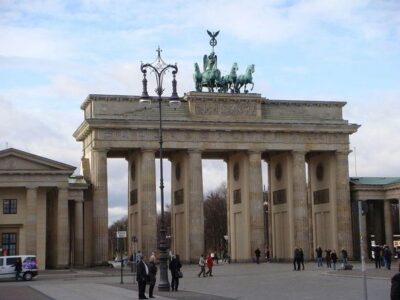
Brandenburg Gate is the natural symbol of Berlin, and the guide uses it to connect several eras of the city’s story. It began as a Prussian gateway, later became a Cold War emblem near the Wall, and now represents a reunited capital.
The value here is the context. A quick photograph can make the gate seem like a single monument, but its meaning changed as Berlin changed around it. Your guide can help place it within the nearby government quarter, the former division of the city, and the political events that made it famous around the world.
This is also one of the tour’s busiest sightseeing points. You will want a camera ready, but do not expect a quiet, private pause. The route is designed to keep moving.
The Holocaust Memorial and Berlin’s difficult memory
The Memorial to the Murdered Jews of Europe is one of the most powerful stops on the route. Its field of concrete blocks invites a personal response, but the site can be confusing without some explanation. A guide helps place it within Germany’s effort to confront the Holocaust in the center of the capital.
The schedule allows guided commentary and free time here. That matters. You are not rushed through every stop with a speech while walking. You can pause, look around, and take in the memorial’s unusual form.
This is a serious section of the tour. The guide’s humor may help keep the overall walk lively, but the memorial itself calls for quiet attention. If you prefer to spend a long time at the nearby underground information center, ask how much time the group can spare. The three-hour format may not allow a full visit.
Something different for another day:
- Berlin: Reichstag, Dome and Government District Guided Tour
★ 4.7 · 18,288 reviews - Berlin: 1-Hour City Tour by Boat with Guaranteed Seating
★ 4.3 · 16,993 reviews - Berlin: Boat Tour Along the River Spree
★ 4.4 · 11,252 reviews - Berlin: Hop-on Hop-off Bus Tour with Live Commentary
★ 4.3 · 8,579 reviews
Potsdamer Platz and the rebuilt center
Potsdamer Platz gives you a sharp change of mood. This was once a major central square, then a divided and heavily damaged zone, and later a showcase of modern redevelopment.
The stop works well in a walking overview because it demonstrates how quickly Berlin’s appearance can change. Old political borders, wartime destruction, the Wall, and new construction all meet in the same part of town.
I would pay attention to the guide’s explanation of what disappeared and what was rebuilt. Without that context, Potsdamer Platz can look like a modern business district with little connection to the rest of Berlin. With it, the area becomes another chapter in the city’s repeated reinvention.
Checkpoint Charlie and the Berlin Wall story
Checkpoint Charlie is one of the clearest reminders of Berlin’s Cold War division. The famous crossing point attracts plenty of attention, and the surrounding area has a strongly commercial tourist feel. That is precisely why a local guide is useful here.
You can learn how the city was divided, how people moved between East and West, and how the Wall shaped ordinary life. The route also includes longer sections of Wall-related history than a basic top-ten walk, so this is not just a quick stop for a photograph beside the checkpoint sign.
Do not expect the original border crossing to survive as a complete historic site. The location is valuable mainly for the story attached to it and for understanding how the surrounding streets functioned during the divided years.
Martin-Gropius-Bau and the Topography of Terror
The walk continues past Martin-Gropius-Bau, a grand exhibition building near the former border area. The guide treats it as part of the city’s architectural and historical setting, not as a scheduled museum visit.
Nearby, the Topography of Terror memorial occupies the grounds of the former Gestapo headquarters. This is one of the tour’s strongest additions for anyone who wants more than royal buildings and famous photo stops. It focuses on the machinery of Nazi persecution and gives physical meaning to a place that might otherwise look like an ordinary city block.
The outdoor section can be especially useful in a short tour because it connects the location to the wider streetscape. Still, the full documentation center requires more time than this walk provides. I would return later if you want to read the exhibitions carefully.
Gendarmenmarkt, Bebelplatz, and Prussian Berlin
Gendarmenmarkt offers a calmer architectural pause, with its grand square and historic buildings. It helps shift the story from the twentieth century back to the Prussian capital and the city’s formal civic design.
Next comes Bebelplatz, a beautiful square with a painful memory. It is associated with the Nazi book burning of 1933, and the ground-level memorial gives the site a quiet, unsettling power. This is another place where a guide’s explanation changes what you notice.
The route along Unter den Linden then brings together Berlin’s ceremonial boulevard, Prussian history, and the city’s cultural institutions. The itinerary includes the New City Palace, now known as the Humboldt Forum building, as well as other major sights along the central avenue.
The exact sequence of the additional stops may vary, since the experience is advertised as a Top 20 route but only the principal locations are individually named. That flexibility can work in your favor if you have a particular interest, but ask the guide at the start how the day’s route will run.
Lustgarten, Berlin Cathedral, and Museum Island
Lustgarten is a useful place to see Berlin’s architectural layers in one view. From here, the cathedral and surrounding museums create one of the city’s most impressive central ensembles.
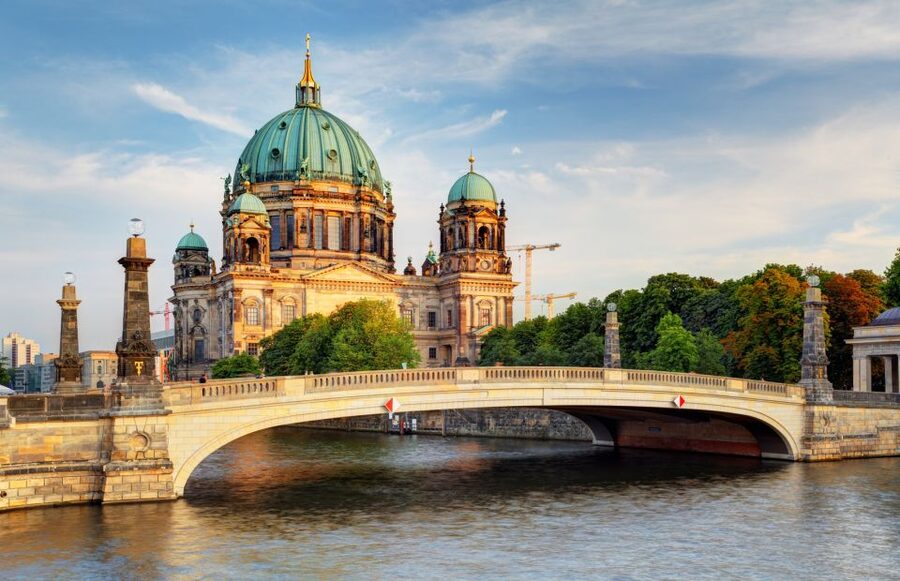
Berlin Cathedral is included as a guided sightseeing stop. The tour does not list an interior visit, so plan on hearing the building’s story and viewing it from outside. Its dome and grand facade make it one of the easiest places on the walk to appreciate with a camera in hand.
Museum Island is the final major district on the route. Five museums occupy this area, including the Alte Nationalgalerie. The tour includes sightseeing and explanation, not a museum admission. That distinction matters because a single museum can take several hours by itself.
If you already have tickets for one of the museums, this walk can help you choose where to return. If art and archaeology are your main reasons for visiting Berlin, you may prefer to schedule the walking tour on another day so you are not trying to combine both activities.
Finishing at Friedrichsbrücke
The tour ends at Friedrichsbrücke, close to Museum Island and the central riverfront. This is a useful finishing point rather than an isolated drop-off. You can continue sightseeing in the museum district, stop for food, or use Berlin’s public transport to reach another neighborhood.
Ending here also makes the tour practical for first-time visitors. You finish with a mental map of central Berlin instead of simply returning to the starting point. The guide can offer tips for food, nightlife, and neighborhoods to explore afterward, which is one of the better uses of a local perspective.
How the guides shape the experience
The strongest feature is the guide-led storytelling. The experience is available in English, Spanish, and German, and the guides are described as certified local professionals. Small groups and private bookings should give you more room to ask questions than a large city walk.
The personalities attached to this experience have been a major part of its appeal. Carlos has been praised for his warmth, care, city knowledge, and ability to keep people moving in cold rain. Carlo has been described as a native Berliner who added personal stories about living through the city’s changes. Antonella and Max were also singled out for friendly, capable guiding.
Those details tell you what to look for: not just a guide who recites facts, but someone who can explain what Berlin felt like during division and reunification. Your guide will not necessarily be one of these named people, but the best version of the tour depends heavily on that personal touch.
The walk can also run beyond three hours. One group continued for at least 30 extra minutes because the guide kept answering questions and expanding on the sights. That sounds generous, but you should not count on extra time if you have a fixed appointment afterward.
Walking effort, weather, and access
The route covers approximately 6 kilometers. That is manageable for many people, but it is still a serious urban walk, especially when you add standing at each stop and walking on hard surfaces.
Comfortable shoes are essential. Bring a water bottle, and carry rain protection because tours operate in all weather. One particularly rainy outing continued successfully because the guide included a stop for a hot drink, but that kind of adjustment depends on the day and group.
The tour is listed as suitable for all ages and wheelchair accessible. Private or small-group arrangements may make it easier to discuss mobility needs in advance. Since the route is long and city conditions can change, contact the provider before booking if you require specific assistance.
Who gets the best value from this walk?
I would recommend it most strongly to first-time visitors who want a clear overview before exploring Berlin alone. It also fits couples, families, small teams, and curious locals who want a guided look at the city’s political and historical center.
It is a good match if you enjoy asking questions, hearing personal anecdotes, and moving between many sites. It is less suitable if you want long museum visits, extended time at memorials, or a slow photography walk.
The experience has earned a 4.5 rating from 196 bookings, and the most consistent praise has focused on guide warmth, historical passion, personal stories, and the amount covered in three hours. The repeated warning is equally clear: you may be tired at the end. That is not a flaw for everyone. It means the tour gives you a substantial first look at Berlin.
Should you book the Berlin Top 20 walk?
Book this tour if you want a broad, serious introduction to Berlin and value a local voice more than a slow visit inside one attraction. At $94, it makes the most sense as a private or small-group experience, especially when you want the guide to adapt the discussion to your interests.
Skip it if you dislike long walks or already have a tight museum schedule. For most first-time visitors, though, this route offers a useful bargain in time: government Berlin, Prussian Berlin, Nazi Berlin, Cold War Berlin, and reunited Berlin, all before the afternoon is over.
FAQ
How long does the Berlin sightseeing walking tour last?
The tour lasts three hours, or 180 minutes. The route covers approximately 6 kilometers on foot.
What is the price of the tour?
The listed price is $94 per person.
Where does the tour meet?
Meet in front of the main entrance of the Paul-Löbe-Haus, opposite the Federal Chancellery, at Konrad-Adenauer-Straße 1, 10557 Berlin, Germany.
What time does the tour start?
Tours are scheduled daily at 10:00 AM and 2:00 PM. You should check availability for the starting time offered on your date.
Which languages are available?
The live guide is available in English, Spanish, and German.
Is the tour private or shared?
Private and small-group options are available. The experience is designed for a more personal format.
Is the walking tour wheelchair accessible?
Yes. The activity is listed as wheelchair accessible.
Can I cancel or pay later?
You can cancel up to 24 hours in advance for a full refund. A reserve-now, pay-later option is also available.
Just added around Berlin
- Berlin: Guided Private Bike Tour to Explore the Highlights★ 5.0 · 12 reviews
- Berlin: Decolonial Berlin Castle/ Humboldt Forum Guided Tour★ 4.4 · 12 reviews
- Private Third Reich Walking Tour of Berlin★ 5.0 · 12 reviews
- Berlin: Hop-On Hop-Off Bus & LEGOLAND Discovery Centre★ 4.1 · 12 reviews
- Berlin Bike and Electric Bike Rentals★ 4.5 · 12 reviews
- Private Sightseeingtour im Taxi nach Potsdam und Sanssouci★ 5.0 · 12 reviews
- Berlin: Berlin Wall and the Cold War Walking Tour★ 4.7 · 12 reviews
- Berlin: Private Guided Tour of the Main Sights★ 5.0 · 13 reviews
Walking Tours, compared.


Berlin’s Best: 2 Hour Walking Tour Third Reich and the Cold War
Read our review →
Third Reich Berlin: Hitler and WWII Walking Tour
Read our review →Browse the lists this tour appears in