
Reviewed · THIRD REICH & WWII TOURS
World War 2 Hamburg Private Guided Tour
Hamburg remembers with bricks, gardens, and silence. This private World War II tour connects the city’s interwar troubles, Nazi rule, Jewish history, air raids, bunkers, and postwar remembrance in one carefully ordered route. I like that you are not left to find scattered memorials on your own, and I like the private format, which gives you room to stop and ask questions.
The tour’s strongest feature is its range. You move from the First World War and the Treaty of Versailles to Kristallnacht, deportations, forced remembrance, deception tactics, and the destruction of Hamburg in 1943. Guides Evan and Sarah have both received warm praise for their ability to tailor the experience and explain difficult subjects clearly. The main consideration is the price: $714.85 per group, which is excellent value for a large group but costly for one or two people.
In This Review
- Five things to know before you book
- Why this Hamburg history tour is different
- Starting at Laeiszhalle with the years before 1933
- Sievekingplatz and the collapse of public institutions
- Feldstraße and Hamburg’s huge bunker
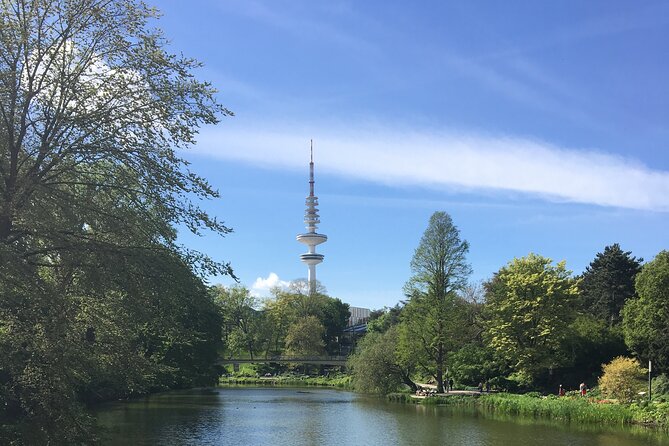
- Planten un Blomen, a park with a darker past
- Five memorials at Dammtordamm
- Turmbar and the disguised bunker
- One hour in Grindel, Hamburg’s former Jewish district
- Jungfernstieg and the attempt to fool Allied bombers
- Rathausmarkt and Nazi power in the city center
- Afrikahaus and the colonial roots of racial policy
- St. Nikolai, Hamburg’s ruined wartime church
- Price, pace, and who gets the best value
- Should you book the World War II Hamburg tour?
- FAQ
- Where does the tour start?
- Where does the tour end?
- Can I be dropped off somewhere else?
- How long does the tour last?
- Is the tour private?
- Is the tour offered in English?
- Are admission tickets included?
- Is the tour suitable for someone with limited fitness?
- What is the cancellation policy?
Five things to know before you book
- The route covers more than wartime battles: You begin with World War I, hyperinflation, antisemitism, and the political failures that helped prepare the way for Nazi rule.
- You see several kinds of bunker: Feldstraße is linked to one of Hamburg’s huge wartime bunkers, while Turmbar offers a quick look at a bunker disguised as a water tower.
- Grindel receives a full hour: This former Jewish district is the tour’s most detailed stop, covering deportations, Kristallnacht, book burning, the Born Synagogue, and the Talmud Torah School.
- Planten un Blomen has a troubling past: Today it is a pleasant city park, but the tour addresses executions, propaganda, a human zoo, and a displaced persons camp connected with the site.
- St. Nikolai is the visual finale: The ruined church recalls the 1943 bombing, victims of war and terror, the Neuengamme concentration camp, and postwar reconciliation with the United Kingdom.
Why this Hamburg history tour is different
Many city tours treat World War II as a short chapter between older sights. This route gives the subject its full setting. You look first at the pressures after World War I, then at the breakdown of political and judicial systems, and only afterward at Nazi persecution and wartime destruction.
That order matters. You are less likely to see the Nazi period as an isolated interruption in German history. Instead, you follow a chain of events: defeat in World War I, economic hardship, growing antisemitism, political radicalization, the weakening of institutions, dictatorship, persecution, war, and the hard work of remembrance afterward.
I also like the private structure. Your group can ask for more explanation at a memorial, move past a point that feels too familiar, or spend more time on Jewish Hamburg and less time on military details. The tour is offered in English, and only your party participates.
The guide also helps with orientation. Hamburg’s memorials are spread through different neighborhoods, and some are easy to pass without noticing. Having someone lead you from the city center toward bunkers, Grindel, and Feldstraße makes the experience more coherent than visiting each place separately.
More Third Reich & WWII Tours:
- Berlin: Third Reich and Cold War 2 Hour Walking Tour
★ 4.9 · 6,830 reviews - Munich: Third Reich & WWII Walking Tour
★ 4.6 · 6,181 reviews - Berlin’s Best: 2 Hour Walking Tour Third Reich and the Cold War
★ 5.0 · 5,486 reviews
Starting at Laeiszhalle with the years before 1933
The tour begins at the memorial for those killed in both world wars near Schleusenbrücke, close to Laeiszhalle. The first 20 minutes set up the period before Nazi power.
You will hear about World War I, the Treaty of Versailles, the economic shock of hyperinflation in the 1920s, and the growth of antisemitism. This opening is useful because Hamburg’s wartime story did not begin with the first bombs. The social and political damage of the earlier period shaped what followed.
This part may feel less dramatic than a bunker or ruined church, but it is essential. If you want a tour focused only on military history, you may find the opening slower. I think it pays off, especially for anyone trying to understand how ordinary political institutions can weaken over time.
The meeting point is specific, but you should allow a little extra time to locate the memorial and arrive ready to walk. The tour begins in central Hamburg and finishes at the large bunker on Feldstraße.
Sievekingplatz and the collapse of public institutions
At Sievekingplatz, the guide turns to Hamburg’s judicial and political systems in the 1930s. The stop lasts about 15 minutes, but the subject is large: how institutions were undermined and what followed when law and politics no longer offered meaningful resistance.
This is one of the route’s more thoughtful choices. A war tour can focus on weapons, air raids, and military leaders. Here, the emphasis is also on the systems that allowed persecution and dictatorship to take hold.
You might find this stop most useful if you enjoy civic and political history. It is not a museum visit, and admission is free, so the quality of the explanation matters more than the physical setting. That is another reason a private guide helps. You can ask how local government and justice changed rather than simply receiving a list of dates.
Feldstraße and Hamburg’s huge bunker
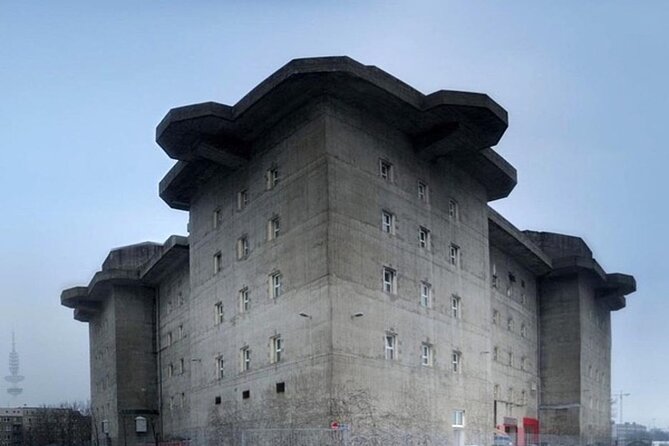
Feldstraße introduces one of the city’s most visible wartime structures. The large bunker here was built during World War II and is now being repurposed with a skyline garden.
The contrast is striking. A structure made for protection during air raids now belongs to a changing modern city. The tour does not treat the bunker as a novelty alone. It places the building within the wider story of Hamburg, where more than 2,000 bunkers were built during the war.
The stop itself is listed at about 15 minutes, and the tour ends here. That makes Feldstraße both an early subject and the final practical destination. If you want to see the bunker’s interior or visit a specific attraction there, ask the guide what is included. The listed admission-free stop is an exterior visit, while the separate paid tower experience at St. Nikolai is the only entrance fee specifically identified.
A few more tours and experiences worth a look
- Your private 3-hour Hamburg driving tour with a former policeman
★ 5.0 · 304 reviews - Hamburg: Private Tour Red Light District Walking Tour
★ 4.7 · 227 reviews - Hamburg: Private Couples’ Photoshoot and Walking Tour
★ 4.9 · 212 reviews - Private 2-Hour Hamburg Highlights Walking Tour
★ 5.0 · 105 reviews
Planten un Blomen, a park with a darker past
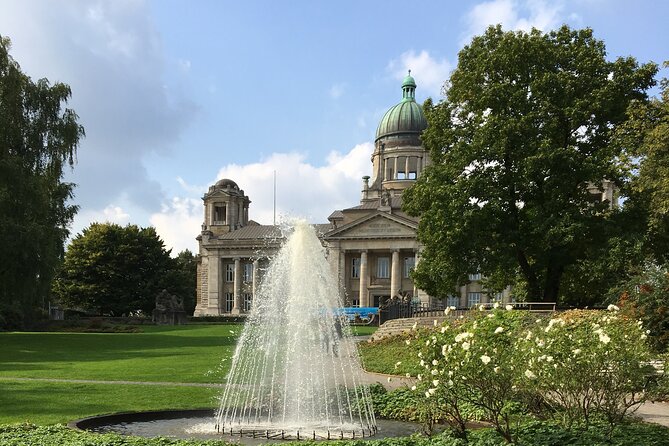
Planten un Blomen is one of the most unsettling stops because the present-day setting can seem so peaceful. The tour spends about 30 minutes explaining how the area was connected with executions during World War II, propaganda, a human zoo, and a displaced persons camp.
You should give this stop your full attention. Its value comes from the clash between what you see now and what the site once represented. Public spaces can carry more than one memory, and Hamburg’s pleasant park setting makes that point sharply.
The subjects are serious and may be difficult, particularly the discussion of executions and displaced people after the war. The guide’s role is important here. A private format gives you the chance to ask for context rather than moving on with unanswered questions.
This is also a good reminder that wartime history is not confined to forts and ruins. Parks, squares, schools, courts, and ordinary streets can all be part of the story.
Five memorials at Dammtordamm
At the Kriegerdenkmal am Dammtordamm, you examine five war memorials from different periods. Together they show how public memory changes, and how the same city can use monuments to express very different political ideas.
The stop takes about 25 minutes. Rather than treating every monument as a simple tribute, the guide helps you consider who created it, what message it carried, and how people in modern Hamburg understand it now.
The location includes memorials connected with more than one era. That makes it a useful place to compare remembrance after World War I, remembrance under Nazi rule, and later efforts to confront the consequences of war and dictatorship.
I like this stop for readers who want to understand present-day Germany’s culture of remembrance. It is less about one dramatic event and more about how a city chooses what to honor, question, or reinterpret.
Turmbar and the disguised bunker
Turmbar is a very short stop, about five minutes, but it offers a memorable detail. What appears to be a water tower is actually one of Hamburg’s more than 2,000 World War II bunkers.
Do not expect a long visit here. The point is recognition. Once the guide identifies the structure, you begin to see how wartime construction was fitted into the city in ways that could be easy to miss.
This quick stop works well in a walking route because it adds another type of bunker to the story. Feldstraße presents a massive, obvious structure. Turmbar shows how defensive buildings could be disguised or made to resemble useful civic infrastructure.
One hour in Grindel, Hamburg’s former Jewish district
Grindel is the heart of the tour for many people. You spend about an hour in an area that once held a substantial Jewish community, examining who lived there, how the district developed, what happened during the Nazi period, and what the area is like today.
The guide covers the deportation of Hamburg’s Jewish residents, Kristallnacht in 1938, the 1933 book burning, the Born Synagogue, and the Talmud Torah School. These subjects give the stop both personal and institutional scale. You learn about a community, but also about the buildings, schools, and public actions that shaped its fate.
This is where the private format earns its keep. An hour allows questions about specific sites and names, and you can ask the guide to clarify terms or explain how the neighborhood changed. Sarah has been praised for explaining the period clearly and for pointing out monuments and shelters that might otherwise be missed.
You should not treat Grindel as a quick photo stop. The subject demands time, and the hour is the right length for a serious introduction. If Jewish history is your main reason for booking, tell the provider in advance so the guide can shape the emphasis around your interests.
Jungfernstieg and the attempt to fool Allied bombers
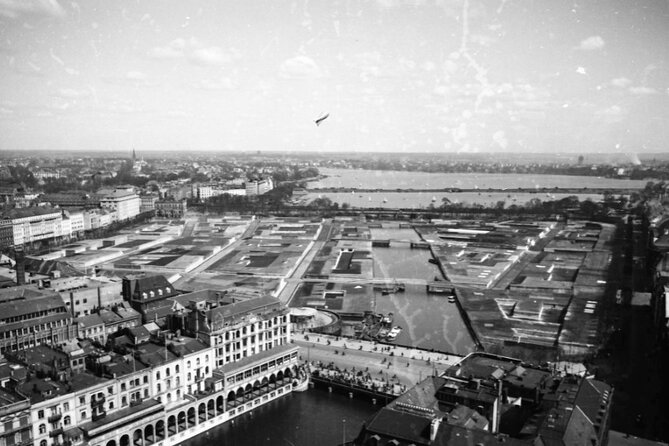
At Jungfernstieg, the tour explains how Hamburg tried to create a decoy city center during World War II to draw bombs away from the real one. The stop lasts around 10 minutes.
This is a compact but memorable lesson in wartime deception. It shows that the city’s response to bombing involved more than shelters and emergency measures. Authorities also tried to manipulate what enemy aircraft would see from above.
The subject is unusual, which makes it a welcome change from memorials and persecution sites. At the same time, the brief timing means you should expect an explanation rather than an extended examination of aerial warfare.
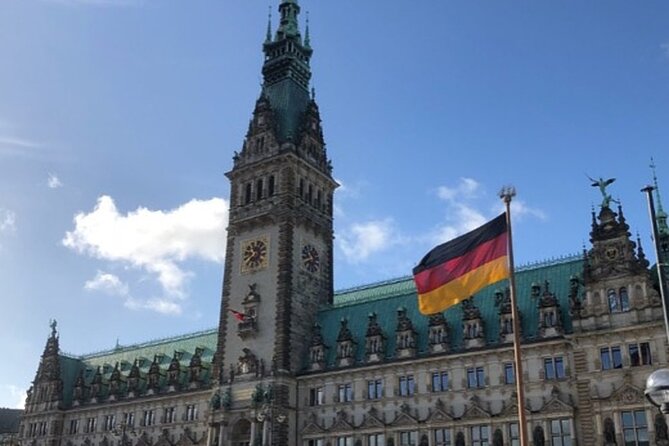
Rathausmarkt and Nazi power in the city center
Rathausmarkt is the symbolic and literal seat of Hamburg’s power. Here you learn how the Nazi party used the town hall and surrounding square during World War II.
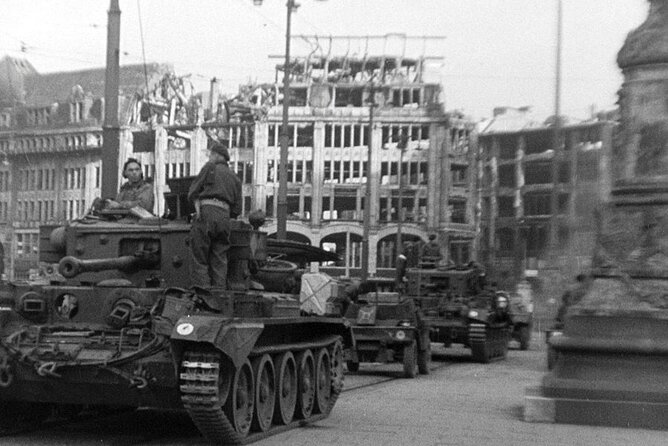
The area contains memorials connected with political opposition to the Nazi party, the 1933 book burnings, and World War I propaganda in Nazi Germany. The stop lasts about 40 minutes, giving the guide enough time to connect the physical square with political power and public messaging.
I find this kind of stop especially useful because it shows how dictatorship operated in civic spaces. Nazi rule was not only carried out in distant camps or on battlefields. It also used town halls, ceremonies, symbols, and public gatherings.
The square’s memorials can be difficult to interpret without help. Their meanings are not always obvious from a quick look, and the private guide can explain the differences between honoring victims, opposing dictatorship, and confronting propaganda.
Afrikahaus and the colonial roots of racial policy
Afrikahaus brings in Germany’s colonial past. The building is a leftover from that period, which the tour presents as important background for understanding racial segregation and genocide in Nazi Germany.
This is another reason the route is broader than a standard war walk. It links colonial ideas about race and power with later policies in Germany. The stop lasts about 15 minutes, so you will receive a focused explanation rather than a full colonial history course.
Some readers may find this subject unexpected in a World War II tour. I think it belongs here, particularly if you want to understand how racist systems developed across different periods instead of treating Nazi racial policy as something with no earlier context.
St. Nikolai, Hamburg’s ruined wartime church
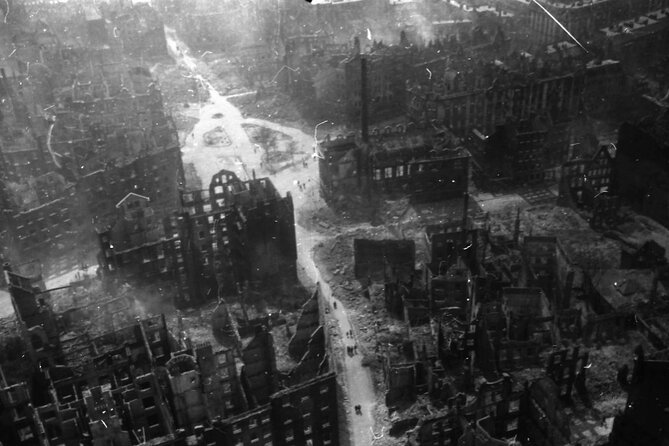
St. Nikolai Memorial is one of the most powerful physical reminders of the 1943 bombing of Hamburg. The church remains in ruins, and the site now memorializes victims of war and Nazi terror.
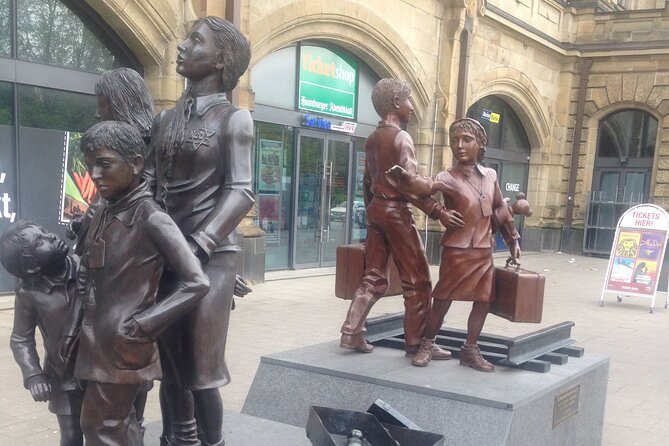
The church also contains memorials connected with the bombing of Hamburg, victims of the Neuengamme concentration camp, and reconciliation between postwar Germany and the United Kingdom. That mix gives the stop a wide scope. You confront destruction, persecution, responsibility, and the possibility of relations improving after the war.
The stop lasts about 25 minutes. A museum is located here, and a tower with an elevator offers a city view, but admission is not included in the tour price. If you want to enter the museum or go up the tower, budget separately and ask how the timing fits with your group’s plans.
The tower can add a useful final perspective, but it is optional and paid. The ruined church itself is the key experience. It gives the wartime story a physical focus after several stops where the meaning depends mainly on the guide’s explanation.
Price, pace, and who gets the best value
The price is $714.85 for a private group of up to 15 people. For a full group, that works out to about $47.66 per person. For four people, it is about $178.71 each, and for two people, about $357.43 each.
That makes this a strong choice for a family group, school group, reunion, or several friends sharing the cost. The three-generation family experience is a useful clue: Evan was able to tailor the tour so different ages could enjoy it. A private route also lets you ask questions that may not suit a large public group.
For one or two people, the price is much harder to justify unless World War II history is a central reason for your Hamburg visit. You are paying for a five-hour private guide, not simply transportation or entry tickets. All listed stops are free, but St. Nikolai’s museum and tower are not included.
The stated duration is approximately five hours. The listed stop times add up to a little over four hours, so the remaining time likely allows for walking and moving between places. Wear comfortable shoes and expect a moderate level of physical fitness, as the experience involves several city locations.
The tour begins at Schleusenbrücke 1 and normally ends at Hamburg BUNKER, Feldstraße 66. On request, you can be dropped at a location of your choice instead. The route is near public transportation, and service animals are allowed.
Free cancellation is available if you cancel at least 24 hours before the local start time. Changes or cancellations inside that window are not refunded.
Should you book the World War II Hamburg tour?
Book it if you want serious historical context, not just a list of bombed buildings. The route is especially well suited to families, private groups, and people who want to ask questions about Jewish Hamburg, Nazi power, bunkers, memorials, and the postwar meaning of these places.
I would also choose it if you have only one day for this subject. The tour brings together sites that would be hard to connect on your own, from Laeiszhalle and Grindel to Rathausmarkt, St. Nikolai, and Feldstraße.
Think twice if you are traveling alone or as a couple and mainly want a low-cost walk. The group price is substantial at that size, and St. Nikolai’s museum and tower require an extra fee. But for a group of four or more, the cost becomes easier to defend, and for a large family group, it can be very good value.
FAQ
Where does the tour start?
It starts at Denkmal für die Gefallenen beider Weltkriege, Schleusenbrücke 1, 20354 Hamburg, Germany.
Where does the tour end?
The usual end point is Hamburg BUNKER, Feldstraße 66, 20359 Hamburg, Germany.
Can I be dropped off somewhere else?
Yes. You can request drop-off at a location of your choosing.
How long does the tour last?
The experience lasts approximately five hours.
Is the tour private?
Yes. Only your group participates, with a maximum group size of 15 people.
Is the tour offered in English?
Yes. English is the listed language.
Are admission tickets included?
All listed stops are free except St. Nikolai Memorial’s museum and tower. Admission there is not included.
Is the tour suitable for someone with limited fitness?
A moderate level of physical fitness is recommended.
What is the cancellation policy?
You can cancel for a full refund up to 24 hours before the experience starts. Cancellations or changes made less than 24 hours before the local start time are not accepted for a refund.
Just added around Hamburg
- St George’s Culinary Food Tour★ 5.0 · 3 reviews
- Discover Hamburg: Private Walking Tour★ 5.0 · 3 reviews
- Private Hamburg rickshaw tour for 2 people★ 5.0 · 3 reviews
- private city tour of Hamburg’s UNESCO World Heritage Site★ 5.0 · 3 reviews
- 10 secrets of Hamburg’s old town – exciting scavenger hunt tour★ 4.5 · 3 reviews
- Hamburg Private Food Tours with a Local: 100% Personalized★ 5.0 · 3 reviews
- The Beatles on St. Pauli★ 5.0 · 3 reviews
- Short walk St. Pauli – the St. Pauli quickie★ 5.0 · 3 reviews
Third Reich & WWII Tours, compared.



Berlin’s Best: 2 Hour Walking Tour Third Reich and the Cold War
Read our review →

Third Reich Berlin: Hitler and WWII Walking Tour
Read our review →
Walking Tour of Former Nazi Party Rally Grounds
Read our review →
Browse the lists this tour appears in