

Reviewed · WALKING TOURS
Weimar Private Guided Walking Tour
Weimar turns a walk into a history lesson. This private tour brings Goethe and Schiller into focus, then connects their friendship to the Bauhaus, Duchess Anna Amalia, and modern German politics. I like the private format, which lets your group ask questions and request some on-the-spot customization. I also like the strong focus on people and ideas, not just old façades. The main drawback is price: $280 for two hours is fair for a full group of up to 15, but expensive for one or two people, especially since entrance fees are extra.
The route begins at Markt 20 and covers major sights on foot, including the Goethe and Schiller memorial, Goethe’s House, Schiller’s House, Liszt Haus, Saint Peter and Paul Church, and the House of the Weimar Republic. A guide such as Herr Letetzki can make a real difference. His historical and cultural knowledge, humor, and lively delivery earned especially warm praise, though one rating called the experience very good but too expensive.
In This Review
- Key points to know before you book
- Why Weimar deserves two focused hours
- Starting at Markt 20 in Weimar’s old center
- The Goethe and Schiller memorial: two figures, one friendship
- Goethe’s House on Frauenplan and the work behind Faust
- Schiller’s House and the creative partnership
- Saint Peter and Paul Church, Herder, and Anna Amalia
- Liszt Haus and Weimar’s musical side
- Bauhaus and the new direction of Weimar art
- The House of the Weimar Republic and 1919
- How much value do you get for $280?
- Who will get the most from this walking tour?
- Practical advice for making the two hours count
- Should you book the Weimar private walking tour?
- FAQ
- Where does the Weimar private walking tour meet?
- How long does the tour last?
- How much does the private tour cost?
- Which languages are available?
- Are entrance fees included?
- Is the tour private?
- What is the cancellation policy?
Key points to know before you book
- The private-group price works best for a larger party: $280 covers up to 15 people, so the cost per person drops sharply when shared.
- Goethe and Schiller are the heart of the story: Their friendship helped make Weimar a center of German literature and thought.
- The route reaches beyond the classical era: You also hear about Walter Gropius, the Bauhaus movement, and the Weimar Republic.
- Several major interiors cost extra: Entrance fees are not included, so budget separately if you want to go inside museums and historic houses.
- The tour is available in English or German: You receive a live local guide and a private experience for your group only.
- Two hours goes by quickly: One German-language review praised Herr Letetzki’s presentation but said the time passed far too fast.
Why Weimar deserves two focused hours
Weimar is a small city with an outsized place in German culture. Its name is tied to poets, philosophers, musicians, artists, and political change. That mix gives this walk more range than a standard old-town stroll.
You begin in the world of Weimar Classicism, the period linked most closely with Johann Wolfgang von Goethe and Friedrich Schiller. Their work matters, but the tour also helps you see the human story behind it: Schiller came to Weimar at Goethe’s invitation, and the two developed a friendship that fed intense creative work.
From there, the story widens. Duchess Anna Amalia helped shape Weimar’s cultural life. Franz Liszt lived and taught here. Johann Sebastian Bach is also part of the city’s musical legacy. Friedrich Nietzsche, Lucas Cranach, and Johann Gottfried Herder add still more layers.
The final shift is political. In 1919, Weimar gave its name to Germany’s first democratic republic after World War I. The House of the Weimar Republic helps explain why this quiet-looking cultural center became linked with one of the most important and troubled periods in modern German history.
I like this broad time span. You are not given two hours of statues and dates. You get a clear thread from court culture and literature to music, design, philosophy, and democracy.
More Walking Tours in Erfurt
- Erfurt: Old Town Guided Walking Tour
★ 4.7 · 1,617 reviews - Weimar: Old Town Guided Walking Tour
★ 4.7 · 1,080 reviews - Weimar: Scavenger Hunt Self-Guided Walking Tour
★ 4.3 · 108 reviews
Starting at Markt 20 in Weimar’s old center
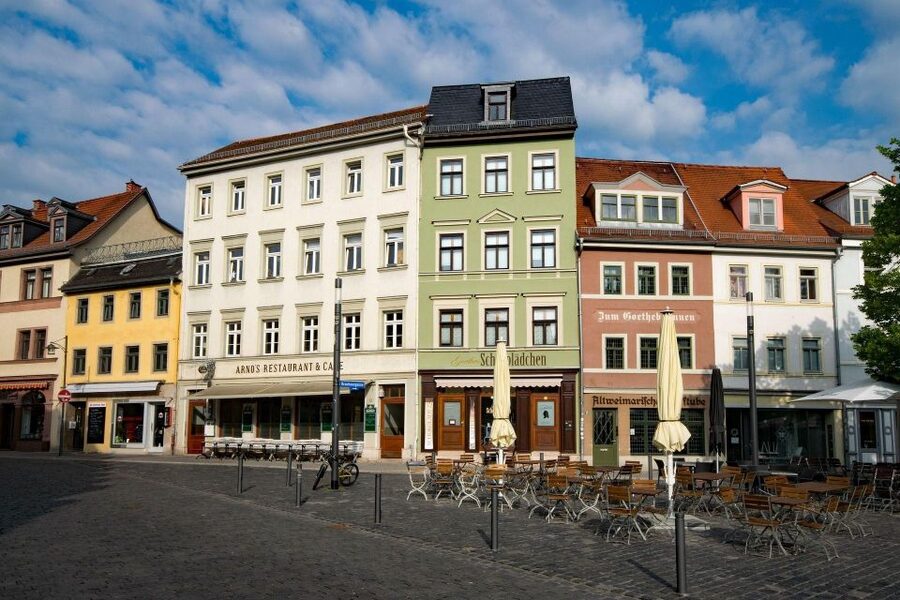
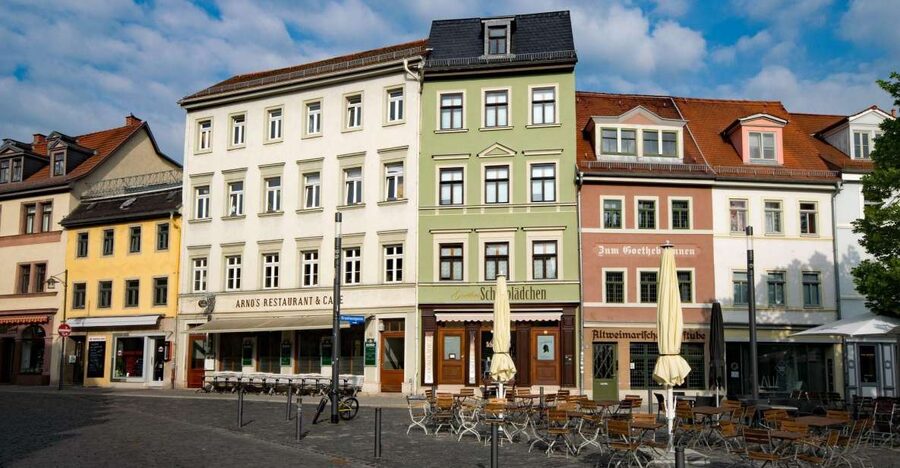
The meeting point is Markt 20, 99423 Weimar. This puts you in the city’s central historic area, close to places connected with Lucas Cranach, who lived near the Market Square.
The square is a useful beginning because it immediately places you in old Weimar rather than in an isolated museum district. Your guide can establish the city’s basic shape here, then lead you through the main chapters of its story.
Do not expect a long-distance excursion or transport between sights. This is a walking experience lasting two hours. Wear comfortable shoes, and keep your schedule open enough that you are not hurrying away from the final stop.
The guide speaks English or German. Since the group is private, you can ask for more detail on literature, music, politics, or architecture as the walk develops. The description also allows possible customization on the spot, though the exact changes will depend on time and the guide.
The Goethe and Schiller memorial: two figures, one friendship

The Goethe and Schiller memorial stands in front of the National Theater. It is one of Weimar’s most recognizable sights and a natural place to discuss the relationship at the center of the tour.
The two men were not simply famous writers who happened to live in the same city. Their friendship became a working partnership. Their conversations and shared creative energy helped define Weimar Classicism, and the tour uses that relationship to make the period easier to understand.
You will likely get more from this stop if you enjoy people-centered history. Instead of treating Goethe and Schiller as distant names from a school textbook, the guide can show how their connection shaped the city’s cultural identity.
The memorial itself is a quick outdoor stop, not an interior attraction. That is helpful during a short tour because you can take in the monument without spending time in a ticket line. If you want a fuller look at their writings and personal lives, the nearby houses require separate admission.
The National Theater also gives the stop a useful setting. You can see how literature and performance remain linked in Weimar’s public life, even if the walk does not include a performance.
Goethe’s House on Frauenplan and the work behind Faust
Goethe’s House on Frauenplan is one of the key stops. Goethe lived there until the end of his life and worked on Faust, his major dramatic work.
This detail gives the house more weight than a simple famous-person address. You can connect the building to a long period of work, thought, and daily life. It helps explain why Weimar is so closely associated with Goethe: he was not merely passing through. He lived and worked here for decades.
The exterior can be viewed during the walking tour, but entrance fees are not included. That distinction matters. If you want to see the rooms inside, check the current admission arrangements separately and allow extra time beyond the two-hour walk.
I would treat the guided stop as an introduction rather than a replacement for the interior visit. The guide can give you the context first, making a later visit more meaningful. If your group has a serious interest in Goethe, you may want to ask about spending less time on other stops and using your remaining time around Frauenplan.
The tour’s value here is the connection between place and work. Faust was not created in an abstract literary world. A real house in Weimar was part of Goethe’s long working life.
More Walking Tours:
- Erfurt: On the road with the Brückenkrämer. Walking tour with anniversary tasting.
★ 4.9 · 28 reviews - Weimar: AdventureDate, walk with quiz and dinner for couples
★ 3.8 · 4 reviews - Erfurt: Express Walk with a Local
★ 5.0 · 4 reviews - Discover Berlin Half-Day Walking Tour
★ 5.0 · 9,624 reviews
Schiller’s House and the creative partnership
Friedrich Schiller’s House continues the story from the memorial. Schiller came to Weimar at Goethe’s invitation, and this stop lets you see the friendship from a more personal angle.
The pairing is important. A walk that treats Goethe and Schiller separately can leave you with two names and two houses. This tour presents them as collaborators whose relationship helped produce a period of exceptional cultural activity.
You can expect to view Schiller’s House as part of the route, while any interior visit costs extra. The outdoor explanation is still worthwhile because the guide can place Schiller’s arrival in the context of his relationship with Goethe.
For literature lovers, this is likely one of the strongest sections. For people who do not know much about German writing, the guide’s storytelling matters even more. A good explanation can turn a formal literary movement into a story about friendship, invitation, rivalry, and shared work.
The four-star rating that called the tour great but expensive is worth keeping in mind here. The stop is meaningful, but two hours cannot offer an extended visit inside both writers’ homes. You are paying mainly for interpretation and a private guide, not a bundle of admissions.
Saint Peter and Paul Church, Herder, and Anna Amalia
Saint Peter and Paul Church brings religion, philosophy, and court culture into the walk. The church is Gothic, Martin Luther preached here, and Johann Gottfried Herder is buried inside. Duchess Anna Amalia is also buried there.
This is a useful change of pace after the literary houses. You move from private working spaces to a major religious building tied to several important figures. The church helps show that Weimar’s culture was not limited to poetry and theater.
Herder’s presence adds a philosophical and theological strand. Anna Amalia connects the church to the ruling court and to the duchess’s cultural legacy. Her role matters because Weimar’s artistic life did not grow by accident. The interests and support of its court helped create the conditions for music, literature, and scholarship to flourish.
The church is also a place where the city’s long timeline becomes clear. Luther belongs to an earlier religious chapter, Herder to the world of eighteenth-century ideas, and Anna Amalia to the court culture that shaped Weimar’s classic period.
Again, the tour does not include entrance fees. If the church is open for entry at the time of your walk, ask the guide what you can see within the scheduled route. The supplied information confirms the church as a stop, but it does not promise an interior visit or a particular amount of time there.
Liszt Haus and Weimar’s musical side
Franz Liszt gives the tour a musical turn. At Liszt Haus, you learn about the composer’s life in Weimar, where he lived and taught.
This stop keeps the city from becoming a Goethe-and-Schiller-only destination. Weimar’s cultural identity also includes composers and teachers, and Liszt’s connection shows how the city continued to attract major artistic figures after the classicists.
The house is especially useful for anyone who wants to understand Weimar as a place of instruction as well as inspiration. Liszt did not simply reside here. He taught, linking the city to musicians who came to learn from him.
The tour also mentions Bach as part of Weimar’s musical legacy. The information provided does not specify a separate Bach stop, so you should not expect a dedicated visit to a Bach museum or residence during these two hours.
As with Goethe’s and Schiller’s houses, admission is not part of the tour price. The guide’s explanation can help you decide if paying for the interior later is worthwhile.
Bauhaus and the new direction of Weimar art

Walter Gropius and the Bauhaus movement add a modern edge to the walk. This is one of the tour’s most useful features because it prevents Weimar from being frozen in the age of wigs, poetry, and court life.
Gropius’s Bauhaus movement had a groundbreaking influence on modern design and art. Including it in a two-hour walk shows that Weimar’s cultural importance did not end with Goethe and Schiller.
You should see this part as a bridge between old cultural prestige and modern creative practice. The same city associated with classical literature also became connected with a movement that changed how people thought about design, buildings, craft, and art.
The supplied details do not name a specific Bauhaus building or promise an interior visit. Your guide will explain the movement’s connection to Weimar, but you should ask at the start if Bauhaus is a high priority for your group. With only two hours, the guide may need to balance it against the literary and political stops.
I like the inclusion because it gives the walk a wider purpose. You are not only seeing where famous people lived. You are tracing how Weimar kept producing new cultural ideas.
The House of the Weimar Republic and 1919
The House of the Weimar Republic brings the route into the twentieth century. In 1919, the future of post-World War I Germany was decided in Weimar, and the republic that followed took its name from the city.
This stop changes the question from What did Weimar create? to What did Weimar represent? The city became associated with a new political order during a tense period in German history.
The house is an important counterweight to the literary focus. You can admire Goethe’s home and discuss Schiller’s friendship, but the city’s story also includes political upheaval and the attempt to build a new Germany after war.
The tour’s information does not state that admission is included, so plan on paying separately if you want to enter. The guide can still introduce the site from outside, but the interior may offer more detail than a brief street-side explanation.
This is likely the section where your questions matter most. If you want to understand the republic’s creation, its challenges, or the way Weimar’s cultural reputation influenced its political symbolism, tell the guide early. The private format makes that request possible, though the two-hour limit remains real.
How much value do you get for $280?
The price is $280 per private group of up to 15 people. At the maximum group size, that works out to about $18.67 per person. For a family, school group, reunion, or party of friends, that can be a sensible price for two hours with a guide dedicated only to you.
For two people, the calculation changes. You are paying $140 per person before any entrance fees, which is a serious expense for a short city walk. A shared tour would normally offer better value for a couple, but this experience is specifically private.
The strongest reason to pay more is the guide. Herr Letetzki received especially warm praise for his historical and cultural knowledge, humor, and presentation style. The German-language feedback described the two hours as passing too quickly, which suggests the quality of the explanation may be the main product here.
You should also factor in what is not included. Museum and historic-house entrance fees are separate, so the final cost rises if you enter Goethe’s House, Schiller’s House, Liszt Haus, or the House of the Weimar Republic.
I would book it for a group that values personal attention and wants a broad introduction without arranging several separate visits. I would hesitate if you are alone, traveling as a couple, or mainly want museum interiors.
Who will get the most from this walking tour?
This tour suits you best if you enjoy culture but want help connecting the names. Goethe, Schiller, Liszt, Herder, Anna Amalia, Gropius, and Nietzsche can form a confusing list without a guide to put them in order.
It also suits first-time visitors who want an overview before choosing which interiors to visit. After the walk, you can decide if Goethe’s House, Schiller’s House, Liszt Haus, or the House of the Weimar Republic deserves more of your time.
A private group is useful for families and mixed-interest parties. One person can ask about literature, another about music, and another about twentieth-century politics without being limited to a fixed public-group script.
You may find it less suitable if you want a slow architectural tour, long museum visits, or extensive time inside each building. Two hours is enough for orientation and storytelling, not for a full study of every site.
The tour is also a good fit for English-speaking visitors because a live guide is available in English. German-speaking groups can choose German, and the positive feedback about Herr Letetzki was given in German.
Practical advice for making the two hours count
Arrive at Markt 20 ready to walk. The route is built around central Weimar sights, but you should still wear comfortable shoes and avoid scheduling a tight appointment immediately afterward.
At the beginning, tell the guide which subjects matter most to you. If your group is fascinated by Goethe and Schiller, ask for more time on their friendship. If you care about design, request extra attention to Bauhaus. If political history is your priority, mention the House of the Weimar Republic.
Keep extra money available for entrance fees. The walking tour itself does not cover admissions, and the most important homes and museums may be more satisfying inside than from the street.
You can cancel for a full refund up to 24 hours before the activity, and you can reserve now and pay later. Those terms help if your Germany itinerary is still shifting, though they do not change the tour’s basic value calculation.
The rating is 4.5 from six reviews, with praise for the guide’s presentation and one clear concern about cost. That is a small sample, so I would focus less on the number and more on the pattern: the experience appears strongest when you value lively explanation and personal attention.
Should you book the Weimar private walking tour?
Book it if you are traveling with a group, care about German culture and history, and want one guide to connect classic literature, music, Bauhaus, Anna Amalia, and the Weimar Republic. The private format and possible customization make the $280 price easier to justify for a larger party.
For one or two people, think carefully. The guide may make the walk engaging, but the per-person price is high, and entrance fees are not included. If you choose it, contact the guide early in the walk about your priorities, because two hours disappears quickly.
I would especially recommend it as a first look at Weimar. Use the walk to understand the city’s main stories, then return on your own to the interiors that interest you most.
FAQ
Where does the Weimar private walking tour meet?
The meeting point is Markt 20, 99423 Weimar.
How long does the tour last?
The tour lasts two hours.
How much does the private tour cost?
The price is $280 per private group of up to 15 people.
Which languages are available?
The live guide is available in English or German.
Are entrance fees included?
No. Entrance fees are not included in the tour price.
Is the tour private?
Yes. It is offered for a private group, and the local professional guide is with your group only.
What is the cancellation policy?
You can cancel up to 24 hours in advance for a full refund. You can also reserve now and pay later.
Just added around Erfurt
- Weimar: AdventureDate, walk with quiz and dinner for couples★ 3.8 · 4 reviews
- Erfurt: Express Walk with a Local★ 5.0 · 4 reviews
- Mystery Backpack 2p: explore the city with an Erfurt novel★ 4.2 · 12 reviews
- Erfurt: Romantic Rickshaw Tour For Two★ 5.0 · 15 reviews
- Erfurt: Egapark garden Entrance Ticket★ 4.6 · 16 reviews
- Weimar: “Illuminati”, unique Escape Room, Goethe’s secret★ 4.6 · 17 reviews
- Weimar: Old Town Tour Classical Weimar★ 4.4 · 26 reviews
- Erfurt: KiKa TV Characters Kids Tour by Pedicab★ 4.9 · 41 reviews
Walking Tours, compared.





Berlin’s Best: 2 Hour Walking Tour Third Reich and the Cold War
Read our review →


Third Reich Berlin: Hitler and WWII Walking Tour
Read our review →Browse the lists this tour appears in