
Reviewed · MUSEUMS
Berlin: Neues Museum Entry Ticket
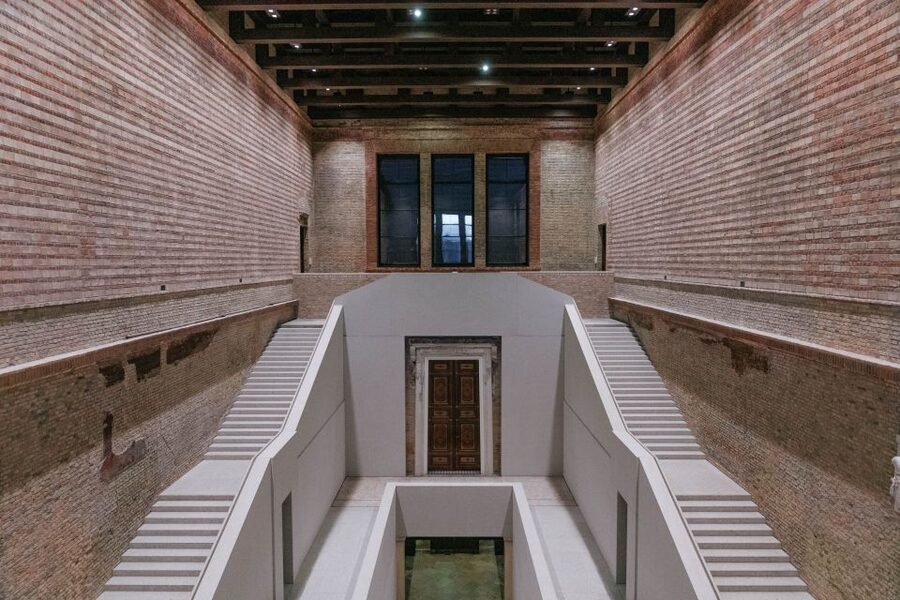
Ancient faces wait inside Berlin’s grandest museum rooms. I like the Egyptian collection, especially the famous bust of Nefertiti, and I like how one ticket brings together Egyptian, prehistoric, and classical antiquities. The restored building is an attraction in its own right, with dramatic staircases, high ceilings, and visible traces of wartime damage.
The main drawback is that some display cases can be dim, and parts of the audio guide may be unavailable or under revision. You also need to leave backpacks behind, and cloakroom space is limited, so arrive with a small bag if possible.
In This Review
- Key points to know before you go
- Why the Neues Museum deserves a place on your Berlin schedule
- Starting at the James Simon Gallery
- The restored building is part of the exhibition
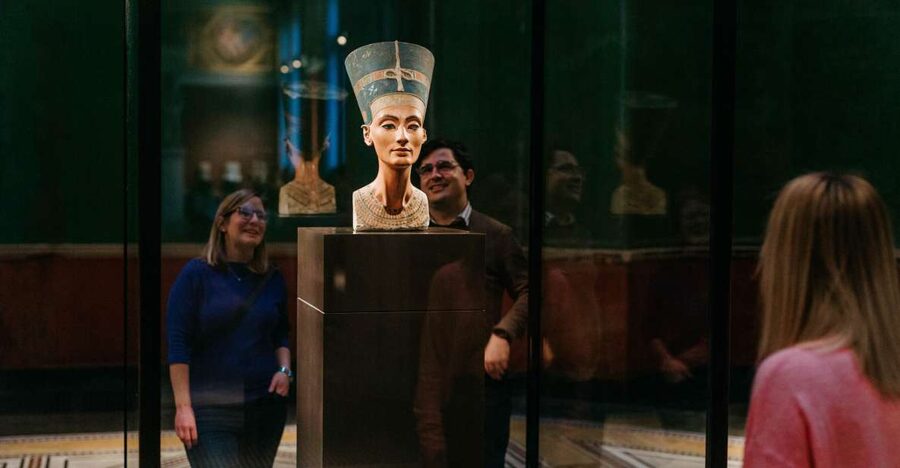
- The Egyptian Museum and the bust of Nefertiti
- Prehistory from the Middle East to Scandinavia
- The Antique Collection and classical sculpture
- Priam’s Treasure and the politics of collecting
- How long should you spend inside?
- Audio guide, language choices, and practical comfort
- Who will get the most from this ticket?
- Is the $16 ticket good value?
- Should you book the Neues Museum ticket?
- FAQ
- Where is the entrance to the Neues Museum?
- What does the ticket include?
- Does the ticket include other Museum Island museums?
- Which collections can I see inside?
- Can I see the bust of Nefertiti?
- How long can I stay in the museum?
- What languages are available for the audio guide?
- Are backpacks allowed?
Key points to know before you go
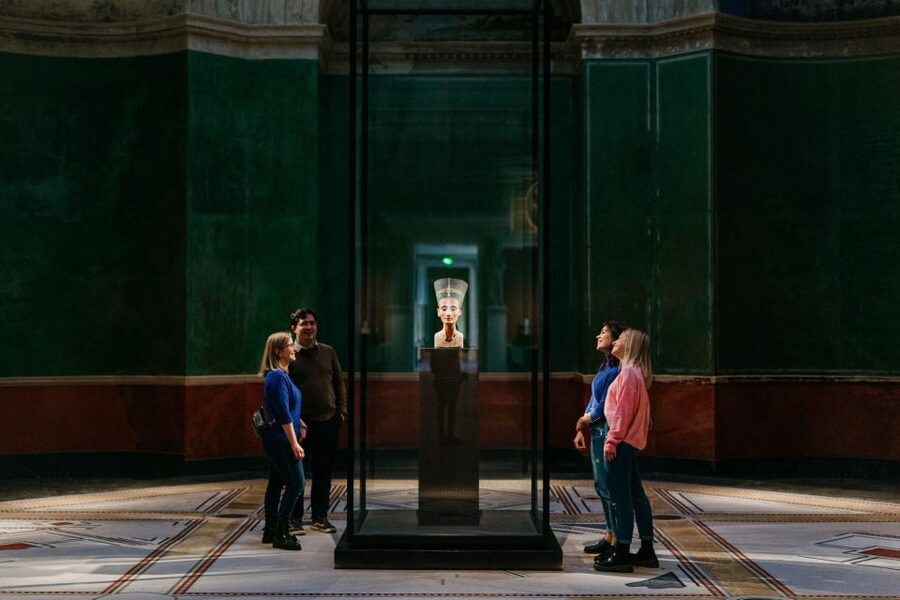
- Nefertiti is the star: The famous painted limestone bust is the museum’s essential stop, though photography rules apply around it.
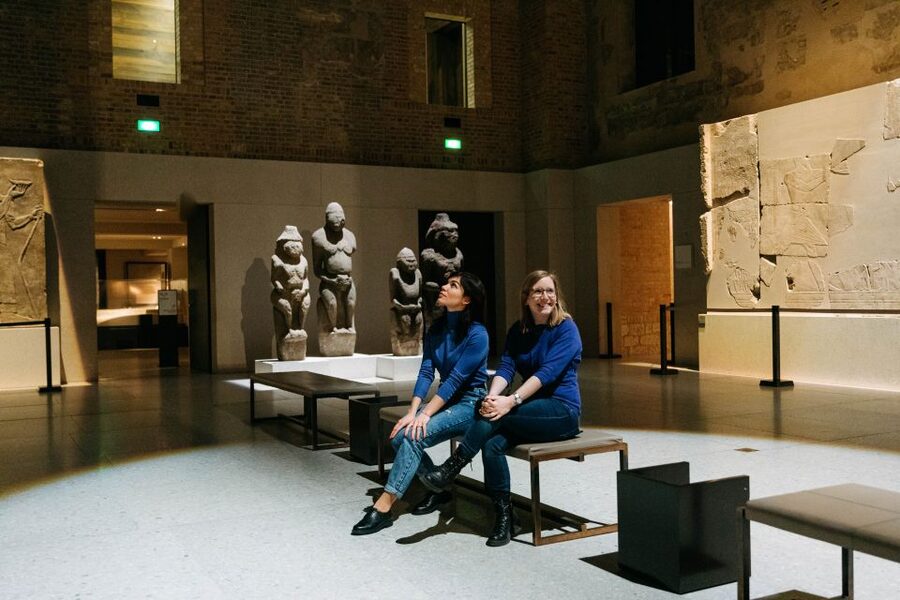
- Three collections share one building: You’ll see the Egyptian Museum, the Museum of Prehistory and Early History, and the Antique Collection.
- The building tells its own story: David Chipperfield’s restoration keeps wartime scars and historic details visible alongside the exhibits.
- Advance entry saves time: Mobile tickets have often allowed visitors to pass the ticket queue, especially on rainy or crowded days.
- Plan for two to three hours: You can move faster, but the collection rewards a slow visit with time for labels, audio stops, and seats.
- Travel light: Backpacks are not allowed in the exhibition areas, and locker and cloakroom capacity is limited.
Why the Neues Museum deserves a place on your Berlin schedule
Berlin’s Museum Island is not just a cluster of grand buildings. It is one of the city’s best places to see how European museums collected, classified, restored, and displayed the ancient world.
The Neues Museum is particularly interesting because it combines three major collections under one roof. You can move from Egyptian royal art to prehistoric tools, then on to Greek and Roman sculpture without changing museums or buying another ticket.
At $16 per person, this is a reasonable admission price for Berlin. You are paying for access to a large permanent collection, the building itself, and an audio guide in Spanish, English, French, German, or Italian. Other Museum Island museums are not included, so think of this as a focused museum visit rather than a pass for the entire island.
The experience is also flexible once you enter. The ticket information describes a 15-minute activation period, but you can remain inside as long as you like. In practical terms, do not confuse the short entry window with a 15-minute museum visit. The museum needs at least two hours for most people, and three hours is a better target if ancient Egypt is your main interest.
More Museums in Berlin
- Berlin: Jewish Museum Berlin Entrance Ticket
★ 4.5 · 8,393 reviews - Berlin: DDR Museum Tickets
★ 4.3 · 3,443 reviews - Berlin: Natural History Museum Entrance Ticket
★ 4.6 · 3,382 reviews
Starting at the James Simon Gallery
Your entry point is the visitors’ entrance at the James Simon Gallery on Bodestrasse, 10178 Berlin. This modern gallery serves as an important access point for Museum Island, and it is worth checking your mobile ticket before you arrive so you can head to the correct entrance without fuss.
The great advantage of booking ahead is time. Several people have entered directly with a mobile voucher while ticket buyers waited at the sales desk. That benefit is most useful on rainy days, holidays, and warm afternoons when standing outside is unpleasant.
Do not assume you must arrive at the exact minute shown on your ticket. Some people were admitted early or arrived later than their selected time without trouble. Still, I would treat the stated entry time seriously. Flexibility may depend on the staff member at the door and how busy the museum is.
Once inside, collect the audio guide and deal with coats or bags before beginning the exhibits. Small lockers are available, but space is limited. Backpacks are not allowed in the exhibition areas, so a compact shoulder bag is a safer choice than a large daypack.
The restored building is part of the exhibition
The Neues Museum was badly damaged during the Second World War. Its restoration by architect David Chipperfield did not try to make every surface look new. Instead, the design places repaired historic sections beside plain modern materials and surviving scars.
This approach gives the building a strong sense of time. You are not simply walking through neutral galleries. You are seeing ancient objects inside a nineteenth-century museum that was itself damaged, repaired, and brought back into use.
The main staircase is one of the memorable spaces. High ceilings and broad rooms give large sculptures and architectural fragments room to breathe. Some people come mainly for Nefertiti but leave equally impressed by the building’s structure and restoration.
I recommend taking a moment before rushing toward the Egyptian galleries. Look at the walls, columns, staircases, and areas where old and new materials meet. The museum’s design helps explain that museum objects have their own stories, but the places that preserve them have stories too.
The Egyptian Museum and the bust of Nefertiti
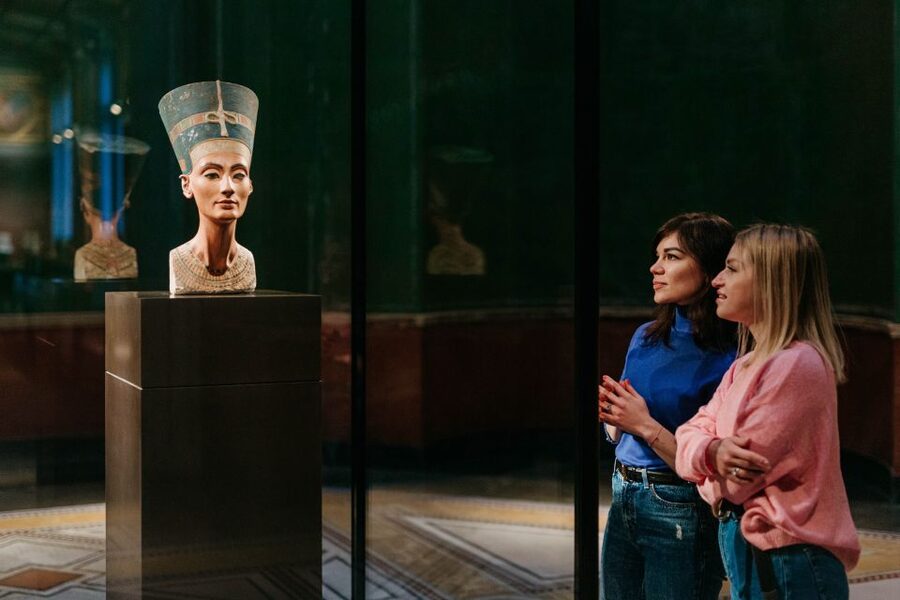
The Egyptian collection is the emotional center of the visit. It includes royal sculpture, funerary objects, architectural pieces, sarcophagi, and displays that trace Egyptian culture across long periods.
The famous bust of Nefertiti is the object most people want to see. It is displayed in a dedicated room, where the lighting and setting focus attention on the painted face, elegant neck, and finely shaped features. Seeing it in person gives you a better sense of its scale and surface than any photograph can provide.
Photography restrictions around Nefertiti are worth noting. Several people were disappointed that they could not take a picture from the usual viewing position. One useful detail is that photography may be possible from behind a marked line, but you should follow the current signs and staff instructions rather than count on a close-up image.
The bust is not the only reason to spend time here. The surrounding rooms provide context, showing how Egyptian objects were collected and arranged in a nineteenth-century European museum. You can also see a replica of an Egyptian sarcophagus, along with other pieces that help make the collection feel broader than a single famous portrait.
If ancient Egypt is your main reason for coming, use the audio guide. Commentary can turn a beautiful object into a more meaningful one by explaining its purpose, date, and place within Egyptian culture. The guide is included, and it is offered in five languages, so there is little reason to skip it.
The audio system is not perfect. Some English commentary points have been missing or under update, and the route can feel confusing in places. A few people wanted more audio stops. I would use the guide selectively, listening to the main objects rather than expecting every case to have a full explanation.
Something different for another day:
- Berlin: Reichstag, Dome and Government District Guided Tour
★ 4.7 · 18,288 reviews - Berlin: 1-Hour City Tour by Boat with Guaranteed Seating
★ 4.3 · 16,993 reviews - Berlin: Boat Tour Along the River Spree
★ 4.4 · 11,252 reviews - Discover Berlin Half-Day Walking Tour
★ 5.0 · 9,624 reviews
Prehistory from the Middle East to Scandinavia
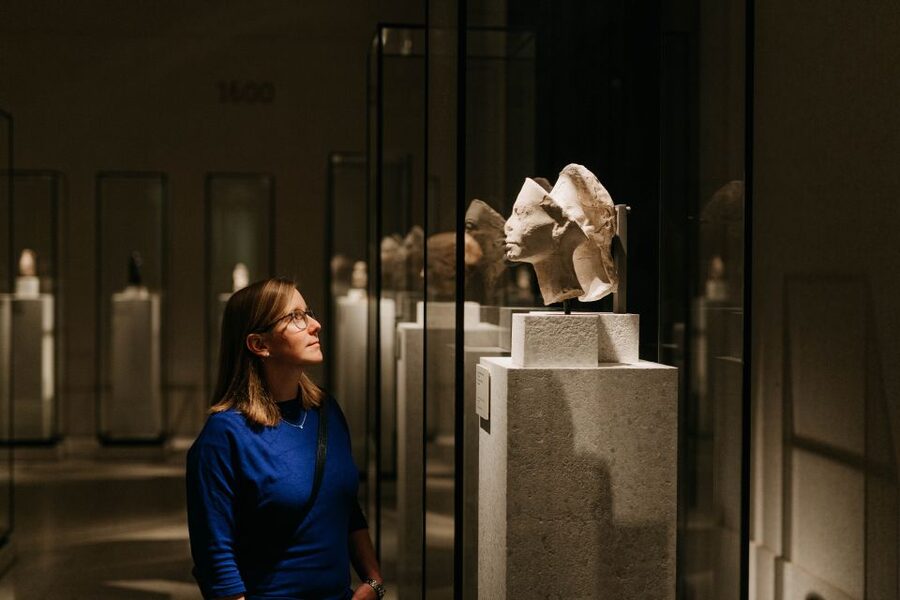
The Museum of Prehistory and Early History broadens the visit beyond ancient Egypt. Its displays follow the development of prehistoric cultures across a wide area, from the Middle East to the Atlantic and from North Africa to Scandinavia.
This section is useful if you enjoy seeing how people made tools, ornaments, weapons, and ritual objects long before written records. It also provides a change of pace after the highly polished Egyptian galleries.
One especially memorable object is the Berlin Gold Hat. Its thin gold surface and decorated form make it easy to see why it attracts attention, but the wider value lies in what it suggests about early technology, status, and ceremony.
The Xanten Boy is another important highlight. This statue gives the prehistoric and early historical sections a human presence, while the surrounding material helps you connect individual objects with larger cultural developments.
The layout is generally easy to follow, and the route helps prevent you from missing major sections. Still, the sheer amount of material can become tiring. If your concentration fades, use the seating along the route. Several rooms include places to rest, which makes a slow visit much easier than trying to see everything while standing.
The Antique Collection and classical sculpture
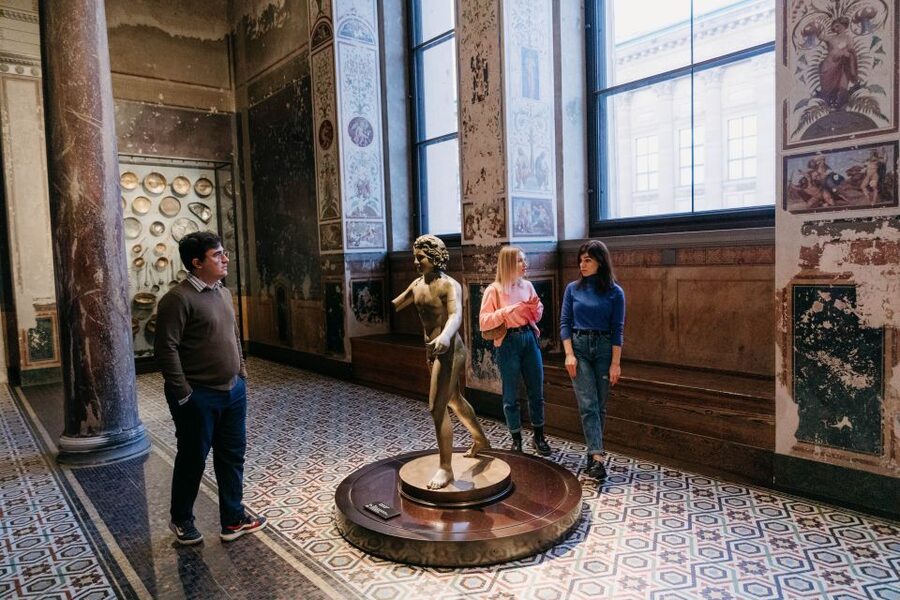
The Antique Collection adds Greek and Roman material to the museum’s mix. It is not a separate museum visit, but it gives you another way to understand the ancient world through sculpture, fragments, and religious imagery.
Look for one of the surviving statues of the Roman sun god Helios. The object offers a clear link between art, mythology, and public religion in the Roman period.
The classical material also helps you compare different traditions. Egyptian art often emphasizes ritual, identity, and symbolic order, while Greek and Roman sculpture can feel more focused on the human body, gods, leaders, and idealized form. You do not need specialist knowledge to notice these differences.
A small interactive area may include objects that you can touch. This is an unusual feature in a museum filled with fragile antiquities, especially for children who need a hands-on moment after several quiet galleries.
Some sections may feel less clearly arranged than others. The permanent collection is large, and not every room gives you an obvious narrative at first glance. The audio guide and museum map can help, but I would not try to memorize every label. Choose the pieces that catch your eye and allow the collection to work at a comfortable pace.
Priam’s Treasure and the politics of collecting
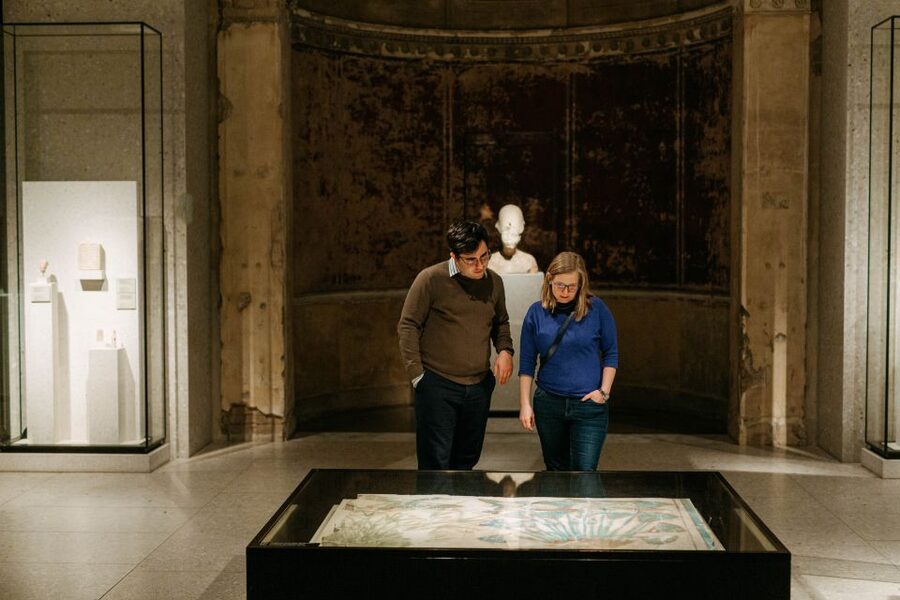
Priam’s Treasure, from Heinrich Schliemann’s collection, is one of the better-known objects connected with the museum. It also raises questions that are important when visiting European institutions with ancient material.
Schliemann was a nineteenth-century archaeologist and collector associated with excavations at Troy. Objects taken from archaeological sites often carry complicated ownership stories, and the display can prompt a useful question: who should hold ancient treasures, and how should museums explain their origins?
One visitor specifically wondered if Egyptian treasures should be in Berlin or returned to Egypt. You may have the same thought while moving through the galleries. That does not reduce the visual power of the objects, but it adds another layer to the visit.
The Neues Museum reflects the nineteenth-century passion for art, archaeology, museums, and technology. It shows not only ancient cultures, but also the period when European institutions gathered objects from across the world and presented them to a public audience. That history is worth keeping in mind as you admire the collection.
How long should you spend inside?
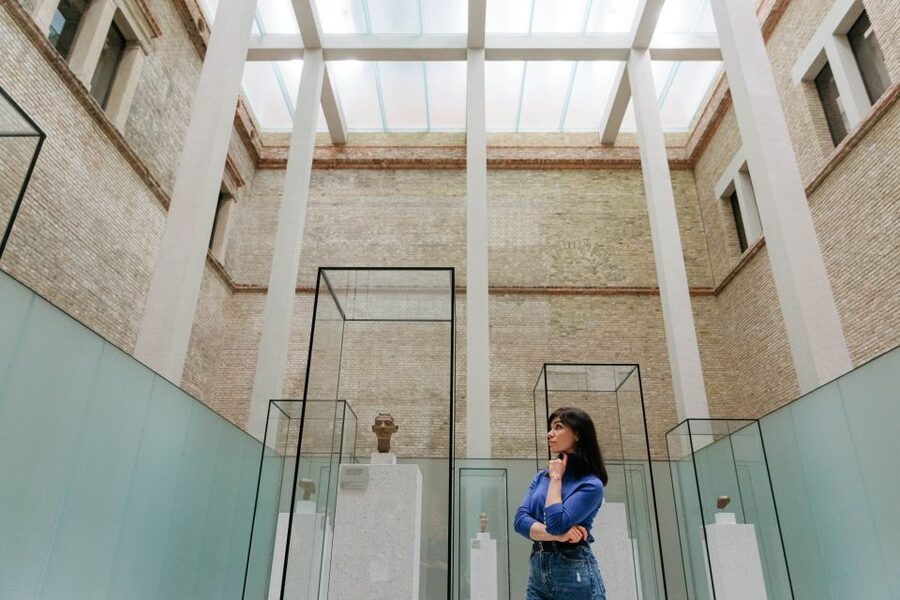
The official activity duration is listed as 15 minutes, but that refers to the ticket activation window, not the full museum visit. Once admitted, you may stay as long as you like.
For a quick visit, allow around two hours. That gives you time for Nefertiti, the main Egyptian rooms, the Gold Hat, the Xanten Boy, the Antique Collection, and a look at the restored architecture.
Three hours is better if you want to read labels and use the audio guide. Some people have spent half a day inside and still felt they had more to see. The museum is large enough that rushing can turn a rewarding visit into a checklist.
A sensible plan is to begin on the upper floor, then work through the galleries rather than wandering randomly. This suggestion comes from practical experience with the museum’s layout. If you begin near the top, you can follow the collection downward and reduce the chance of skipping a major section.
Build in a break. Seating is available along the route, and the museum café has been praised for its quality. A short stop can help you return to the displays with fresh attention instead of treating the last rooms as an endurance test.
Audio guide, language choices, and practical comfort
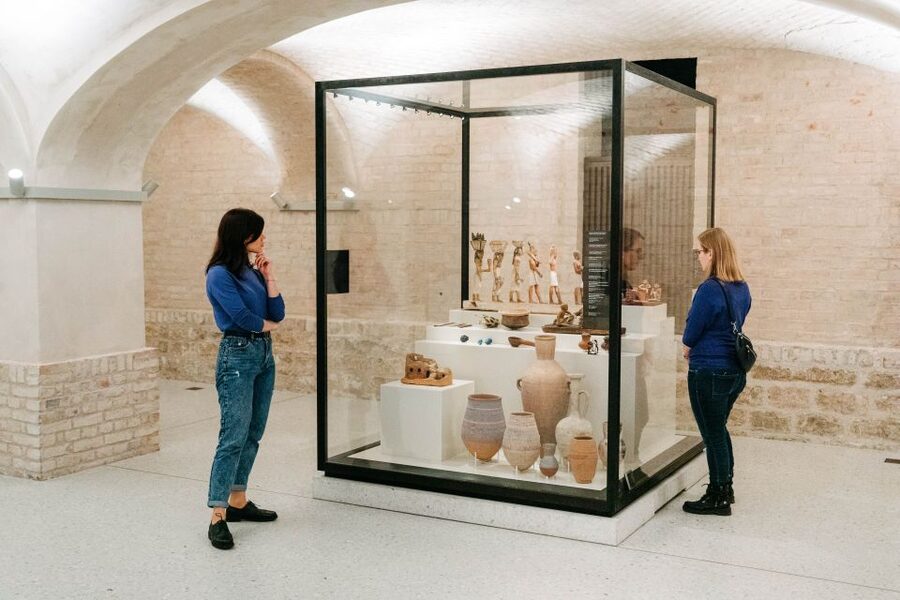
The included audio guide is available in English, Spanish, French, German, and Italian. It is especially helpful for Nefertiti and the major Egyptian displays, where a short explanation can add much more than a quick label.
The guide has some weaknesses. Audio stops may be limited, and some English material has been unavailable while being updated. The route can also seem confusing if you try to follow every number in order.
I would not let that put you off. Use the guide for the highlights, then read the labels that interest you. The museum is organized well enough to explore without listening at every stop.
The building is wheelchair accessible throughout. Backpacks are not permitted in the exhibition spaces, and locker and cloakroom capacity is limited, so plan accordingly. These details matter most during busy periods, when arriving with a large bag can slow your entry.
Who will get the most from this ticket?
This is a strong choice for first-time visitors to Berlin who want one major museum rather than a rushed tour of several. It suits anyone interested in Egyptian art, archaeology, classical sculpture, museum design, or the physical effects of war and restoration.
Families can also enjoy it, especially because the displays cover different periods and may include objects visitors can touch. Younger children may not have the patience for every gallery, so choose a few highlights rather than insisting on the full route.
The museum is less suitable if you have only 30 minutes before another appointment. Nefertiti alone can be seen quickly, but the ticket’s real value comes from giving yourself time to explore the other two collections and the building.
It is also a good rainy-day plan. Advance booking can save you from waiting outside, and the museum offers enough indoor space to fill several hours without feeling like a small exhibit hall.
Is the $16 ticket good value?
At $16, I consider this good value if you plan to stay for two hours or more. You get three collections, an audio guide, access to one of Museum Island’s most important buildings, and the chance to see Nefertiti in person.
The value is weaker if you only want a quick photograph or a single famous object. Other Museum Island museums are not included, so make sure this is the collection you most want to see before purchasing.
The advance ticket adds practical value even when the museum is quiet. On some days, the ticket queue is short. On others, especially in bad weather or during holiday periods, walking past the sales line can make the admission fee feel like money well spent.
Because the activity is non-refundable, check your date and plans carefully before booking. Discounted admission requires the relevant identification, and children who enter free may still need their own ticket, so confirm that every member of your group has the correct entry document.
Should you book the Neues Museum ticket?
Yes, I would book it if Nefertiti, ancient Egypt, or Museum Island is high on your Berlin list. The restored architecture, the wide range of collections, and the easy advance entry make this more than a quick celebrity-object stop.
Book ahead for a busy weekend, a holiday, or a rainy day. Arrive with a small bag, allow two to three hours, and use the audio guide for the main exhibits rather than expecting perfect coverage.
Skip it only if your schedule is too tight for a proper museum visit, or if you need a ticket covering several Museum Island museums. For everyone else, $16 buys a thoughtful, visually impressive slice of Berlin’s cultural history.
FAQ
Where is the entrance to the Neues Museum?
The visitors’ entrance is at the James Simon Gallery on Bodestrasse, 10178 Berlin.
What does the ticket include?
It includes entry to the Neues Museum and an audio guide.
Does the ticket include other Museum Island museums?
No. Entry to other museums on Museum Island is not included.
Which collections can I see inside?
The museum contains the Egyptian Museum, the Museum of Prehistory and Early History, and the Antique Collection.
Can I see the bust of Nefertiti?
Yes. The famous bust of Nefertiti is one of the museum’s main highlights.
How long can I stay in the museum?
You can stay as long as you like after entering. The stated 15-minute validity refers to the activation period for entry, not the length of your museum visit.
What languages are available for the audio guide?
The audio guide is available in Spanish, English, French, German, and Italian.
Are backpacks allowed?
No. Backpacks are not allowed in the exhibition areas. Locker and cloakroom space is limited, so bring as little luggage as possible.
Just added around Berlin
- Berlin: Private Guided Tour of the Main Sights★ 5.0 · 13 reviews
- Private Highlights of Berlin Bike Tour★ 5.0 · 13 reviews
- Modern Berlin Private Walking Tour: Diverse, Vibrant and Exciting German Capital★ 5.0 · 13 reviews
- Tour in Berlin from Warnemünde and Rostock Cruise Port★ 4.1 · 13 reviews
- Berlin: Stasi Museum Private Guided Tour with Entry Ticket★ 4.8 · 13 reviews
- Private Food Tour Experience with a born and bred Berliner★ 5.0 · 14 reviews
- Berlin: Rheinsberg Palace Entrance Ticket★ 4.8 · 14 reviews
- Berlin in one day – day tour with an expert guide★ 5.0 · 14 reviews
Museums, compared.





Skip-the-Line: Berlin Wall Museum at Checkpoint Charlie
Read our review →
Browse the lists this tour appears in