Reviewed · BERLIN TOURS
Wall Tour Berlin – Fates, Heroes & Love Stories
Berlin’s Wall still shapes the city. This two-hour walk follows the former border from Nordbahnhof to Mauerpark, using real escape stories, family tragedies, church history, and Cold War oddities to make the past feel close. I like the route for two clear reasons: it visits the best-preserved section of the Berlin Wall Memorial, and it ties famous events to personal stories, including Conrad Schumann’s escape and the tunnel attempts beneath Bernauer Strasse. The main concern is reliability, since two separate bookings report that no guide appeared at the meeting point.
I also like the modest price, about $19.66 per person, and the small maximum group of 25. You get a focused history walk without paying for museum admission at every stop. Still, the tour covers painful subjects, including deaths, forced separation, and people jumping from windows, so it suits you best if you want a serious, story-led look at Berlin rather than a light sightseeing stroll.
In This Review
- Key points to know before you book
- Why this stretch of the Berlin Wall matters
- Starting at Nordbahnhof and the ghost stations
- Seeing how the border was built
- The memorial window and the price of freedom
- The Bernauer Strasse viewing platform
- The Reconciliation Church and divided worship
- Passenger agreements and the use of young people
- Windows, desperate escapes, and personal tragedy
- Tunnel escapes and a battle over propaganda
- Conrad Schumann and the famous border jump
- Kidnappings and the Cold War loudspeaker war
- Ending at Mauerpark and getting away
- Price, group size, and booking concerns
- Who should book this Berlin Wall walk?
- Should you book Wall Tour Berlin?
- FAQ
- How long does Wall Tour Berlin last?
- Where does the tour begin?
- Where does the tour end?
- Does the tour include the Berlin Wall Memorial?
- Is admission included?
- What historical subjects does the guide cover?
- Is the tour available with a mobile ticket?
- How large can the group be?
- Can most people participate?
- What happens if bad weather cancels the tour?
- Can I cancel for a refund?
Key points to know before you book
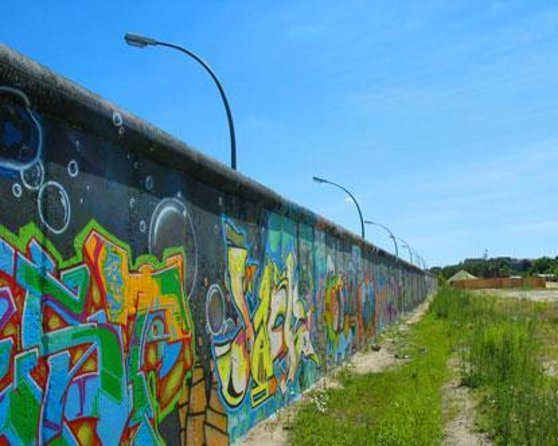
- A two-hour route through Berlin’s most important Wall memorial area, beginning near Nordbahnhof and ending at Mauerpark.
- Real stories of escape and loss, including border guard Conrad Schumann, tunnel escapes, kidnappings, and deaths at the Wall.
- The viewing platform on Bernauer Strasse gives you a clear look across the former border strip.
- The tour includes ghost-station history, church history, loudspeaker battles, and the way the East German state used children for propaganda.
- The walk is outdoors and emotionally heavy, with free admission at each listed stop.
- Booking reliability deserves attention, because two accounts describe a guide failing to appear, despite the group being at the agreed meeting point.
Why this stretch of the Berlin Wall matters
The Berlin Wall did not merely divide two political systems. It cut through streets, apartment buildings, churches, railway lines, and ordinary family life. It ran for more than 40 kilometers through Berlin and remained in place for 28 years.
I find Bernauer Strasse one of the best places to understand that division because the border was unusually visible here. Buildings stood in East Berlin, while their windows and entrances opened toward West Berlin. A few steps could separate a family from freedom, work, school, or relatives on the other side.
This tour uses that setting well. Instead of showing you a single painted section of concrete and moving on, it follows the former border zone and explains how the system worked. You learn about the wall’s construction, the border strip, escape attempts, surveillance, propaganda, and the human cost.
The route ends at Mauerpark, a fitting place to finish. The area is linked to the former border, and the tour closes by explaining how the Wall fell. The ending gives the walk a sense of movement from sealed borders toward an open city.
Other Berlin trips people book alongside this one:
- Berlin: Reichstag, Dome and Government District Guided Tour
★ 4.7 · 18,288 reviews - Berlin: 1-Hour City Tour by Boat with Guaranteed Seating
★ 4.3 · 16,993 reviews - Berlin: Boat Tour Along the River Spree
★ 4.4 · 11,252 reviews
Starting at Nordbahnhof and the ghost stations
The meeting point is at Elisabeth-Schwarzhaupt-Platz, near the entrance to the Nordbahnhof S-Bahn station on Gartenstrasse. The opening reference to jumping over the Wall is symbolic, not a physical stunt. Your guide uses the location to introduce the strange railway world created by Berlin’s division.
During the Cold War, some subway and S-Bahn lines crossed East Berlin but served West Berlin. Trains passed through stations that were closed to East Berlin residents and heavily guarded. These became known as ghost stations. From the train windows, passengers could see dim platforms and East German guards, but could not get off.
This is a smart beginning because it shows that the Wall was more than concrete. It also controlled movement underground. If you have used Berlin’s public transport, this first story gives you a better sense of how complicated the city’s divided transport system became.
The first stop lasts only about five minutes, so do not expect a long railway lecture. It works as an introduction before the walk moves into the memorial area.
Seeing how the border was built
At the Berlin Wall Memorial, you receive a short explanation of how the border could be constructed in the first place. The key date is August 13, 1961, when East Germany sealed the border and began building the Wall.
The tour also covers Walter Ulbricht’s famous denial in June 1961, when he said that nobody intended to build a wall. Because the guide presents the political setup before describing the physical barrier, you can follow the sequence more easily: mass departures from East Germany, increasing pressure on the government, sudden border closure, and the rapid transformation of streets into a fortified frontier.
You learn about the construction of the border strip, not only the familiar concrete slabs. The system included barriers, patrol routes, watchtowers, lighting, fences, and controlled ground between East and West Berlin. That detail matters. A wall sounds like one object, but escaping meant crossing a whole military zone.
The stop itself is brief, around ten minutes. I would pay close attention here, since later stories make more sense once you understand the layers of the border.
The memorial window and the price of freedom
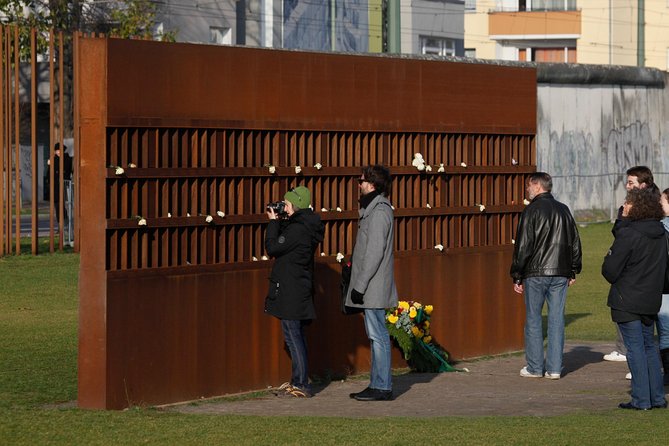
The memorial window is one of the tour’s most serious stops. At least 140 people died at the Berlin Wall between 1961 and 1989, though the exact number of victims remains uncertain.
The guide tells individual stories connected with those deaths. This personal approach is one of the tour’s strongest features. Statistics explain scale, but names, choices, fear, and family details help you grasp what the border meant to actual people.
You should know that the subject matter is direct. The tour discusses people who died while trying to escape and people who jumped from windows in fear or despair. It does not soften the cruelty of the system or turn the memorial into a simple Cold War photo stop.
For some visitors, this will be the most affecting part of the walk. For others, it may feel heavy, especially if you are traveling with young children. The supplied information says most people can participate, but it does not give a recommended age. Use your own judgment based on how your group handles difficult history.
Something different for another day:
- Discover Berlin Half-Day Walking Tour
★ 5.0 · 9,624 reviews - Berlin: Hop-on Hop-off Bus Tour with Live Commentary
★ 4.3 · 8,579 reviews - Berlin: Government District around the Reichstag Guided Tour
★ 4.7 · 8,447 reviews - Berlin: Reichstag, Plenary Chamber, Cupola & Government Tour
★ 4.6 · 8,422 reviews
The Bernauer Strasse viewing platform
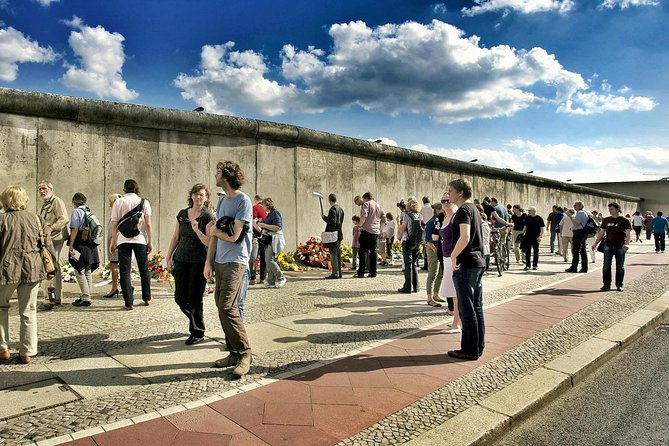
The walk continues to a viewing platform overlooking the former border strip on Bernauer Strasse. This is where the geography becomes easiest to read.
From above, you can see how close the two sides once were and how much space the border system required. The platform gives you time to look rather than simply pass a memorial marker. I like this pause because Berlin’s Wall sites can otherwise blur together after several stops.
The platform also helps explain the relationship between the apartment buildings and the border. Homes on the East Berlin side had windows and exits facing West Berlin. Once the border closed, these ordinary buildings became dangerous escape points.
The stop lasts around 15 minutes, the longest single pause on the route. It is a good place to ask a question if your guide allows time for one. Bring your attention back to the physical setting: the Wall did not run through an empty field. It cut across a lived-in neighborhood.
The Reconciliation Church and divided worship
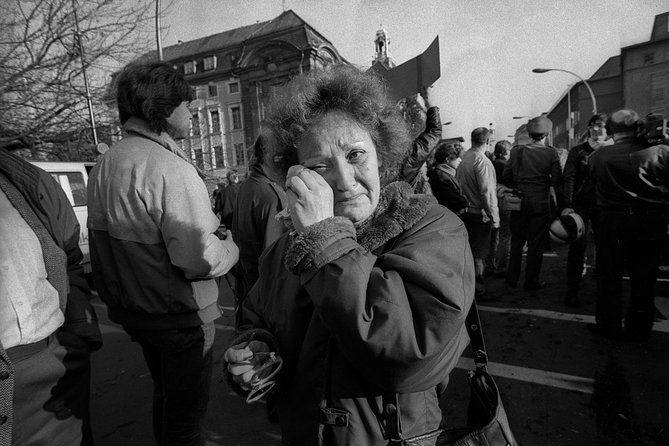
Near Ackerstrasse, the tour visits the Chapel of Reconciliation. The original Church of Reconciliation once stood in the middle of the border strip.
Before the border closed, people from East and West Berlin worshipped together there. After August 1961, the church was trapped between barriers and became inaccessible to much of its congregation. The guide explains what happened to the building after the border was sealed.
This stop adds a religious and community angle to the story. The Wall disrupted more than travel and politics. It broke up shared institutions, regular services, friendships, and local routines.
The stop lasts about five minutes, so it is more of a concise explanation than a full church visit. If you want to explore the memorial site at length, you may need to return independently. The walking route gives you a framework, then leaves you with reasons to look more closely.
Passenger agreements and the use of young people
The next section deals with passenger agreements between West Berlin’s Senate and the East German government. These agreements were attempts to make the Wall more permeable in limited ways.
This subject shows that the border was not entirely static. Travel rules changed, negotiations took place, and carefully controlled crossings opened or closed. The political language can sound dry, but it affected who could visit relatives and under what conditions.
The guide also explains how the East German state used children and young people for propaganda. That detail is especially disturbing because it shows how the government shaped public behavior from an early age. The tour presents the political system not only as a set of barriers, but as a structure that reached into schools, youth groups, and public messaging.
The pace is brisk, with roughly ten minutes for this section. I appreciate that the tour includes it, since many Wall walks focus only on escapes and overlook the machinery used to support the border.
Windows, desperate escapes, and personal tragedy
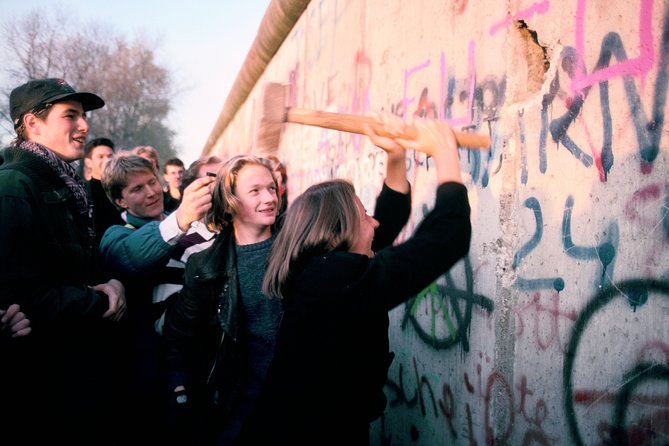
The residential buildings along Bernauer Strasse produced some of the most tragic scenes in Berlin’s Wall history. Their windows and doorways faced West Berlin, but the buildings themselves stood in East Berlin.
When the border closed, residents found themselves living beside freedom they could see but could no longer reach. Some people jumped from upper-floor windows before the buildings were sealed or altered. Others waited below, hoping West Berlin rescue workers could catch them.
The tour discusses the deaths and desperation connected with these buildings. It also gives you time to look at photographs and videos at your own pace. That last point matters. A guide’s story gives the place meaning, but the images let you examine individual faces, buildings, and moments without being rushed immediately to the next stop.
This part can be emotionally demanding. I would not choose this walk if you want only cheerful sightseeing or if you have just arrived after a tiring journey. The subject is essential, but it deserves your attention.
Tunnel escapes and a battle over propaganda
The 1960s produced many tunnel escape attempts. One famous tunnel is located close to the border house, and the tour takes you to that area.
Tunnels required planning, secrecy, labor, and luck. They also show the different ways people challenged the Wall. Some escaped over it, some under it, and some tried to exploit weaknesses in the system. The guide explains how East Germany used one tunnel’s story for propaganda and altered the meaning of events to serve the state.
That lesson is useful far beyond this particular escape. In a divided country, information itself became part of the conflict. Both sides wanted to control how escapes, arrests, and deaths were understood.
The tunnel stop lasts about ten minutes. Do not expect to enter a long underground passage based on the information provided. The value is the account of what happened nearby and how the East German government presented it.
Conrad Schumann and the famous border jump
One of the best-known escape images from the Berlin Wall shows border guard Conrad Schumann leaping over barbed wire into West Berlin. The jump took place early in the Wall’s history and became a powerful symbol of defection.
The tour does not stop at the photograph alone. It explains Schumann’s later life and the fact that he remained wanted by the East German state until the fall of the GDR.
This personal follow-up is important. Famous images can flatten people into symbols. Learning what happened to Schumann afterward reminds you that an escape did not end the danger. Families, identities, employment, and personal safety could remain under pressure for years.
The stop takes about five minutes, so the explanation is compact. Still, it is one of the easiest stories to remember and a useful link between a single photograph and the larger history.
Kidnappings and the Cold War loudspeaker war
The walk then turns to a darker subject: kidnappings ordered by the East German government. Former members of the National People’s Army and People’s Police were especially vulnerable to being taken from the West back to East Germany by criminal groups working for the state.
The tour includes a kidnapping that ended in death. This part expands your picture of the Cold War. The Wall was not the only tool used to punish opponents and control former officials. Covert operations continued beyond the visible border.
The final subject before Mauerpark is the loudspeaker war. East and West Berlin used loudspeakers to make life difficult for the other side, turning sound into another weapon of division.
I like this closing sequence because it moves beyond the standard Wall stories. You hear about secret operations and everyday harassment, not only concrete and barbed wire. The five-minute stops are short, but together they show how the conflict reached into public space.
Ending at Mauerpark and getting away
The tour ends at Mauerpark near the corner of Bernauer Strasse and Oderberger Strasse. Here, the guide explains the story of the Wall’s fall and brings the route to a close.
Mauerpark is a practical ending point. You are in a different part of the city from Nordbahnhof, and the M10 tram can take you toward Berlin Hauptbahnhof. The end point also gives you the option to continue exploring the area on your own.
The walk itself lasts about two hours. Because there are 13 stops, several explanations last only five minutes. You get a broad sweep of events rather than a long museum-style discussion at any one location.
Wear comfortable shoes and prepare for an outdoor route. The supplied details do not promise shelter, and the activity requires good weather. If poor weather causes cancellation, you are offered another date or a full refund.
Price, group size, and booking concerns
At about $19.66 per person, I consider the price fair if the tour operates as planned. Every listed stop has free admission, so you are paying for the guide’s interpretation, route planning, and storytelling rather than entry tickets.
A maximum of 25 people keeps the group from becoming enormous, though it is not an intimate private walk. At that size, your ability to hear the guide may depend on where you stand. Staying near the guide is sensible, especially at roads or open memorial spaces.
The experience uses a mobile ticket, and confirmation is provided at booking. It is near public transport, and most people can participate. You can cancel for a full refund up to 24 hours before the start time. Within 24 hours, changes and refunds are not accepted unless the operator cancels for weather or because the minimum number is not met.
The serious issue is the no-show record. Two separate accounts describe groups arriving at the agreed meeting point and finding no guide. One also describes a late and rude response when the group tried to make contact. Those reports conflict sharply with the positive accounts praising the tour as exciting, clear, and worthwhile.
I would confirm the meeting point and start time carefully on the day of the walk. Keep your booking confirmation available on your phone. If no guide appears, document your arrival and contact the provider promptly.
Who should book this Berlin Wall walk?
I would choose this tour if you want the Wall explained through human stories rather than a list of dates. It suits first-time visitors who need context, history-minded adults, and anyone interested in escape attempts, border policing, propaganda, and the daily effects of division.
It may also work well for you if you have limited time. In two hours, you reach the memorial window, viewing platform, Chapel of Reconciliation, tunnel site, Conrad Schumann story, and Mauerpark.
I would think twice if you need a guaranteed private experience, dislike emotionally difficult subjects, or prefer to explore museums at your own pace. The route is also not ideal if you want a relaxed neighborhood stroll with little political discussion.
Should you book Wall Tour Berlin?
The content is strong. The route covers one of Berlin’s best Wall sites, and the most praised qualities are its engaging pace and the sense that the past becomes easier to understand through real people and specific places. At $19.66, it can be good value.
The no-show reports are the reason I cannot give it an unqualified recommendation. If you book, confirm the details, arrive early, and keep the cancellation terms in mind. Choose it for the history and storytelling, but book with a little caution because dependable operation is not fully established by the information available.
FAQ
How long does Wall Tour Berlin last?
The tour lasts approximately two hours.
Where does the tour begin?
It begins at Elisabeth-Schwarzhaupt-Platz, 10115 Berlin, near the entrance to the Nordbahnhof S-Bahn station on Gartenstrasse.
Where does the tour end?
It ends at Mauerpark near Bernauer Strasse and Oderberger Strasse in Berlin’s Pankow district.
Does the tour include the Berlin Wall Memorial?
Yes. Several stops take place at the Berlin Wall Memorial, including the memorial window, the viewing platform area, and locations along Bernauer Strasse.
Is admission included?
The listed stops have no admission charge. The experience is a guided outdoor walk, and no separate entry fee is specified.
What historical subjects does the guide cover?
The tour covers the Wall’s construction and fall, ghost stations, the border strip, deaths at the Wall, tunnel escapes, Conrad Schumann’s escape, kidnappings, passenger agreements, propaganda involving young people, and the loudspeaker conflict between East and West.
Is the tour available with a mobile ticket?
Yes. The experience includes a mobile ticket.
How large can the group be?
The maximum group size is 25 people.
Can most people participate?
The provided information says most people can participate and that the tour is near public transportation. No more detailed accessibility information is provided.
What happens if bad weather cancels the tour?
If poor weather causes cancellation, you are offered a different date or a full refund. The tour requires good weather.
Can I cancel for a refund?
Yes. You can cancel at least 24 hours before the start time for a full refund. Cancellations or changes made within 24 hours are not refunded.
Just added around Berlin
- Kreuzberg Private Walking Tour: Immigrants, Artists & Hipsters★ 5.0 · 3 reviews
- Private Photo Tour in Kreuzberg★ 5.0 · 3 reviews
- Individual city tour Berlin for max. 8 persons★ 5.0 · 3 reviews
- Berlin’s Jewish Heritage: Private Tour of the Vibrant Jewish District★ 5.0 · 3 reviews
- Berlin & The Third Reich Private Guided Tour★ 5.0 · 3 reviews
- Private Analogue Photography Experience in Berlin★ 5.0 · 3 reviews
- Spy Mission in Berlin: Self-Guided Espionage Puzzle Quest★ 5.0 · 3 reviews
- Berlin Christmas Markets Walking Tour with Local Guide★ 5.0 · 3 reviews
Berlin Tours, compared.
Reichstag, Dome and Government District Guided Tour
Read our review →
1-Hour City Tour by Boat with Guaranteed Seating
Read our review →

Government District around the Reichstag Guided Tour
Read our review →
Reichstag, Plenary Chamber, Cupola & Government Tour
Read our review →