Reviewed · BERLIN TOURS
The Old Berlin Tour: Travel Through Time With a Historian
Berlin keeps its old stones under pressure. This small-group walk links vanished streets, medieval ruins, churches, and the Berlin Wall era into one clear story of a city repeatedly rebuilt. I like the maximum group of eight, which should make questions easier, and I like having historian Sean Stewart lead the route rather than a guide who only points at famous façades. The main drawback is that two hours can feel short for Berlin’s enormous story.
The tour begins near Alexanderplatz and ends by Berlin Cathedral, so you finish in a useful central area. You should expect an easy walking pace, outdoor stops, and plenty of historical explanation rather than food, drinks, or paid entries. At $23, it is a fair buy if you want context more than a quick photo checklist.
In This Review
- Key points to know before you book
- Why this Berlin history walk is different
- Alexanderplatz and the streets Berlin lost
- Franziskaner Klosterkirche and a medieval ruin
- St. Mary’s Church and medieval Berlin
- Nikolaiviertel, reconstructed rather than untouched
- From medieval Berlin to the Wall era
- What Sean Stewart adds to the walk
- Group size, pace, and practical comfort
- Is $23 a fair price?
- Who should book this Berlin walk?
- Final verdict: a smart choice for history-minded visitors
- FAQ
- Where does the Old Berlin Tour begin?
- What time does the tour start?
- Where does the tour end?
- How long does the tour last?
- What places are included on the route?
- Is admission included?
- How many people can join the tour?
- Is the tour offered in English?
- Is the tour accessible by public transportation?
- Can I cancel for a refund?
Key points to know before you book
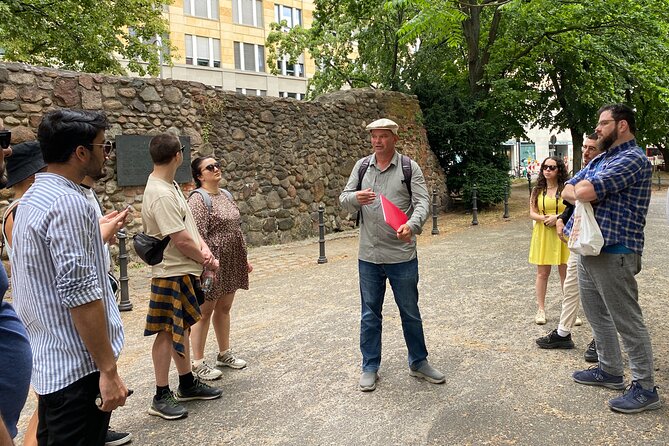
- Historian-led storytelling: Sean Stewart brings a formal European history background and focuses on how Berlin changed, rather than simply naming buildings.
- Four central stops: The route covers Alexanderplatz, Franziskaner Klosterkirche, St. Mary’s Church, and Nikolaiviertel.
- Small group size: The maximum is eight people, a useful advantage on a discussion-based walk.
- A city of replacements: You will look at vanished streets, reconstructed buildings, and ruins that show how Berlin has repeatedly rewritten itself.
- Convenient route: Meet near Alexanderplatz Station at 11:00 a.m. and finish at Berlin Cathedral in the Lustgarten.
- Weather matters: The walk requires good weather, and cancellations for poor conditions may be moved or refunded.
Why this Berlin history walk is different
Many central Berlin walks concentrate on the most photographed sights. This one uses those places as evidence in a much larger story. You move from medieval Berlin through imperial ambition, wartime destruction, reconstruction, and the divided city of the Berlin Wall era.
That approach suits you if you want to understand why Berlin looks so uneven. A grand avenue may sit beside an empty patch of land. A modern building may mark the location of a vanished street. A medieval church may survive only as a ruin, while an entire old quarter has been rebuilt in recent decades.
Sean Stewart’s role is central to the experience. The strongest praise focuses on his ability to teach you how to read Berlin, not just photograph it. One particularly useful quality is his attention to contradiction and irony. Berlin often presents history in pieces, and Stewart’s job is to show how those pieces fit together.
The small group helps here. With no more than eight people, the walk should feel closer to a guided conversation than a public lecture. You can ask about a courtyard, a church, or a confusing change in the street plan without trying to catch a guide’s voice from the back of a crowd.
The route is also useful for repeat visitors. One person who had already seen Berlin’s major sights used the walk to seek a less familiar side of the city. That is a good clue about the tour’s value: it is not only for a first visit, though first-time visitors will gain the most from its broad timeline.
Other Berlin trips people book alongside this one:
- Berlin: Reichstag, Dome and Government District Guided Tour
★ 4.7 · 18,288 reviews - Berlin: 1-Hour City Tour by Boat with Guaranteed Seating
★ 4.3 · 16,993 reviews - Berlin: Boat Tour Along the River Spree
★ 4.4 · 11,252 reviews
Alexanderplatz and the streets Berlin lost
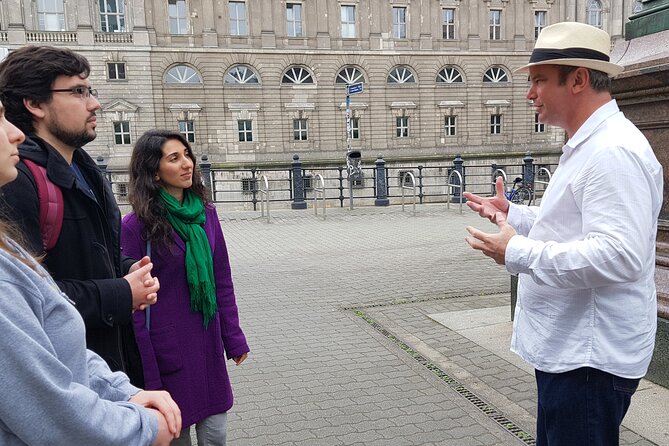
The meeting point is Espresso House Alea 101 at Rathausstraße 6, near Alexanderplatz Station. The start time is 11:00 a.m., which gives you a practical morning option and places you close to major transport links.
Alexanderplatz is more than a large square and a convenient place to meet. The first stop focuses on streets and buildings that disappeared. That makes the square a useful opening lesson in Berlin’s habit of replacement.
You should not expect a preserved medieval town center here. Instead, you will consider what once occupied this part of the city and how later changes erased or reshaped it. The stop lasts about 15 minutes and has no admission fee.
This is a strong beginning because it changes the way you look at the rest of the route. Rather than asking only what survives, you start asking what is missing, why it vanished, and who made the decision to rebuild. That is one of the clearest ways to understand Berlin.
The practical limitation is that Alexanderplatz can be visually confusing. Modern construction, broad open space, and layers of redevelopment do not always make the past easy to picture. You will depend on the guide’s explanation to give the vanished streets a place in your mind.
Franziskaner Klosterkirche and a medieval ruin
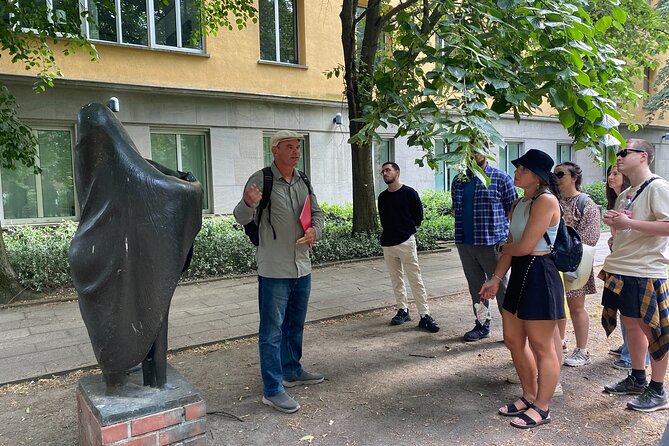
The next stop is Franziskaner Klosterkirche, described as Berlin’s only medieval romantic ruin. The phrase points to a rare kind of atmosphere in the city: medieval remains presented not as a complete monument, but as broken masonry with a long afterlife.
The stop lasts about 15 minutes and is free to enter. Its appeal is not size. It is the contrast between a fragment of old Berlin and the city around it.
A ruin can tell a different story from a restored church. It shows damage, neglect, changing priorities, and the limits of reconstruction. Here, you get a chance to consider what Berlin chooses to preserve and what it leaves incomplete.
This stop also rewards careful listening. On your own, you might glance at the remains and move on quickly. Stewart’s historical framing helps explain why the ruin matters within the wider city story. It becomes part of a pattern: Berlin does not simply preserve the past or destroy it. It often does both at once.
The site may appeal most to you if you enjoy traces and fragments rather than polished monuments. If you want a grand interior or a long visit inside a working church, this short outdoor-focused stop may feel modest.
St. Mary’s Church and medieval Berlin
St. Mary’s Church brings the medieval period into a more recognizable religious setting. It is identified as an important church from medieval times and gives the walk a place to discuss Berlin’s early civic and spiritual life.
Again, the planned stop is about 15 minutes, with no admission ticket included or needed for the tour stop. The short visit keeps the route moving, but it also means you should not expect a full church tour or extended time for private inspection.
Its position in the sequence matters. After hearing about vanished streets and seeing a ruin, you reach a surviving medieval church. Together, these stops show three different outcomes for old Berlin: disappearance, partial survival, and continued recognition.
I like this kind of progression because it avoids treating history as a list of dates. You see how the physical city carries some periods forward while losing others. The church also helps connect the medieval story to later political and urban changes.
Keep your expectations measured. The tour’s purpose is historical orientation, not an in-depth architectural study of every feature. If St. Mary’s Church particularly interests you, make a note of it and consider returning after the walk, though the provided tour details do not specify extra visiting time or interior access.
Something different for another day:
- Discover Berlin Half-Day Walking Tour
★ 5.0 · 9,624 reviews - Berlin: Hop-on Hop-off Bus Tour with Live Commentary
★ 4.3 · 8,579 reviews - Berlin: Government District around the Reichstag Guided Tour
★ 4.7 · 8,447 reviews - Berlin: Reichstag, Plenary Chamber, Cupola & Government Tour
★ 4.6 · 8,422 reviews
Nikolaiviertel, reconstructed rather than untouched
Nikolaiviertel is presented as Berlin’s reconstructed medieval Disneyland. That blunt description is useful because it warns you not to mistake the quarter for an untouched medieval district.
The area offers a lesson in modern ideas about the past. Reconstruction can create a strong sense of place, but it can also simplify history and turn it into a carefully arranged setting. On this walk, you look at that tension directly.
The stop lasts about 15 minutes and is free. In such a short visit, the guide’s interpretation matters more than the number of buildings you see. Stewart can help you distinguish between genuinely old fabric, rebuilt forms, and the political choices behind presenting an old-looking neighborhood.
This is likely one of the most revealing stops for anyone curious about how cities use history. You are not asked to accept a picturesque quarter at face value. Instead, you are encouraged to notice the difference between survival and recreation.
Nikolaiviertel also gives the tour a little visual variety. Ruins and church history can feel solemn. A reconstructed quarter adds questions about style, memory, and public taste. It is a good example of the tour’s wider habit of pairing old Berlin with the ways later generations imagined it.
From medieval Berlin to the Wall era
The advertised story reaches from the Middle Ages to the Berlin Wall. The four named stops are concentrated in the historic center, so the walk cannot show every major Wall site or cover every period in equal physical detail.
What you gain is a framework. The guide connects the medieval city to the imperial capital and then to the modern divisions and changes that shaped Berlin. The result should help you make sense of other parts of the city during the rest of your visit.
That broad span is ambitious for an approximately two-hour walk. The four stops are each listed at around 15 minutes, leaving roughly an hour for movement and explanation. You will get a guided overview, not a university seminar or a full tour of every era.
For me, that is the right way to judge the duration. If you want dates, battles, and names in great detail, this will move too quickly. If you want a clear map of how Berlin’s past keeps appearing in its streets, the pace makes sense.
The reference to the Berlin Wall is especially helpful for first visits. Berlin’s modern history can seem separated from its medieval center, but the walk’s larger message is that the city’s political changes keep reshaping the same central ground.
What Sean Stewart adds to the walk
The guide is the main reason to choose this experience over a basic sightseeing circuit. Sean Stewart is described as a professional historian, and the strongest praise centers on his ability to explain Berlin’s courtyards, contradictions, and odd turns.
One person living in Berlin found places on the route they had never noticed. That tells you something important: the walk is not limited to the obvious headline sights. Stewart appears to use small details to explain larger forces, which is exactly what you need in a city where history is not always labeled.
Another useful feature is the guide’s apparent flexibility. Before one walk, he asked about the visitor’s previous experience and interests, then shaped the route toward less familiar material. The supplied details do not promise a custom itinerary for every booking, so you should not assume a private tour. Still, it is worth telling him at the start if you have already seen Berlin’s main monuments.
The tone also seems to matter. Stewart is praised for presenting the city’s irony and contradictions rather than offering a smooth, tidy story. Berlin’s past is not tidy. A guide who acknowledges that can give you a more honest sense of place.
Group size, pace, and practical comfort
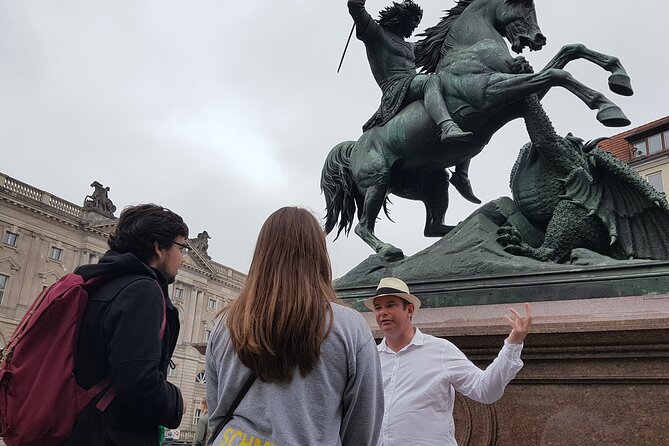
The group is capped at eight people. That is one of the tour’s strongest practical features, especially when the guide is explaining complex changes to streets and buildings.
The walk is described as easy-paced, and most people can participate. It begins near public transportation, which makes Alexanderplatz a simple starting point. The end at Berlin Cathedral is also useful, since you finish near the Lustgarten and several central sights.
You receive a mobile ticket, and booking confirmation arrives at the time of booking. Service animals are allowed. Food and drinks are not included, so bring what you need for the two-hour outing.
The tour requires good weather. If conditions force a cancellation, you are offered another date or a full refund. You can also cancel for a full refund up to 24 hours before the 11:00 a.m. start time. Inside that window, changes are not accepted and the payment is not refunded.
Wear comfortable shoes even though the pace is easy. The route includes several outdoor locations, and the historical value comes from moving through the city rather than sitting in one building.
Is $23 a fair price?
At $23, this is priced below many longer guided city experiences, but the real question is what you want from the money. You are paying for a professional historian, a very small group, and a connected explanation of Berlin’s past. You are not paying for meals, museum admission, or a large number of interior visits.
The value is strongest if you are new to Berlin and want a structure for exploring the center on your own. It is also strong for repeat visitors who have already seen the major sights and want to notice less obvious traces.
The value is weaker if you expect a full half-day tour, despite one enthusiastic description using that phrase. The official duration is approximately two hours, and the named itinerary is compact. Think of it as a focused orientation walk with serious historical content.
The five-star overall rating is based on four posted ratings, so the sample is small. The praise is consistent in the areas that matter most here: Sean Stewart’s historical ability, his feel for Berlin, and the unusual route. That gives the tour a promising record, but you should still match it to your interests rather than treat the rating as a guarantee.
Who should book this Berlin walk?
I would choose this tour if you enjoy history, want to understand why Berlin looks the way it does, or prefer thoughtful explanation to a parade of photo stops. It is especially suitable for first-time visitors who need a central orientation and for repeat visitors who want a different angle.
It may also work well for people who enjoy ruins, reconstructed districts, and questions about public memory. The route asks you to look at what has vanished as much as what remains.
I would hesitate if your priority is visiting interiors, seeing major Berlin Wall memorials in detail, or covering a large area. The tour mentions the Wall era but the four named stops are in the historic center. You should also reconsider if the forecast is poor, since the activity depends on suitable weather.
Final verdict: a smart choice for history-minded visitors
Book the Old Berlin Tour if you want Berlin explained as a changing city rather than displayed as a collection of monuments. The $23 price, eight-person limit, central meeting point, and historian-led format make it a sensible first or repeat-visit choice.
Go in expecting an approximately two-hour walk, not an exhaustive study of every Berlin era. If you give Sean Stewart your interests at the start, you may get more from the route, especially if you already know the famous sights. For curious visitors who want to read the city more carefully, this is a focused and fairly priced introduction.
FAQ
Where does the Old Berlin Tour begin?
It begins at Espresso House Alea 101, Rathausstraße 6, 10178 Berlin, Germany, near Alexanderplatz Station.
What time does the tour start?
The tour starts at 11:00 a.m.
Where does the tour end?
It ends at Berlin Cathedral, Am Lustgarten, 10178 Berlin, Germany.
How long does the tour last?
The experience lasts approximately two hours.
What places are included on the route?
The named stops are Alexanderplatz, Franziskaner Klosterkirche, St. Mary’s Church, and Nikolaiviertel.
Is admission included?
The listed stops have no admission ticket charge for the tour. Food and drinks are not included.
How many people can join the tour?
The maximum group size is eight people.
Is the tour offered in English?
Yes. The guide is an English-speaking professional historian.
Is the tour accessible by public transportation?
Yes. The meeting point is near public transportation.
Can I cancel for a refund?
You can cancel up to 24 hours before the experience start time for a full refund. Cancellations or changes made less than 24 hours before the start are not refunded or accepted.
Just added around Berlin
- Kreuzberg Private Walking Tour: Immigrants, Artists & Hipsters★ 5.0 · 3 reviews
- Private Photo Tour in Kreuzberg★ 5.0 · 3 reviews
- Individual city tour Berlin for max. 8 persons★ 5.0 · 3 reviews
- Berlin’s Jewish Heritage: Private Tour of the Vibrant Jewish District★ 5.0 · 3 reviews
- Berlin & The Third Reich Private Guided Tour★ 5.0 · 3 reviews
- Private Analogue Photography Experience in Berlin★ 5.0 · 3 reviews
- Spy Mission in Berlin: Self-Guided Espionage Puzzle Quest★ 5.0 · 3 reviews
- Berlin Christmas Markets Walking Tour with Local Guide★ 5.0 · 3 reviews
Berlin Tours, compared.
Reichstag, Dome and Government District Guided Tour
Read our review →
1-Hour City Tour by Boat with Guaranteed Seating
Read our review →


Government District around the Reichstag Guided Tour
Read our review →
Reichstag, Plenary Chamber, Cupola & Government Tour
Read our review →