Reviewed · PRIVATE
The Cold War and The Wall – Private Tour with Jacob
Berlin’s divided past is still underfoot. This private tour links major Cold War sites with the personal stories behind them, from the 1953 East German uprising to escape attempts, border controls, and the fall of the Berlin Wall. I like the private guide format, which lets your group ask questions and set the pace, and I like that the tour ends at Alexanderplatz, a useful place to continue exploring on your own. The main drawback is its brisk schedule: ten stops in less than three hours means some locations receive only a short explanation.
I also like the practical help included by Nadav Jacobs Berlin experience. You receive a picture folder, a large subway map, and guide availability for questions about the rest of your Berlin visit. Just remember that public transport costs extra, and much of the experience takes place outdoors, so an umbrella is sensible in Berlin’s changeable weather.
In This Review
- Key points to know before booking
- Why this private Berlin tour works well
- The Victory Column and the 1953 East German uprising
- Brandenburg Gate and the Wall’s rise and fall
- Potsdamer Platz and a city split in two
- The Aviation Ministry and an escape from East Germany
- The Trabant and everyday East German life
- Checkpoint Charlie and the main East-West crossing
- Friedrichstrasse, Unter den Linden, and the route to the border
- The Palace of Tears and controlled departures
- Alexanderplatz, the TV tower, and the space race
- What the $310 group price really means
- Who should book this experience?
- Should you book the Cold War and The Wall tour?
- FAQ
- How long is the Cold War and The Wall private tour?
- How much does the tour cost?
- Is this a private tour?
- Who guides the tour?
- Does the tour offer pickup?
- Where does the tour end?
- Are public transport tickets included?
- Are admission tickets included?
- Does the tour operate in bad weather?
- Can I cancel for a full refund?
Key points to know before booking
- Ten Cold War stops in 2 hours 45 minutes: The route covers central Berlin from the Victory Column to Alexanderplatz, with several short stops along the way.
- Private experience for your group: Only your party participates, with a guide such as Jacob or Nadav Jacobs.
- Strong focus on personal stories: The route includes the 1953 uprising, Heinz Holzapfel’s escape attempt, East German cars, and the Palace of Tears.
- Pickup can simplify your morning: Hotel, Airbnb, train station, and airport pickup in Berlin are offered.
- Transport is not included: Plan on about €3 to €11 for a two-hour or day ticket, depending on what you buy.
- A good first look at divided Berlin: You will see major landmarks, but the schedule is better for orientation than for long museum visits.
Why this private Berlin tour works well
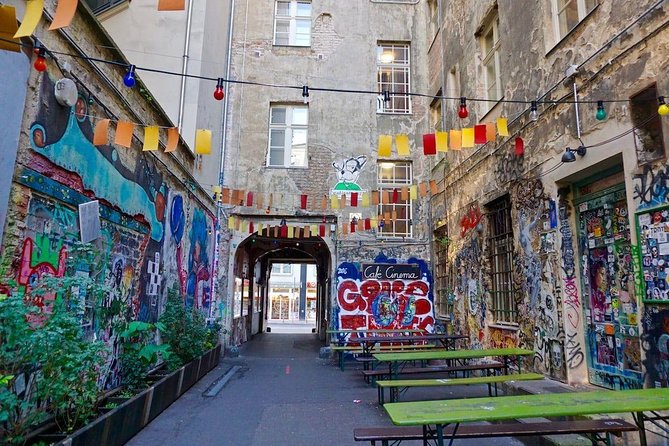
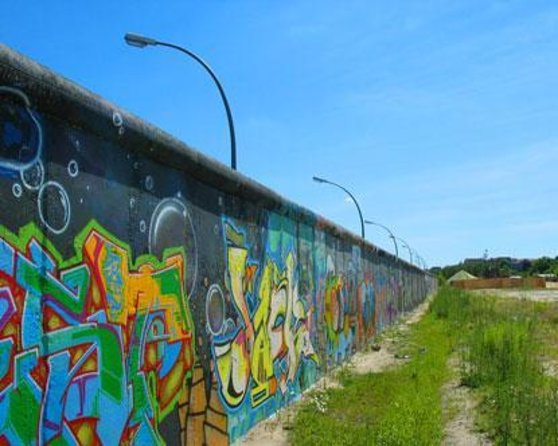
The Cold War can be hard to grasp from dates alone. Berlin makes the subject physical. Streets, stations, government buildings, squares, and border crossings tell the story in a way that a textbook cannot.
This tour brings those places together in one route. You move from the wide Straße des 17. Juni near the Victory Column to Brandenburg Gate, Potsdamer Platz, Checkpoint Charlie, Friedrichstrasse, Unter den Linden, the Palace of Tears, and Alexanderplatz. That sequence helps you see how the city was divided and how the old border cut through its center.
The private setup is the key advantage. A group of up to six can ask questions without waiting for a large crowd to catch up. If you want more detail about escape attempts, East Germany’s daily life, or the political meaning of a particular site, you can ask at once. If your group prefers a faster pace, the guide can keep things moving.
The route also has a human scale. It is not only about presidents, walls, and official speeches. You hear about the 1953 revolution, Heinz Holzapfel’s attempt to escape, the East German Trabant car, and the control exercised at the Palace of Tears. Those details help explain what life felt like for ordinary people living behind the border.
A few more tours and experiences worth a look
- Berlin: Private Reichstag and Glass Dome Tour
★ 4.8 · 2,226 reviews - Berlin Private Complete History All Day Walking Tour
★ 5.0 · 474 reviews - Private Walking Tour Berlin Third Reich Hitler and World War II
★ 5.0 · 360 reviews
The Victory Column and the 1953 East German uprising
The first stop is the Siegessäule, or Victory Column, on Straße des 17. Juni. You spend about 15 minutes here, with no admission charge.
The important connection is the street itself. Straße des 17. Juni takes its name from the East German uprising of June 17, 1953. The tour uses this stop to explain the revolt and the response to it, giving you an early example of tension inside East Germany long before the Wall fell.
This is a useful opening because it moves beyond the familiar image of the Wall. The Cold War was not simply a dispute between two governments. It affected workers, families, political groups, and people who challenged the system.
The Victory Column is also a broad, open location, so it gives the tour room to begin without the cramped feel of a border crossing or narrow city street. Fifteen minutes is enough for an explanation and orientation, but not enough for a long visit to the monument itself.
Brandenburg Gate and the Wall’s rise and fall
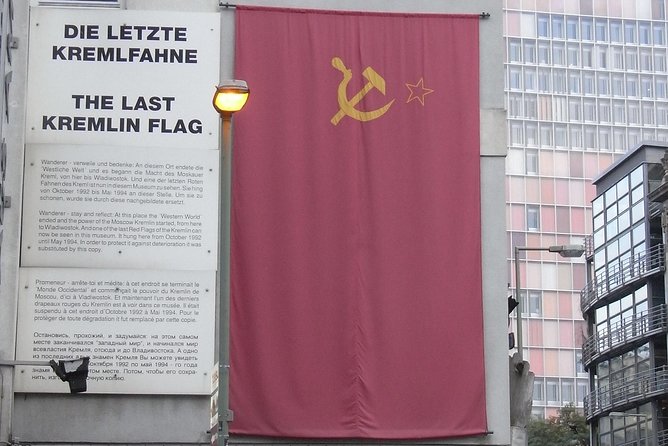
At Brandenburg Gate, the guide covers the erection and fall of the Berlin Wall. The scheduled stop lasts about 10 minutes, and admission is free.
Brandenburg Gate is one of Berlin’s essential sights, but its Cold War meaning matters as much as its architecture. During the city’s division, the gate sat in the border zone and became a powerful symbol of separation. After 1989, it became one of the clearest symbols of reunification.
I find this stop valuable because the gate connects several periods at once. You are not looking at a single event. You are seeing how a familiar landmark changed meaning as Berlin moved from imperial capital to divided city to reunited capital.
The short timing is the tradeoff. You will get the historical explanation, but you should not expect a long architectural discussion or an extended photo stop. If Brandenburg Gate is high on your personal list, return later with more time.
Potsdamer Platz and a city split in two
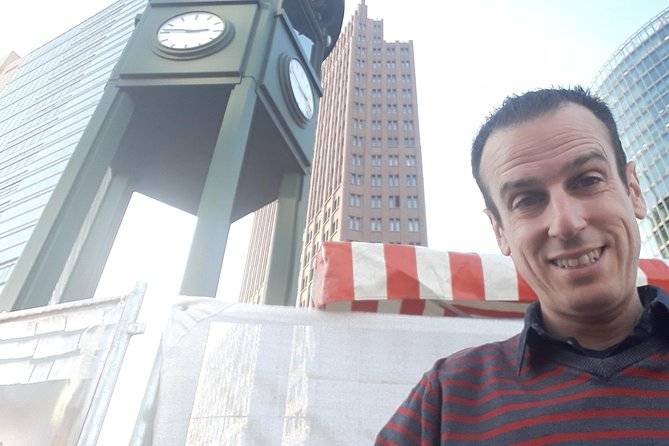
The tour spends about 15 minutes at Potsdamer Platz, focusing on the division of Berlin and a post-Cold War freedom concert.
Potsdamer Platz is especially useful for understanding how sharply the border split the city. A place once associated with central Berlin became part of the divided zone, then took on a new role after the Wall disappeared. The stop shows how a once-severed urban space became connected again.
The reference to a freedom concert adds a cultural note to the political story. The end of the Cold War was not only a matter of treaties and border openings. Music, public gatherings, and shared celebrations helped people express the change.
This is another short visit, so you will mainly listen, look around, and move on. I would treat it as a scene-setting stop rather than a place for a full architectural tour.
Something different for another day:
- Berlin: Reichstag, Dome and Government District Guided Tour
★ 4.7 · 18,288 reviews - Berlin: 1-Hour City Tour by Boat with Guaranteed Seating
★ 4.3 · 16,993 reviews - Berlin: Boat Tour Along the River Spree
★ 4.4 · 11,252 reviews - Discover Berlin Half-Day Walking Tour
★ 5.0 · 9,624 reviews
The Aviation Ministry and an escape from East Germany
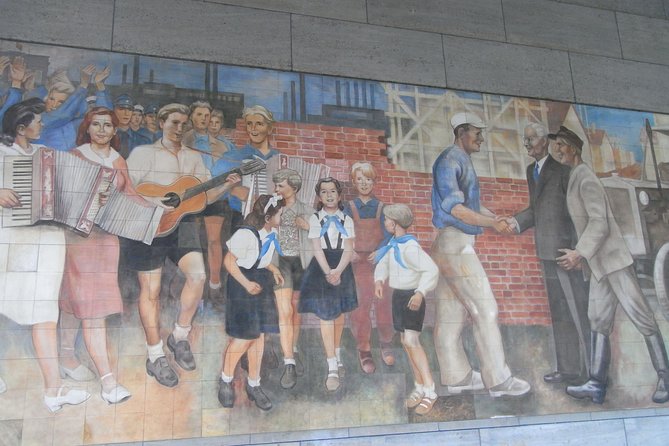
The former Aviation Ministry receives about 10 minutes. The guide discusses Max Lingner’s communist utopia and Heinz Holzapfel’s escape attempt.
This stop brings together official ideals and private resistance. Max Lingner’s work represents the public image of the communist state and its vision of society. Heinz Holzapfel’s escape attempt points to the very different reality faced by people who wanted to leave East Germany.
That contrast is one of the tour’s stronger features. You get a look at what the state wanted people to see, followed by a story about someone who wanted to get out. The result is more revealing than a list of government buildings and political dates.
The limited time means the guide’s explanation does much of the work. You should expect to view the location from the outside rather than spend a long period examining the building.
The Trabant and everyday East German life
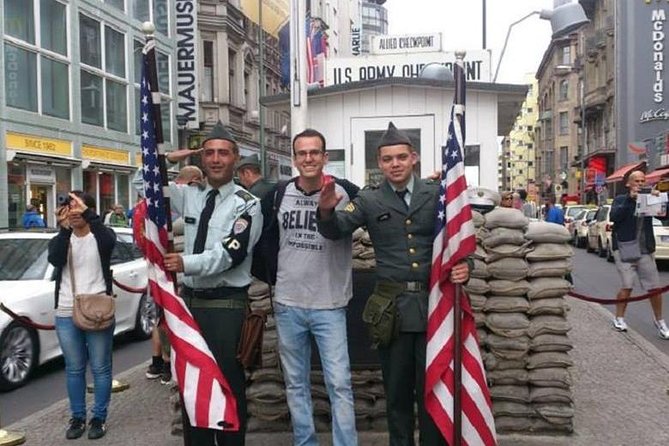
The Trabi Museum is scheduled for 30 minutes, the longest stop on the route. The admission cost is listed as free.
The Trabant, often called the Trabi, was the famous East German car. It offers a welcome change of scale after the major political sites. Instead of focusing on presidents and borders, this stop turns to transport and daily life under communism.
A car can tell you a surprising amount about a society. Production, availability, design, and ownership all reflect the limits and priorities of the East German system. The Trabi also remains one of the most recognizable objects associated with East Germany, so this is likely to be a memorable stop even if you are not especially interested in cars.
The 30-minute allocation suggests that this is more than a quick photograph. Still, the supplied information does not specify the museum’s exact displays or whether there is a separate guided entry. Ask the guide what you will see during the visit if the museum is a priority for you.
Checkpoint Charlie and the main East-West crossing
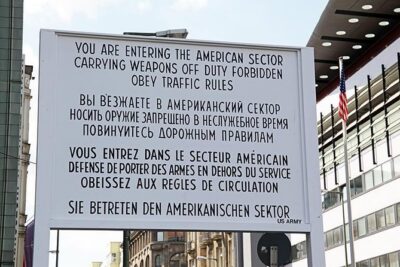
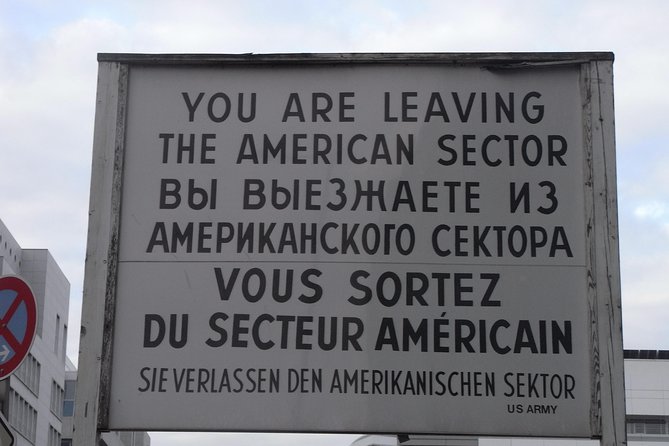
Checkpoint Charlie gets about 10 minutes. Here, the focus is the main crossing between East and West and its role in Cold War Berlin.
This is one of the city’s best-known Cold War locations. It helps explain how border movement was controlled and why crossing points mattered so much to Berliners, diplomats, and foreign visitors.
The stop is useful for first-time visitors because it places the border story at a recognizable crossroads. It also gives your guide a chance to explain how the city worked when crossing from one side to the other was closely controlled.
Checkpoint Charlie is a busy central sight, and ten minutes can pass quickly. The tour gives you context and orientation, but you may want to return later if you want to study the displays or spend more time looking around.
Friedrichstrasse, Unter den Linden, and the route to the border
Friedrichstrasse receives about 20 minutes and is presented as the street of checkpoints. That longer stop gives the guide room to explain how movement through central Berlin was monitored.
You then continue along Unter den Linden for about 20 minutes. This was East Germany’s main avenue leading toward the border. Taken together, these two stops show the border as part of the city’s daily street plan, not an isolated wall placed far from ordinary life.
I like this section because it makes the division easier to picture. You are following roads that connected important parts of Berlin, while also learning how political control shaped where people could go and how they could cross.
The route is a walking experience, so comfortable shoes matter. Public transport may be used to connect parts of the itinerary, and that ticket is not included. The listed estimate is about €3 to €11 for a two-hour or day ticket.
The Palace of Tears and controlled departures
The Palace of Tears is scheduled for about 20 minutes. It was the main checkpoint for citizens leaving East Berlin, and the tour focuses on communist control there.
The name alone gives this place emotional weight, but the useful point is practical: this was where departures were checked and controlled. A border crossing could mean separation, fear, uncertainty, or a final goodbye. The site helps explain the human cost of a divided city better than a wall fragment by itself.
This stop also fits well after Friedrichstrasse and Unter den Linden. You have just followed the streets and checkpoints of divided Berlin, and now you see what crossing meant for people trying to leave or visit.
The schedule allows a proper explanation, though the supplied details do not state whether the tour includes an interior visit. Ask Jacob or Nadav Jacobs about the exact arrangement if entering the site is important to you.
Alexanderplatz, the TV tower, and the space race
The final stop is Alexanderplatz, where the guide discusses the TV tower and the space race. The tour ends here at 10178 Berlin.
Alexanderplatz gives the experience a distinctly East German finish. The TV tower reflects the state’s public image and technological ambitions, while the space race places East Germany within the wider competition between the communist and Western blocs.
Ending here is practical. Alexanderplatz is a major city location, and you can continue exploring Berlin after the tour. The guide also offers advice for future independent sightseeing, supported by the large subway map included with the experience.
The stop itself lasts around 10 minutes. It is a concise ending rather than a long final visit, but it pulls together themes of propaganda, technology, and the public face of East Germany.
What the $310 group price really means
The price is $310 per group of up to six people. That works out to about $52 per person for six, before public transport costs. For a smaller party, the per-person figure rises, but the private format remains the main value.
You are paying for a dedicated guide, not simply transport between landmarks. Hotel, Airbnb, train station, and airport pickup in Berlin are offered, which can be useful if you are new to the city or want to avoid finding the first meeting point. Private van and driver service is available by request, but it is not included.
All listed admission tickets are free, so the extra expense is mainly for the guide’s time, planning, interpretation, and private attention. I would consider it good value for a group of four to six people who wants a focused introduction to Cold War Berlin. For one or two people on a tight budget, a public walking tour may cost less, but it will not offer the same private question time.
The tour is commonly booked well ahead, with an average booking time of about 40 days. That is a useful warning if your Berlin dates are fixed.
Who should book this experience?
I would recommend it most strongly to first-time Berlin visitors who want a clear introduction to the Cold War and the Wall. It also suits families or small groups with mixed interests, since the route includes politics, architecture, cars, escape stories, public spaces, and transport advice.
History-focused visitors should appreciate the range of subjects. You get more than the standard Brandenburg Gate and Checkpoint Charlie circuit, including the 1953 uprising, the communist utopian message, and the Palace of Tears.
The tour may be less suitable if you want long museum visits, extensive time at each landmark, or a slow photography walk. Ten stops in 2 hours 45 minutes is efficient, but it is not leisurely.
The experience operates in all weather. Bring an umbrella, and wear shoes suited to walking and possible public transport connections. Service animals are allowed, the route is near public transportation, and most people can participate.
Should you book the Cold War and The Wall tour?
Book it if you want a private, efficient introduction to Berlin’s divided past and value having a guide available for follow-up questions. The strongest parts are the personal stories, the broad route, and the chance to connect famous sights with less familiar episodes such as the 1953 uprising and Heinz Holzapfel’s escape attempt.
I would be more cautious if you want detailed time at every stop. The tour covers a lot of ground quickly, and the short visits at Brandenburg Gate, Checkpoint Charlie, and Alexanderplatz leave little room for lingering.
For a group of up to six, the $310 price is easier to justify, especially with pickup and the included subway map and picture folder. Free cancellation is available up to 24 hours before the start time, which gives you some flexibility. If Berlin’s Cold War story is near the top of your list, this is a strong first look, followed by independent visits to the sites that catch your attention.
FAQ
How long is the Cold War and The Wall private tour?
The tour lasts approximately 2 hours and 45 minutes.
How much does the tour cost?
The price is $310 per group of up to six people.
Is this a private tour?
Yes. Only your group participates in the activity.
Who guides the tour?
The experience is provided by Nadav Jacobs Berlin experience. The tour is described as a private tour with Jacob, and one experience specifically identifies the guide as Nadav Jacobs.
Does the tour offer pickup?
Yes. Pickup is offered from hotels, Airbnbs, train stations, and the airport in Berlin.
Where does the tour end?
The tour ends at Alexanderplatz, 10178 Berlin.
Are public transport tickets included?
No. Public transport tickets cost extra. The listed estimate is around €3 to €11 for a two-hour or day ticket.
Are admission tickets included?
The listed stops show free admission. The tour also includes a private guide, an A3 picture folder, and a large subway station map.
Does the tour operate in bad weather?
Yes. It operates in all weather conditions. You should bring an umbrella.
Can I cancel for a full refund?
Yes, if you cancel at least 24 hours before the experience start time. Cancellations made less than 24 hours before the start time are not refunded.
Just added around Berlin
- Kreuzberg Private Walking Tour: Immigrants, Artists & Hipsters★ 5.0 · 3 reviews
- Private Photo Tour in Kreuzberg★ 5.0 · 3 reviews
- Individual city tour Berlin for max. 8 persons★ 5.0 · 3 reviews
- Berlin’s Jewish Heritage: Private Tour of the Vibrant Jewish District★ 5.0 · 3 reviews
- Berlin & The Third Reich Private Guided Tour★ 5.0 · 3 reviews
- Private Analogue Photography Experience in Berlin★ 5.0 · 3 reviews
- Spy Mission in Berlin: Self-Guided Espionage Puzzle Quest★ 5.0 · 3 reviews
- Berlin Christmas Markets Walking Tour with Local Guide★ 5.0 · 3 reviews
Private, compared.
Berlin Private Complete History All Day Walking Tour
Read our review →
Munich Private Tour with a Local – Highlights & Hidden Gems
Read our review →
Private Walking Tour Berlin Third Reich Hitler and World War II
Read our review →
Your private 3-hour Hamburg driving tour with a former policeman
Read our review →
Private Berlin: Iconic Sights and Hidden Gems Walking Tour
Read our review →
1.5-Hour Private Tour through Historical Old Town
Read our review →