
Reviewed · HISTORICAL TOURS
Berlin Protest History Tour: Rebels, Resistance, and Revolution
Berlin’s streets still remember every protest. This two-hour walk connects Berlin’s revolts, Nazi-era resistance, East German opposition, and the fall of the Wall through places you might otherwise pass without a second look. I like the small group limit of 15 and the way the route links famous sights with lesser-known stories. I also like that the walk is short, about two kilometers, yet covers several turning points in Berlin’s past. The main consideration is that this is an outdoor history walk, so poor weather can cancel it and several stops are brief.
The route begins at Rotes Rathaus and ends at the World Time Clock in Alexanderplatz. Along the way, you’ll hear about the March Revolution of 1848, Jewish civil disobedience in 1943, Martin Luther King Jr.’s Berlin sermon, and the peaceful revolution of 1989. Guides Martina and Simone have received especially warm praise for making careful research lively and for pointing out details that even Berlin residents may have missed.
In This Review
- Key points to know before booking
- Why this Berlin walk works better than a standard city tour
- Meeting the city at Rotes Rathaus
- Nikolaiviertel and the remains of socialist Berlin
- A missing wall in the timeline at Gasthaus Mutter Hoppe
- Marx, Engels, and the argument over their monument
- Humboldt Forum and the March Revolution of 1848
- Rosenstraße and one courageous act in 1943
- St. Mary’s Church and Martin Luther King Jr. in Berlin
- The Television Tower and the road to 1989
- Ending at the World Time Clock in Alexanderplatz
- What $30.04 buys you
- Guide style and group size
- Who should book this walk?
- Should you book the Berlin Protest History Tour?
- FAQ
- How long is the Berlin Protest History Tour?
- How much does the tour cost?
- In what language is the tour offered?
- Where does the tour begin?
- Where does the tour end?
- How large is the tour group?
- Are entrance tickets included?
- Is the tour suitable for most people?
- What happens if the weather is poor?
Key points to know before booking
- A two-kilometer walk through Berlin’s political center: The route stays in central Berlin and takes about two hours.
- History from 1848 to 1989: You’ll move from the March Revolution to the protests that helped bring down the Berlin Wall.
- Socialist Berlin gets careful attention: Nikolaiviertel, Marx-Engels-Forum, the Palace of the Republic, the TV Tower, and Alexanderplatz all help explain life in East Germany.
- Rosenstraße brings the tour to a human scale: The monument recalls women who protested the arrest of Jewish men in 1943.
- Guides focus on overlooked details: Martina and Simone are praised for entertaining, well-researched storytelling.
- Good value for a history-minded visitor: At $30.04, the price is reasonable for a guided walk with a maximum of 15 people.
Why this Berlin walk works better than a standard city tour
Many Berlin tours focus on the Wall, Checkpoint Charlie, the Brandenburg Gate, and the Holocaust Memorial. Those places matter, but this walk takes a different route. It asks you to read the city through acts of protest, resistance, and political change.
I like that the tour does not treat Berlin’s past as one straight story. You’ll see royal power, socialist state power, religious life, Nazi persecution, East German control, and popular resistance in a compact part of town. The buildings and monuments do not always agree with one another, which is exactly the point.
The route also gives you a useful way to understand central Berlin today. A reconstructed palace sits near socialist-era landmarks. A modern entertainment district covers traces of East Germany. A quiet monument recalls a protest that was nearly forgotten outside its own neighborhood.
This is not a museum tour with long indoor visits. Admission is free at the listed stops, and the guide supplies the interpretation. You should expect to listen outdoors, look closely at monuments and facades, and keep moving between locations.
More Historical Tours in Berlin
- Berlin: Natural History Museum Entrance Ticket
★ 4.6 · 3,382 reviews - Berlin: World Heritage Cruise to Potsdam
★ 4.5 · 1,435 reviews - Berlin Historical Highlights Walking Tour
★ 4.9 · 657 reviews
Meeting the city at Rotes Rathaus
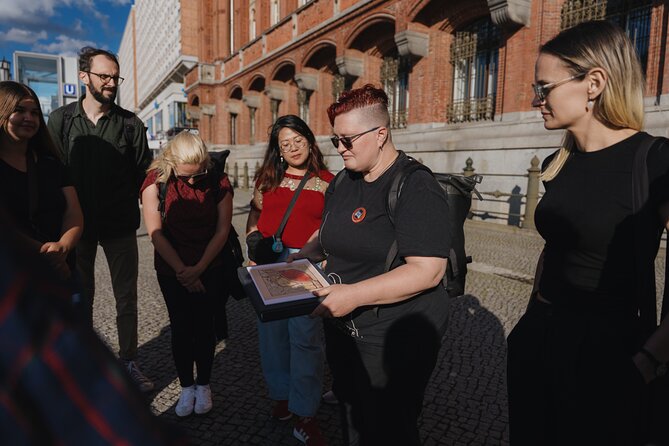
The meeting point is the sculpture Aufbauhelferin near Rotes Rathaus on Jüdenstraße. Rotes Rathaus, Berlin’s Red Town Hall, is an imposing terracotta-colored building, but the tour starts with more than a quick photograph of its facade.
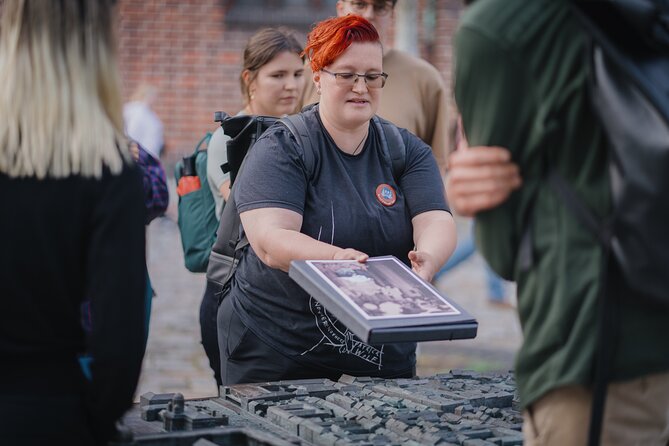
Around the building is a terracotta timeline of Berlin’s past. The reliefs show the city’s origins and important moments in its early development. One of those moments concerns the uprising that shaped Berlin’s early political story.
This is a smart opening because it gives you a visual guide to the city before the walk moves into later centuries. You can look at history in stone instead of receiving a list of dates. The first stop lasts about 15 minutes, enough time to understand the setting without using up the whole tour at one landmark.
If you arrive early, pay attention to the meeting point. The sculpture’s name is specific, and the start is not simply described as somewhere in front of the town hall. A mobile ticket is provided, and confirmation comes at booking.
Nikolaiviertel and the remains of socialist Berlin
From Rotes Rathaus, the walk continues into Nikolaiviertel. This area is known for its old-looking streets and church, but the tour points out an important modern layer: much of the district was rebuilt for Berlin’s 750th anniversary.
The result is a striking example of socialist-era city design. It can look old at first glance, but the district also reflects the political taste of East Germany. The tour calls attention to that mixture rather than letting the setting pass as a simple medieval quarter.
You’ll also see the last remnants of the Palace of the Republic. The building once housed East Germany’s parliament and also served as one of the socialist half of the city’s best-known entertainment venues. That combination tells you something useful about East German public life. A political institution and a leisure venue occupied the same symbolic space.
The Nikolaiviertel stop lasts about 10 minutes. That is enough for an explanation and a look around, but not enough for a long architectural study. I see that as a strength for this particular walk. The tour has many subjects to cover, and the guide keeps the story moving.
A missing wall in the timeline at Gasthaus Mutter Hoppe
The next stop, Gasthaus Mutter Hoppe, offers a small but revealing detail. Here you’ll see an East German answer to the terracotta timeline at Rotes Rathaus. It presents major moments in the history of the socialist state.
The important detail is what the timeline leaves out. The building of the Berlin Wall is absent. That omission gives the guide a chance to explain how governments use public art and official history to shape memory.
This is one of the tour’s best habits: it asks you to notice not only what is shown, but also what is missing. A five-minute stop may sound short, yet this kind of visual clue can stay with you longer than a long speech.
You may not get a full account of East German political life here, but you will get a clear way to think about official storytelling. The stop works especially well if you enjoy reading monuments as political documents.
Something different for another day:
- Berlin: Reichstag, Dome and Government District Guided Tour
★ 4.7 · 18,288 reviews - Berlin: 1-Hour City Tour by Boat with Guaranteed Seating
★ 4.3 · 16,993 reviews - Berlin: Boat Tour Along the River Spree
★ 4.4 · 11,252 reviews - Discover Berlin Half-Day Walking Tour
★ 5.0 · 9,624 reviews
Marx, Engels, and the argument over their monument
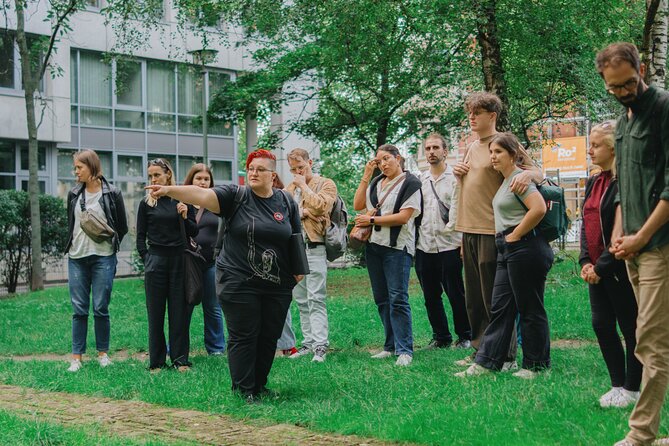
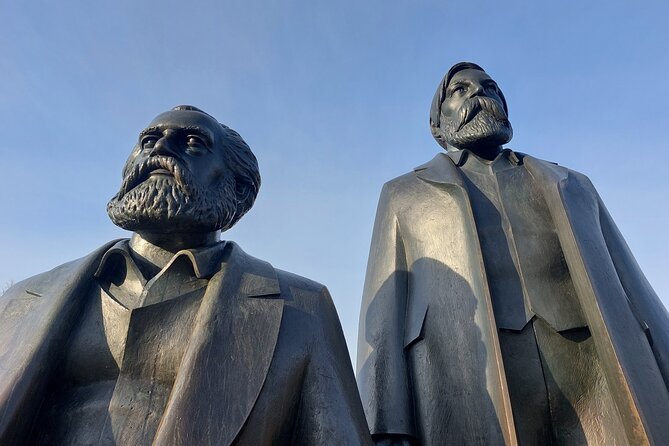
At Marx-Engels-Forum, you’ll meet Karl Marx and Friedrich Engels in statue form. The two men, authors of The Communist Manifesto, sit together in one of Berlin’s most recognizable socialist monuments.
The statue has sparked debate over the years. That debate matters because the monument is not simply a leftover piece of East German decoration. It raises questions about what a city should preserve, what it should remove, and how it should present people linked to a political system that shaped half of Berlin for decades.
The stop lasts about 15 minutes. That gives the guide time to connect the statue to communist thought, East German public space, and modern arguments over memory. I would not book this walk expecting a full course in Marxist theory. The value is the connection between the monument and the political arguments still attached to it.
Humboldt Forum and the March Revolution of 1848
The Humboldt Forum occupies the reconstructed Berlin Palace, one of the most visually striking buildings on the route. The palace looks royal, but its story includes protest and revolution.
The original palace witnessed several uprisings. The most important for this tour is the March Revolution of 1848, which helped plant the seeds of democracy in Germany. The guide uses the building to connect architecture with power. Royal buildings are not just backdrops. They are places where people gather, demand change, and challenge authority.
You’ll spend about 20 minutes here, the longest stop on the walk. That makes sense. The palace carries several layers of meaning, and the guide needs time to explain both the original building and its reconstructed form.
I like this section because it prevents the tour from becoming only a story about the twentieth century. Berlin’s protest history did not begin with the Nazis or the Berlin Wall. The events of 1848 provide an earlier chapter in the long struggle over representation and political rights.
Rosenstraße and one courageous act in 1943
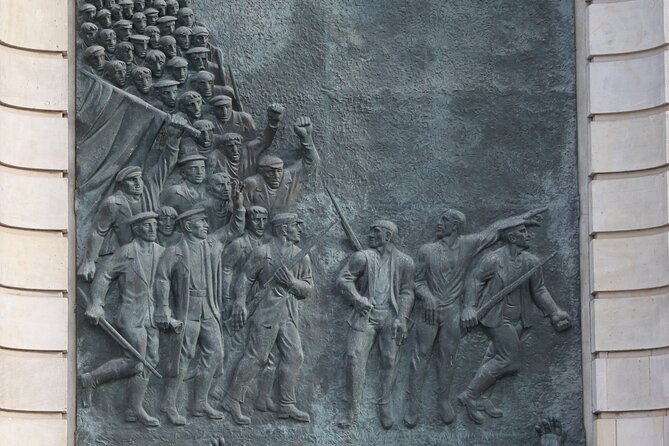
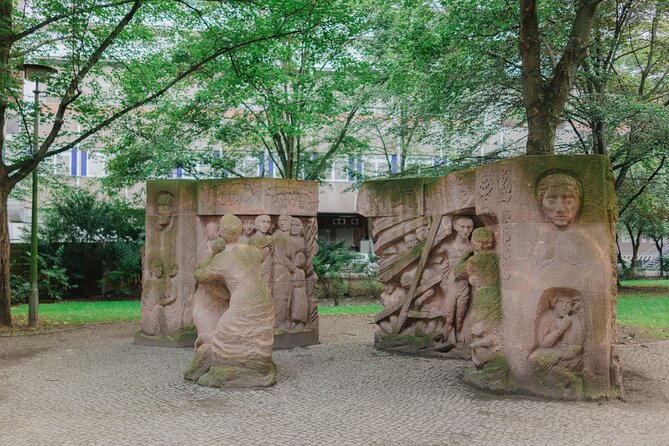
Rosenstraße is the emotional center of the walk. Here you’ll see the monument to women who staged a protest in the winter of 1943. They demonstrated against the detention of their Jewish husbands and relatives.
The tour presents this as the only protest by Germans against the Final Solution. You’ll also hear about Jewish life under Nazi rule and see the foundations of Berlin’s oldest synagogue.
This stop is not just about resistance in the abstract. It brings the story down to families, marriage, fear, and public courage. The women who protested faced a regime built on intimidation, yet they gathered and demanded the release of their loved ones.
The stop lasts about 15 minutes. You should expect a serious section of the walk, handled through a specific place rather than a broad lecture. The foundations of the synagogue add another layer, reminding you that Jewish life in Berlin existed long before Nazi persecution and cannot be reduced to the years of destruction.
If you prefer a tour that avoids difficult subjects, this may feel heavy. If you want Berlin presented honestly, Rosenstraße is an essential part of the route.
St. Mary’s Church and Martin Luther King Jr. in Berlin
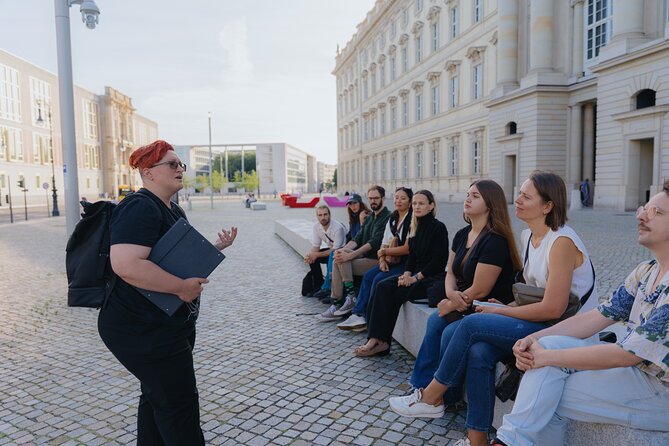
St. Mary’s Church is one of Berlin’s oldest churches. Its importance on this walk comes not only from its age, but from a speech delivered there by Martin Luther King Jr. in 1964.
He preached to a large crowd at the church. That moment links Berlin’s religious spaces with the wider struggle for civil rights and social change. It also shows how Berlin could serve as a stage for international political ideas during the Cold War.
The stop lasts about 10 minutes. You’ll have time to appreciate the church and hear why King’s visit mattered, but the tour will not linger as an architectural visit. The focus stays on protest, public speech, and the political meaning of the site.
After the church, the route passes Berlin’s Television Tower. The tower is one of the city’s defining landmarks and a symbol of communist power. It is hard to miss, which makes it a useful visual marker as the tour moves toward the events of 1989.
The Television Tower and the road to 1989
The TV Tower helps explain how East Germany presented itself. It was not only a piece of infrastructure. It became a symbol of the socialist state and its confidence in modern technology.
From here, the story turns toward the Peaceful Revolution. At the Brunnen der Völkerfreundschaft, the Fountain of International Friendship, you’ll learn how events built toward the fall of the Berlin Wall.
The guide also tells the story of young East German oppositionists who staged a T-shirt protest near the fountain in autumn 1989. That detail gives the larger revolution a personal and inventive quality. Opposition did not always look like a huge march. Sometimes it began with a small public gesture that challenged official control.
This stop lasts about 15 minutes. It is one of the most useful parts of the tour if you already know the basic date of the Wall’s fall but want to understand the pressure that came before it.
Ending at the World Time Clock in Alexanderplatz
The walk ends at the Weltzeituhr, or World Time Clock, in Alexanderplatz. The rotating clock shows the time in 148 cities around the world and became the most popular meeting point in East Berlin.
That makes it a fitting final stop. The clock reflects East Germany’s international outlook, while Alexanderplatz brings together shopping, transport, public gathering, and political memory. After hearing about protests across several periods, you finish at a place associated with everyday public life and mass gatherings.
The final stop lasts about 15 minutes. You’ll have a clear endpoint by the World Time Clock, at Alexanderplatz 1. It is practical if you want to continue sightseeing, use public transportation, or simply pause and consider the route.
What $30.04 buys you
At $30.04 per person, this is a fair price for a two-hour guided walk, especially with a maximum of 15 people. You are paying for the guide’s research and connections rather than entrance tickets, since admission at the listed stops is free.
The value improves if you care about context. You can see the palace, TV Tower, World Time Clock, and Red Town Hall on your own. What is harder to find alone is the connection between a missing scene on a socialist timeline, a protest at Rosenstraße, and a T-shirt demonstration in 1989.
The tour also gets good use from its compact route. A reported distance of about two kilometers makes it manageable, and the two-hour length fits neatly into a day of central Berlin sightseeing. You are not committing half a day to one subject.
The main limit is pace. With nine main stops and several shorter pauses, you will not get a long visit inside any building. This is a walking history lesson, not a series of museum tours.
Guide style and group size
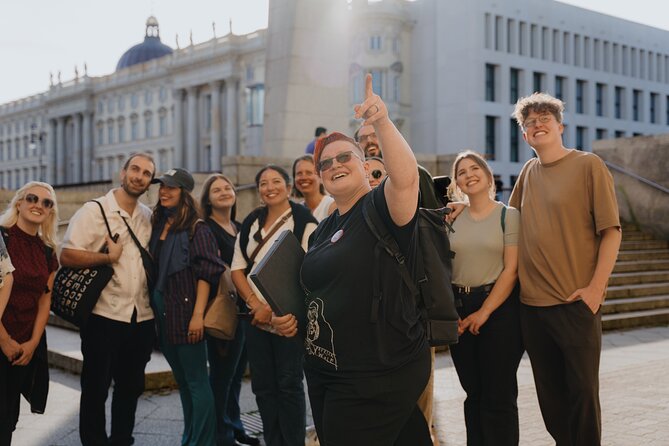
The strongest praise for Beyond and Beneath Tours focuses on careful research, lively explanations, and overlooked details. Martina is singled out for making facts exciting, while Simone is thanked for bringing knowledge and enthusiasm to the subject.
That matters here because the route depends on interpretation. Several stops could seem ordinary without a guide. A wall, statue, fountain, or church only becomes significant when you understand the argument or event attached to it.
The group limit of 15 is another plus. It should be easier to hear the guide and ask questions than on a large coach tour. The supplied information does not promise a particular guide, so you should not assume Martina or Simone will lead your departure. Still, the company’s approach appears consistent: small groups, detailed research, and stories beneath familiar facades.
Who should book this walk?
I would choose this tour if you have already seen Berlin’s headline sights and want a more focused look at political change. It suits people interested in German history, Cold War Berlin, public monuments, Jewish life under Nazi rule, and the mechanics of protest.
It is also a good choice for Berlin residents. The route’s appeal comes from small details that can change how you see familiar places. Several people who live in Berlin have found new information on these walks, which is a useful sign for repeat visitors.
Families with older children may enjoy it if they can handle serious subjects and two hours of walking. The tour is offered in English, and most people can participate. Service animals are allowed, and the route is near public transportation.
I would think twice if you want a relaxed sightseeing stroll with little political discussion. This tour covers persecution, state power, revolution, and civil disobedience. It is informative and entertaining, but the material is not light.
You should also plan for outdoor conditions. The experience requires good weather. If conditions force a cancellation, you’ll be offered another date or a full refund. Otherwise, you can cancel for a full refund up to 24 hours before the start time. Changes or cancellations made inside that window are not accepted.
Should you book the Berlin Protest History Tour?
Book it if you want Berlin explained through the people who challenged power, not only through its grand buildings. The route is short, the price is reasonable, and the small group format gives the guide room to focus on details.
My favorite feature is the range. In two hours, you move from the 1848 revolution to Nazi-era resistance, from Martin Luther King Jr. to young East German protesters in 1989. You also see how governments use statues, timelines, palaces, towers, and clocks to tell their preferred version of the past.
Skip it if you need extensive indoor access or a broad first-time overview of every major Berlin sight. For a thoughtful, compact walk through the city’s protest history, though, this is a strong choice.
FAQ
How long is the Berlin Protest History Tour?
The tour lasts approximately two hours.
How much does the tour cost?
The listed price is $30.04 per person.
In what language is the tour offered?
The tour is offered in English.
Where does the tour begin?
It begins at the sculpture Aufbauhelferin near Rotes Rathaus on Jüdenstraße, 10178 Berlin, Germany.
Where does the tour end?
The tour ends at the World Time Clock, or Weltzeituhr, in Alexanderplatz.
How large is the tour group?
The experience has a maximum of 15 travelers.
Are entrance tickets included?
The listed stops have free admission. The experience includes an expert guide.
Is the tour suitable for most people?
Most travelers can participate. The experience is near public transportation, and service animals are allowed.
What happens if the weather is poor?
The experience requires good weather. If it is canceled because of poor weather, you will be offered a different date or a full refund.
Just added around Berlin
- Kreuzberg Private Walking Tour: Immigrants, Artists & Hipsters★ 5.0 · 3 reviews
- Private Photo Tour in Kreuzberg★ 5.0 · 3 reviews
- Individual city tour Berlin for max. 8 persons★ 5.0 · 3 reviews
- Berlin’s Jewish Heritage: Private Tour of the Vibrant Jewish District★ 5.0 · 3 reviews
- Berlin & The Third Reich Private Guided Tour★ 5.0 · 3 reviews
- Private Analogue Photography Experience in Berlin★ 5.0 · 3 reviews
- Spy Mission in Berlin: Self-Guided Espionage Puzzle Quest★ 5.0 · 3 reviews
- Berlin Christmas Markets Walking Tour with Local Guide★ 5.0 · 3 reviews
Historical Tours, compared.
City History Canal Sightseeing Tour on a Motorboat
Read our review →

Bamberg: Guided Beer History Tour with Optional Tasting
Read our review →Browse the lists this tour appears in