Reviewed · BERLIN TOURS
Berlin: Modernist Architecture Tour in the Hansaviertel
Berlin hides its boldest ideas in plain sight. This two-hour walk through Hansaviertel connects 19th-century villas, Jewish history, and Cold War design in one leafy pocket between the Spree and Tiergarten. I like the unusual mix of stories, and I like that the route gets you beyond Berlin’s usual landmarks without sending you far from the center.
The modernist buildings are the main draw, especially the work linked to Walter Gropius, Oscar Niemeyer, and Alvar Aalto. The possible drawback is that this is a history-heavy walking tour, with about two hours of standing and walking, so it suits curious adults and older teenagers better than young children.
In This Review
- Key points about the Hansaviertel walk
- Why Hansaviertel makes such a good walking tour
- Meeting at Tiergartenquelle beside the S-Bahn
- The elegant Hansaviertel before the war
- A quiet memorial to Jewish Berlin
- Interbau 1957 and the Cold War city
- Meeting Gropius, Niemeyer, Aalto, and other modernists
- What Morgan adds to the experience
- Ending at Hansaplatz
- Is $23 a fair price?
- Who should book this walk?
- Should you book the Hansaviertel tour?
- FAQ
- How long does the Hansaviertel tour last?
- Where does the tour begin?
- How will I identify the guide?
- Where does the tour finish?
- Which languages are available?
- Is the tour wheelchair accessible?
- What should I bring?
- Is the tour suitable for children?
Key points about the Hansaviertel walk
- Interbau 1957 turned a bomb-damaged district into a Cold War design showcase, with architects from Germany and abroad shaping a new vision of city life.
- The route begins with 19th-century Hansaviertel, once an elegant residential quarter for Berlin’s middle and upper classes.
- Jewish history is treated as part of the neighborhood’s story, including a memorial at the site of a community destroyed under Nazi rule and wartime bombing.
- Modernist names include Gropius, Niemeyer, and Aalto, giving you a chance to compare different ideas about housing, light, space, and public life.
- Morgan’s lively guiding style is a major strength, with the ability to answer questions and follow useful turns in the conversation.
- The tour costs $23 per person, a fair price for a focused, expert-led walk, though food, drinks, and museum admissions are not included.
Why Hansaviertel makes such a good walking tour
Hansaviertel does not announce itself with one famous monument. Its appeal comes from the way several eras sit close together. You can move from elegant prewar housing to a quiet memorial, then into a group of modernist buildings designed to make a political point as much as an architectural one.
That makes this a good choice if you have already seen the Brandenburg Gate, Reichstag, and Museum Island and want a more local-scale view of Berlin. The neighborhood gives you a useful question to carry through the walk: how much can buildings shape the way people live?
The answer is not simple. Modernist planners hoped better housing, open space, sunlight, and new traffic patterns could create a healthier and more democratic city. At the same time, the buildings were part of a Cold War contest. West Berlin wanted to show that its future-facing ideas could outshine the Soviet-backed reconstruction model elsewhere in the city.
You do not need an architecture degree to follow the tour. The value comes from seeing the buildings in context rather than treating them as isolated shapes. Your guide explains what the architects were trying to achieve and asks whether those ideas still work today.
Other Berlin trips people book alongside this one:
- Berlin: Reichstag, Dome and Government District Guided Tour
★ 4.7 · 18,288 reviews - Berlin: 1-Hour City Tour by Boat with Guaranteed Seating
★ 4.3 · 16,993 reviews - Berlin: Boat Tour Along the River Spree
★ 4.4 · 11,252 reviews
Meeting at Tiergartenquelle beside the S-Bahn
The walk begins in front of the Berlin-Tiergarten S-Bahn station, at the Siegmunds Hof and Bachstraße exit. Look beside the beer garden called Biergartenquelle for the guide with the orange umbrella.
This is a practical starting point. The S-Bahn station makes the meeting place fairly easy to reach, and the nearby beer garden gives you a clear visual reference. Arrive with comfortable shoes and water. You will be outside for roughly two hours, with regular walking and standing.
The activity is described as two hours overall, while the Hansaviertel guided portion is listed as about one and a half hours. That small difference may reflect the opening and closing portions of the walk. I would allow the full two hours and avoid scheduling a tight appointment immediately afterward.
The tour is offered in English or German. The guide is live rather than audio-based, which matters here because the buildings need explanation. A recorded commentary could point out names and dates, but it would not respond to your questions or connect the architecture to the issues you find most interesting.
The elegant Hansaviertel before the war
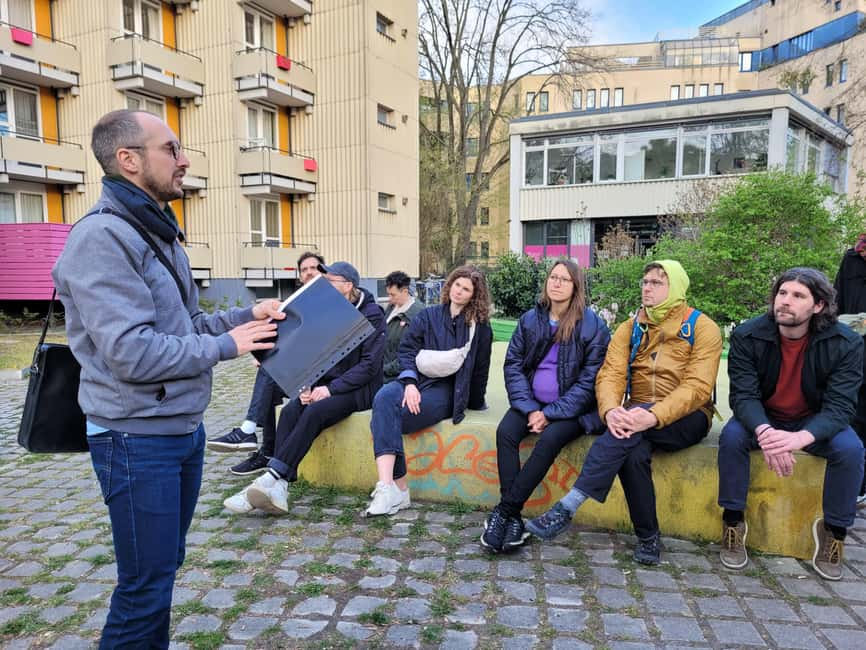
The first historical layer reaches back to the late 19th century, when Berlin’s population was expanding quickly. Hansaviertel developed as a middle- and upper-class district, with villas, gardens, and carefully designed façades.
This opening gives the modernist section a needed contrast. Before you see postwar concrete and experimental apartment blocks, you learn that the area already had a strong identity. It was not an empty site waiting for architects. It had residents, social customs, and a built character that war later damaged.
The tour also brings in figures associated with the old district, including Rosa Luxemburg, Nelly Sachs, and Käthe Kollwitz. Their names help make the neighborhood feel inhabited rather than purely architectural. You are not only looking at façades. You are considering the people connected to this part of Berlin and the different forms of art, politics, and writing that emerged around it.
I especially like this chronological start because it prevents the common mistake of seeing Hansaviertel only as a 1950s project. The newer buildings are easier to understand once you know what was lost and what came before.
A quiet memorial to Jewish Berlin
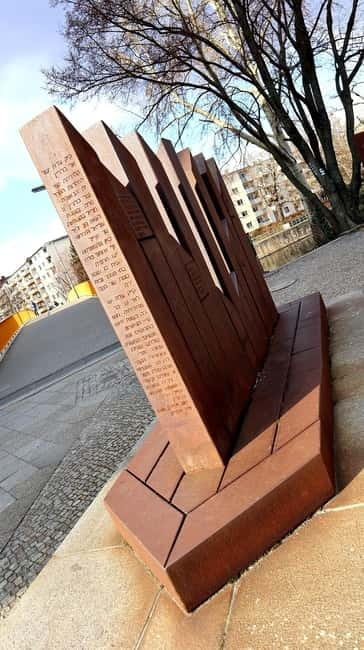
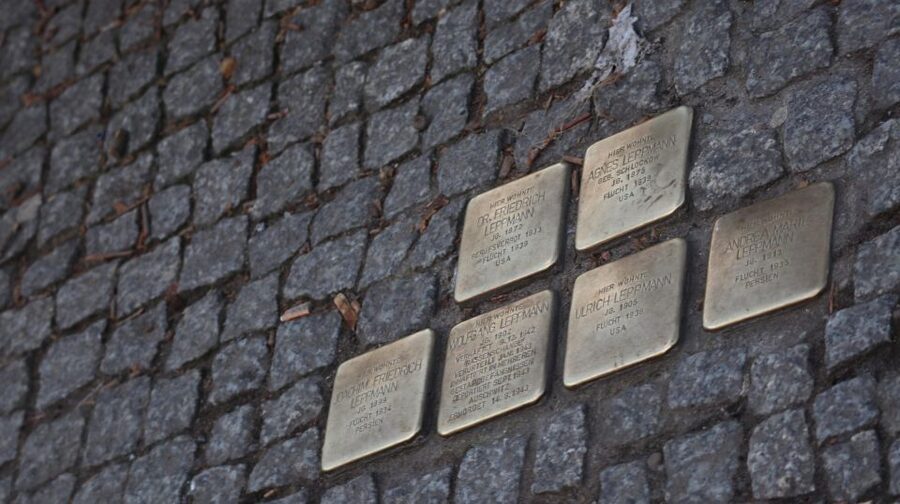
One of the most serious parts of the route is the visit to a memorial marking the site of an important Jewish community. The neighborhood was destroyed socially by Nazi persecution and physically through the war and Allied bombing.
The memorial is described as quiet and powerful, which is fitting. It gives the tour a pause between the older Hansaviertel and the postwar rebuilding story. The modernist buildings can look optimistic, even playful, but this stop reminds you that reconstruction followed persecution, murder, displacement, and destruction.
This part also keeps the Cold War story from becoming too neat. Interbau 1957 was meant to present a new West Berlin, but it rose on land shaped by catastrophe. The walk asks you to hold both facts at once: the postwar city wanted a fresh beginning, yet it could not erase what had happened.
Because the tour covers difficult history, it is recommended for ages 14 and up. That guidance makes sense. Younger children may enjoy the open streets and unusual buildings, but the political and social material requires attention. Minors must be accompanied by an adult.
Something different for another day:
- Discover Berlin Half-Day Walking Tour
★ 5.0 · 9,624 reviews - Berlin: Hop-on Hop-off Bus Tour with Live Commentary
★ 4.3 · 8,579 reviews - Berlin: Government District around the Reichstag Guided Tour
★ 4.7 · 8,447 reviews - Berlin: Reichstag, Plenary Chamber, Cupola & Government Tour
★ 4.6 · 8,422 reviews
Interbau 1957 and the Cold War city
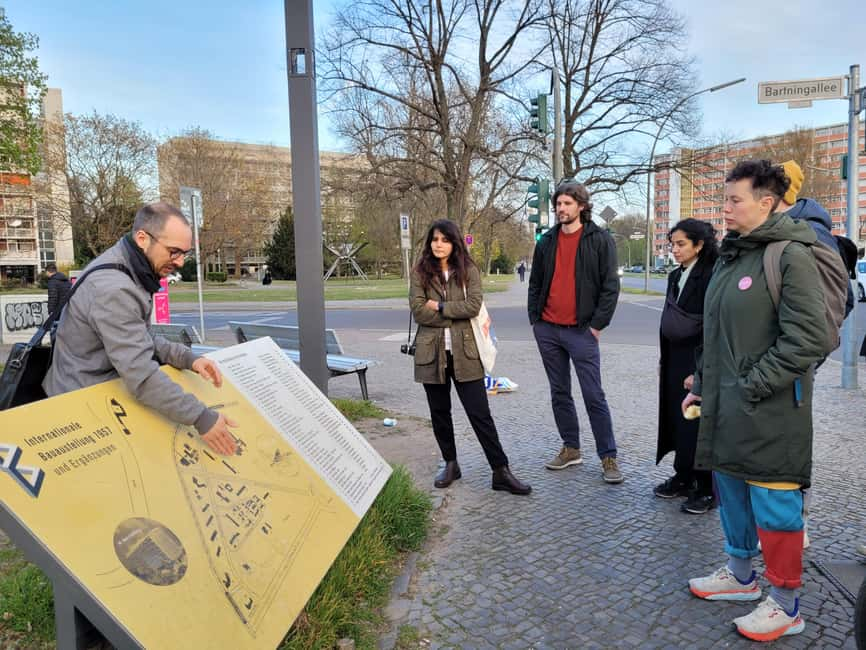
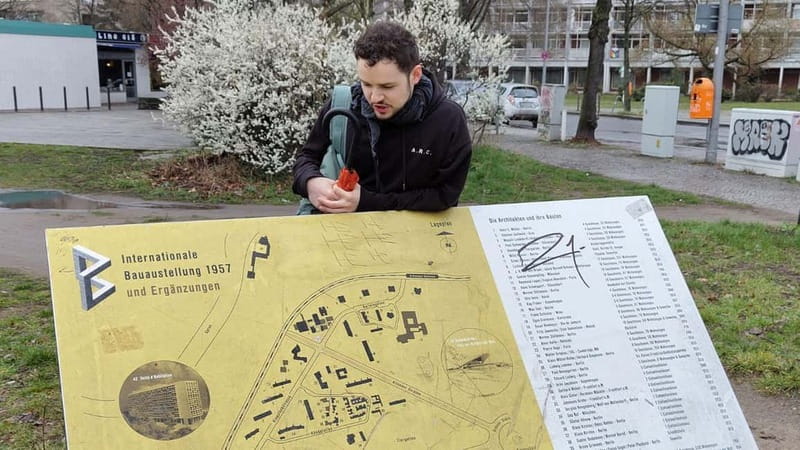
The turning point comes in 1957, when West Berlin hosted Interbau, an international architecture exhibition. Hansaviertel became a showcase for new housing and a public statement about the kind of city West Berlin wanted to build.
The district had been damaged during World War II, and the exhibition used the cleared area for an ambitious redesign. Architects from different backgrounds were invited to create buildings that were modern in form and modern in purpose.
This is where the tour gains its political edge. Interbau was not just a design festival. It was also part of the rivalry between East and West. West Berlin presented open space, international cooperation, and modern housing as signs of a better future.
You will hear about the ideas behind the buildings rather than simply ticking off famous names. What should an apartment building provide? How should people relate to gardens, streets, and shared areas? Can a new building encourage a new social outlook?
Those questions remain useful today. Modernist architecture is often praised for clean lines and criticized for feeling impersonal. Hansaviertel lets you consider both sides in the place where those ideas were tested.
Meeting Gropius, Niemeyer, Aalto, and other modernists
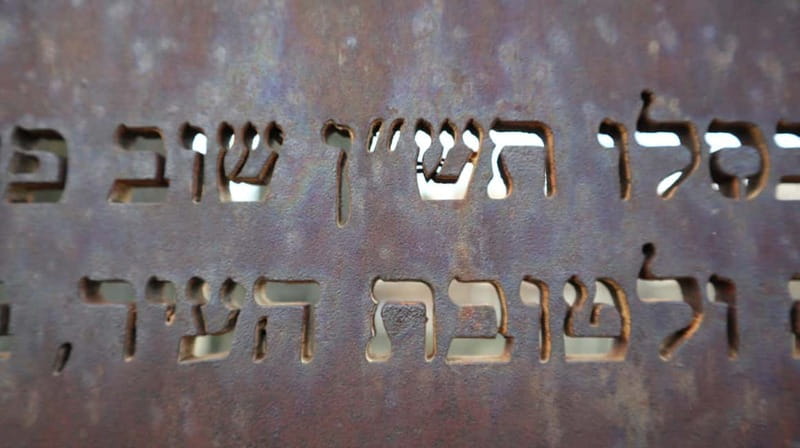
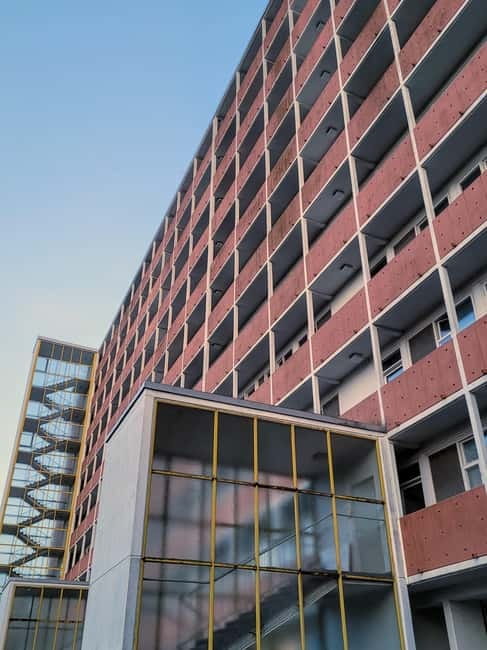
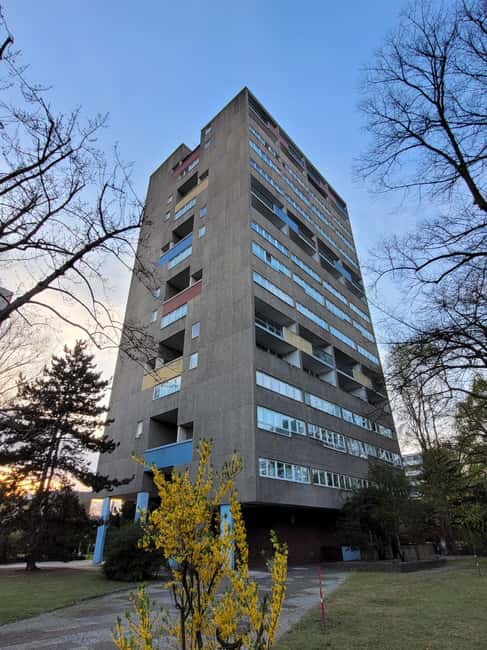
The strongest architectural section focuses on the buildings associated with major 20th-century designers. Walter Gropius, Oscar Niemeyer, and Alvar Aalto are among the names connected with the district.
Their presence gives the walk real weight, but the point is not simply that famous architects worked here. You get to compare different approaches within the same planned area. One building may emphasize geometry and efficiency, while another feels more sculptural or human-scaled.
Oscar Niemeyer is known for expressive curves, Walter Gropius for disciplined modernism, and Alvar Aalto for a more humane approach to materials and space. The tour uses these contrasts to explain how modernism was never one single look.
You may also find that the buildings do not all feel equally modern today. Some still look daring. Others reveal their age through materials, maintenance, or the assumptions built into their layouts. That is part of the appeal. The walk does not ask you to admire everything without question.
Instead, you can consider what the architecture promised and how those promises have aged. Did open space make daily life better? Did the new blocks create a strong neighborhood? Did the buildings feel welcoming, or did their grand ideas overpower ordinary needs?
What Morgan adds to the experience
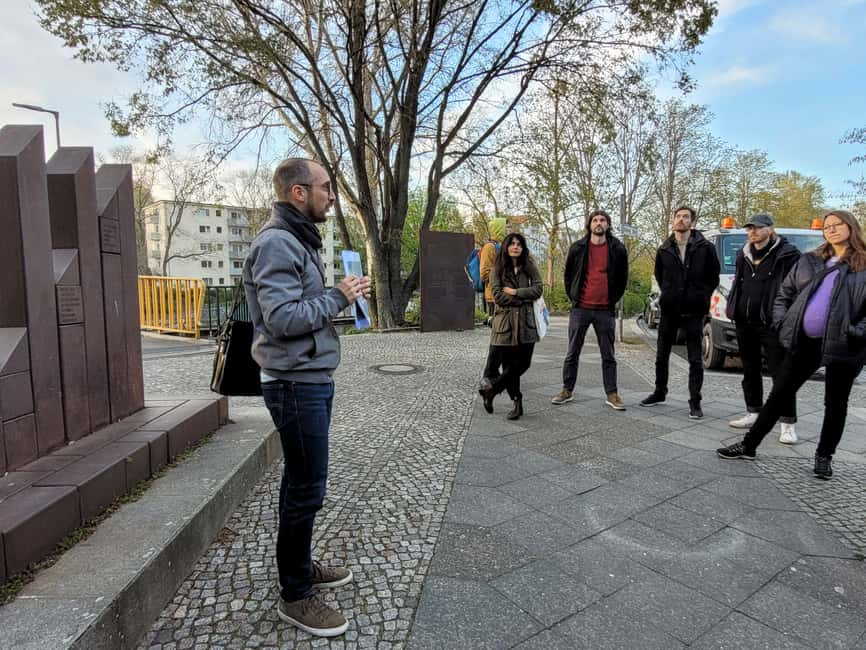
The available feedback gives special praise to Morgan, who leads the tour in a lively way and takes the group from the old Hansaviertel into the modernist district. That description matters because this route could become a string of dates and architect names if handled poorly.
Morgan is also praised for answering a wide range of questions and allowing useful turns in the conversation. That suggests the walk is not a rigid script. If you want to ask about politics, architecture, Jewish Berlin, or daily life in the buildings, you should have room to do so.
One short German-language comment also rates the experience very highly. The overall rating is 5 from five reviews, a small sample rather than proof of perfection, but the praise is consistent around the guide’s delivery and the way the story moves through time.
I would treat the guiding style as a major reason to book. The buildings are accessible on your own, but their meaning is less obvious. A good explanation turns an ordinary path through a residential area into a lesson in urban planning and postwar identity.
Ending at Hansaplatz
The walk finishes at Hansaplatz, the central point of the modern Hansaviertel. By then, you should have seen the neighborhood as more than a collection of apartment blocks.
Hansaplatz gives the route a natural endpoint because it represents the postwar vision at full scale. The tour begins near Tiergartenquelle and leads you through the district before ending here. Activity information also describes the experience as ending back at the meeting point, so check the exact end point shown for your chosen departure when booking.
Do not expect a museum visit or an interior architecture tour. The experience is built around the streets, buildings, memorial, and public spaces. Entry fees are not included, and no museum or monument admission is specified.
That outdoor format is part of its value. You see how the buildings relate to one another and how the district works at walking speed. You also get a better sense of scale than you would from photographs.
Is $23 a fair price?
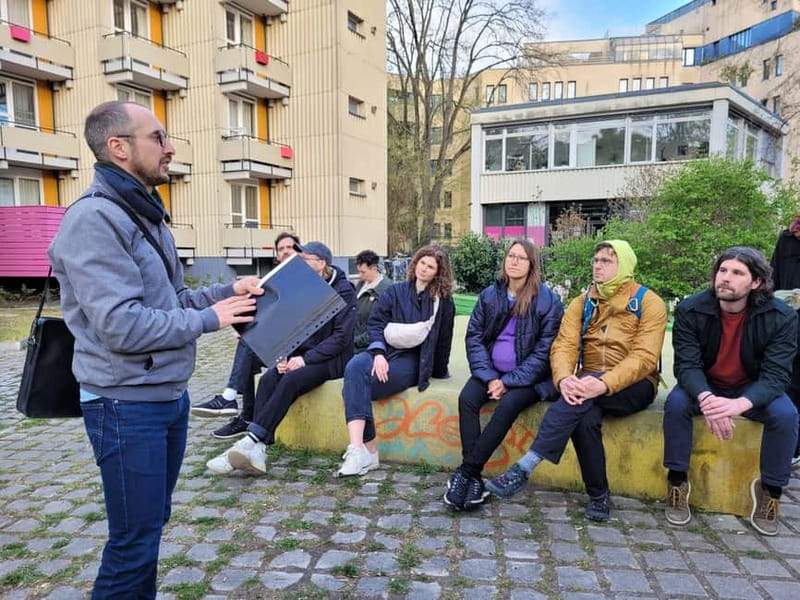
At $23 per person, this is a reasonably priced specialist walk. You are paying for an expert local guide and a focused two-hour route, not for transport, meals, or admission tickets.
The value is strongest if you enjoy understanding places rather than simply photographing them. A self-guided walk would cost less, but you would need to research the district’s 19th-century origins, Jewish history, Interbau, the Cold War setting, and each architect on your own.
The price is less attractive if you only want a quick look at unusual buildings. In that case, you could see parts of Hansaviertel without booking a tour. You would miss the connections between the old district, wartime destruction, and the political purpose of the 1957 exhibition.
Free cancellation up to 24 hours before the activity and the option to reserve now and pay later make the booking less restrictive. The tour is also wheelchair accessible, though it remains a walking activity with extended periods on your feet.
Who should book this walk?
I would recommend it to adults interested in architecture, urban planning, modern European history, or Berlin’s Cold War division. It also suits repeat visitors who want a quieter district with a strong story.
The tour is a good fit for older teenagers, especially those studying design, history, or politics. The recommended minimum age is 14, and all minors need an adult with them.
You should be comfortable walking and standing for about two hours. Wear practical shoes, bring water, and remember that the tour runs outdoors. The beer garden meeting point may be useful for orientation, but food and drinks are not part of the price.
This is not the best choice if you want a fast-paced sightseeing list, a museum interior, or a tour built around Berlin’s most famous landmarks. It asks you to slow down and look carefully at buildings that were designed to shape ordinary life.
Should you book the Hansaviertel tour?
Book it if you want Berlin history at neighborhood scale. The route links elegant villas, the destruction of Jewish life, wartime damage, Cold War competition, and international modernist design without requiring a long journey across the city.
The strongest reason to go is the interpretation. Morgan’s lively, flexible style appears to make the complicated material easy to follow, while the architecture gives you plenty to look at along the way.
Skip it if two hours of walking and serious historical discussion sounds tiring, or if your main goal is to enter major sights. At $23, it offers good value for an architecture-minded visitor who wants context, not just a photo stop.
FAQ
How long does the Hansaviertel tour last?
The activity lasts two hours. The guided Hansaviertel portion is listed as approximately one and a half hours, so allow the full two hours.
Where does the tour begin?
It begins in front of the Berlin-Tiergarten S-Bahn station at the Siegmunds Hof and Bachstraße exit, next to Biergartenquelle.
How will I identify the guide?
Look for the guide carrying an orange umbrella near the beer garden.
Where does the tour finish?
The route finishes at Hansaplatz. The activity information also describes the experience as ending back at the meeting point, so check the confirmed end point for your selected departure.
Which languages are available?
The tour is offered in English and German.
Is the tour wheelchair accessible?
Yes, the activity is listed as wheelchair accessible.
What should I bring?
Bring comfortable shoes and water. You should be ready to walk and stand for approximately two hours.
Is the tour suitable for children?
The tour is recommended for ages 14 and up because of its historical content. There is no strict age restriction, but all minors must be accompanied by an adult.
Just added around Berlin
- Kreuzberg Private Walking Tour: Immigrants, Artists & Hipsters★ 5.0 · 3 reviews
- Private Photo Tour in Kreuzberg★ 5.0 · 3 reviews
- Individual city tour Berlin for max. 8 persons★ 5.0 · 3 reviews
- Berlin’s Jewish Heritage: Private Tour of the Vibrant Jewish District★ 5.0 · 3 reviews
- Berlin & The Third Reich Private Guided Tour★ 5.0 · 3 reviews
- Private Analogue Photography Experience in Berlin★ 5.0 · 3 reviews
- Spy Mission in Berlin: Self-Guided Espionage Puzzle Quest★ 5.0 · 3 reviews
- Berlin Christmas Markets Walking Tour with Local Guide★ 5.0 · 3 reviews
Berlin Tours, compared.
Reichstag, Dome and Government District Guided Tour
Read our review →
1-Hour City Tour by Boat with Guaranteed Seating
Read our review →

Government District around the Reichstag Guided Tour
Read our review →
Reichstag, Plenary Chamber, Cupola & Government Tour
Read our review →