
Reviewed · GHOST & NIGHT WATCHMAN TOURS
Medieval city tour with night watchman in Munich in German
The city changes after dark. This German-language walking tour follows Wolfram, a costumed night watchman carrying a lantern, halberd, and horn through Munich’s old center. I like the clear medieval theme and the small group, capped at 10 people. I also like the unusual objects and demonstrations, from silver pennies to a tally stick and a mock execution.
The main drawback is the language: this tour is in German, so it will not suit you if you need English commentary. The route also deals with executions, torture, cemeteries, and punishment, which may feel too grim for young children or anyone seeking a light sightseeing walk.
In This Review
- Key points to know before booking
- Meeting Wolfram at Marienplatz after dark
- St. Peter’s Church and the poor sinner bell
- Petersplatz and medieval burial customs
- Viktualienmarkt and the first city wall
- Old Town Hall and the Talburg gate
- Burgstraße, the dungeon, and medieval punishment
- Münzstraße and the silver pennies in Wolfram’s purse
- Alter Hof and strict Duke Ludwig
- The Schwabinger gates and vanished addresses
- Schäfflerstraße and the tally stick
- Frauenkirche and the final medieval traces
- Kaufingerstraße and the Beautiful Tower
- Price, timing, and the real value
- Who will enjoy this German-language walk
- Should you book it?
- FAQ
- What language is the tour conducted in?
- Where does the tour begin?
- What time does the tour start?
- Where does the tour finish?
- How long does the tour last?
- How large is the group?
- What does the price include?
- Are service animals allowed?
- Can I cancel for a refund?
Key points to know before booking
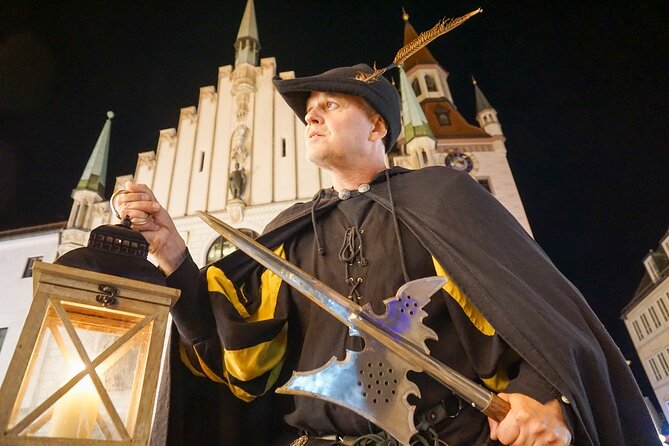
- Wolfram leads in full night-watchman character, using a lantern, halberd, and horn to set the mood.
- The 14-stop route traces medieval Munich, including old gates, the first city wall, the Alter Hof, and the Frauenkirche.
- Hands-on details make the past easier to grasp, including silver pennies, a tally stick, and a medieval weapon.
- The tour begins at Marienplatz at 8:30 pm and ends on Kaufingerstraße near Hirmer.
- The group is limited to 10 people, a useful advantage for a story-led walk through busy central streets.
- The price is about $16.13 per person, strong value for roughly 90 minutes of guided history.
Meeting Wolfram at Marienplatz after dark
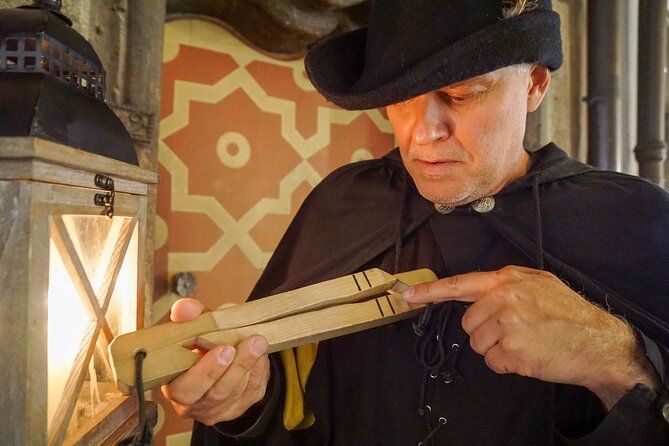
The evening starts at 8:30 pm outside Rathaus Apotheke at Marienplatz 8. This puts you in the heart of Munich, close to public transportation and the city’s most recognizable square. Look for Wolfram’s period-style gear, lantern, halberd, and horn.
His opening talk explains what a night watchman actually did in the Middle Ages. This matters because the role involved more than walking around with a light. A night watchman helped guard the town, watched for danger, closed gates, and kept order after dark.
That practical beginning gives the tour a useful frame. Instead of treating medieval Munich as a collection of old buildings, Wolfram presents it as a guarded town with rules, gates, punishments, religious customs, and strict control over movement.
The small maximum of 10 people should help here. You are not standing at the back of a large crowd while a guide speaks into the night. A small group also suits Wolfram’s playful approach, which includes bringing people into the story. One especially amusing review describes him giving a participant named Friedrich the invented job of Fritz the lantern supervisor.
More City Tours in Munich
- Munich: Old Town & Viktualienmarkt City Walk in German
★ 4.7 · 2,304 reviews - Munich: City Bus Tour & FC Bayern Munich Allianz Arena Tour
★ 4.5 · 2,071 reviews - Munich City Hop-on Hop-off Tour
★ 3.5 · 1,233 reviews
St. Peter’s Church and the poor sinner bell
The first major stop is St. Peter’s Church, where Wolfram points out the poor sinner bell. The name alone gives you a sense of the evening’s tone. This is not a tour that skips over the harsher side of medieval life.
He also demonstrates the execution of Marco Bragadino. The supplied information does not describe the exact staging, so you should expect a historical demonstration rather than assume a theatrical production with elaborate props. The value is in hearing how punishment was presented and understood in the period.
This section may be fascinating if you enjoy social history. It may be uncomfortable if you prefer architecture without stories of public death. Families should consider their children’s age and sensitivity before booking.
Petersplatz and medieval burial customs
At Petersplatz, the group visits the site of the medieval cemetery near St. Peter’s. Wolfram explains why people wanted to be buried as close to the altar as possible.
That question opens a window onto medieval religious life. Burial location was not simply a matter of convenience or family preference. Your place near the church reflected spiritual hopes, status, and the importance people placed on proximity to sacred space.
This is one of the quieter stops, but I think it gives the tour needed balance. After the execution demonstration, the cemetery story shifts attention toward belief, death, and the way medieval people understood their place in the next world.
Viktualienmarkt and the first city wall
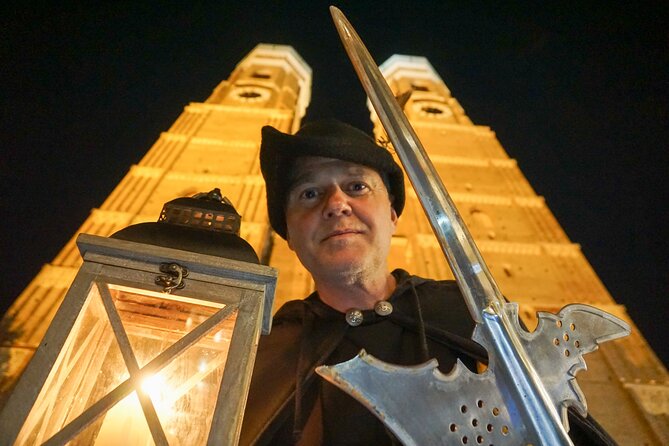
The route then reaches Viktualienmarkt, where Wolfram identifies the location of Munich’s first city wall. The market is now one of central Munich’s best-known food areas, but the tour asks you to picture it as part of a smaller fortified settlement.
The appeal here is not a surviving wall section that you can walk along. It is the ability to connect present-day streets and public spaces with the town’s early boundaries. A city wall tells you where Munich ended, where gates controlled entry, and how compact urban life once was.
The stop lasts only about six minutes, so expect a focused explanation rather than a long lecture. That short format keeps the walk moving, but it also means you should pay close attention if medieval town planning interests you.
More Ghost & Night Watchman Tours in Munich
- Munich: Night Watchman Walking Tour
★ 4.7 · 2,092 reviews - Munich: Night Watchman Torch Tour in German
★ 4.8 · 1,280 reviews - Munich: Middle Ages Tour with Night Watchman
★ 4.9 · 652 reviews - München: Der Nachtwächter für Kinder – Führung auf Deutsch
★ 5.0 · 322 reviews
Old Town Hall and the Talburg gate
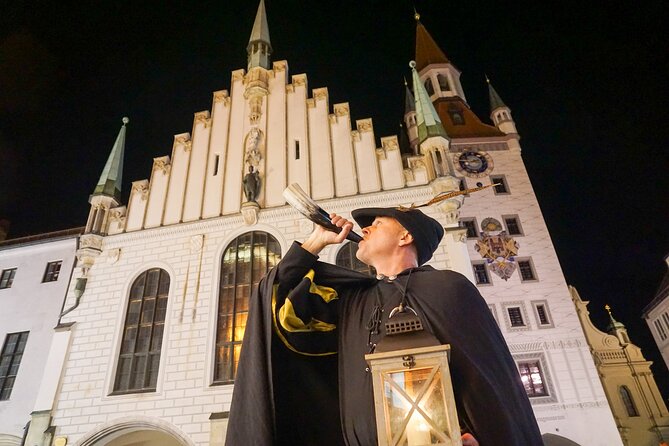
At the Old Town Hall, Wolfram closes the Talburg gate and shows you a medieval halberd. The gate action brings the city’s nightly routine to life. A fortified town did not remain open around the clock, and closing a gate was a serious civic task.
The halberd gives the stop a physical detail that maps and dates cannot provide. You can see the sort of weapon linked with guarding and authority, while Wolfram explains its place in the medieval town.
I like this part because it connects an ordinary old-town building with a vanished system of control. You are not only looking at the Old Town Hall. You are learning how Munich’s gates shaped movement and security.
Burgstraße, the dungeon, and medieval punishment
Burgstraße brings the darker material. Wolfram explains Munich’s medieval prison, including the dungeon, torture, and punishments used during the Middle Ages.
The information provided does not promise access to a surviving prison interior, so approach this as a street-side historical explanation. The strength of the stop is the subject matter and Wolfram’s storytelling, not a guaranteed underground visit.
This is also where the tour’s tone may divide audiences. Several comments praise the mix of humor and shivers, and that combination seems central to Wolfram’s style. He presents difficult material with energy, but the subject remains difficult. If you want a gentle evening stroll, this may be too grim. If you want to understand how law worked before modern rights and courts, it adds useful context.
Münzstraße and the silver pennies in Wolfram’s purse
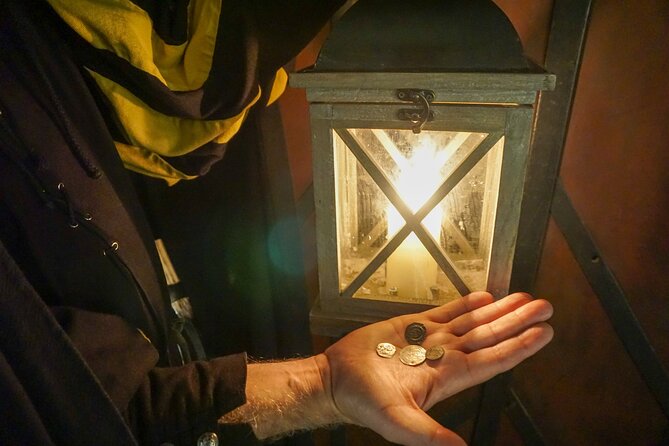
At Münzstraße, Wolfram opens his purse and shows original silver pennies from the Middle Ages. This is one of the tour’s best details because it turns an abstract subject, medieval money, into something visible.
Coins can tell you a great deal about a society. They point to trade, rulers, value, and the practical problem of carrying money in a world without modern banking cards. Seeing the pennies in the night watchman’s purse also fits the character he has built.
You should not expect a museum collection or a long numismatic lesson. The attraction is the close, personal presentation. A small group makes this sort of object easier to appreciate, since you are less likely to miss the explanation or the view of the coins.
Alter Hof and strict Duke Ludwig
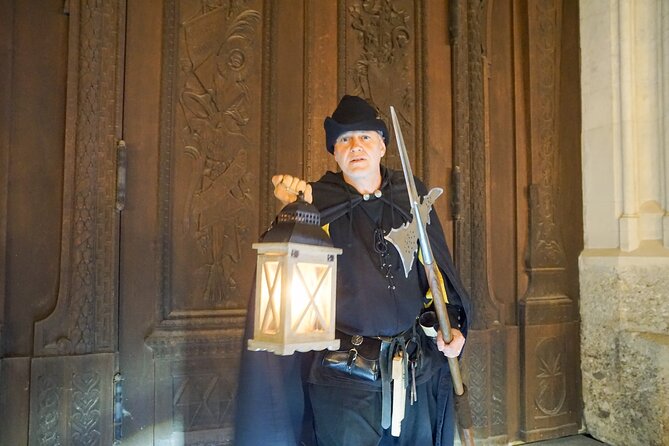
At Alter Hof, Wolfram introduces Munich’s first castle built by the Wittelsbach family. He also explains why Duke Ludwig, its builder, was called the strict one.
This stop adds political background to the tour. Medieval Munich was not only a town of walls, gates, churches, and markets. It was also shaped by powerful ruling families. The castle helps you see how authority operated within the city.
The title attached to Duke Ludwig gives the story a human edge. Rather than memorizing a dynasty name, you get a clue about his reputation and style of rule. The stop lasts about eight minutes, enough for a compact introduction without turning the evening into a lecture on Bavarian rulers.
The Schwabinger gates and vanished addresses
The next stops follow two former Schwabinger gates. At Dienerstraße, Wolfram closes the Vorderes Schwabinger Tor and points out what still recalls Munich’s first city wall. At Weinstraße, he closes the Rear Schwabing Gate and explains how addresses worked in the past.
These moments are useful because medieval Munich is not preserved as a complete medieval town. Much of the wall and many gates are gone. Wolfram helps you read clues in the modern center and understand how the old defenses once organized the city.
The address explanation is a small but memorable piece of daily-life history. Modern street numbers feel obvious to us, but earlier systems could be tied to gates, districts, buildings, or local landmarks. This stop shows how much urban life depends on systems that change quietly over time.
The gate sequence also gives the tour a sense of purpose. You are not simply moving from one famous sight to another. You are following the outline of a former fortified city.
Schäfflerstraße and the tally stick
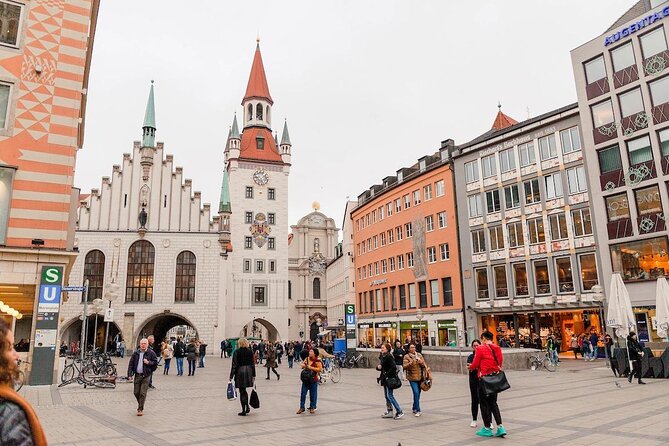
At Schäfflerstraße, Wolfram explains how people could get into debt using a tally stick. He carries his own and demonstrates how the system worked.
This is an excellent example of the tour’s approach. A tally stick is simple, physical, and easy to understand once you see how it was used. It also shows that financial records did not require paper contracts in the form we know today.
I especially like this stop for visitors who enjoy ordinary details. Kings and castles get attention, but a device used to record debt can tell you just as much about medieval life. It shows trust, obligation, trade, and the risk of being unable to pay.
Frauenkirche and the final medieval traces
The route reaches the Frauenkirche, where Wolfram explains how the huge church could be built in only 20 years. The building’s scale makes this a natural point for discussing medieval construction, organization, and religious ambition.
The provided details do not specify the exact construction explanation, so you should expect a broad historical account rather than a technical engineering tour. Still, the setting gives the story real force. Standing before the Frauenkirche helps you grasp the challenge of raising such a large church in a medieval city.
At nearby Frauenplatz, Wolfram points out medieval traces that remain in Munich’s old town. This is a reminder to look carefully after the tour ends. The old center is not a perfect medieval scene, but fragments, street patterns, and surviving structures can still suggest the earlier city.
Kaufingerstraße and the Beautiful Tower
The final stop is on Kaufingerstraße near Hirmer at number 28. Wolfram completes the Beautiful Tower and says goodbye there.
The phrase marks a symbolic ending to the route through Munich’s former gates. By this point, the gates, wall, castle, church, market, and prison have formed one connected picture. The walk finishes not with a grand performance, but with the sense that you have followed the city’s medieval boundary.
The end location is practical for anyone continuing into central Munich. It is also close to the start, though you should not treat the route as a round trip. Arrange your evening plans around finishing on Kaufingerstraße.
Price, timing, and the real value
At about $16.13 per person, this is a modestly priced guided experience for roughly 90 minutes. You pay for a guide, a character-led presentation, and access to a compact route through central Munich. There are no separate admission fees listed for the stops.
The price looks particularly fair if you value stories more than interiors. You are not buying entry to museums or monuments. You are paying for Wolfram’s interpretation, objects, demonstrations, and the structure that links ordinary streets to medieval Munich.
Allow more than the advertised 1 hour 30 minutes. One detailed comment describes the experience as lasting almost two hours, and the stop times add up to about 95 minutes before small pauses and movement between locations. That is not a problem, but it matters if you have a train, dinner reservation, or another evening booking.
The experience needs good weather. If poor weather cancels the tour, you can receive a different date or a full refund. The tour also requires a minimum number of participants, so a cancellation for that reason brings the same choice of another date or a refund.
You can cancel for a full refund up to 24 hours before the local start time. Changes or cancellations inside that 24-hour window are not accepted for a refund.
Who will enjoy this German-language walk
I would choose this tour if you:
- Understand German well enough to follow fast spoken storytelling
- Like local history told through streets and objects
- Enjoy a little theatrical character work
- Want a small group rather than a large city walk
- Are comfortable with executions, cemeteries, torture, and punishment
- Have already seen Munich’s main sights and want a different angle
I would skip it if you need English, dislike dark historical subjects, or want to enter several monuments. The tour is also less useful if you need a fully accessible format, since the supplied details only confirm that most people can participate and that service animals are allowed.
The positive comments place strong emphasis on Wolfram himself. His humor, commitment to the role, and clear storytelling receive repeated praise. One German-language comment calls the tour informed, capable, and funny, while another says the route along the old city wall remained interesting enough that nearly two hours did not feel too long.
Should you book it?
Book this tour if you want Munich’s old center to feel like a lived-in medieval town rather than a row of photo stops. Wolfram’s lantern, halberd, coins, and tally stick give the history a physical shape, while the route links city gates, walls, churches, punishment, money, and power.
The decision rests on two points: German fluency and your comfort with grim subjects. If both work for you, the small group and $16.13 price make this an appealing evening choice. If not, choose a tour in a language you follow easily and with a gentler theme.
FAQ
What language is the tour conducted in?
The tour is conducted in German.
Where does the tour begin?
It begins at Rathaus Apotheke, Marienplatz 8, 80331 Munich, Germany.
What time does the tour start?
The start time is 8:30 pm.
Where does the tour finish?
It ends at Hirmer, Kaufingerstraße 28, 80331 Munich, Germany.
How long does the tour last?
The stated duration is approximately 1 hour 30 minutes. One detailed account describes the experience as lasting close to two hours, so allow extra time.
How large is the group?
The tour has a maximum of 10 participants.
What does the price include?
The price is about $16.13 per person. The listed stops have no separate admission fees, and the experience focuses on the guided walk, stories, demonstrations, and objects Wolfram presents.
Are service animals allowed?
Yes. Service animals are allowed.
Can I cancel for a refund?
Yes. You can cancel at least 24 hours before the local start time for a full refund. Cancellations or changes made less than 24 hours before the start are not refunded.
Just added around Munich
- Munich: Private or Group Third Reich and WWII Walking Tour★ 4.9 · 13 reviews
- From Munich: Neuschwanstein Castle and Linderhof Private Tour★ 5.0 · 13 reviews
- Private Transfer from Munich to Salzburg with 2 hours for sightseeing★ 4.5 · 13 reviews
- Munich: Historical Walking Tour on the Rise of Hitler★ 5.0 · 13 reviews
- Private Scenic Transfer from Munich to Prague with 4h of Sightseeing★ 5.0 · 13 reviews
- From Munich: VIP day trip to Salzburg★ 5.0 · 14 reviews
- National Socialism WWII with licensed guide – private tour★ 5.0 · 14 reviews
- Munich: Walking Tour Old Town 3D VR Tour in GERMAN★ 4.3 · 14 reviews
Ghost & Night Watchman Tours, compared.
The Original Night Watchman Tour in Lantern Light
Read our review →

1.5-Hour Public Tour with Night Watchman Bremme
Read our review →
The Night Watchman Old Town Walking Tour in German
Read our review →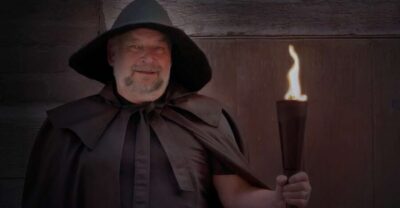

Browse the lists this tour appears in