
Reviewed · NUREMBERG TOURS
Das ehemalige Reichsparteitagsgelände – Geländebegehung
Nuremberg’s Nazi past is written in stone. This two-hour German-language walking tour makes the former Reich Party Rally Grounds understandable, showing how architecture, crowds, and political theater worked together. I especially like the way it connects the grand buildings with the propaganda behind them, and I like that it addresses how the site is used today. The main drawback is simple: you need enough German to follow a serious historical discussion.
The tour costs about $16.13 per person, a fair price for two hours at three major historic locations. You will walk outdoors, and weather matters. A dry day will make the experience far more comfortable, especially at the wide-open Zeppelin Field, where there is little shelter.
In This Review
- Key points to know before you book
- Why this Nuremberg tour matters
- Starting at Bayernstraße 110
- Zeppelin Field: where mass politics became theater
- Congress Hall: monumentality on an almost absurd scale
- The Great Road: a 60-meter-wide axis
- How the guide brings the site to life
- Price, pace, and practical value
- Who should book this experience
- Should you book the former Reich Party Rally Grounds walk?
- FAQ
- Where does the tour begin?
- Where does the tour end?
- How long does the tour last?
- What language is the tour conducted in?
- Which historic sites are visited?
- How large can the group be?
- Is admission to the sites included?
- Is the tour suitable for most people?
- Can I cancel for a full refund?
Key points to know before you book
- A two-hour walk through three major sites: The route covers Zeppelin Field, the unfinished Congress Hall, and the Great Road.
- German-language guiding: The explanations are designed for German speakers and deal with difficult subjects in a clear, direct way.
- Architecture used as propaganda: You will see how scale, symmetry, and mass gatherings were meant to impress and control.
- Zeppelin Field is the emotional center: This was the main setting for Nazi rallies, parades, and military displays.
- A group of up to 30 people: The tour is not private, but the maximum group size keeps it reasonably manageable.
- Free cancellation up to 24 hours ahead: You can receive a full refund if you cancel at least one day before the starting time.
Why this Nuremberg tour matters
Nuremberg is often linked with medieval walls, sausages, and the postwar trials. Yet just outside the historic center sits one of Germany’s most important reminders of the Nazi period. The former Reich Party Rally Grounds preserve the scale of the regime’s public theater in a way that photographs cannot fully convey.
This is not a cheerful sightseeing walk. It is a serious history experience, but it is not presented as a dry list of dates. The guide explains how the rallies were planned, how the architecture shaped the crowds, and how the Nazi leadership tried to turn politics into spectacle.
The tour also makes an important connection to the concentration camp system. The rallies presented unity, strength, and national purpose. Behind that polished show was a system built on persecution, violence, imprisonment, and murder. You need that contrast to understand why the buildings matter.
I like tours that do more than point at an old structure and say who built it. Here, the key question is what each place was meant to do to the people standing there. That makes the experience useful even if you already know the basic history.
The tour also addresses the current debate over the site’s use. These enormous structures are not easy to preserve, explain, or integrate into modern Nuremberg. A guided walk gives you a chance to consider why some parts remain as ruins, why others have been adapted, and how a city should deal with architecture created to serve dictatorship.
Other Nuremberg trips people book alongside this one:
- Bamberg: Guided Walking Tour
★ 4.6 · 3,202 reviews - Nuremberg: City Tour with the Bimmelbahn Train
★ 4.4 · 2,475 reviews - Nuremberg: Old Town Guided Walking Tour
★ 4.6 · 2,416 reviews
Starting at Bayernstraße 110
The tour begins at Bayernstraße 110 in Nuremberg and ends at Zeppelin Field on Zeppelinstraße. That point-to-point format is worth noting before you reserve. You do not finish where you began, so plan your next journey from the Zeppelinfeld end point.
The entire experience lasts about two hours. That is long enough to connect the three locations without turning the visit into an exhausting full-day commitment. It also means the guide has time to explain the purpose of the site rather than rushing from one photo stop to the next.
The tour is conducted in German. If you understand German comfortably, you should be able to follow a detailed discussion of political symbolism, architecture, and historical context. If you do not, this is not the right choice simply because the buildings look impressive. The meaning comes through the spoken explanation.
The maximum group size is 30 people. This is a shared walk, not an intimate private tour, but the limit gives the guide a reasonable chance to address questions and keep the group together. Service animals are allowed, and the starting point is near public transportation.
Zeppelin Field: where mass politics became theater
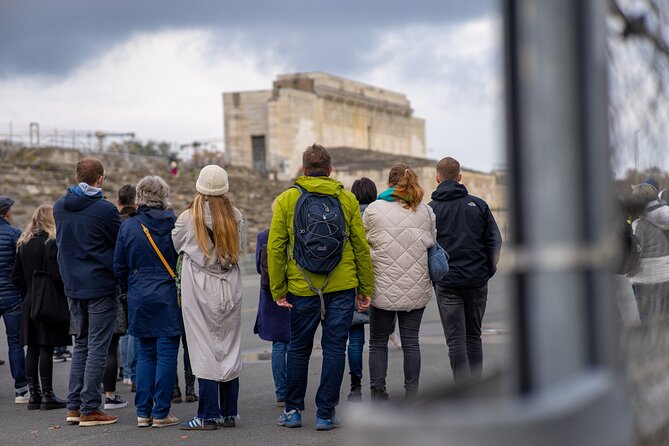
Zeppelin Field is the most important stop on the route. It was the main part of the former Reich Party Rally Grounds during the Nazi period, and its broad scale helps you understand the power of the rallies.
The field takes its name from Count Zeppelin, who made a sensational landing here with one of his airships in 1909. Under the Nazi regime, the area was transformed into a setting for huge public events. The Zeppelin Tribune and the field were used for the Reich Labor Service rally, the Day of the Political Leaders, and the Day of the Community.
These gatherings were not casual public meetings. Parades, military displays, and staged maneuvers helped create the image of a disciplined nation moving as one body. The architecture gave those performances a fixed frame. The crowd was arranged, directed, and displayed.
Your guide explains how the space worked as propaganda. The point was not only what speakers said. It was also the view of thousands of uniformed people, the carefully ordered movement, the scale of the stands, and the sense that the individual mattered less than the mass.
Give this stop your full attention. It can be tempting to treat the field as an empty open area, especially if you arrive without context. The guide’s explanation turns that emptiness into evidence. You begin to picture how the space was filled with formations, flags, speeches, and military theater.
The site is also a good place to grasp the difference between what was built and what was planned. Nazi architecture often aimed at a future of permanent power. The physical remains show both the ambition of that project and the fact that it was never completed as intended.
The main practical issue is weather. Zeppelin Field is outdoors, and the experience is much easier on a dry day. Wear sensible shoes and bring protection from rain or sun. The supplied information does not specify seating or shelter, so assume you will spend much of this section standing or walking.
Congress Hall: monumentality on an almost absurd scale
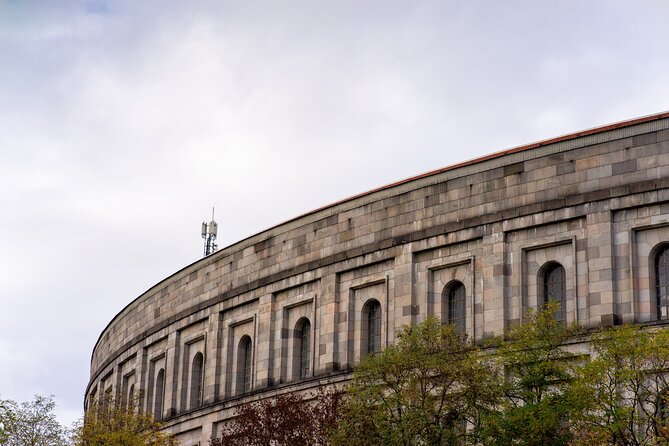
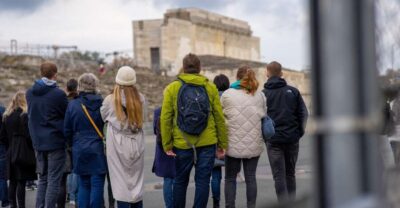
The unfinished Congress Hall is the most immediately striking building on the route. Even incomplete, it is one of the largest structures in Nuremberg. Its design recalls ancient buildings, especially the Colosseum in Rome, but its purpose was modern political control on a mass scale.
The hall was intended to host the Party Congress during the annual rallies. It was planned to hold 50,000 people, which would have made it the largest hall in the world. That number is not just a curious statistic. It tells you how the regime imagined political participation: not as a debate among citizens, but as a giant display of obedience and unity.
The building’s size was part of the message. Monumental architecture can make people feel small, watched, or swept into something larger than themselves. Here, the physical surroundings were designed to support the political performance.
I find this stop especially valuable because it helps you read architecture as a political tool. The Congress Hall was not built merely to solve a practical problem, such as finding a large indoor meeting room. Its scale was meant to impress people and reinforce the authority of the regime.
The unfinished condition adds another layer. You see a structure that was intended to project permanence but remains incomplete. The result is visually powerful and historically uncomfortable. It shows how much effort and ambition went into the project while also revealing that the planned Nazi future did not arrive.
Expect the guide to spend time on the building’s intended function and its visual references to antiquity. This is where a clear explanation matters. Without one, you might simply see a huge curved facade. With one, you can understand why the designers borrowed from imperial architecture and how the building was supposed to affect its audience.
The Congress Hall also helps connect the outdoor spaces. It was one part of a huge planned complex, not an isolated monument. The site was arranged so that buildings and gathering areas worked together as a stage for the rallies.
Something different for another day:
- Nuremberg: Tunnels and Secret Passages in the City Wall Tour
★ 4.8 · 2,334 reviews - Nuremberg: Medieval Dungeons Guided Tour
★ 4.8 · 1,726 reviews - Nuremberg: Walking Tour of Former Nazi Party Rally Grounds
★ 4.7 · 1,665 reviews - Medieval Tour in Nuremberg in Spanish
★ 5.0 · 1,374 reviews
The Great Road: a 60-meter-wide axis
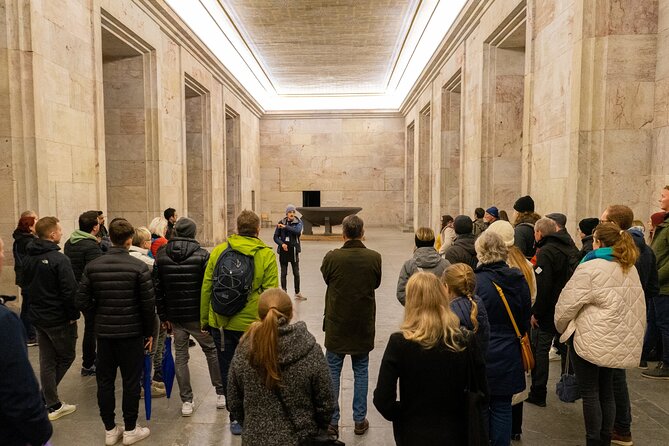
Construction on the Great Road began in 1935. It was planned to run for two kilometers, though only about 1.5 kilometers were completed. At 60 meters wide, it is less a normal city street than a ceremonial axis built for military display.
The road was intended as the central parade route for the German armed forces. It forms a north-south line around which the other buildings and event spaces were arranged. That planning gives you another way to understand the grounds: this was a carefully organized system of movement, not a random collection of oversized structures.
The Great Road is a good stop for reading the site from above, at least conceptually. You can imagine how troops, officials, and crowds would have been positioned along it. The width was necessary for spectacle, but it also created distance between the leaders and the people watching.
The 20-minute visit here may sound short, but the road works well as a linking section between the larger stops. It gives the guide time to explain how the whole complex was organized and why the Nazis wanted such a dominant north-south route.
This is also the stop most likely to feel less dramatic at first glance. There is no giant enclosed hall to enter and no single building to photograph from every angle. Its meaning comes from scale and function. Pay attention to the measurements. A 60-meter-wide road tells you more about the intended event than a normal street scene ever could.
How the guide brings the site to life
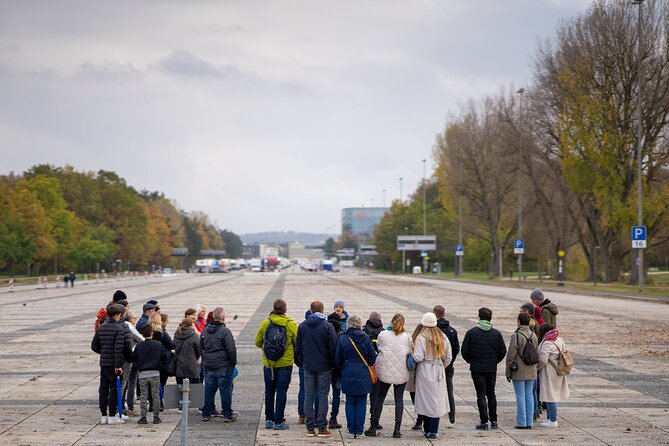
The strongest part of this experience is the quality of the explanation. The tour is designed to make the function and effect of the buildings clear, not to leave you alone with an information plaque.
Guide Clemens is praised for presenting each station in a vivid, easy-to-understand way and for keeping the two hours lively. Another guide is described as answering questions fully and bringing clear enthusiasm to the subject. Those details matter because the site can feel overwhelming without a strong narrative.
Good guiding is particularly important here for another reason: the subject can be reduced to slogans. A useful explanation has to cover the propaganda show, the architecture, the Nazi view of history, and the violence hidden behind the public image. The tour’s stated focus includes all of those elements.
You should also expect a sober tone. This is not a performance in the theatrical sense, and it should not be. The energy comes from the guide’s ability to explain, compare, and connect facts. The best moments are likely to be the ones when a measurement or building suddenly clarifies how the rallies were staged.
The tour has received a 4.9 rating from nine reviews, with repeated praise for clear information, strong presentation, and the ability to answer questions. That is a small sample, so I would not treat the number as proof of perfection. Still, the same strengths appear more than once, which supports the view that the guiding is the main reason to book.
Price, pace, and practical value
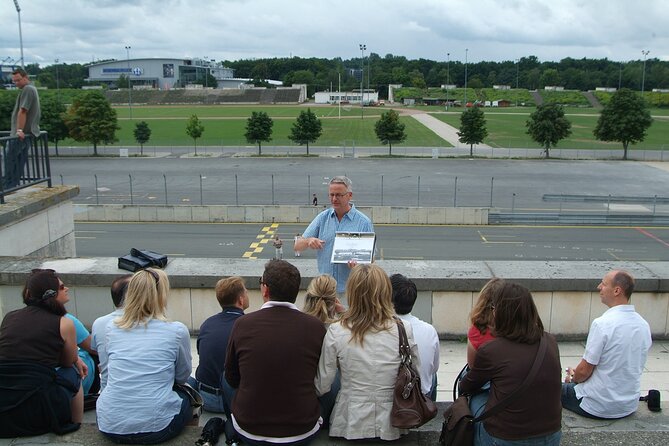
At about $16.13 per person, this is good value if you want context rather than a self-guided look at the buildings. The entrance admission for the listed stops is free, so you are paying mainly for the guide’s time and interpretation.
That distinction is important. You can see parts of the former rally grounds without paying for a walking tour. But the full meaning of Zeppelin Field, Congress Hall, and the Great Road is not obvious from the structures alone. The guide helps you understand why the spaces were designed as they were and how they worked together.
Two hours is a sensible length. A shorter tour might leave you with only a few dramatic images. A much longer version could become tiring because the subject is heavy and several areas are open and exposed. This format gives you a focused introduction.
The group can include up to 30 people. If you prefer a private conversation or a highly flexible pace, that limit may be a drawback. For most people, though, it is small enough to keep the route organized while keeping the price modest.
The tour is booked, on average, about 12 days ahead. That suggests you should not wait until the last minute if your Nuremberg schedule is fixed. Confirmation is provided when you book, and free cancellation is available until 24 hours before the start time. Inside that window, refunds are not available and changes are not accepted.
Who should book this experience
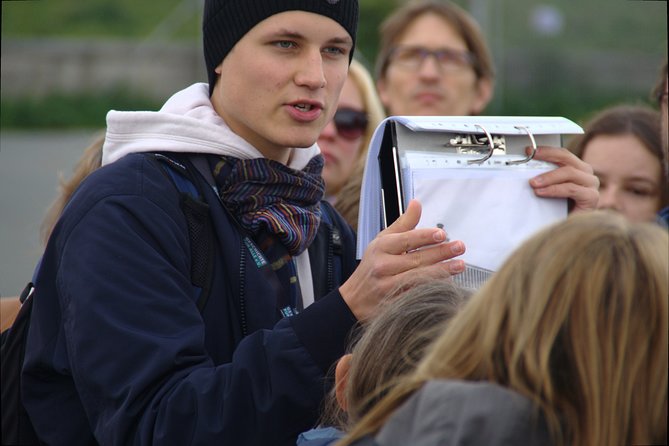
I would choose this tour if you want to understand how architecture and public ceremony supported Nazi power. It suits history-focused visitors, students, and anyone who feels that a museum display alone cannot convey the size of the former rally grounds.
It is also a good choice if you prefer a guided explanation to reading signs on your own. The repeated praise for clear and engaging presentation suggests that the guide can make difficult material easier to follow without making it shallow.
You should think twice if you do not understand German well. The tour is specifically German-language, and the interpretation is the heart of the experience. You should also consider the weather and your comfort with a two-hour outdoor walk.
Families can judge this individually. The supplied information says most people can participate, but it does not give a recommended minimum age or a child-focused format. Because the subject includes dictatorship, mass propaganda, concentration camps, and historical violence, parents should decide whether the material suits their children.
Should you book the former Reich Party Rally Grounds walk?
Book it if you want the site explained rather than merely photographed. For about $16.13, you receive two hours of historical context at Zeppelin Field, Congress Hall, and the Great Road, with particular attention to the size, purpose, and propaganda effect of the buildings.
The best reason to go is the guide. Clemens and the other praised guides appear to bring clarity, energy, and a willingness to answer questions. The main reasons to skip it are limited German comprehension, poor weather, or a preference for a private tour.
For a serious, well-priced introduction to one of Nuremberg’s most difficult places, I consider this a strong choice. Bring good shoes, check the forecast, and arrive ready to think as much as you look.
FAQ
Where does the tour begin?
The tour begins at Bayernstraße 110, 90478 Nuremberg, Germany.
Where does the tour end?
The tour ends at Zeppelin Field, on Zeppelinstraße in Nuremberg.
How long does the tour last?
The tour lasts approximately two hours.
What language is the tour conducted in?
The tour is conducted in German.
Which historic sites are visited?
The route includes Zeppelin Field, the Congress Hall in Nuremberg, and the Great Road.
How large can the group be?
The tour has a maximum group size of 30 people.
Is admission to the sites included?
The listed stops have free admission. The price of the experience covers the guided tour.
Is the tour suitable for most people?
The available information says most people can participate. Service animals are also allowed.
Can I cancel for a full refund?
Yes. You can cancel for a full refund at least 24 hours before the experience begins. Cancellations or changes made within 24 hours are not refunded or accepted.
Just added around Nuremberg
- Private Guided Walking Tour of Bayreuth With A Professional Guide★ 5.0 · 3 reviews
- Get to know Nuremberg. Highlights in the old town★ 5.0 · 4 reviews
- Nuremberg Culinary Walking Tour★ 4.0 · 4 reviews
- PRIVATE – Nuremberg Combo Tour WWII + Old Town★ 5.0 · 4 reviews
- Private transfer from Nuremberg to Munich with 2h for sightseeing★ 5.0 · 4 reviews
- Nuremberg: World War 2 History Tour with Beer Tasting★ 5.0 · 4 reviews
- Discover Nuremberg’s Christmas Market Magic with a Local★ 5.0 · 5 reviews
- Airport Transfer in or to Nuremberg★ 4.5 · 5 reviews
Nuremberg Tours, compared.

Tunnels and Secret Passages in the City Wall Tour
Read our review →
Walking Tour of Former Nazi Party Rally Grounds
Read our review →
Browse the lists this tour appears in